The Indian Space Policy 2023, approved by the Cabinet Committee on Security in April 2023, is the single biggest structural reform that India’s space programme has seen in six decades. It is not a tweak. It rewrites who does what, who pays for what, and who gets to launch a rocket from Indian soil. For the first time since 1962, ISRO is being told, in writing, to step out of routine satellite manufacturing and concentrate on cutting-edge research, deep-space exploration and human spaceflight. The mundane work of building communication satellites, leasing transponders and selling launch slots is being handed to a commercial arm and to private companies that did not legally exist as space operators five years ago.
For UPSC aspirants, the policy is a triple threat. It is GS-III science and technology, GS-III economy (because of FDI and the space economy target), and GS-II governance (because of the four-pillar institutional architecture). This guide explains every dimension you need, with the comparative tables, prelims pointers and mains-grade analysis the syllabus demands.
Quick Facts: Indian Space Policy 2023 at a Glance
- Approved by: Cabinet Committee on Security (CCS), April 2023
- Released by: Department of Space, Government of India
- Core shift: Supply-driven model (ISRO does everything) to demand-driven model (private sector and NSIL meet demand)
- Target: Grow India’s share of the global space economy from about 2 percent to 8 to 10 percent by 2030
- Four pillars: Department of Space, ISRO, IN-SPACe, NSIL
- Headline reform: End-to-end participation of Non-Government Entities (NGEs) in space activities
- FDI rule (2024 update): Up to 100 percent automatic route in component manufacturing, 74 percent in satellites, 49 percent in launch vehicles and spaceports
- Data threshold: Satellite imagery above 5 metre resolution is free; below 5 metre is paid for private buyers
What Is the Indian Space Policy 2023?
The Indian Space Policy 2023 is the umbrella framework that defines roles, responsibilities and rules for every actor in India’s space sector. Until the policy was notified, ISRO had a near-monopoly on Indian space activity. It designed satellites, built them, launched them, operated them and sold the data. Private firms were limited to vendor contracts and component supply. The policy ends that monopoly by carving out four mutually exclusive roles and by recognising private companies, called Non-Government Entities (NGEs), as legitimate end-to-end players in the space value chain.
In practical terms, the policy answers four questions that India’s space ecosystem had been quietly fighting over for a decade. Who does R&D? Who regulates? Who commercialises? And who represents India internationally? Without clear answers, every private space startup had to negotiate a custom deal with ISRO. With the policy in place, the rules are written down.
Background and Historical Context
India’s space programme began in 1962 with the Indian National Committee for Space Research (INCOSPAR) under Vikram Sarabhai. ISRO was formed in 1969, the Department of Space and the Space Commission in 1972. For the next fifty years, the architecture was simple. The Department of Space made policy, ISRO did everything else, and Antrix Corporation (set up in 1992) handled the commercial sales. There was no regulator because there was nothing to regulate. There was only one player.
This worked while space stayed expensive and government-funded. It stopped working when private capital arrived. Globally, SpaceX showed that a private company could do reusable rockets, lunar landings and crew transport at a fraction of NASA’s cost. In India, IIT graduates began starting space companies in the mid-2010s, only to discover that there was no legal pathway to actually operate as a space business. They could not own a launch vehicle, file for an orbital slot at the International Telecommunication Union (ITU) or even legally signal a satellite without explicit ISRO permission, which itself had no legal framework to grant.
The first big reform came in June 2020 with the announcement of IN-SPACe as a single-window agency. NSIL was set up in 2019 to take over Antrix’s commercial role. But neither move had a written policy backing it. The Indian Space Policy 2023 closes that gap. It also operationalises the larger reform package that includes the Space Activities Bill (still pending), the FDI liberalisation of February 2024 and the Indian Space Act that the government has indicated it will introduce.
The Four Institutional Pillars
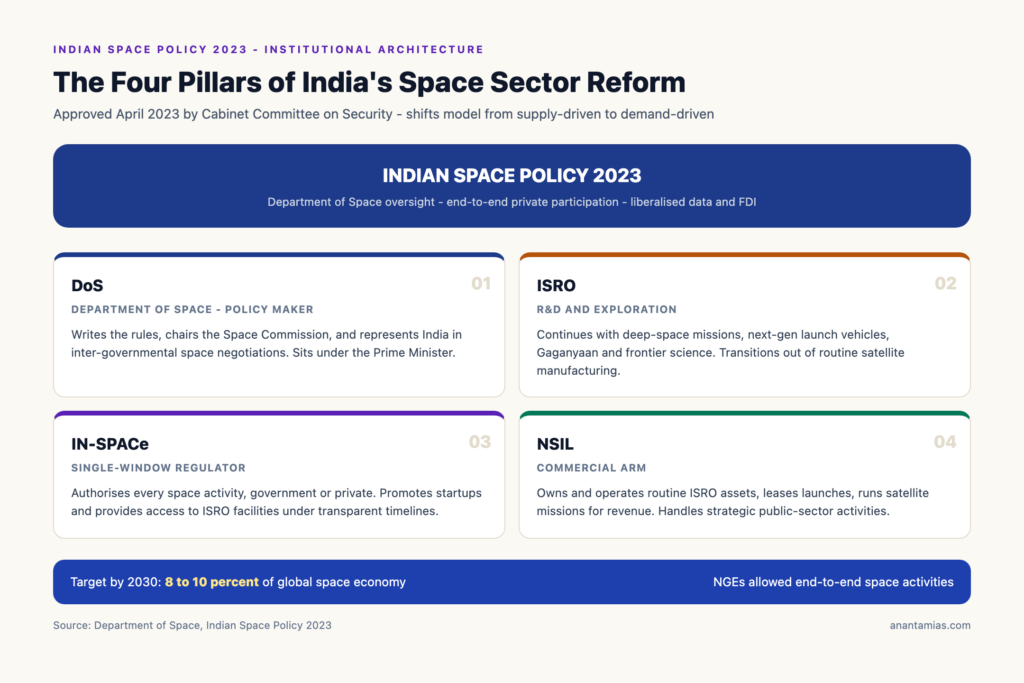
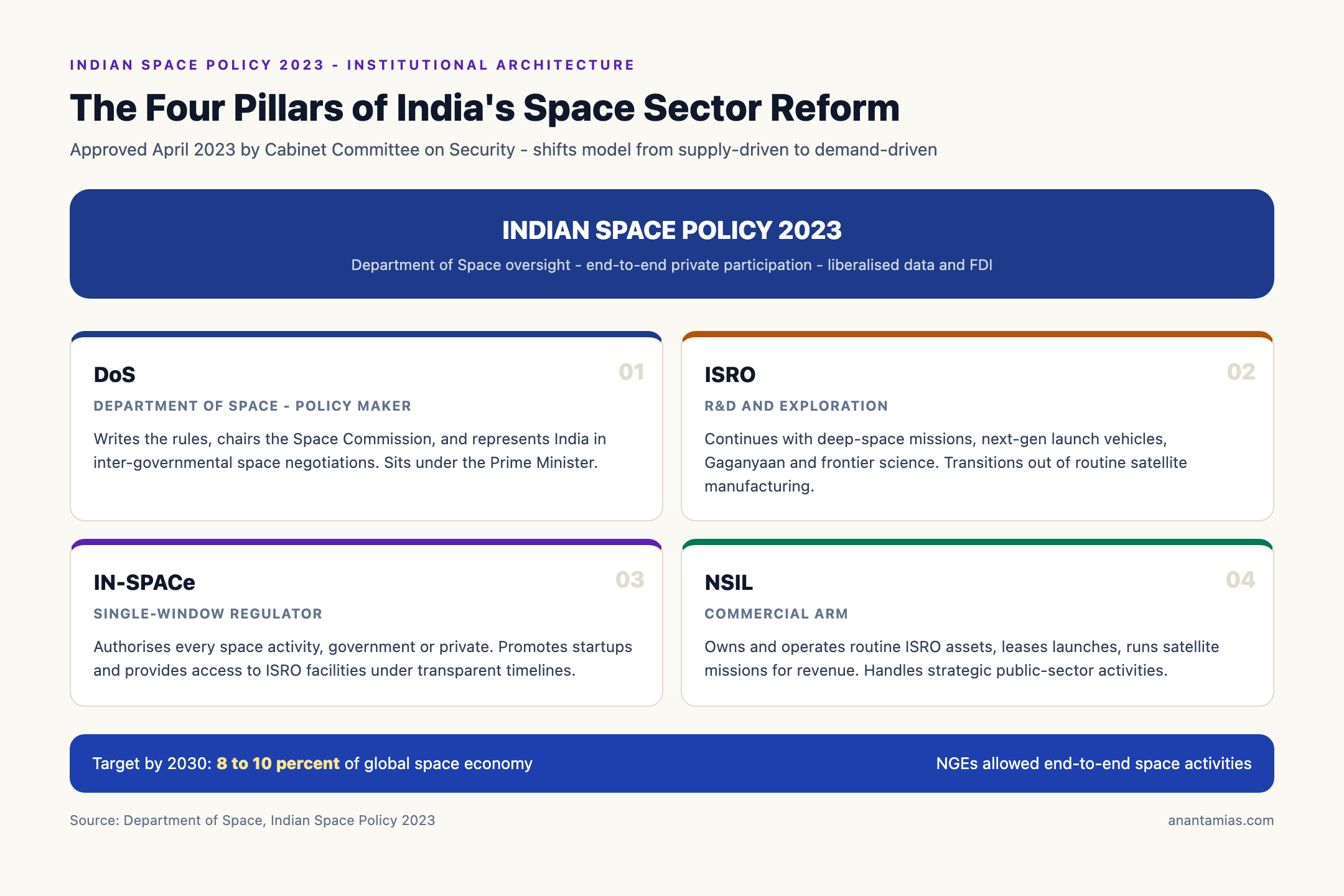
The most quoted feature of the policy is its four-pillar institutional design. Each pillar has a sharply defined role.
Department of Space (DoS). The policy maker. DoS sits under the Prime Minister, chairs the Space Commission, and represents India in inter-governmental space negotiations. It does not build, regulate or sell. It writes the rules and signs the treaties.
ISRO (Indian Space Research Organisation). The R&D and exploration agency. ISRO will continue with deep-space missions like Chandrayaan, Aditya-L1 and Gaganyaan, develop next-generation launch vehicles, and pursue cutting-edge science. Crucially, the policy directs ISRO to transition out of operational manufacturing of routine satellites. Building yet another communication satellite that NSIL or a private firm can supply is no longer ISRO’s job.
IN-SPACe (Indian National Space Promotion and Authorisation Centre). The single-window regulator. IN-SPACe authorises every space activity in India, government or private. It also promotes the sector by hand-holding startups, providing access to ISRO facilities and clearing applications under transparent timelines. Think of it as the SEBI of space, with a developmental mandate added on top.
NSIL (NewSpace India Limited). The commercial arm. NSIL owns and operates routine ISRO assets, leases launches to commercial customers, runs satellite missions for revenue, and handles strategic activities the government wants kept inside a public-sector entity. It absorbed Antrix’s role and went further by taking over end-to-end mission ownership.
End-to-End Role for Non-Government Entities
The single most consequential clause in the policy is the explicit permission for NGEs to undertake end-to-end space activities. Before April 2023, the legal status of a private rocket was ambiguous. After the policy, it is not.
NGEs may now own, lease, operate, sell or buy satellites and provide communication services within and outside India. They may design, manufacture and launch their own rockets, including from private launchpads. They may directly file for ITU orbital and spectrum slots in their own name, or use orbital resources held by foreign operators. They may engage in the commercial recovery of asteroid resources, a clause that aligns India with the Artemis Accords principle that resources extracted in space belong to the entity that extracted them.
The policy also liberalises ground operations. NGEs may set up their own ground stations, run mission control centres and provide launch and payload integration services. The combined effect is that an Indian space startup can now, in principle, do everything a US firm like SpaceX or Rocket Lab does, without needing ISRO’s hands on every step.
The FDI Reform of February 2024
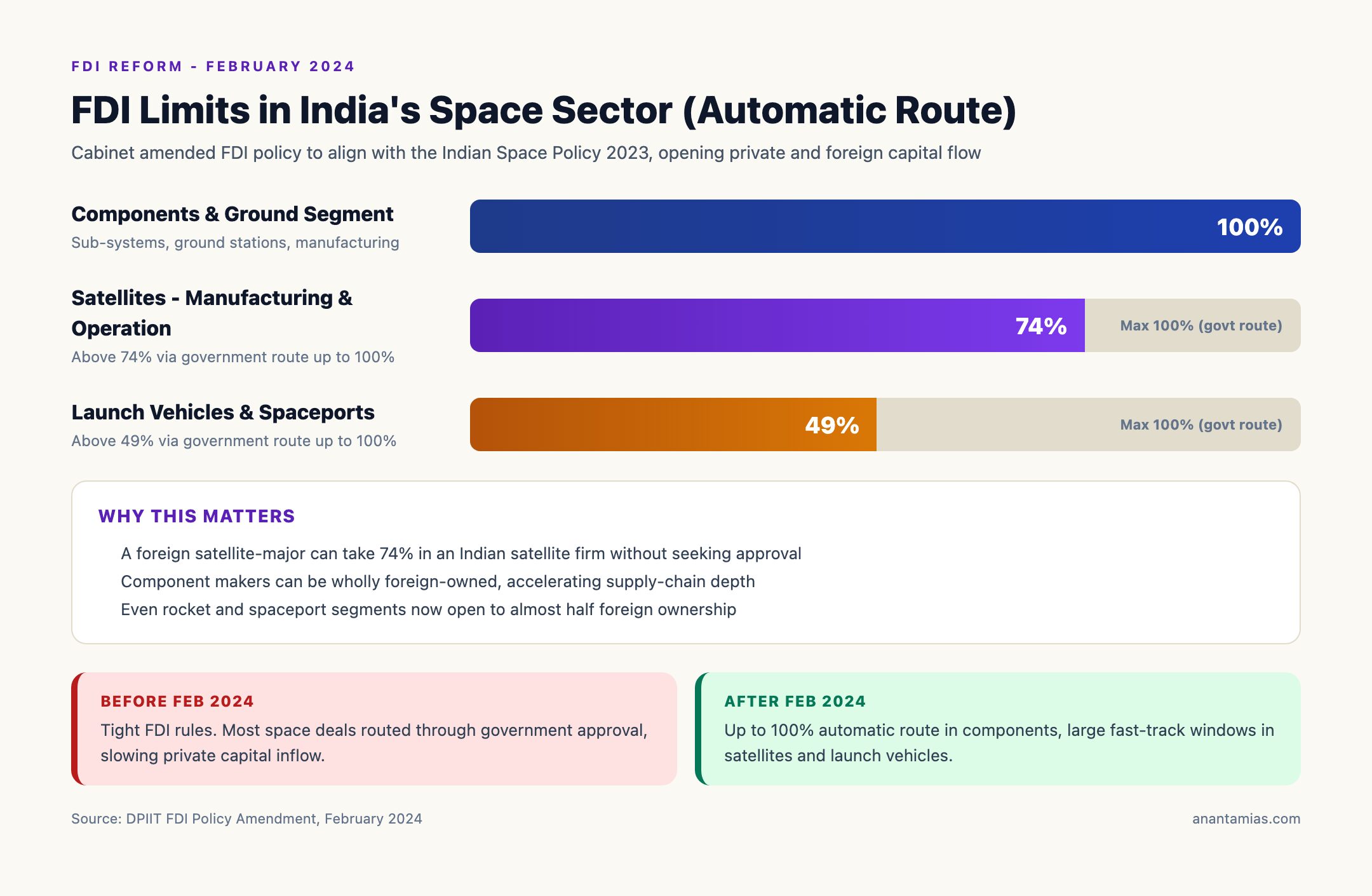
The policy by itself was incomplete because foreign capital still faced the old FDI rules, which capped automatic-route foreign investment at very low levels and routed most space deals through government approval. In February 2024, the Cabinet amended the FDI policy to align with the Indian Space Policy.
| Activity | FDI Limit (Automatic Route) | FDI Limit (Government Route) |
|---|---|---|
| Manufacturing of components, sub-systems and ground segment | Up to 100 percent | Beyond 100 percent (not applicable) |
| Manufacturing and operation of satellites, satellite data products | Up to 74 percent | Beyond 74 percent up to 100 percent |
| Launch vehicles, associated systems, spaceports | Up to 49 percent | Beyond 49 percent up to 100 percent |
This is a structural change. A foreign satellite-manufacturing major can now take a 74 percent stake in an Indian satellite firm without seeking government approval. Component makers can be wholly foreign-owned. Even rocket and spaceport companies, the most strategic segment, are now open to almost half foreign ownership without bureaucratic delay.
Data Dissemination Policy
Indian satellite imagery used to be controlled tightly. The policy creates a clean, two-tier rule.
- Imagery with resolution coarser than 5 metres is free and open to everyone.
- Imagery finer than 5 metres is free for government agencies and available at fair, transparent pricing to private buyers.
The 5-metre threshold matters because high-resolution imagery is the input for precision agriculture, urban planning, defence intelligence, mining surveys and disaster mapping. A clear pricing rule lets Indian and foreign buyers plan their data budgets and lets Indian satellite operators build viable revenue lines without case-by-case negotiation.
Why the Policy Matters: Strategic and Economic Significance
The policy unlocks four kinds of value at once.
Economic. India’s space economy was around 8 to 9 billion dollars in 2023. The government has set a target of 44 billion dollars by 2033, a fivefold growth. That target is unreachable on ISRO’s budget alone. It needs private capital, foreign investment and commercial revenue, all of which the policy enables.
Strategic. A robust private launch base means India is less dependent on any single national agency for surge capacity. If a tactical surveillance satellite is needed quickly, NSIL or a private firm can supply it. The policy thereby strengthens space-based situational awareness for the armed forces.
Scientific. ISRO can now stop spending engineering hours on routine builds and concentrate on first-of-a-kind science. The same talent pool that perfected the Mars Orbiter Mission, Chandrayaan-3 lunar landing and Aditya-L1 solar observatory is now free to attempt the Bharatiya Antariksh Station, interplanetary probes and reusable launch vehicles.
Developmental. The data dissemination tier and the IN-SPACe single-window mechanism reduce friction for Indian sectors that depend on space data. Agriculture, fisheries, forestry, mining, disaster management, telecom and aviation all benefit from cheaper and faster access to satellite information.
Detailed Analysis: Private Space Companies Powering the Reform
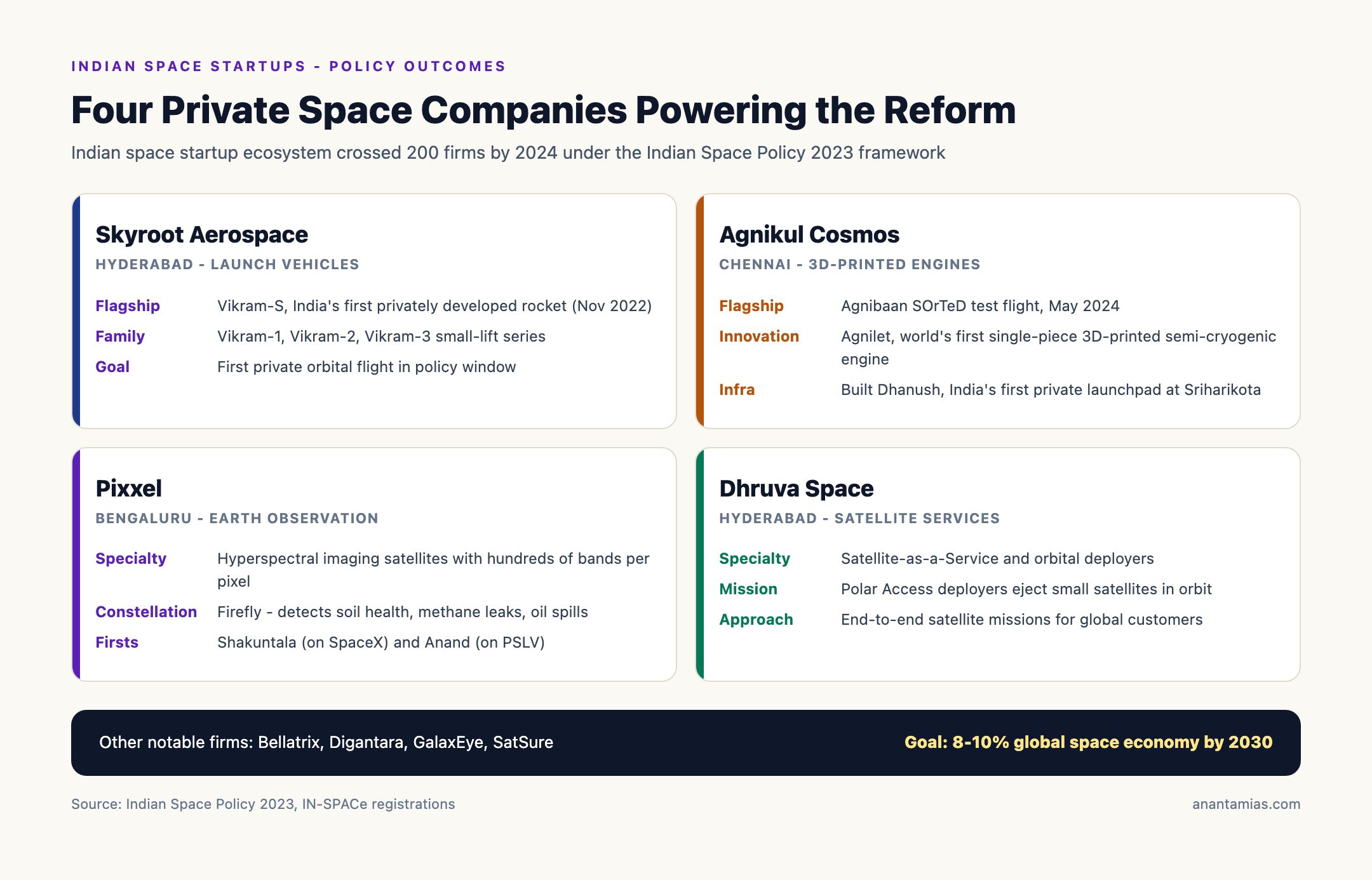
The Indian space startup scene was nearly invisible in 2018. By 2024 it had crossed 200 companies, with several unicorns and serial fundraisers. Four firms illustrate how the policy has translated into capability.
Skyroot Aerospace, Hyderabad. Skyroot launched Vikram-S in November 2022, India’s first privately developed rocket. The Vikram series of small-lift launch vehicles is being scaled up to Vikram-1, Vikram-2 and Vikram-3, with the first orbital flight targeted within the policy window.
Agnikul Cosmos, Chennai. An IIT Madras incubatee, Agnikul flew Agnibaan SOrTeD in May 2024, a sub-orbital test of a single-piece, 3D-printed semi-cryogenic engine called Agnilet. The world’s first 3D-printed rocket engine of its kind. Agnikul also built India’s first private launchpad, named Dhanush, at the ISRO spaceport in Sriharikota.
Pixxel, Bengaluru. Pixxel builds hyperspectral imaging satellites that capture hundreds of bands of light per pixel, allowing detection of soil micronutrients, methane plumes, oil spills, crop stress and mineral deposits. The Firefly constellation began deployment with Shakuntala (launched on SpaceX) and Anand (launched on PSLV).
Dhruva Space, Hyderabad. Dhruva specialises in satellite-as-a-service, providing customers with end-to-end satellite missions, and in deployers (orbital ejection systems) that release small satellites into orbit, similar to Pez dispensers. Their Polar Access missions have already validated the deployer hardware on commercial flights.
These four are the visible tip. Dozens more, including Bellatrix Aerospace (in-space propulsion), Digantara (space situational awareness), GalaxEye (synthetic aperture radar) and SatSure (geospatial analytics), are scaling under the policy umbrella. Read the broader ISRO missions roadmap for the public-sector counterpart.
Indian Space Policy 2023 vs Pre-2023 Regime
| Dimension | Pre-2023 Regime | Post-2023 Regime |
|---|---|---|
| Lead doer | ISRO does almost everything | ISRO does R&D, NGEs and NSIL do operations |
| Regulator | None, ISRO acted as both player and referee | IN-SPACe, an independent single-window authoriser |
| Commercial sales | Antrix, with limited mandate | NSIL, with end-to-end commercial mandate |
| Private rockets | Legally ambiguous | Explicitly permitted |
| FDI | Tight, mostly government route | Up to 100 percent automatic in components |
| ITU filings by NGEs | Not allowed | Allowed in their own name |
| Asteroid mining | Not addressed | Permitted under commercial recovery clause |
| High-resolution data | Restricted | Sold at transparent pricing |
Challenges and Open Questions
The policy is enabling, not exhaustive. Five gaps remain that will shape whether the reform succeeds or stalls.
Absence of an Indian Space Act. A policy is not a statute. Liabilities arising from a failed launch, third-party damage, or in-orbit collision still rest on murky ground. The Space Activities Bill has been pending since 2017. Without it, NGEs face uncertain insurance and indemnity terms.
IN-SPACe capacity. A single-window authoriser must process applications quickly. IN-SPACe is still building staff and adopting digital workflows. Bottlenecks here would defeat the purpose.
ISRO transition friction. Asking a 50-year-old agency to walk away from satellite manufacturing is culturally and operationally hard. Without a clear transfer-of-technology mechanism, NSIL and private firms cannot absorb production lines fast enough.
Export control alignment. Indian space exports still face controls under the SCOMET list and MTCR commitments. Private firms need clear export licensing pathways.
Spectrum and orbital slot competition. ITU filings are first-come, first-served. India’s slow filing history has cost it slots. NGE direct filing helps, but coordination at the global level remains a state job.
Prelims Pointers
- The Indian Space Policy 2023 was approved by the Cabinet Committee on Security (CCS) in April 2023.
- Four pillars: Department of Space, ISRO, IN-SPACe, NSIL.
- IN-SPACe was set up in June 2020 and is the single-window regulator and promoter for space activities.
- NSIL was set up in March 2019 as the commercial arm of the Department of Space.
- Vikram-S, the first privately developed Indian rocket, was launched by Skyroot Aerospace on 18 November 2022.
- Agnibaan SOrTeD flew in May 2024 from Dhanush, India’s first private launchpad.
- FDI in component manufacturing is now up to 100 percent on the automatic route, satellites up to 74 percent, launch vehicles up to 49 percent (February 2024 amendment).
- Satellite imagery coarser than 5 metres is free; finer than 5 metres is paid for private buyers.
- The policy permits commercial recovery of asteroid resources, aligning India with the Artemis Accords approach.
Mains Practice Questions
- The Indian Space Policy 2023 marks a shift from a supply-driven to a demand-driven model. Critically examine its institutional architecture and its likely impact on India’s space economy. (GS Paper 3, 250 words)
- Discuss the role of IN-SPACe and NSIL in liberalising India’s space sector. How do they complement each other? (GS Paper 3, 150 words)
- Despite policy reforms, India’s space economy remains a small share of the global market. Identify the regulatory and structural bottlenecks and suggest a way forward. (GS Paper 3, 250 words)
- Foreign Direct Investment in the space sector has been substantially liberalised. Analyse the strategic and economic implications of permitting up to 100 percent FDI in space components. (GS Paper 2 / 3, 250 words)
Way Forward
Three priorities will decide whether the policy meets its 2030 targets. First, pass the Indian Space Act to give NGEs statutory clarity on liability, indemnity and dispute resolution. Second, scale up IN-SPACe with technical staff, defined service-level agreements and a transparent application portal so that a startup can plan around predictable timelines. Third, complete ISRO’s transition by formalising technology transfer and supply-chain handover to NSIL and private firms, freeing the agency for moonshot science. If the government also publishes annual policy reviews and tracks progress against the 8 to 10 percent global market share target, India will not just open its space sector. It will own a meaningful slice of the global space economy by the end of the decade.
Frequently Asked Questions
What is the Indian Space Policy 2023?
It is the umbrella policy framework approved by the Cabinet Committee on Security in April 2023. It defines the roles of the Department of Space, ISRO, IN-SPACe and NSIL, opens India’s space sector to Non-Government Entities for end-to-end activities, and sets the regulatory and data-access principles for the country’s space economy.
Who are the four pillars of the policy?
The four pillars are the Department of Space (policy and international representation), ISRO (R&D and exploration), IN-SPACe (single-window regulator and promoter), and NSIL (commercial arm).
What is the role of IN-SPACe?
IN-SPACe is the single-window agency that authorises and promotes space activities by both government and private entities. It replaces the earlier ad-hoc model where ISRO acted as player and referee.
How much FDI is now allowed in the Indian space sector?
Following the February 2024 amendment, up to 100 percent FDI is allowed on the automatic route for component and ground-segment manufacturing, up to 74 percent for satellite manufacturing and operation, and up to 49 percent for launch vehicles and spaceports.
Can private companies launch their own rockets in India?
Yes. The policy explicitly allows Non-Government Entities to design, manufacture, own and operate launch vehicles and to build private launchpads. Skyroot Aerospace and Agnikul Cosmos are the early examples.
What is the difference between ISRO and NSIL?
ISRO is the R&D and exploration agency. NSIL is the commercial arm that handles routine satellite operations, launch service sales and revenue-generating missions. The policy directs ISRO to transition out of operational manufacturing.
What did the policy change for satellite data?
Satellite imagery with resolution coarser than 5 metres is now free and open. Finer-than-5-metre imagery is free for government and is sold at fair, transparent pricing to private buyers, replacing the earlier discretionary regime.
Does the policy permit space mining?
The policy allows Non-Government Entities to engage in the commercial recovery of asteroid and other space resources, broadly aligning India with the principle followed by the Artemis Accords signatories.
How does the policy support India’s space economy target?
By inviting private and foreign capital, removing licensing ambiguity and freeing ISRO for high-end research, the policy aims to grow India’s share of the global space economy from about 2 percent to 8 to 10 percent by 2030.
Is an Indian Space Act in force?
Not yet. The Space Activities Bill has been pending since 2017. The policy operates under existing law and Cabinet authority, but a statute remains the missing piece for full legal certainty.
Tell Google you want more of this.
Add Anantam IAS as a preferred sourceOne tap, and this site shows up more often in your own Top Stories, AI Overviews and AI Mode. Remove it any time.