Ramsar Convention — 1971 Iran, Wetlands of International Importance & India’s Sites
UPSC guide to the Ramsar Convention — 1971 Iran, Wetlands of International Importance, India's 85+ Ramsar sites, Montreux Record, and World Wetlands Day.
The Ramsar Convention is the oldest modern multilateral environmental agreement and the only global treaty dedicated to a single ecosystem — wetlands. Signed in the Iranian city of Ramsar on 2 February 1971, the Convention establishes a framework for national action and international cooperation for the conservation and wise use of wetlands and their resources. India became a contracting party in 1982 and today hosts over 85 Ramsar sites — the largest number in Asia. For UPSC Prelims and GS Paper III (Environment), Ramsar is a recurring, high-yield topic.
Historical Background
Why Wetlands Needed a Treaty
By the 1960s, more than 60% of wetlands in Europe and North America had been lost to drainage, agriculture, urbanisation and industry. Migratory waterbirds — which depended on chains of wetlands — were in sharp decline. Scientists from IUCN, IWRB (International Waterfowl Research Bureau) and ICBP began negotiations in 1962 to create a binding treaty.
Signing at Ramsar, Iran
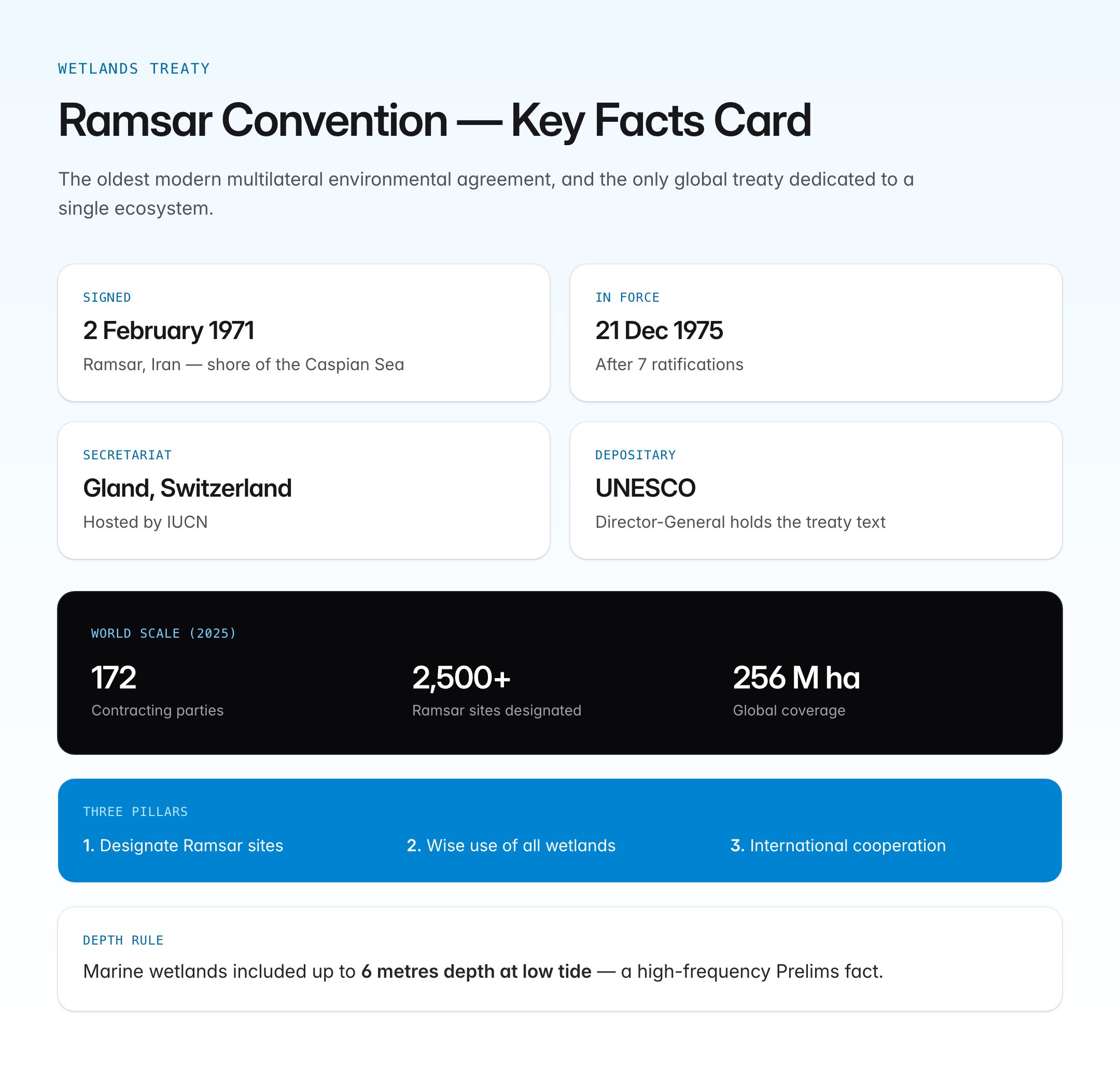
- Date: 2 February 1971
- Venue: Ramsar, a city on the shore of the Caspian Sea, Iran
- Entry into force: 21 December 1975 (after 7 ratifications)
- Depositary: UNESCO Director-General
- Secretariat: Gland, Switzerland (hosted by IUCN)
As of 2025, the Convention has 172 contracting parties and over 2,500 designated sites covering more than 256 million hectares globally.
Definition of Wetlands — A Broad Scope
Article 1 of the Convention defines wetlands very broadly:
"Areas of marsh, fen, peatland or water, whether natural or artificial, permanent or temporary, with water that is static or flowing, fresh, brackish or salt, including areas of marine water, the depth of which at low tide does not exceed six metres."
This definition includes:
| Category | Examples |
|---|---|
| Marine/coastal | Estuaries, coral reefs, mangroves, seagrass beds, lagoons |
| Inland | Rivers, lakes, marshes, swamps, peatlands, oases, springs |
| Human-made | Reservoirs, salt pans, aquaculture ponds, canals, rice paddies |
The six-meter depth rule for marine waters is a crucial prelims fact.
The Three Pillars of the Convention
The Ramsar Convention rests on three main commitments by contracting parties:
Pillar 1: Designation of Ramsar Sites
Each party must designate at least one wetland to the List of Wetlands of International Importance (the Ramsar List) at the time of accession.
Pillar 2: Wise Use of All Wetlands
Parties must promote the "wise use" — defined as "maintenance of ecological character, achieved through implementation of ecosystem approaches, within the context of sustainable development" — of all wetlands in their territory, not just designated sites.
Pillar 3: International Cooperation
Parties must cooperate on transboundary wetlands, shared species, and development assistance for wetland conservation.
Criteria for Designation as a Ramsar Site
A wetland qualifies if it meets at least one of nine criteria grouped into two categories.
Group A — Sites containing representative, rare or unique wetland types
Criterion 1: Contains a representative, rare, or unique example of a natural or near-natural wetland type found within the appropriate biogeographic region.
Group B — Sites of international importance for conserving biological diversity
| Criterion | Description |
|---|---|
| 2 | Supports vulnerable, endangered or critically endangered species or threatened ecological communities |
| 3 | Supports populations of plant and animal species important for maintaining biological diversity of a particular biogeographic region |
| 4 | Supports species at a critical stage of their life cycle or provides refuge during adverse conditions |
| 5 | Regularly supports 20,000 or more waterbirds |
| 6 | Regularly supports 1% of the individuals in a population of one species or subspecies of waterbird |
| 7 | Supports a significant proportion of indigenous fish species or life-history stages |
| 8 | Important source of food for fishes, spawning ground, nursery, or migration path on which fish stocks depend |
| 9 | Regularly supports 1% of a non-avian animal species (reptiles, amphibians, mammals) |
India and the Ramsar Convention
India's Accession
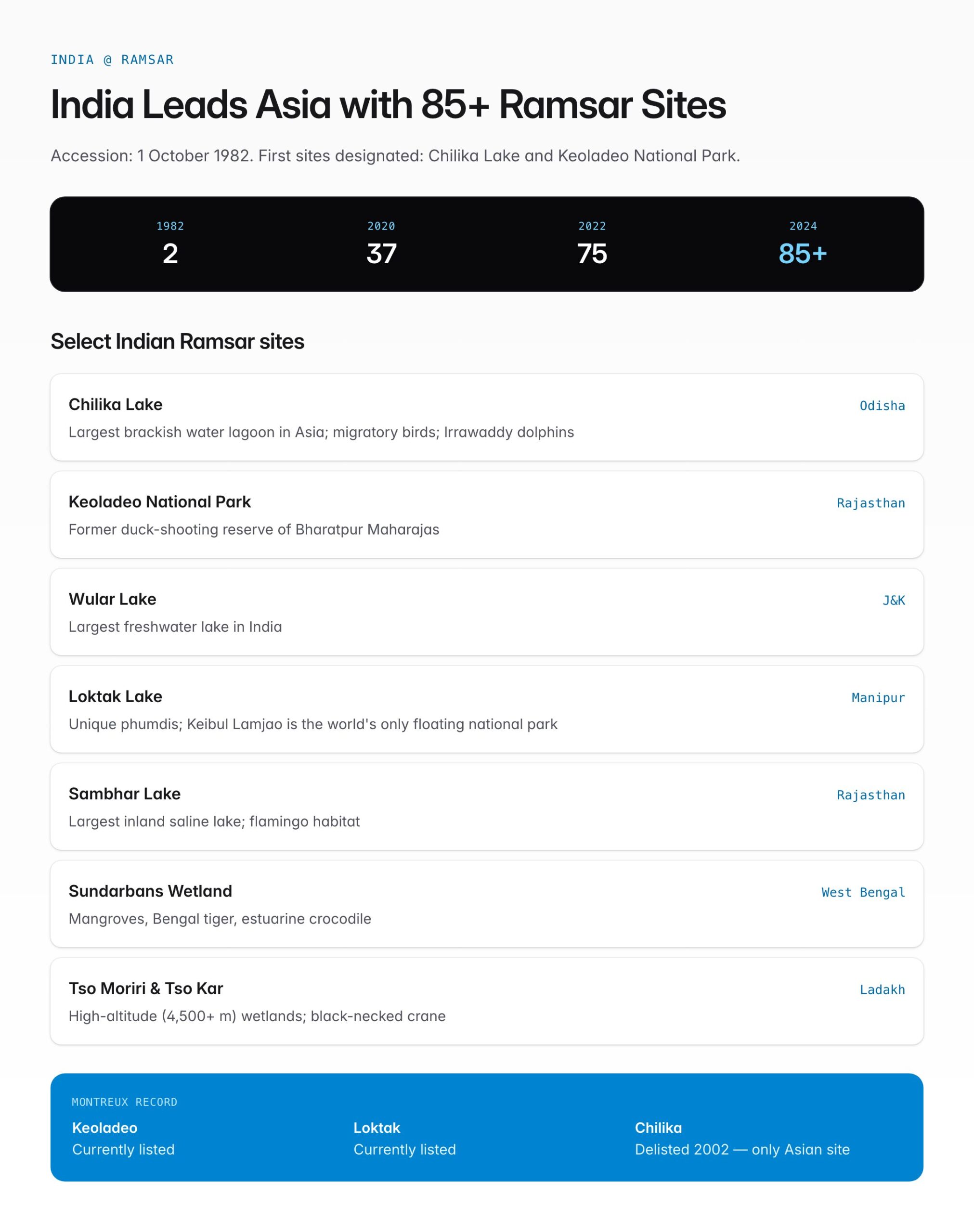
- Signed: 1 February 1982
- Became a contracting party: 1 October 1982
- First Ramsar sites (1981 designation, effective 1982): Chilika Lake (Odisha) and Keoladeo National Park (Rajasthan)
Growth of India's Ramsar Network
| Year | Sites | Milestone |
|---|---|---|
| 1982 | 2 | Chilika, Keoladeo designated |
| 2020 | 37 | — |
| 2022 | 75 | At India@75; largest in Asia |
| 2024 | 85+ | India leads Asia in Ramsar sites |
As of 2025, India has over 85 Ramsar sites, covering more than 1.35 million hectares. Tamil Nadu has the highest number of Ramsar sites among Indian states.
Selected Ramsar Sites in India
| Site | State | Highlights |
|---|---|---|
| Chilika Lake | Odisha | Largest brackish water lagoon in Asia; migratory birds; Irrawaddy dolphins |
| Keoladeo National Park | Rajasthan | Former duck shooting reserve of Bharatpur Maharajas |
| Wular Lake | J&K | Largest freshwater lake in India |
| Loktak Lake | Manipur | Unique phumdis (floating vegetation); Keibul Lamjao (world's only floating NP) |
| Sundarbans Wetland | West Bengal | Mangroves, Bengal tiger, estuarine crocodile |
| Sambhar Lake | Rajasthan | Largest inland saline lake; flamingo habitat |
| Point Calimere | Tamil Nadu | Coastal wetland; flamingo wintering ground |
| Deepor Beel | Assam | Brahmaputra floodplain wetland |
| Tso Moriri, Tso Kar | Ladakh | High-altitude (4,500+ m) wetlands; black-necked crane |
| Nal Sarovar | Gujarat | Large inland wetland; pelicans, flamingos |
The Montreux Record
The Montreux Record is a subset of the Ramsar List — wetlands where ecological character has changed, is changing or is likely to change due to human interference, pollution or other threats. Inclusion is meant to mobilise resources for restoration.
Indian Wetlands on the Montreux Record
| Wetland | Status |
|---|---|
| Chilika Lake | Earlier added; removed in 2002 after successful restoration (removal of sediment, opening of new mouth) — only Asian wetland to be delisted |
| Keoladeo National Park | Currently on Montreux Record due to water shortages and invasive species |
| Loktak Lake | Currently on Montreux Record due to Ithai barrage impacts and phumdi degradation |
Chilika's delisting is considered one of the greatest success stories of the Ramsar Convention globally.
Legal and Institutional Framework in India
Wetlands (Conservation and Management) Rules, 2017
Notified under the Environment (Protection) Act, 1986, these rules:
- Define regulated and permitted activities
- Mandate a State Wetland Authority in each state
- Prohibit reclamation, solid waste dumping, construction on notified wetlands
- Replace the earlier 2010 rules
National Wetland Conservation Programme
Initiated in 1985–86; merged with National Lake Conservation Plan in 2013 to form the National Plan for Conservation of Aquatic Ecosystems (NPCA).
Space Applications Centre — ISRO
Published the National Wetland Atlas (2011, 2021 editions) mapping over 2 lakh wetlands in India.
World Wetlands Day — 2 February
Every year, 2 February is celebrated globally as World Wetlands Day, marking the anniversary of the signing of the Ramsar Convention at Ramsar, Iran, in 1971. Annual themes draw attention to specific threats:
| Recent Themes |
|---|
| 2022: Wetlands Action for People and Nature |
| 2023: It's Time for Wetland Restoration |
| 2024: Wetlands and Human Wellbeing |
| 2025: Protecting Wetlands for Our Common Future |
Ecosystem Services of Wetlands
Wetlands are among the most productive ecosystems on Earth. Their services include:
| Service | Example |
|---|---|
| Water regulation | Flood control, groundwater recharge |
| Water purification | Sediment trapping, nutrient cycling |
| Carbon sequestration | Peatlands store 30% of global soil carbon |
| Biodiversity | 40% of world's species use wetlands |
| Fisheries | Source of livelihoods for millions |
| Climate regulation | Moderate local climate |
| Cultural value | Sacred sites, tourism |
Threats to Wetlands
- Land conversion — agriculture, real estate, industry
- Pollution — sewage, agricultural run-off, industrial effluents
- Invasive species — water hyacinth in Loktak, Chilika
- Sedimentation due to deforestation in catchments
- Climate change — altered hydrology, sea-level rise
- Aquaculture expansion — especially in coastal wetlands
- Encroachment — urban wetlands like Bellandur (Bengaluru), East Kolkata Wetlands under pressure
UPSC Relevance
GS Paper Mapping
- GS Paper III — Environment (biodiversity, conservation), Wetland ecosystems, Climate change
- GS Paper II — International treaties and institutions
- Essay — Environment and sustainable development
Prelims Pointers
- Signed: Ramsar, Iran, 2 February 1971
- Entry into force: 21 December 1975
- Secretariat: Gland, Switzerland
- Depositary: UNESCO
- World Wetlands Day: 2 February
- Wetland depth at low tide ≤ 6 metres
- India acceded: 1 October 1982
- First Indian Ramsar sites: Chilika Lake (Odisha) and Keoladeo National Park (Rajasthan)
- India has 85+ Ramsar sites (largest in Asia)
- Montreux Record — sites with ecological change; Keoladeo and Loktak currently on it; Chilika delisted in 2002
- Loktak Lake — phumdis, Keibul Lamjao (world's only floating national park)
- Wular Lake — largest freshwater lake in India
- Sambhar Lake — largest inland saline lake
- Governed in India by Wetlands (Conservation and Management) Rules, 2017 under Environment (Protection) Act, 1986
- Nine criteria: Criterion 5 — 20,000+ waterbirds; Criterion 6 — 1% of waterbird population
- Related plan: National Plan for Conservation of Aquatic Ecosystems (NPCA)
The Ramsar Convention transformed wetlands from wasteland to living infrastructure. For India, with over 4.7% of its geographic area as wetlands, the treaty is a vital instrument for water security, biodiversity and climate resilience.