
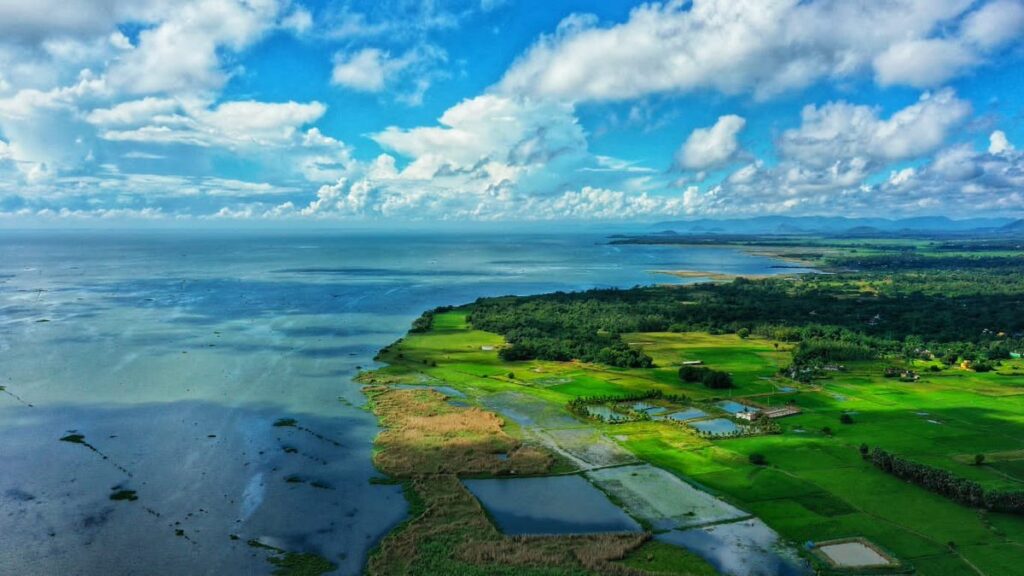
Chilika Lake, sprawling across the districts of Puri, Khordha, and Ganjam on the eastern coast of Odisha, is the largest brackish water lagoon in India and the largest coastal lagoon in Asia. Shaped like an irregular pear and separated from the Bay of Bengal by a narrow sandy ridge sixty kilometres long, Chilika Lake covers between 900 and 1,165 square kilometres depending on the season, swelling during the south-west monsoon and shrinking through the post-monsoon months. The lagoon was designated as India’s first Ramsar site of international importance in 1981, and it remains the most studied wetland ecosystem on the subcontinent. Chilika Lake supports an extraordinary mix of marine, brackish, and freshwater species, including the only resident population of the Irrawaddy dolphin in India, more than 230 species of migratory birds at peak season, and a fishing economy that sustains over 150,000 people from 132 villages along the lagoon’s rim.
Geographical Setting and Origin
Chilika Lake lies between latitudes 19°28′ and 19°54′ north and longitudes 85°06′ and 85°35′ east, with its outlet to the Bay of Bengal at the village of Satapada. The lagoon is generally classified as a barrier-built estuarine lagoon, formed during the late Pleistocene and Holocene by the combined action of long-shore currents that built the protective sand spit and the silt-laden discharge of rivers draining the Eastern Ghats. The maximum length of Chilika Lake is about 64.3 kilometres along the north-east to south-west axis, while the average width is roughly 20 kilometres. Depth varies from less than a metre in the northern sector to about four metres near the sea mouth.
Sectors of the Lagoon
For administrative and ecological study, Chilika Lake is divided into four hydrologically distinct sectors. The Northern Sector, into which the freshwater rivers discharge, has the lowest salinity and the highest sediment load. The Central Sector forms the broad heart of the lagoon and shows intermediate salinity. The Southern Sector is the calmest and most stable, holding the deepest waters during summer. The Outer Channel near Satapada connects Chilika Lake to the Bay of Bengal and is where the salinity gradient is steepest, ranging from near-marine values at the mouth to brackish values inside.
Tributaries and Catchment
The catchment of Chilika Lake covers about 3,560 square kilometres and is drained primarily by 52 rivers and rivulets. The dominant freshwater contributors are the Daya and the Bhargavi, both distributaries of the Mahanadi river that turn south after the Mahanadi delta. Other significant feeders include the Nuna, Salia, Kansari, and Kusumi. The annual sediment input from this catchment is the principal driver of the slow infilling that has reduced the average depth of Chilika Lake by nearly half over the past century.
Hydrology and the Sea Mouth
The salinity regime of Chilika Lake is controlled by the dynamic interplay of freshwater inflow from rivers and tidal exchange with the Bay of Bengal through the sea mouth. Historically the sea mouth migrated steadily northward along the sand bar, lengthening the outlet channel and choking tidal exchange. By the late 1990s the mouth had drifted about thirty kilometres north of its original position, the outlet channel had become a stagnant lagoon-within-a-lagoon, and salinity had dropped to dangerously low levels across much of Chilika Lake. The result was a population explosion of invasive freshwater weeds, a collapse in commercial fish stocks, and the listing of the lagoon on the Montreux Record in 1993 as a Ramsar site under threat.
In September 2000, the Chilika Development Authority cut a new, shorter sea mouth directly opposite Sipakuda, restoring tidal flushing almost overnight. Salinity returned to historic ranges within a year, the freshwater weeds receded, and migratory fish species reappeared. On the strength of this recovery, the Ramsar Secretariat removed Chilika Lake from the Montreux Record in 2002, the first wetland anywhere in the world to be delisted. The 2000 mouth opening is now treated globally as a textbook case of large-scale ecological restoration.
Biodiversity of Chilika Lake
Chilika Lake hosts more than 800 species of fauna spanning marine, brackish, and freshwater niches. The combination of shallow water, gentle salinity gradient, and abundant submerged vegetation makes the lagoon one of the most productive wetland ecosystems in the country. The biological wealth of Chilika Lake has been catalogued in successive surveys by the Zoological Survey of India, the Wetlands International South Asia office, and the Chilika Development Authority.
Irrawaddy Dolphins
Chilika Lake supports the only known lagoonal population of the Irrawaddy dolphin (Orcaella brevirostris) in the world. The 2024 annual census recorded 162 individuals, including 26 calves, concentrated in the Outer Channel near Satapada. The Irrawaddy dolphin is listed as Endangered on the IUCN Red List and is protected under Schedule I of the Wildlife (Protection) Act 1972. The species is unique in being equally at home in fresh, brackish, and shallow coastal waters, and the Satapada population is considered geographically and behaviourally distinct from the riverine populations of the Ayeyarwady, Mekong, and Mahakam.
Avifauna and Nalabana Bird Sanctuary
Chilika Lake is one of the most important wintering grounds for migratory waterbirds along the Central Asian Flyway. During the peak winter months of December and January, the lagoon hosts over a million birds in some years. The Nalabana Bird Sanctuary, a 15.53 square kilometre island in the Central Sector, was notified in 1987 under the Wildlife (Protection) Act and submerges during the monsoon to re-emerge as exposed mudflats from October onwards, becoming the principal feeding and roosting ground for the migrants. The 2024 bird census at Chilika Lake recorded 1,135,759 birds of 199 species, including the Bar-headed Goose, Northern Pintail, Common Coot, Lesser Flamingo, and Black-tailed Godwit.
Fish, Crustaceans, and Other Fauna
Chilika Lake supports about 323 species of fish, including 261 marine, brackish, and estuarine species. The lagoon’s fishery yields between 11,000 and 14,000 tonnes annually, with prawns, mullet, milkfish, beckti, and crabs forming the commercial backbone. The brown spotted grouper and the giant tiger prawn are commercially important, and the spawning runs of hilsa from the sea into the river mouths of Chilika Lake remain one of the most-watched events of the fishing calendar.
The Fishing Economy
Approximately 150,000 fisherfolk depend directly on Chilika Lake for their livelihood. The traditional fishing community is organised into village-level cooperatives that hold customary rights to demarcated fishing zones called jano. The use of non-traditional fixed engines such as the gheri prawn enclosures, set up by non-fishing investors during the prawn-export boom of the 1990s, became the most contentious legal issue around the lagoon and was the subject of the landmark Supreme Court order in the Chilika Bachao Andolan case, which directed the eviction of all non-traditional aquaculture installations.
Threats to Chilika Lake
Despite the successful sea-mouth intervention, Chilika Lake continues to face several pressures. Catchment-area soil erosion has raised the annual silt load to about 1.8 million tonnes, gradually reducing the average depth of Chilika Lake. Encroachment of the shoreline for shrimp farming and housing has shrunk the lagoon’s effective area in several pockets. Invasive species such as Phragmites karka in the northern sector and Eichhornia crassipes during low-salinity phases threaten native submerged vegetation. Climate change is altering the timing and quantum of monsoon inflow, which in turn shifts the salinity gradient on which the lagoon’s biodiversity depends.
Conservation and Governance
The Chilika Development Authority, set up by the Government of Odisha in 1991, is the lead agency for the management of Chilika Lake. It operates the routine dredging programme at the sea mouth, runs the annual bird and dolphin censuses, and coordinates community-based watershed management in the catchment. Chilika Lake was listed as one of the Ramsar sites of India in 1981, and the Montreux delisting in 2002 placed the lagoon at the centre of international wetland conservation discourse. The lagoon also overlaps with the Eastern Ghats and Coromandel coast, both of which fall within the larger framework of conservation interest under India’s biodiversity hotspots and adjoining ecoregions.
Chilika Lake is often discussed alongside other major Indian lakes such as Vembanad Lake in Kerala, Wular Lake in Kashmir, and Loktak Lake in Manipur, each of which represents a distinct wetland type and a different set of management challenges.
Frequently Asked Questions
Why is Chilika Lake called a lagoon and not a lake?
Chilika Lake is a brackish coastal water body separated from the Bay of Bengal by a narrow barrier sand bar, with a tidal connection to the sea. By strict geographical definition this is a lagoon, not a lake, because lakes are fully enclosed inland water bodies with no marine exchange. The name u0022Chilika Lakeu0022 is a vernacular convention that has stuck in popular and government usage.
Why was Chilika Lake the first Indian Ramsar site?
Chilika Lake was designated India’s first Ramsar site on 1 October 1981 because of its outstanding ecological importance as a wintering ground for over a million migratory waterbirds on the Central Asian Flyway, its productive fishery supporting more than 150,000 people, and its status as the largest brackish water lagoon in Asia.
What is the Montreux Record and why was Chilika delisted?
The Montreux Record is a register maintained under the Ramsar Convention of wetlands of international importance that face ecological change. Chilika Lake was added to the Record in 1993 because of salinity collapse, weed invasion, and fishery decline. After the new sea mouth was cut in 2000, salinity and biodiversity recovered, and Chilika Lake was removed from the Montreux Record in 2002 — the first wetland in the world to be delisted.
What rivers feed Chilika Lake?
The principal freshwater contributors to Chilika Lake are the Daya and the Bhargavi, both distributaries of the Mahanadi. Smaller rivers and streams such as the Nuna, Salia, Kansari, and Kusumi drain the surrounding catchment of the Eastern Ghats into the lagoon.
Where are the Irrawaddy dolphins of Chilika found?
The Irrawaddy dolphins of Chilika Lake are concentrated in the Outer Channel near Satapada, where the lagoon meets the Bay of Bengal. This is the only lagoonal population of the species anywhere in the world. The 2024 census recorded 162 individuals.
What is the Nalabana Bird Sanctuary?
Nalabana Bird Sanctuary is a 15.53 square kilometre island in the Central Sector of Chilika Lake notified in 1987 under the Wildlife (Protection) Act 1972. It submerges during the monsoon and re-emerges as exposed mudflats in October, providing the principal feeding ground for migratory waterbirds in winter.
Why was a new sea mouth cut at Chilika Lake in 2000?
The original sea mouth had drifted thirty kilometres north along the sand bar, choking tidal exchange and dropping the salinity of Chilika Lake to ecologically damaging levels. The Chilika Development Authority cut a new shorter mouth at Sipakuda in September 2000 to restore tidal flushing, salinity, and biodiversity, with results that became a global model of large-scale wetland restoration.
What are the main threats to Chilika Lake today?
The main threats to Chilika Lake today are siltation from catchment soil erosion adding about 1.8 million tonnes a year, shoreline encroachment by aquaculture and housing, invasive weed species, and climate-driven shifts in monsoon inflow and salinity. The Chilika Development Authority manages an ongoing dredging and watershed programme to address these pressures.
Tell Google you want more of this.
Add Anantam IAS as a preferred sourceOne tap, and this site shows up more often in your own Top Stories, AI Overviews and AI Mode. Remove it any time.





