Ravi P. Agrahari Science and Technology: How to Study for UPSC
Read Ravi P. Agrahari through mechanisms and applications. Check the courseware identity, separate official updates and build a complete science-policy answer card.
Ravi P. Agrahari Science and Technology can help you connect a scientific idea with its use in public policy. The difficulty is knowing how much technical detail to learn and which developments need updating. Reading every technology headline as a new chapter makes revision harder.
I’d use the book for mechanisms and topic structure, then add a small official-source update sheet. If basic biology or physics is unclear, repair that concept before moving into its application. You need to explain what a technology does, how it works at the required level and what limits its use.
Identify The Current Courseware
McGraw Hill lists Courseware on Science & Technology, 9th Edition, by Ravi P Agrahari. Retail listings may use Science and Technology Courseware and add an exam-year label. Match the author and ISBN before choosing a copy.
The publisher supplies these details:
- Edition: 9th.
- ISBN: 9789364445931.
- Publisher’s publication date: July 29, 2025.
- Copyright label: 2026.
- Format: a print title with advertised McGraw Hill EDGE learning support.
The official McGraw Hill courseware page provides its identity and contents. You can check the matching English edition on Amazon. This is an affiliate link; a purchase may earn us a commission.
Check the exact access terms for videos, tests and updates before paying for a digital package or buying a used copy. Promotional descriptions don’t establish that an old activation code is usable or that digital access lasts indefinitely.
Decide Whether It Fits Your Preparation
Choose this book when you need a structured science-and-technology reference and can make time to apply what you read. It isn’t a guarantee that every new development will already be included.
| Your Situation | Recommended Approach | Limit |
|---|---|---|
| Non-science background with weak basics | Start with a relevant school-level concept, then the matching book section | Skipping the underlying concept makes technical terms harder |
| Comfortable with basic science | Select an application and work through its mechanism | Familiar vocabulary doesn’t prove causal understanding |
| You own an older edition | Keep stable explanations and identify changed sections | Policies, missions and regulatory decisions need new checks |
| Close to the exam with another usable source | Revise that source and practice explaining topics | Starting a new reference may consume revision time |
The UPSC Prelims book guide helps you judge the wider source load. The UPSC Mains book guide places science and technology within answer preparation.
Separate Concepts From Updates
The book’s published contents offer a topic structure. Treat a mechanism as the stable base and attach dated developments to it. That keeps a mission name or policy announcement from becoming an isolated fact.
These chapter references belong to the publisher’s ninth-edition contents; the study tasks are original suggestions.
| Book Section | Relatively Stable Study Base | What To Check Fresh | Output |
|---|---|---|---|
| Chapters 3 to 5: energy and nuclear topics | Energy conversion, radioactivity and technology vocabulary | Policy decisions, project status and agreements | Mechanism-benefit-constraint card |
| Chapters 6 to 8: space technology | Orbits, satellites and launch systems | Mission objectives, progress and results | Mission card linked to a concept |
| Chapters 9 to 14: ICT and cybersecurity | System functions, networks and basic security concepts | Rules, programs and reported vulnerabilities | Technology-function-risk sheet |
| Chapters 16 to 18: AI, robotics and nanotechnology | What the technology changes in a task | New applications and governance measures | Application and failure-condition card |
| Chapters 22 to 25: biotechnology, health and immunization | Biological processes and immune-response basics | Trial findings, approvals and program guidance | Mechanism-evidence-policy card |
For an update, choose the authority that owns the fact:
- ISRO for its missions and results.
- The Department of Atomic Energy for its own nuclear-energy announcements.
- MeitY for its ICT programs or rules.
- DBT for its biotechnology work.
- The relevant health authority or WHO for the health claim you are studying.
A press announcement, a trial result and permission to deploy a technology are different facts. Keep the stage in the same note as the headline.
Work Through A Vaccine Example
This is an original study exercise, not a UPSC question or advice about a specific vaccine. It shows how to move from a scientific mechanism to a policy answer without copying a technical chapter.
Practice prompt: “Explain why evidence about a vaccine’s mechanism and evidence about its benefit answer different questions.”
Start with the mechanism:
- Antigen: a component the immune system can recognize and respond to.
- Delivery: a vaccine can contain an antigen or genetic instructions for making one. The exact route depends on the platform.
- Response: the body develops an immune response and memory that can help it respond to later exposure.
- Boundary: explaining that mechanism doesn’t tell you the measured protection of a particular product against a particular outcome.
The WHO explanation of how vaccines work supports this general mechanism. Its vaccine-components explainer distinguishes an antigen from the DNA or RNA instructions that can produce it.
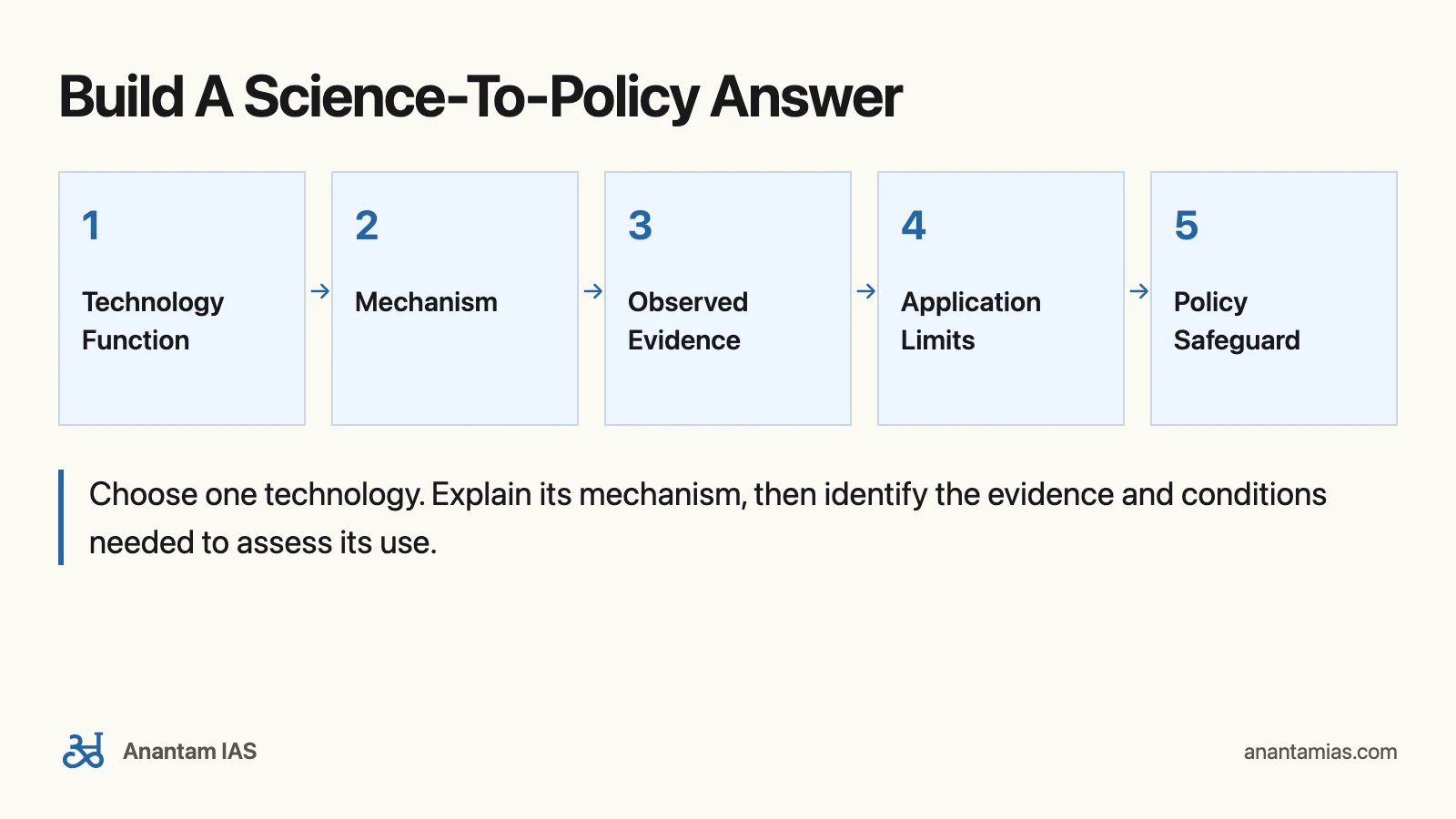
Think of this as two tasks in your notes. A mechanism describes the proposed path to protection. An evidence card records what was observed in a study. Neither should quietly substitute for the other.
Now build the policy reasoning:
| Step | What Your Answer Should Say | Mistake To Avoid |
|---|---|---|
| Mechanism | Explain antigen recognition and immune memory in plain language | Saying all vaccines contain a whole weakened organism |
| Evidence | Identify the product, studied population, measured outcome and follow-up | Turning a result for one outcome into a claim about all outcomes |
| Application | Explain the public-health purpose and relevant delivery requirements | Assuming a scientific effect solves every delivery problem |
| Constraints | Consider storage, access, safety monitoring and evidence limits | Calling a platform universally suitable from its mechanism alone |
| Judgment | Link benefits and safeguards to the actual evidence and program | Promising complete protection without support |
A worked answer could read:
“Vaccination can prepare an immune response by presenting an antigen or instructions for producing it. Immune memory can support a response after later exposure. This explains the biological basis of vaccination. The measured benefit of a specific vaccine still depends on evidence for that product, population and outcome. A public-health decision should therefore combine the mechanism with study findings and delivery requirements. Storage, access and safety monitoring remain relevant even when the biological rationale is sound.”
Notice the intermediate reasoning: mechanism leads to a plausible benefit; observations establish the measured outcome; implementation conditions influence how the intervention reaches people. The answer doesn’t claim that a mechanism alone proves a policy will succeed.
Make A Compact Answer Card
A short card should let you explain a topic in your own words. If the card is full of unexplained abbreviations, reduce it to the missing process before adding more detail.
Use these fields:
- Technology: its name and function.
- Mechanism: the steps that make the function possible.
- Application: one clearly connected use.
- Evidence: what supports the claimed result, with source and date.
- Constraints: what may limit performance or delivery.
- Policy response: a safeguard that addresses a named constraint.
The vaccine exercise can fill each field without prescribing a medical decision. For a different chapter, replace the technology and rebuild the chain. Don’t reuse an unrelated benefit just because it sounds like a good GS answer.
Build An Adjustable Reading Cycle
A 4-week selective cycle gives you time to connect reading with recall. Add time when a concept is new; remove a topic already mastered after testing yourself.
| Week | Focus | Task Before Moving On |
|---|---|---|
| 1 | Foundation gaps and energy | Explain one mechanism and its conditions |
| 2 | Space and ICT | Make one dated application card for each |
| 3 | Biotechnology, health and emerging technologies | Separate mechanism, evidence and claim limits |
| 4 | Mixed revision and genuine PYQs | Repair errors and write two short application answers |
A 45-minute session can use 25 minutes for reading, 10 for a closed-book mechanism diagram and 10 for an answer or question. With 20 minutes, finish one smaller mechanism instead. Don’t measure a difficult day’s progress only by page count.
Your update sheet can stay equally small:
| Topic | Stable Concept | New Claim | Authority And Date | Stage | Change To My Notes |
|---|---|---|---|---|---|
| Your topic | Existing explanation | One checked development | Original source | Proposed, tested, approved or deployed | Precise addition or correction |
Check important developments close to the point of use. A book’s publication date cannot establish the current status of every mission or program. For your next session, choose one technology and explain its mechanism before opening another news tab.
Frequently Asked Questions
What is the official current title and edition?
McGraw Hill lists Courseware on Science & Technology, 9th Edition, by Ravi P Agrahari, ISBN 9789364445931.
Why do the publication and copyright years differ?
The publisher lists a July 29, 2025 publication date and a 2026 copyright label. These are separate fields and should not be treated as evidence of two different editions.
Can a student without a science background use it?
Yes, with a staged approach. Repair a missing school-level concept before reading its application, then explain the mechanism and its limits in your own words.
Does the courseware remove the need for current updates?
No. Missions, policies, approvals and reported results need fresh official-source checks. Keep one small dated update sheet linked to stable concepts.
Does every vaccine contain a whole weakened organism?
No. The WHO explainers distinguish vaccines that present antigens from platforms that provide DNA or RNA instructions for producing antigens. The exact mechanism depends on the platform.
Does the vaccine exercise prescribe a vaccine or quote a PYQ?
No. It is an original study exercise about mechanism, evidence and policy reasoning. It gives no product-specific medical advice and is not a UPSC question.