Disclosure: this guide contains Amazon affiliate links. As an Amazon Associate, Anantam IAS earns from qualifying purchases — at no extra cost to you.
The most common question among UPSC aspirants is "which books should I read?" The most common mistake is reading too many books across too many subjects. UPSC Prelims tests breadth and conceptual clarity across eight subjects — but it does not require depth beyond a specific threshold for most.
This guide gives you the minimum sufficient booklist — what toppers consistently use, updated for the 2026 Prelims (June 2026). Read these books multiple times rather than reading many books once.
Rule of thumb: For Prelims, one good book revised 3 times beats three mediocre books read once.
Prelims Structure and Strategy
Universal Prerequisites: NCERTs
Before any standard reference book, read the NCERTs first. This is non-negotiable.
Essential NCERTs
Class 6-8 History (Old NCERTs recommended):
- Our Pasts — I, II, III (foundational)
- R.S. Sharma's Ancient India
- Satish Chandra's Medieval India (selective)
Class 9-10 (New NCERT):
- India and the Contemporary World I & II (modern history)
- Contemporary India I & II (geography)
- Democratic Politics I & II (polity)
- Understanding Economic Development
Class 11-12 (New NCERT):
- Themes in Indian History (3 volumes)
- Fundamentals of Physical Geography
- India: Physical Environment
- Indian Constitution at Work
- Political Theory
- Indian Economic Development
- Macroeconomics / Introductory Microeconomics
How to Read NCERTs
- First reading: Understand concepts (~2 months)
- Second reading: Make concise notes (~1 month)
- Third reading: Revise before Prelims (~2 weeks)
Don't underline/highlight excessively — it's a trap. Write brief marginal notes instead.
Subject-wise Book List

Indian Polity — M. Laxmikanth (8th Edition)
- McGraw Hill courseware edition, 856 pages
- Covers the full Prelims and Mains polity syllabus in one volume
- Solved Prelims PYQs from 2013–25 plus 12 years of Mains questions
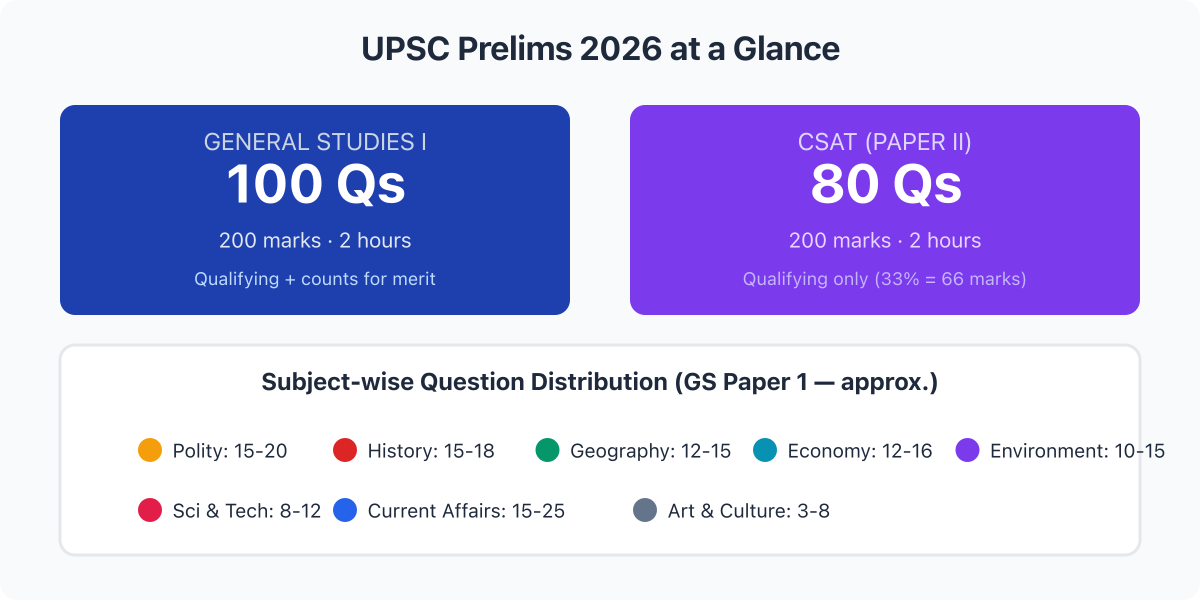
1. Indian Polity (15-20 questions)
| Priority | Book | Author | Notes |
|---|---|---|---|
| ★ Essential | Indian Polity | M. Laxmikanth | The Bible of UPSC Polity |
| Reference | Introduction to the Constitution of India | D.D. Basu | For deeper understanding (if time) |
| Optional | Bare Acts from India Code portal | Government | For specific provisions |
Key strategy:
- Read Laxmikanth 4-5 times — yes, seriously
- Focus on historical evolution of institutions
- Memorise Schedules, Articles covering fundamental rights/DPSPs, Amendments
- Follow current affairs for constitutional developments
Expected effort: 4-5 reads of Laxmikanth = sufficient for 80%+ of polity questions.
2. Modern History (10-12 questions)
| Priority | Book | Author |
|---|---|---|
| ★ Essential | A Brief History of Modern India | Spectrum Publications (Rajiv Ahir) |
| Alternative | India's Struggle for Independence | Bipan Chandra |
| Reference | NCERT Class 8 (Our Pasts III) + NCERT Class 12 (Themes in Indian History III) | NCERT |
Strategy:
- Spectrum is compact, exam-focused — the single best prep book
- Bipan Chandra is comprehensive but denser — optional for deeper reading
- Focus on 1757-1947 (colonial period)
- Freedom struggle phases, key personalities, major events
3. Ancient & Medieval History (3-5 questions)
Ancient History:
| Priority | Book | Author |
|---|---|---|
| ★ Essential | Old NCERT (Class 11) — Ancient India | R.S. Sharma |
| Reference | Themes in Indian History Part I | NCERT |
Medieval History:
| Priority | Book | Author |
|---|---|---|
| ★ Essential | Old NCERT (Class 11) — Medieval India | Satish Chandra |
| Reference | Themes in Indian History Part II | NCERT |
Strategy:
- Ancient + Medieval together may yield 3-5 questions max
- Don't over-invest — 80% effort goes to Modern India
- Focus on dynastic timeline, art & architecture, key texts
4. Geography (12-15 questions)
| Priority | Book | Author |
|---|---|---|
| ★ Essential | Certificate Physical and Human Geography | G.C. Leong |
| ★ Essential | NCERT Class 11 (Physical Geography) + Class 11 (India: Physical Environment) | NCERT |
| ★ Essential | NCERT Class 12 (India — People and Economy) | NCERT |
| Reference | Indian Geography | Majid Husain (optional) |
| ★ Essential | Orient BlackSwan School Atlas or Oxford Student Atlas | — |
Strategy:
- G.C. Leong for world physical geography (climate, landforms)
- NCERTs for Indian geography — economic and physical
- Atlas is critical — map-based questions are common
- Practice locating: major rivers, peaks, passes, mineral deposits, cities
5. Indian Economy (12-16 questions)
| Priority | Book | Author |
|---|---|---|
| ★ Essential | Indian Economy | Ramesh Singh |
| ★ Essential | NCERT Class 11 (Indian Economic Development) + Class 12 (Macro/Micro) | NCERT |
| ★ Essential | Economic Survey (current year) | Government of India |
| ★ Essential | Budget documents (current year) | Government of India |
| Reference | Mrunal.org (YouTube + articles) | Mrunal Patel |
Strategy:
- Ramesh Singh covers static portion comprehensively
- Economic Survey has the contemporary data and analysis
- Budget for fiscal/tax policy questions
- Mrunal.org for simplified explanations
- Follow RBI reports, PIB releases for current affairs
6. Environment & Ecology (10-15 questions)
| Priority | Book | Author |
|---|---|---|
| ★ Essential | Environment | Shankar IAS Academy |
| ★ Essential | NCERT Class 12 (Biology — selected chapters on Environment) | NCERT |
| Reference | State of Environment Report (CSE) | Centre for Science and Environment |
Strategy:
- Shankar IAS is compact and exam-focused
- Cover biodiversity hotspots, endangered species, environmental laws
- Follow MoEFCC notifications
- International conventions: Ramsar, CITES, CBD, UNFCCC, Paris Agreement
7. Science & Technology (8-12 questions)
| Priority | Book | Author |
|---|---|---|
| ★ Essential | NCERT Class 6-10 Science books | NCERT |
| ★ Essential | The Hindu newspaper — science pages | — |
| Reference | Science and Technology in India | Ravi P. Agrahari |
| Supplementary | ISRO/DRDO/PIB press releases | Government of India |
Strategy:
- NCERTs build foundation
- Current affairs dominate S&T in recent Prelims (70%+)
- Focus on: space missions, defence tech, biotechnology, nanotechnology, AI, IT
- Don't memorise formulas — understand applications
8. Art & Culture (3-8 questions)
| Priority | Book | Author |
|---|---|---|
| ★ Essential | NCERT Class 11 (An Introduction to Indian Art) | NCERT |
| Reference | Indian Art and Culture | Nitin Singhania |
| Reference | Cultural India — CCRT website | Government |
Strategy:
- Nitin Singhania's book is comprehensive — the standard reference
- Focus on: architecture, dance, music, paintings, festivals
- Indus Valley to modern — wide chronological span
- Images in your memory — art questions are often visual identification
Current Affairs (15-25 questions)
This is the single most important category in modern Prelims.
Primary Sources
| Source | Frequency | Coverage |
|---|---|---|
| The Hindu newspaper | Daily | Main source |
| Indian Express | Daily | Alternative to The Hindu |
| PIB (Press Information Bureau) | Daily | Government announcements |
| Yojana Magazine | Monthly | Policy and development |
| Kurukshetra Magazine | Monthly | Rural development focus |
Monthly Compilations (Highly Recommended)
| Source | Notes |
|---|---|
| Vision IAS Current Affairs | Most used by toppers |
| Shankar IAS Monthly | Topic-wise organized |
| Drishti IAS Current Affairs | Free online + Hindi option |
| The Hindu — Editorials | For analysis |
How to Study Current Affairs
Daily (1-1.5 hours):
- Read The Hindu (main news + editorial page)
- Skim Indian Express (if time)
- Make brief notes on important issues
Weekly (2-3 hours):
- Review the week's compiled notes
- Watch Rajya Sabha TV or similar analysis programmes
Monthly (4-5 hours):
- Revise monthly compilations
- Connect current events to static concepts
Cut-off: Current affairs relevant for UPSC Prelims 2026 typically cover April 2025 to April 2026.
CSAT (Paper II)
CSAT is qualifying only (33% = 66 marks), but it eliminates roughly 30-40% of aspirants.

Quantitative Aptitude — R.S. Aggarwal (Revised 2026–27)
- The standard drill book for arithmetic and data interpretation
- Graded exercises from basics to exam level
- Far more questions than a CSAT candidate needs
CSAT Pattern
- 80 questions in 2 hours
- Topics:
- Comprehension (~25-30 questions)
- Logical Reasoning (~20 questions)
- Decision Making (~5-10 questions)
- Quantitative Aptitude (~15-20 questions)
- Data Interpretation (~5-8 questions)
Best Books for CSAT
| Priority | Book | Author |
|---|---|---|
| Essential | CSAT Paper-II | TMH (Tata McGraw Hill) |
| Essential | Analytical Reasoning | M.K. Pandey |
| Essential | Quantitative Aptitude for Competitive Examinations | R.S. Aggarwal |
| Essential | Verbal and Non-Verbal Reasoning | R.S. Aggarwal |
| Reference | CSAT Solved Papers | Various publishers |
CSAT Strategy
If you are strong in CSAT: 1-2 weeks of practice before Prelims is enough.
If you are weak in CSAT: Start practicing 3 months before Prelims.
- 1 hour daily
- Focus on reading comprehension first — 30+ marks alone
- Quantitative: Master 6th-8th class mathematics thoroughly
Target: Aim for 90-100 marks (well above 66 qualifying cut-off).
Previous Year Questions (PYQs)
This is non-negotiable. PYQs are the most important single resource after the core books.
What PYQs to Solve
- Previous 10 years UPSC Prelims papers (minimum)
- Chronological PYQ books (by Arihant, TMH, McGraw Hill)
- Subject-wise PYQ compilations
How to Use PYQs
- First pass: Solve unsolved — test your baseline
- Analyze patterns: Which topics appear repeatedly?
- Second pass: Solve again after 2-3 months
- Revise errors — focus on your weak areas
- Pre-Prelims: Solve 2023, 2024, 2025 papers in timed conditions
Realistic goal: Solving PYQs should yield 60-70% accuracy consistently.
Mock Tests
Which Mock Test Series?
Toppers typically take tests from:
| Institute | Strengths |
|---|---|
| Vision IAS | Comprehensive, detailed solutions |
| Vajiram & Ravi | Topic-wise tests |
| Forum IAS | Good for CSAT practice |
| Drishti IAS | Hindi + English option |
| Insights IAS | Quality analysis |
| ClearIAS | Affordable, online |
Mock Test Strategy
4-6 months before Prelims:
- Take 1-2 mock tests per week
- Focus on time management
- Analyze every wrong answer
2-3 months before:
- Increase to 2-3 mock tests per week
- Include subject-wise tests
1 month before:
- Full-length mock tests daily (alternate days)
- Focus on revision, not new content
Week before Prelims:
- Stop mock tests 3-4 days before
- Focus on revision only
- Relax and sleep well
Complete Booklist Summary
The "Essential Seven" Books
If you could only read seven books for UPSC Prelims, these would be:
| # | Book | Subject |
|---|---|---|
| 1 | Indian Polity — M. Laxmikanth | Polity |
| 2 | A Brief History of Modern India — Spectrum | Modern History |
| 3 | Indian Economy — Ramesh Singh | Economy |
| 4 | Environment — Shankar IAS | Environment |
| 5 | Certificate Physical and Human Geography — G.C. Leong | World Geography |
| 6 | NCERT Class 11-12 Geography (Indian) | Indian Geography |
| 7 | Indian Art and Culture — Nitin Singhania | Art & Culture |
Total pages: ~3,000 Reading time: ~6-8 months for first pass Revisions needed: 3-4 before Prelims
Daily/Monthly Must-Haves
| Resource | Purpose |
|---|---|
| The Hindu (daily) | Current affairs |
| Vision IAS CA Compilation (monthly) | Consolidated current affairs |
| Economic Survey (annual) | Economic current affairs |
| Budget documents | Fiscal policy |
| Previous year papers | Practice and pattern |
Topper-Recommended Sequence
Month 1-2: NCERTs
- Read all relevant NCERTs
- Build foundational understanding
Month 3-5: Standard Reference Books
- Laxmikanth, Spectrum, Ramesh Singh, Shankar IAS, G.C. Leong, Nitin Singhania
- First pass only
Month 6: Revision
- Re-read all books
- Make concise notes
Month 7-8: Current Affairs + Revision
- Add current affairs seriously
- Second pass of static books
Month 9-10: PYQs and Mocks
- Intensive PYQ practice
- Mock tests
- Identify and fill gaps
Month 11: Final Revision
- Revise notes
- Key facts/numbers
- Full mock tests
Month 12: Prelims Week
- Light revision only
- Rest well
- Take the exam with a clear mind
Common Mistakes to Avoid
Mistake 1: Reading Too Many Books
Aspirants accumulate 15-20 books per subject — then don't read any of them thoroughly. Stick to the essential list.
Mistake 2: Skipping NCERTs
NCERTs are foundational. Directly jumping to Laxmikanth without polity NCERTs means you miss conceptual base.
Mistake 3: Ignoring Current Affairs Early
Starting current affairs only 3 months before Prelims is too late. Start on Day 1.
Mistake 4: Over-relying on Mock Tests
Mock tests should evaluate your preparation, not replace books. Don't take 50 mocks if you've read books only once.
Mistake 5: Not Using the Right Sequence
Read NCERTs first → then reference books → then PYQs → then mocks. Jumping around is inefficient.
Mistake 6: Memorising Without Understanding
Especially in Polity, Economy, and Science — understanding concepts helps you answer questions you've never seen. Rote learning fails.
Mistake 7: Comparing with Others
Aspirants feel anxious seeing others "ahead." Your preparation is your own. Consistency beats speed.
Language and Medium
English Medium
All books mentioned are available in English. This is the standard UPSC medium.
Hindi Medium
Most books have Hindi translations:
- Laxmikanth — Hindi version available
- Spectrum — Hindi version available
- Ramesh Singh — Hindi version available
- Shankar IAS — Hindi version available
- NCERTs — bilingual
Regional Language Options
UPSC Prelims allows Hindi and regional languages. Books in Marathi, Bengali, Tamil, Telugu, Gujarati are available for select subjects.
Books for Aspirants with Time Constraints
"Short Crash Course" — 3-4 months
If you have only 3-4 months:
| Priority | Resource |
|---|---|
| 1 | Laxmikanth (Polity) |
| 2 | Spectrum (History) |
| 3 | NCERT 9-12 Geography + G.C. Leong |
| 4 | NCERT Economics + Ramesh Singh (selective) |
| 5 | Shankar IAS Environment (short) |
| 6 | Last 10 years PYQs |
| 7 | Daily newspaper + monthly current affairs |
Warning: Short preparation means you'll need exceptional focus. Consider postponing if not ready.
Digital/Online Alternatives
Video Channels (Free)
- Unacademy Free Classes
- Study IQ (daily current affairs)
- Mrunal (economy, environment)
- Drishti IAS (Hindi + English)
- ClearIAS (polity, basics)
Online Platforms (Paid)
- Unacademy Plus
- BYJU's Exam Prep
- Tathastu IAS
- Padhai.ai
- Vision IAS Online
Apps
- Test Book
- Gradeup
- Adda247
Reading and Note-Making
The "3R" Method
- Read the chapter first, underlined minimally
- Revise with brief notes
- Recall from memory, then test with PYQs
Note-Making Tips
- Write short notes — one page per chapter
- Use diagrams — especially for institutions, processes
- Colour coding: Red for important, green for already mastered, yellow for revision
- Digital notes (optional): OneNote, Notion, Evernote
Revision Strategy
- Daily review: 30-45 minutes
- Weekly review: Saturday or Sunday
- Monthly review: End of month
- Final month: Only revision, no new content
Final Word
UPSC Prelims is about consistency and strategy, not about reading a specific number of books. The books listed here are time-tested — used by hundreds of toppers over the years.
The magic formula:
- Minimum books, maximum revisions
- PYQs are king
- Current affairs = 25%+ of marks
- CSAT is qualifying — don't neglect it
- Time management matters more than number of books
Start today with the essential booklist, stick to it, revise relentlessly, and you'll clear Prelims 2026.
FAQ: Common Questions
Q: Is Laxmikanth sufficient for Polity? Yes, absolutely. Read it 3-4 times. No other book is needed for 95% of polity questions.
Q: Do I need both Ramesh Singh AND NCERT Economics? Yes. NCERT builds basics, Ramesh Singh covers depth. Both are essential.
Q: Is the Hindu newspaper enough for Current Affairs? Along with monthly magazines (Vision/Shankar), yes. Supplement with PIB for government schemes.
Q: Are online resources enough — or are books essential? Books are essential. Online resources supplement but cannot replace them.
Q: How many PYQ papers should I solve? Minimum 10 years, ideally 12-15 years. Solve each at least twice.
Q: What if I've been reading wrong books for months? Stop. Reassess. Start fresh with the essential booklist. Better late than wrong forever.
Data reflects 2026 UPSC Prelims preparation. Updated based on topper recommendations and recent UPSC trends (2022-2025 papers).
Tell Google you want more of this.
Add Anantam IAS as a preferred sourceOne tap, and this site shows up more often in your own Top Stories, AI Overviews and AI Mode. Remove it any time.