Rocket Propulsion: Chemical, Cryogenic and Green Propellants (UPSC Science & Tech)
Every rocket runs on one law of physics and a choice of propellant. This explainer walks through how propulsion works — Newton's third law, specific impulse, and the full family of engines from solid boosters to cryogenic, semi-cryogenic, hypergolic, electric and nuclear — then explains why the world, and ISRO, is moving from toxic hydrazine to green propellants. Built for UPSC GS3 Science & Tech.
Every rocket that has ever left the ground runs on a single sentence of physics, written down more than three centuries ago: for every action there is an equal and opposite reaction. A rocket throws mass — hot gas — backward at enormous speed, and the gas throws the rocket forward with exactly the same force. That is the whole secret. A rocket does not “push against the air” the way a propeller or a jet partly does; it carries everything it needs and works just as well in the vacuum of space, where there is nothing to push against. Newton’s third law is doing the entire job. What changes from one rocket to the next is not the law but the fuel, and that single choice — what you burn, and how — decides whether a vehicle can heave a 600-tonne stack off a launch pad or nudge a satellite a few metres a day across the emptiness between planets.
And that choice has suddenly become a live policy question, not just an engineering one. For half a century the workhorse fuel of spacecraft has been hydrazine — fantastically reliable and fantastically poisonous. Now space agencies, including the Indian Space Research Organisation, are racing to replace it with safer “green” propellants, while also building new engines that burn cleaner kerosene instead of toxic storables and accelerate ions with electricity instead of fire. For a UPSC aspirant, rocket propulsion has stopped being a dry table of fuel names. It sits at the centre of India’s space ambitions, its push for self-reliance, and the global “green space” movement — and it rewards anyone who can explain it with one law of physics, one key number, and a clear map of engine types.
How Propulsion Works: Thrust, Specific Impulse and the One Law
Start with the engine, then climb up to the vehicle. Inside any rocket engine, a propellant is converted into a fast-moving stream of gas and shot out through a nozzle. The force this produces is thrust, and it depends on two things — how much mass you throw out each second, and how fast you throw it. Thrust is what lifts the rocket against gravity; if thrust beats weight, the rocket rises. But raw thrust alone is a crude measure, because a wasteful engine can produce a lot of thrust by simply guzzling propellant. The number engineers actually care about is specific impulse, written as Isp and measured in seconds. Think of it as the rocket’s fuel economy: how much thrust you get for each unit of propellant burned per second. A higher specific impulse means you extract more push from every kilogram of fuel — so you can go faster, or carry more payload, on the same tank.
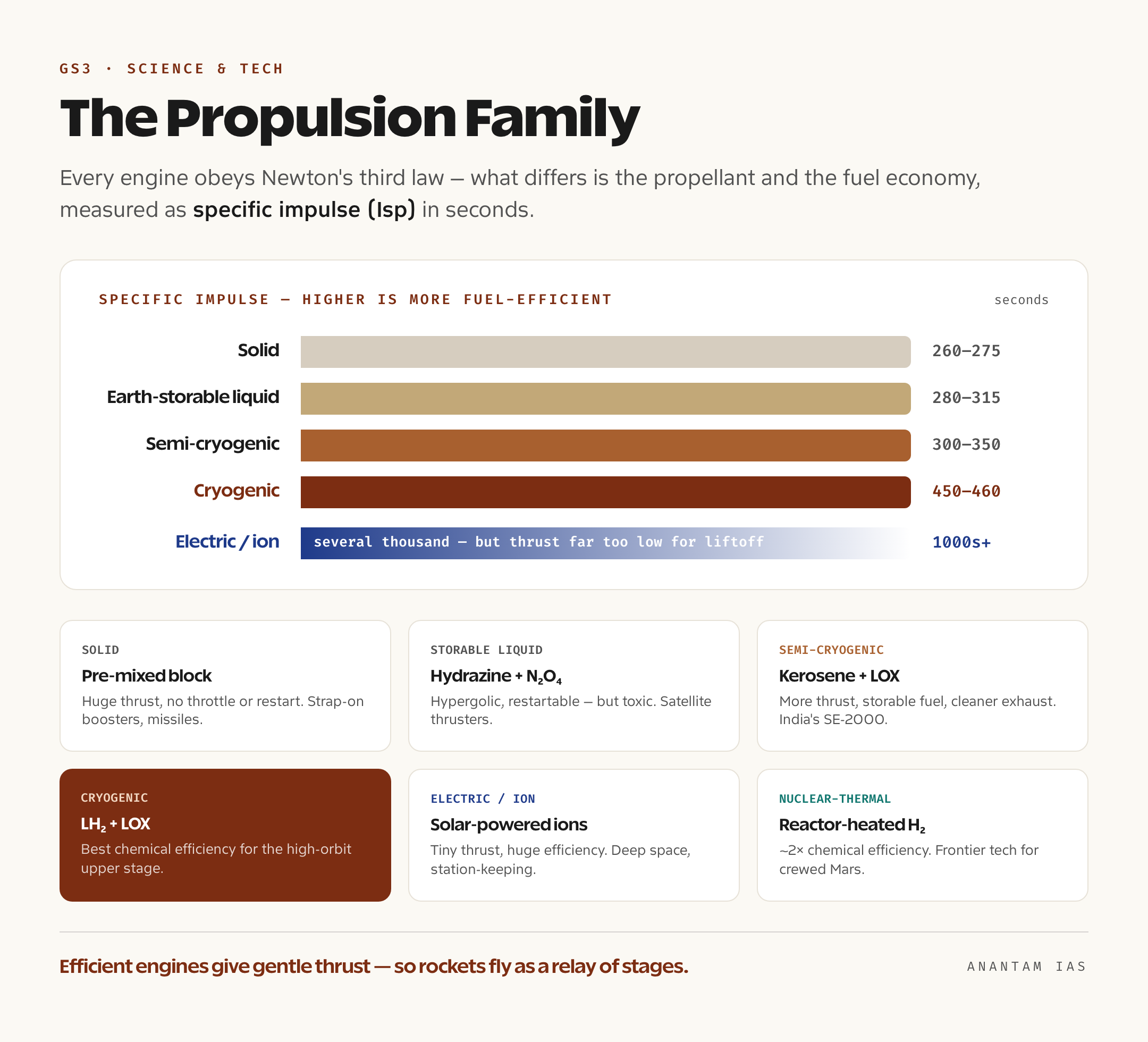
This one number quietly ranks every propulsion system in the world, and it is worth carrying into any answer. Solid propellants sit at the bottom, with a specific impulse of roughly 260-275 seconds. Earth-storable liquids — the toxic but dependable fuels that sit in a tank for years — manage about 280-315 seconds. Semi-cryogenic engines, burning kerosene and liquid oxygen, reach 300-350 seconds. And cryogenic engines, burning liquid hydrogen and liquid oxygen, top the chemical chart at 450-460 seconds, as India’s Liquid Propulsion Systems Centre lists them. Electric propulsion blows past all of these — its specific impulse can be several thousand seconds — but it does so at a price we will come to.
The catch, and it is the catch that explains the entire design of a rocket, is that specific impulse and thrust pull in opposite directions. The most fuel-efficient engines tend to produce gentle thrust; the most powerful engines tend to be thirsty. No single engine is best at both lifting a heavy rocket off the pad and sipping fuel efficiently in space. So rockets are built in stages — different engines stacked on top of one another, each tuned for one phase of flight, each dropped away once its job is done. A brawny, thirsty engine claws the rocket off the ground; a lean, efficient engine takes over in the thin upper atmosphere and finishes the climb to orbit. Understanding propulsion means understanding that no rocket uses one kind of engine. It uses a relay team.
The Family of Engines, From Solid Boosters to Ion Drives
With thrust and specific impulse in hand, the different engine types fall into a clean order. Solid-propellant rockets are the simplest: fuel and oxidiser are pre-mixed into a rubbery block, like a giant firework. Light them and they burn fiercely to the end — you cannot throttle them, you cannot shut them off, and you cannot restart them. What they offer is brute thrust and instant readiness, which is why they make ideal strap-on boosters for the violent first seconds of liftoff and why most missiles use them. Liquid-propellant engines store fuel and oxidiser separately and pump them into a combustion chamber, which means they can be throttled, shut down and restarted — far more controllable, but mechanically complex. Within the liquids, the families divide by what they burn.
Earth-storable liquids are propellants that stay liquid at ordinary temperatures and can sit in a tank for years — perfect for the upper stages and the on-board engines of satellites that must fire on command after a long wait. The classic pairing is a hydrazine-type fuel with nitrogen tetroxide; many of these combinations are hypergolic, meaning fuel and oxidiser ignite the instant they touch, with no spark or igniter needed. That self-igniting reliability is gold for spacecraft, but the fuels are brutally toxic. Cryogenic engines go to the other extreme, burning liquid hydrogen and liquid oxygen chilled to roughly minus 250°C and minus 183°C. They deliver the best efficiency of any chemical engine, which is why they power upper stages that must squeeze a heavy satellite into a high orbit — but storing super-cold liquids is hard, so they cannot wait around fuelled. Semi-cryogenic engines split the difference: they burn ordinary, storable kerosene with cryogenic liquid oxygen, giving more thrust and density than hydrogen, less hassle than full cryogenics, and a far less toxic exhaust than storables.
Then come the engines that barely use fire at all. Electric (ion) propulsion uses electricity, usually from solar panels, to ionise a gas like xenon and hurl the charged particles out at tremendous speed with electric or magnetic fields. The thrust is feeble — often less than the weight of a sheet of paper — so an ion engine could never lift a rocket off Earth. But it sips propellant so frugally, with a specific impulse in the thousands, that it can run for months or years, gradually building up enormous velocity. That makes it the engine of choice for deep-space probes and for nudging satellites to hold their station in orbit. Further out on the frontier sits nuclear-thermal propulsion, which would use a nuclear reactor to superheat hydrogen and blast it out, roughly doubling the efficiency of the best chemical engines — a technology still mostly on the drawing board but watched closely for future crewed missions to Mars.
India’s Stages: S200, L110, C25 and the New Semi-Cryogenic Engine
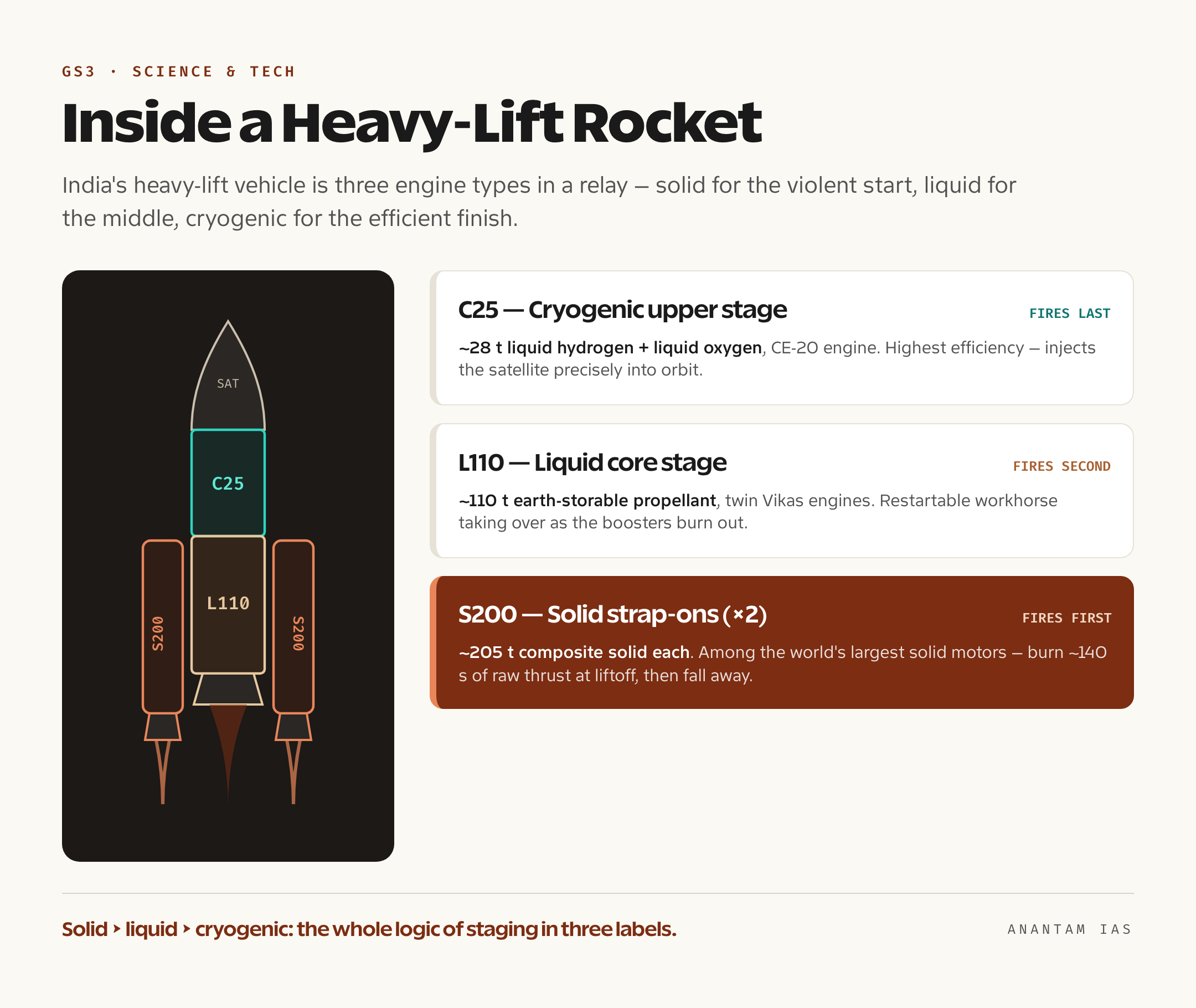
The relay-team idea is easiest to see in India’s own rockets, and the stage names are worth memorising because they spell out the whole strategy. Take the heavy-lift vehicle that carries India’s biggest satellites and will fly the Gaganyaan crew. Its first push comes from two S200 strap-on boosters — among the largest solid rocket motors in the world, each packed with about 205 tonnes of composite solid propellant. They light at liftoff, burn for around 140 seconds of raw thrust, and fall away. Beneath and behind them fires the L110 core stage, a liquid stage holding roughly 110 tonnes of earth-storable propellant and powered by twin Vikas engines — the storable, restartable workhorse that takes over as the solids burn out. And the final climb belongs to the C25 cryogenic upper stage, powered by the indigenous CE-20 engine, carrying about 28 tonnes of liquid hydrogen and liquid oxygen to inject the satellite precisely into its target orbit. Solid for the violent start, liquid for the middle, cryogenic for the efficient finish — the whole logic of staged propulsion in three labels.
Cryogenic technology is the part India fought hardest to master, and that struggle is itself examinable. Through the 1990s, denied the technology by a sanctions regime that feared its missile applications, India was forced to build its cryogenic engine from scratch. After years of failures, the indigenous cryogenic stage finally flew successfully, and today the CE-20 is a proven engine — putting India in the small club of nations that can build the hardest chemical engine there is. The country’s smaller workhorse rocket, the PSLV, tells the same staged story in miniature, alternating solid and liquid stages, with its fourth stage able to restart in orbit to drop satellites at different altitudes.
The frontier now is the semi-cryogenic engine, and this is where the most current news sits. India is developing a powerful new engine, the SE-2000, that burns kerosene with liquid oxygen and is designed to deliver about 2,000 kilonewtons of thrust through an oxidiser-rich staged-combustion cycle — the same demanding cycle used by the world’s most advanced engines. Through 2025, the engine cleared a series of hot tests at the ISRO Propulsion Complex at Mahendragiri, building up power level by power level. This semi-cryogenic engine will eventually power a new SC120 core stage to replace the toxic, storable L110 — giving more thrust, higher payload, lower cost, and a far cleaner kerosene-oxygen exhaust in place of the poisonous storable propellants. It is the propulsion backbone planned for India’s Next Generation Launch Vehicle, the heavy reusable rocket meant to follow the current fleet.
Why Green Propulsion Matters and What India Is Doing
Now to the shift that ties this whole topic to the present moment. The dirty secret of spaceflight is that its most trusted fuel is a poison. Hydrazine and its relatives have been the standard monopropellant for satellites and spacecraft thrusters for over fifty years, prized because a single liquid, passed over a catalyst, decomposes into hot gas reliably and on demand — ideal for the small thrusters that keep a satellite pointing the right way and holding its orbit. But hydrazine is highly toxic and carcinogenic, dangerous to handle, and corrosive. Fuelling a spacecraft means workers in full hazmat suits, elaborate safety zones, and slow, expensive procedures. So the “green space” movement — the broad push to make spaceflight cleaner and safer, on the ground and in orbit — has made replacing hydrazine one of its headline goals. A green propellant is not about exhaust in the sky so much as about a fuel that people can handle safely, that costs less to process, and that often performs better too.
The leading replacements are a new class of liquids built around two energetic salts. One is ammonium dinitramide, or ADN; the other is hydroxylammonium nitrate, or HAN. Blended with water, methanol and other ingredients into a single monopropellant, these “green” fuels are far less toxic than hydrazine yet pack more punch. The best-known ADN-based blend, LMP-103S, offers roughly 6% higher specific impulse and about 24% greater density than hydrazine, and it has already flown on more than two dozen satellites — the first green ionic-liquid propellant used in space. HAN-based monopropellants tell a similar story: higher density and higher specific impulse than hydrazine with much lower toxicity, which is precisely their advantage. The one caveat worth knowing is that these green fuels do not ignite by magic — they still need a catalyst bed and a high chamber temperature to decompose and fire. They are safer and denser, not self-starting in a vacuum.
India is firmly inside this race. ISRO and its centres have been developing green propulsion since around 2018, working on both greener solid formulations — using glycidyl azide polymer as fuel with ammonium dinitramide as oxidiser — and HAN-based and ADN-based liquid monopropellants to replace hydrazine. The country’s own Gaganyaan human-spaceflight programme has been a major driver, since flying astronauts demands the safest possible fuels for the crew module’s thrusters. Indian start-ups have joined in too, with Bengaluru’s Bellatrix Aerospace developing green monopropellant thrusters that have been demonstrated in orbit on a PSLV experimental platform. So the green shift is not just imported; it is part of India’s broader space self-reliance, sitting alongside the semi-cryogenic kerosene engine and the reusable next-generation rocket as three faces of the same goal — propulsion that is cleaner, cheaper and more capable.
Electric propulsion belongs to this same green story, which is exactly why it keeps coming up. Because an ion engine uses solar electricity rather than chemical combustion and barely consumes propellant, it is both clean and astonishingly efficient — perfect for the long, patient burns of deep-space missions and for keeping a fleet of satellites in formation. It cannot lift a rocket off the pad, and it never will; its thrust is far too gentle for the heavy-lift liftoff phase. But for the missions it suits, it is the greenest propulsion of all. Put the three threads together — semi-cryogenic kerosene engines on the way up, green monopropellants for spacecraft thrusters, and electric drives for the long haul — and you have the shape of where rocket propulsion is heading for the next decade.
For Your Mains Answer
This is a versatile topic for GS Paper 3, which covers science and technology, developments and applications, and indigenisation and self-reliance in high technology. It connects to space-mission questions, to India’s achievements in space, and to the broader theme of clean, sustainable technology. The skill examiners reward here is the same arc this article follows: anchor the answer in one law of physics, rank the engines by a single number, and then connect the technology to India’s current programmes and the global green-space push.
How to Build the Answer
Open with the physics, not a fuel list — state that propulsion runs on Newton’s third law and that performance is measured by specific impulse. Then lay out the engine families in order of efficiency: solid, earth-storable liquid, semi-cryogenic, cryogenic, electric, with nuclear-thermal as the frontier. Use India’s stages as living examples — S200 solid, L110 liquid, C25 cryogenic — and bring in the SE-2000 semi-cryogenic engine as the current development. Close with green propulsion: why hydrazine must go, what HAN and ADN offer, and where electric propulsion fits. That sequence — law, metric, types, Indian examples, green shift — answers almost any propulsion question.
Common Mistakes to Avoid
Don’t say a rocket “pushes against the air” — it works in vacuum, by Newton’s third law. Don’t claim electric propulsion can be used for liftoff; its thrust is far too low, and that is a classic trap. Don’t confuse cryogenic (liquid hydrogen plus liquid oxygen) with semi-cryogenic (kerosene plus liquid oxygen) — the fuel differs, and so does the reason each exists. And don’t describe green monopropellants as self-igniting in space; they still need a catalyst and heat to decompose.
A Compact Answer Spine
Propulsion = Newton’s third law, performance measured by specific impulse (Isp) → solid (~260-275s, instant thrust, no throttle) → earth-storable liquid (hypergolic, toxic, restartable) → semi-cryogenic kerosene-LOX (~300-350s, cleaner) → cryogenic LH2-LOX (~450-460s, best chemical Isp) → electric/ion (Isp in thousands, tiny thrust, deep space only) → nuclear-thermal (frontier) → India: S200 + L110 + C25 stages, SE-2000 semi-cryo under test → green propulsion: replace toxic hydrazine with HAN/ADN monopropellants (LMP-103S: ~6% higher Isp, ~24% denser), electric drives clean but low-thrust.
Diagram or Flowchart Idea
Draw a vertical bar ranking the engine types by specific impulse — solid lowest, then storable, semi-cryo, cryogenic, with electric drawn off the chart’s top and labelled “very high Isp, very low thrust.” Beside it, sketch a three-stage rocket labelled S200 / L110 / C25 to show the relay of engine types. The two together capture the whole topic at a glance.
A Balanced-Conclusion Line
A line that lands the marks: “Rocket propulsion is one law of physics expressed through many engines — and India’s move from toxic storables toward semi-cryogenic, electric and green monopropellant systems shows that the future of spaceflight will be measured not only by thrust, but by how cleanly and self-reliantly that thrust is produced.”
How to Use Data Without Cramming
You need only a handful of anchors, not a spreadsheet: cryogenic Isp ~450-460s as the chemical ceiling, solid ~260-275s as the floor, the three Indian stage names (S200, L110, C25), the SE-2000’s ~2,000 kN, and LMP-103S being ~6% more efficient and ~24% denser than hydrazine. Attribute them plainly — “as ISRO’s Liquid Propulsion Systems Centre lists” — rather than scattering numbers loose.
FAQ
What is the basic principle behind rocket propulsion? Newton’s third law of motion — for every action there is an equal and opposite reaction. A rocket burns propellant and ejects hot gas backward at high speed; the gas pushes the rocket forward with an equal force. Because the rocket carries both fuel and oxidiser, it needs no surrounding air and works in the vacuum of space, unlike a jet engine. The two key measures are thrust (the forward force) and specific impulse (how efficiently the engine uses its propellant).
What is the difference between cryogenic and semi-cryogenic engines? A cryogenic engine burns liquid hydrogen and liquid oxygen, both chilled to extremely low temperatures, and delivers the highest efficiency of any chemical engine (specific impulse around 450-460 seconds) — but the super-cold fuels are hard to store. A semi-cryogenic engine burns ordinary, room-temperature kerosene with cryogenic liquid oxygen. It gives more thrust and a denser, less toxic propellant than full cryogenics, is easier to handle, and is the type of India’s new SE-2000 engine meant to replace the toxic storable core stage.
What is green propulsion and why does it matter? Green propulsion replaces the highly toxic, carcinogenic hydrazine that has fuelled spacecraft thrusters for decades with safer fuels built around energetic salts like ammonium dinitramide (ADN) and hydroxylammonium nitrate (HAN). These green monopropellants are far less toxic to handle, often denser, and frequently more efficient — the ADN-based LMP-103S offers about 6% higher specific impulse and 24% greater density than hydrazine. It matters because safer fuels cut handling costs and risk, especially for crewed missions, and support the broader “green space” movement.
Can electric (ion) propulsion launch a rocket from Earth? No. Electric propulsion uses electricity, usually from solar panels, to accelerate ionised gas to very high speed, giving exceptional fuel efficiency (specific impulse in the thousands). But its thrust is tiny — far too weak to overcome gravity at liftoff. It is used for long-duration deep-space missions and for satellite station-keeping in orbit, where its efficiency over months or years matters more than raw power. Heavy-lift liftoff still needs powerful chemical engines.
Practice Questions
Prelims MCQs
- Rocket propulsion is best explained by which principle?
(a) Bernoulli’s principle
(b) Archimedes’ principle
(c) Newton’s third law of motion
(d) Newton’s law of universal gravitation
Answer: (c) A rocket ejects hot gas backward and is pushed forward by an equal and opposite reaction, which works even in the vacuum of space. - Which of the following has the highest specific impulse?
(a) Solid propellant
(b) Earth-storable liquid propellant
(c) Semi-cryogenic propellant
(d) Cryogenic propellant
Answer: (d) Cryogenic engines burning liquid hydrogen and liquid oxygen reach about 450-460 seconds, the highest of any chemical propulsion system. - The C25 stage of India’s heavy-lift launch vehicle uses which propellant combination?
(a) Kerosene and liquid oxygen
(b) Liquid hydrogen and liquid oxygen
(c) Solid composite propellant
(d) Hydrazine and nitrogen tetroxide
Answer: (b) C25 is a cryogenic upper stage powered by the CE-20 engine, burning liquid hydrogen and liquid oxygen. - With reference to electric (ion) propulsion, which statement is correct?
(a) It provides very high thrust suitable for liftoff from Earth
(b) It uses solar electricity to accelerate ions, giving high efficiency but low thrust
(c) It eliminates the need for any propellant by using Earth’s magnetic field
(d) It is used only during the heavy-lift first stage
Answer: (b) Ion engines accelerate ionised propellant with electric fields, giving very high specific impulse but very low thrust, suiting long-duration deep-space and station-keeping missions, not liftoff. - What is the main advantage of HAN-based green monopropellants over conventional hydrazine?
(a) They react spontaneously with the vacuum of space and need no ignition
(b) They have higher density and specific impulse with much lower toxicity
(c) They require no oxidiser because they burn using atmospheric oxygen
(d) They can only be used in solid rocket boosters
Answer: (b) HAN-based fuels offer higher density and specific impulse with far lower toxicity, but they still need a catalyst and a high chamber temperature to decompose and ignite.
Mains Practice Questions
- Explain the basic principle of rocket propulsion and the concept of specific impulse. How do these together explain why launch vehicles are built in stages? (15 marks, 250 words)
- Compare solid, liquid, cryogenic and semi-cryogenic propulsion systems in terms of performance, controllability and storability. Why does a single launch vehicle use more than one type? (15 marks, 250 words)
- Discuss India’s mastery of cryogenic technology and the development of the semi-cryogenic engine. How do these reflect the goal of self-reliance in space technology? (15 marks, 250 words)
- What is green propulsion? Examine why replacing hydrazine has become a priority for space agencies, and assess India’s efforts in developing green propellants. (15 marks, 250 words)
- “Electric propulsion is the greenest and most efficient drive yet cannot lift a rocket off the ground.” Discuss this apparent paradox and the missions for which electric propulsion is best suited. (10 marks, 150 words)