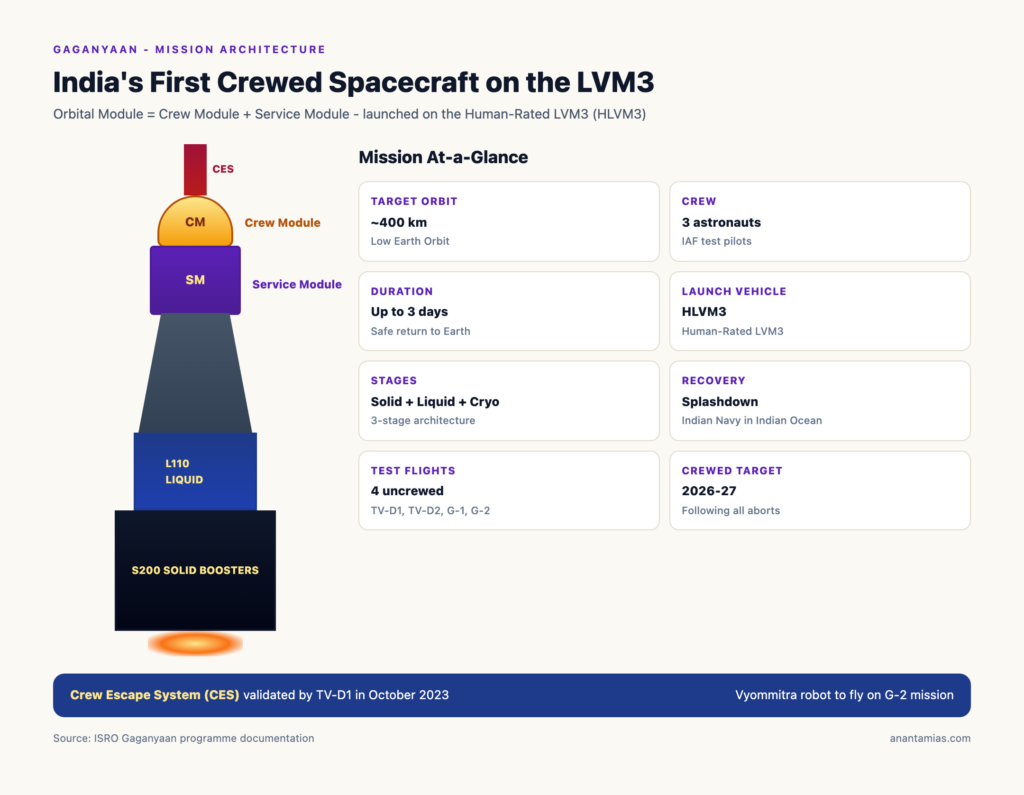
The Gaganyaan mission is India’s first attempt to fly its own citizens to space aboard an indigenous spacecraft. Approved by the Union Cabinet in December 2018 with a budget of ₹9,023 crore, the Gaganyaan mission will carry three astronauts to a 400-kilometre low Earth orbit for a three-day flight and bring them back safely to a splashdown in the Arabian Sea or the Bay of Bengal. Success will make India the fourth country to send humans into space on a homegrown rocket — after the Soviet Union (1961), the United States (1962) and China (2003) — and the first South Asian nation in this elite club. Equally important, the Gaganyaan mission is the launchpad for a much bigger national programme: the Bharatiya Antariksh Station by 2035 and an Indian astronaut on the Moon by 2040.
For UPSC, the Gaganyaan mission cuts across GS-III science and technology, GS-II international cooperation, and current affairs. It is also a stress test for India’s industrial base — over 500 industries and academic institutions are involved.
Background: Why Gaganyaan, Why Now
Prime Minister Narendra Modi first announced the Gaganyaan mission from the ramparts of the Red Fort on 15 August 2018 and asked ISRO to deliver a human flight before the 75th anniversary of independence. The Cabinet approved the programme four months later. The Gaganyaan mission is not just an engineering project — it is a deliberate signal that India intends to be a full-spectrum space power.
Strategic Drivers
Three forces pushed Gaganyaan from study to mission. First, the Chinese Shenzhou programme had already flown astronauts since 2003 and was building a permanent space station. Second, India needed an anchor project to develop human-rated launch technology — life support, redundancy, crew escape, re-entry, splashdown recovery. Third, the global space economy was projected to cross $1.8 trillion by 2035, and human-rated capability is the gateway to that market.
What “Human-Rated” Actually Means
A human-rated spacecraft is engineered to a safety standard ten to a hundred times stricter than a satellite launcher. The Gaganyaan mission required ISRO to redesign almost every subsystem of the LVM-3 — the S200 solid boosters became HS200, the L110 liquid stage became L110-G with stricter quality control, and the C25 cryogenic upper stage was re-qualified for crewed flight. The resulting human-rated launcher is called the HLVM-3, though documentation also references it as HRLV.
Mission Architecture
The Gaganyaan mission’s flight profile is straightforward in description but ferociously demanding in execution.
The Orbital Module
The orbital module sits atop the HLVM-3 and consists of two parts. The Crew Module is a 3.7-metre conical cabin that houses the three astronauts in a shirt-sleeve environment, with life support, displays, manual controls and a heat shield rated for re-entry at 27,000 km/h. The Service Module sits below the Crew Module and carries propulsion, propellant, solar arrays and thermal control. After the three-day orbital phase, the Service Module is jettisoned and only the Crew Module re-enters and splashes down under parachutes.
Trajectory
HLVM-3 will lift off from Sriharikota’s Second Launch Pad, climb to a 400-km circular orbit inclined at about 51.6 degrees, complete approximately 48 orbits over three days, then perform a de-orbit burn for a splashdown about 16 minutes after re-entry begins. The Indian Navy will conduct primary recovery.
Crew Escape System
The Gaganyaan mission’s crew escape system is one of the most heavily tested elements. Five solid-propellant motors on the launch escape tower can pull the Crew Module away from a failing rocket on the pad, during ascent through dense atmosphere, or at high altitude. The system is designed to deliver the crew safely to a parachute-aided splashdown within seconds of an emergency.
The Astronauts
In February 2024, Prime Minister Modi publicly named the four astronaut-designates selected for the Gaganyaan mission. All four are serving Indian Air Force test pilots who completed an initial year of training in Russia at the Yuri Gagarin Cosmonaut Training Centre and continue their preparation in Bengaluru.
- Group Captain Prasanth Balakrishnan Nair
- Group Captain Ajit Krishnan
- Group Captain Angad Pratappal
- Wing Commander Shubhanshu Shukla
Three of the four will form the prime crew for the first crewed Gaganyaan mission. The fourth will serve as the backup. Wing Commander Shubhanshu Shukla has already been designated as the prime crew for Axiom Mission 4 (Ax-4), an Indo-American collaborative flight to the International Space Station scheduled for 2025-26, giving India its first International Space Station experience.
Why IAF Test Pilots
Test pilots are pre-selected for handling unfamiliar flight regimes, high-G manoeuvres and rapid decision-making under failure conditions — exactly the skill set a spacecraft demands. The Gaganyaan mission selection process used Indian Air Force facilities at the Institute of Aerospace Medicine in Bengaluru.
Vyommitra: The Robot Astronaut
Before any human flies, the Gaganyaan mission will fly Vyommitra — a half-humanoid female robot built by ISRO’s Inertial Systems Unit. The name is a Sanskrit compound of vyom (space) and mitra (friend). Vyommitra has a head, arms and torso (no legs in the orbital configuration), can speak Hindi and English, perform switch operations, monitor crew-module parameters, and report telemetry to Mission Control. She will fly on the uncrewed G1 test mission and her data will validate the cabin environment before astronauts step in.
Test Flights and Timeline
The Gaganyaan mission has been deliberately sequenced as a long chain of qualification tests to maximise safety. ISRO’s current schedule, refined in 2024-25, runs as follows.
Completed Tests
- TV-D1 (Test Vehicle Demonstration 1) — 21 October 2023. A single-stage liquid-propulsion test vehicle launched from Sriharikota validated the crew escape system at about 17 km altitude, with the Crew Module splashing down in the Bay of Bengal under parachutes. ISRO recovered the module.
- Cryogenic engine re-qualification — CE20 engine cleared for human rating with multiple ground tests.
- HS200 solid booster test — successful in 2022.
Upcoming Test Flights
- G1 Uncrewed Mission — first orbital test with Vyommitra and a fully instrumented Crew Module. Targeted for late 2025 after timeline slips through 2024-25.
- G2 Uncrewed Mission — second uncrewed flight to repeat the profile and gather statistical confidence.
- H1 Crewed Mission — first crewed Gaganyaan flight, currently targeted in 2026-27 subject to G1 and G2 results.
ISRO has stated that schedules will not be compressed at the cost of safety. The Gaganyaan mission timeline has slipped twice already since the original 2022 target announced in 2018, and every slippage has been explained as a deliberate safety call.
Beyond Gaganyaan: The Long Road Ahead
The Gaganyaan mission is not the destination — it is the door. The Government of India has approved a follow-on roadmap with three large pieces.
Bharatiya Antariksh Station by 2035
In October 2024, the Cabinet approved the first module of the Bharatiya Antariksh Station (BAS) — an indigenous modular space station to be operational by 2035 in low Earth orbit. The first module, BAS-1, is targeted for launch in 2028 and will be uncrewed initially. Five Gaganyaan follow-on missions have been sanctioned to support BAS assembly and crew rotation. India will become the third country to operate its own space station after the Soviet Union (Mir) and China (Tiangong).
Indian Astronaut on the Moon by 2040
The Prime Minister has declared a national goal — landing an Indian astronaut on the Moon by 2040. This requires a Next Generation Launch Vehicle (NGLV) with a payload capacity of 30 tonnes to LEO, in addition to lunar lander and ascent systems that will be partly demonstrated by the Chandrayaan-4 sample-return mission.
Industry and Spinoffs
The Gaganyaan mission has already pumped over ₹4,000 crore into Indian industry across more than 500 contracts. Hindustan Aeronautics Limited supplies the Crew Module integration. Larsen and Toubro fabricates HLVM-3 booster segments. Smaller MSMEs supply life-support sensors, parachute fabrics and re-entry coatings. These spinoffs — closed-loop life support, precision parachutes, fault-tolerant avionics — feed straight into civilian aerospace, medical imaging and defence.
Strategic Significance
The Gaganyaan mission positions India as one of only four nations capable of independent human spaceflight. Combined with Chandrayaan-3, Aditya-L1 and Mars Orbiter Mission, it completes a portfolio that signals technological maturity to global partners — from Artemis Accords cooperation with NASA to bilateral space diplomacy with France, Australia, Japan and the United Arab Emirates.
Comparison With Global Programmes
The Gaganyaan crew of three for three days is conservative compared to SpaceX’s Crew Dragon, which has flown six astronauts for up to six months on the International Space Station. But the strategic gap is closing rapidly — the BAS roadmap puts India on a Chinese-Tiangong-style trajectory by the mid-2030s.
Why the Gaganyaan Mission Matters for UPSC
The Gaganyaan mission is a recurring Mains topic under GS-III science and technology and GS-II international relations. Past questions have asked about indigenous capability, the human-rated launcher, crew escape architecture, and the strategic significance of human spaceflight.
Likely Mains Angles
- Indigenous capability and the make-in-India space sector
- Human-rated launcher engineering
- Spinoff technologies for civilian use
- International collaboration — Russia for training, NASA-Axiom for ISS experience, France for life-support
- Bharatiya Antariksh Station as a strategic asset
Prelims Hooks
- HLVM-3 launcher (also called HRLV)
- TV-D1 abort test date — 21 October 2023
- Vyommitra — humanoid robot, ISRO Inertial Systems Unit
- Astronaut training in Russia at Yuri Gagarin Cosmonaut Training Centre
- BAS-1 module — 2028 target, full station 2035
Frequently Asked Questions
When will the Gaganyaan mission launch?
The first uncrewed Gaganyaan mission (G1) carrying the Vyommitra robot is currently targeted for late 2025. The first crewed flight (H1) is scheduled for 2026-27, after a second uncrewed mission (G2) validates systems. ISRO has emphasised that schedules will not be compressed at the cost of crew safety.
Who are the Gaganyaan astronauts?
The four astronaut-designates are Group Captain Prasanth Balakrishnan Nair, Group Captain Ajit Krishnan, Group Captain Angad Pratappal and Wing Commander Shubhanshu Shukla — all serving Indian Air Force test pilots. They trained initially in Russia at the Yuri Gagarin Cosmonaut Training Centre and continue mission-specific training in Bengaluru.
What is the HLVM-3?
HLVM-3 (Human-Rated Launch Vehicle Mark 3, sometimes called HRLV) is the human-rated version of ISRO’s LVM-3. Its solid boosters are designated HS200, its liquid core stage L110-G and the cryogenic upper stage C25 — all re-qualified to a safety standard ten to a hundred times stricter than for a regular satellite launcher.
What is Vyommitra?
Vyommitra is a half-humanoid female robot built by ISRO that will fly on the uncrewed G1 Gaganyaan mission. She can speak Hindi and English, operate cabin switches, monitor crew-module parameters and report telemetry to Mission Control, validating the cabin environment before astronauts fly.
How much will the Gaganyaan mission cost?
The Gaganyaan mission was approved with a budget of ₹9,023 crore in December 2018. The five follow-on missions for the Bharatiya Antariksh Station were sanctioned in 2024 with an additional ₹11,170 crore, taking the total Indian human spaceflight outlay to roughly ₹20,000 crore by 2035.
What is the Bharatiya Antariksh Station?
The Bharatiya Antariksh Station (BAS) is India’s planned modular space station in low Earth orbit, to be fully operational by 2035. The first module, BAS-1, is targeted for launch in 2028. Five Gaganyaan follow-on missions have been approved to support assembly and crew rotation, making India the third country to operate its own space station after the Soviet Union and China.
What happened in the TV-D1 abort test?
The Test Vehicle Demonstration 1 (TV-D1) on 21 October 2023 validated the Gaganyaan mission crew escape system. A single-stage liquid-propulsion test vehicle launched from Sriharikota, triggered the abort sequence at about 17 km altitude, and the Crew Module splashed down safely in the Bay of Bengal under parachutes. ISRO recovered the module intact.
How is Gaganyaan different from SpaceX Crew Dragon?
The Gaganyaan mission carries three astronauts for three days to a 400-km orbit, while Crew Dragon carries up to seven astronauts and docks with the International Space Station for six-month missions. Gaganyaan is more conservative by design — it is India’s first human spaceflight programme — but the Bharatiya Antariksh Station roadmap puts India on a comparable trajectory by the mid-2030s.
Tell Google you want more of this.
Add Anantam IAS as a preferred sourceOne tap, and this site shows up more often in your own Top Stories, AI Overviews and AI Mode. Remove it any time.