Satavahana Dynasty — Rulers, Administration, and UPSC Guide
Complete UPSC guide to the Satavahana dynasty — founders, major rulers like Gautamiputra Satakarni, Deccan trade, Amaravati stupa, administration, coinage, and decline.
The Satavahana dynasty (also referred to as the Andhra dynasty in Puranic literature) was one of the most significant ruling houses of ancient India, dominating the Deccan region for approximately four centuries (c. 1st century BCE to 3rd century CE). The Satavahanas were the first major Indian dynasty to establish a powerful state in the Deccan after the decline of the Mauryan Empire. They played a pivotal role in the development of trade (including Roman trade), Buddhism, Prakrit literature, and Deccan administration, leaving behind architectural masterpieces such as the Amaravati Stupa and the rock-cut caves at Nashik, Karle, and Bhaja.
For UPSC, the Satavahanas are a core topic in Ancient Indian History (GS1), appearing in questions on post-Mauryan polities, trade routes, Buddhist architecture, and numismatics.
Origin and Founding
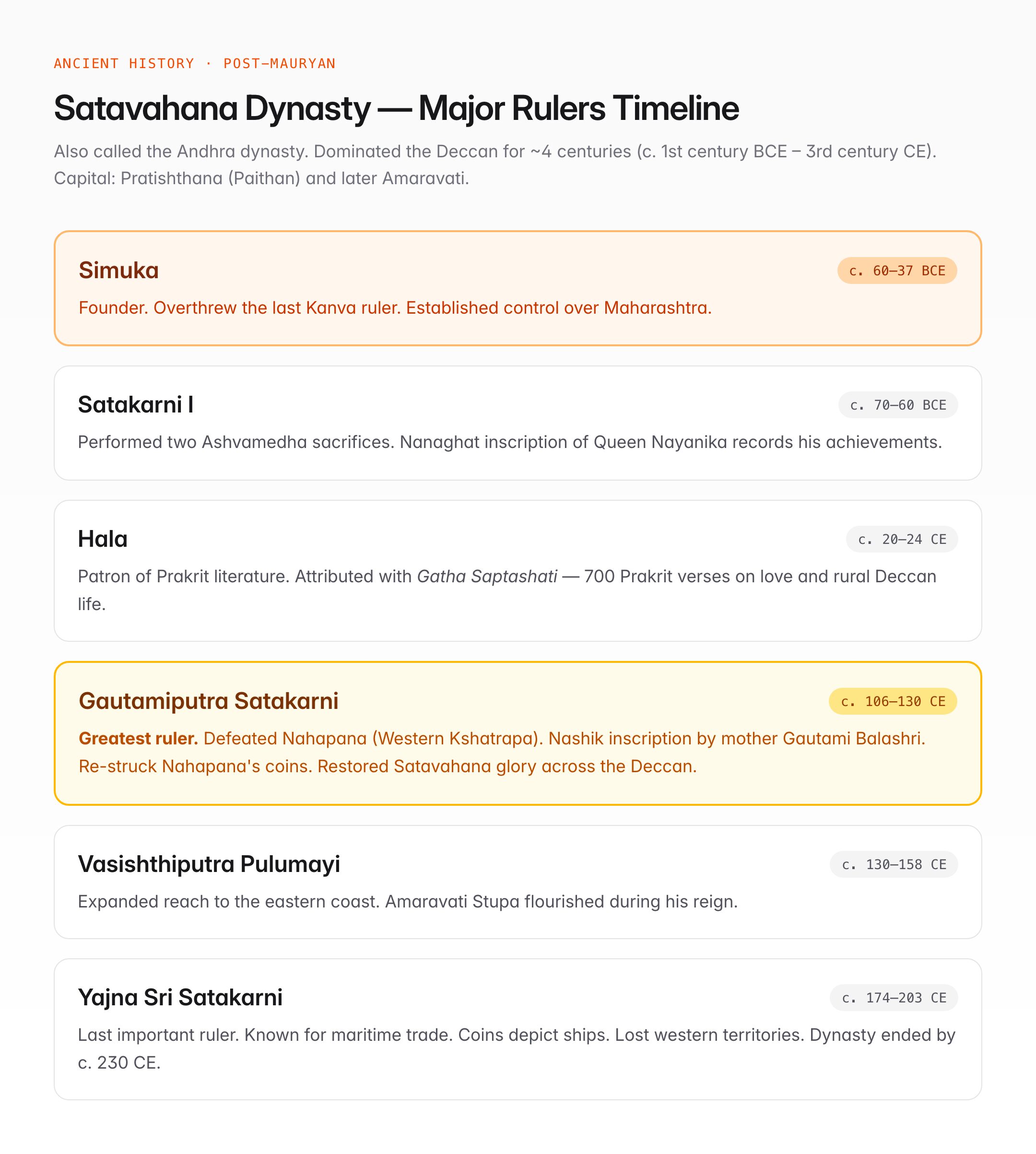
- The dynasty was founded by Simuka (c. 60 BCE), who overthrew the last Kanva ruler and established Satavahana power in the Deccan
- The Puranas call them the "Andhra" dynasty (from their association with the Andhra region), but their political centre was in Maharashtra (Pratishthana/Paithan on the Godavari)
- The Nanaghat inscription of Queen Nayanika (wife of Satakarni I) is one of the earliest Satavahana records
- Capital: Pratishthana (modern Paithan, Maharashtra); later shifted to Amaravati (Andhra Pradesh)
Major Rulers
| Ruler | Approximate Period | Key Achievements |
|---|---|---|
| Simuka | c. 60–37 BCE | Founder; established control over Maharashtra |
| Satakarni I | c. 70–60 BCE | Performed two Ashvamedha sacrifices; extended Satavahana power; Nanaghat inscription |
| Hala | c. 20–24 CE | Patron of Prakrit literature; attributed with Gatha Saptashati (700 Prakrit verses on love and rural life) |
| Gautamiputra Satakarni | c. 106–130 CE | Greatest Satavahana ruler; defeated the Western Kshatrapas (Nahapana); restored Satavahana power across the Deccan; described in the Nashik inscription of his mother Gautami Balashri |
| Vasishthiputra Pulumayi | c. 130–158 CE | Son of Gautamiputra; expanded Satavahana reach to the eastern coast; Amaravati Stupa flourished during his reign |
| Yajna Sri Satakarni | c. 174–203 CE | Last important ruler; known for maritime trade; coins depict ships; lost western territories to Kshatrapas |
Gautamiputra Satakarni — The Greatest Satavahana
The Nashik cave inscription (Cave No. 3) of his mother Gautami Balashri is the most detailed Satavahana record. It describes him as:
- Destroyer of the pride of Kshatriyas (Kshatriya-darpamardana)
- Restorer of the glory of the Satavahana family
- Conqueror who defeated Nahapana (Shaka/Western Kshatrapa ruler); he re-struck Nahapana's coins with his own name
- Upholder of the varnashrama dharma (social order)
- Ruler of territories from the Krishna River to the Malwa region
Extent of the Empire
At its peak under Gautamiputra Satakarni, the Satavahana empire extended over:
- Maharashtra (Nashik, Junnar, Paithan)
- Telangana and Andhra Pradesh (Amaravati, Dhanyakataka)
- Karnataka (northern parts)
- Madhya Pradesh (Malwa region, Vidisha area)
- Western India (after defeating the Shaka Kshatrapas)
The empire controlled both the western coast (Konkan) and the eastern coast (Coromandel), giving it command over India's most important trade routes.
Administration
| Feature | Detail |
|---|---|
| Central authority | King (Rajan); ruled with the help of ministers (amatyas) |
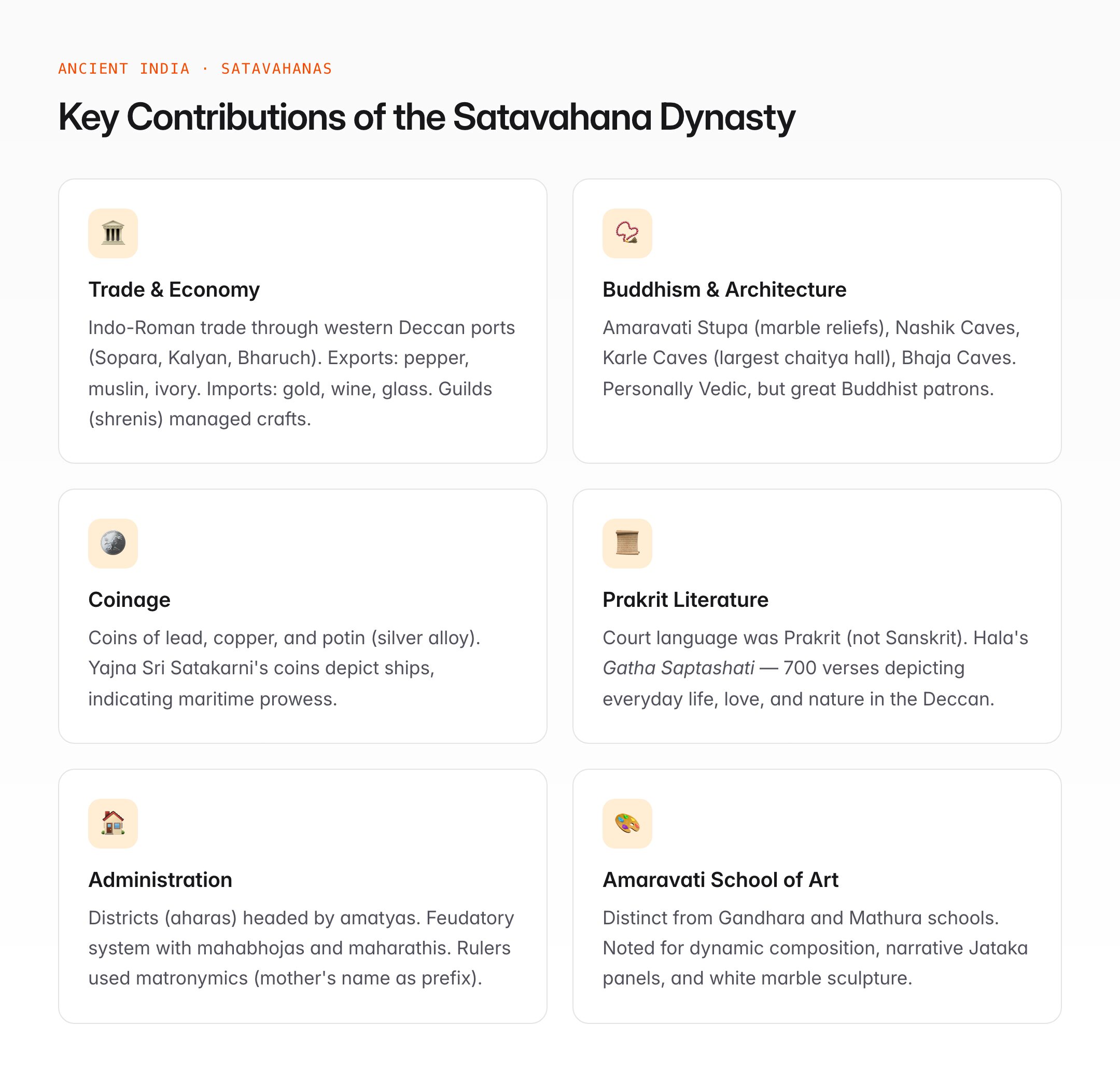
| Provincial divisions | Empire divided into aharas (districts) headed by amatyas and mahasenapatis |
| Local governance | Villages administered by gaulmika (village headman) |
| Military | Significant military apparatus; titles like mahasenapati (great general) and mahatalavara (great lord) appear in inscriptions |
| Feudatory system | Used feudal lords (mahabhojas, maharathis) — an early form of the feudatory system that would characterise later Indian polity |
| Matrilineal names | Rulers used matronymics (e.g., Gautami-putra, Vasishthi-putra), indicating high status of mothers, though the dynasty was patrilineal in succession |
Trade and Economy
The Satavahanas presided over one of the most commercially vibrant periods in ancient Indian history:
- Roman trade: The western Deccan ports (Sopara, Kalyan, Bharuch) were major nodes in Indo-Roman trade. Roman coins, wine amphorae, and artefacts have been found across Satavahana territory
- Key exports to Rome: Pepper, muslin cloth, precious stones, ivory, spices
- Key imports from Rome: Gold, silver, wine, coral, glass
- Internal trade: A robust network of trade routes connected the western coast to the eastern coast through the Deccan Plateau
- Guilds (Shrenis): Artisan and merchant guilds played a major role in the economy. Inscriptions mention guilds of weavers, potters, oil-pressers, and corn-dealers
- Coinage: Satavahana coins were made of lead, copper, and silver (potin). Yajna Sri Satakarni's coins famously depict ships, indicating maritime trade
Religion and Culture
Buddhism Under the Satavahanas
- The Satavahanas were great patrons of Buddhism, although they personally followed Vedic Brahmanism
- Major Buddhist sites developed during their reign:
- Amaravati Stupa (Andhra Pradesh) — one of the largest and most ornate stupas in India; notable for its marble reliefs depicting Jataka tales and the life of the Buddha
- Nashik Caves — rock-cut Buddhist viharas and chaityas
- Karle Caves (Maharashtra) — the largest chaitya hall in India during that period
- Bhaja Caves — early Hinayana Buddhist rock-cut architecture
- Ajanta Caves — some of the earliest caves (Caves 9, 10) date to the Satavahana period
Prakrit Literature
- Prakrit was the court language (not Sanskrit, which was adopted later)
- Hala's Gatha Saptashati (also called Sattasai) is a collection of 700 Prakrit verses — an important work in Indian literary history, depicting everyday life, love, and nature in the Deccan
Art and Architecture
- The Amaravati school of art is distinct from the Gandhara and Mathura schools
- Amaravati sculptures are noted for their dynamic composition, narrative panels, and use of white marble
- The stupa's railings and dome slabs tell stories from Buddhist Jatakas with exceptional artistic skill
Decline of the Satavahanas
The Satavahana dynasty declined in the early 3rd century CE due to:
- Loss of western territories to the Western Kshatrapas (Shaka rulers)
- Rise of feudatories who asserted independence — the Ikshvakus in the Krishna-Guntur region, the Abhiras in Maharashtra, and the Chutus in Karnataka
- Internal succession disputes weakened central authority
- By c. 230 CE, the dynasty had effectively ended, replaced by regional successor kingdoms
UPSC Relevance
GS Paper I: Ancient Indian History — Post-Mauryan polities, Deccan history, trade and commerce, Buddhist art and architecture.
Key Points for Prelims
- Founded by Simuka; greatest ruler was Gautamiputra Satakarni
- Also known as the Andhra dynasty (Puranic name)
- Capital: Pratishthana (Paithan) and later Amaravati
- Gautamiputra Satakarni defeated the Shaka ruler Nahapana — known from the Nashik inscription of Gautami Balashri
- Hala compiled the Gatha Saptashati (Prakrit literature)
- Amaravati Stupa is the signature Buddhist monument of this period
- Satavahana coins featured ships (Yajna Sri Satakarni) and were made of lead and potin
- Rulers used matronymics (mother's name as prefix), e.g., Gautami-putra
- The dynasty patronised Buddhism but personally followed Vedic religion
- Roman trade flourished through western Deccan ports under the Satavahanas
- Declined by c. 230 CE, succeeded by the Ikshvakus, Abhiras, and Chutus