The Amaravati stupa in coastal Andhra Pradesh is one of the four canonical schools of ancient Indian sculpture — the others being Bharhut, Sanchi and Mathura — and the most stylistically distinctive of them. Built on the south bank of the Krishna river, the Amaravati stupa flourished under Satavahana and later Ikshvaku patronage between roughly the second century BCE and the third century CE. Its white limestone reliefs, dynamic compositions and crowded narrative panels marked a clear departure from the more static northern schools and went on to seed Buddhist art across Sri Lanka and Southeast Asia.
This article covers the Amaravati stupa‘s setting in the lower Krishna valley, its patrons, the technical and iconographic features of the Amaravati school of sculpture, its colonial-era discovery and dispersal, and its enduring influence — material UPSC candidates will need across GS-I Art and Culture as well as essay and interview rounds.
Amaravati Stupa: Quick Facts
| Parameter | Detail |
|---|---|
| Location | Amaravati village (ancient Dharanikota), Guntur district, Andhra Pradesh |
| River | South bank of the Krishna, in the lower delta |
| Patron dynasties | Satavahanas, then the Ikshvakus of Vijayapuri |
| Period | c. 2nd century BCE – 3rd century CE |
| Material | White limestone (“Palnad marble”) |
| School | One of four canonical schools of ancient Indian sculpture (with Bharhut, Sanchi, Mathura) |
| Excavated by | Sir Walter Elliot, 1845 |
| Major collections | British Museum (London), Government Museum (Chennai), site museum, National Museum (Delhi) |
The Lower Krishna Valley Setting
The Amaravati stupa stands at the village now called Amaravati (or Dharanikota in antiquity), in Guntur district. The site sits in the lower Krishna delta, on the great riverine highway that connected the Deccan plateau to the Bay of Bengal ports of Motupalli and Ghantasala. That maritime access matters: it explains how the Amaravati style travelled to Sri Lanka, the Andamans, the Mon kingdoms of lower Burma, the Cham kingdoms of Vietnam and the early stupa-builders of central Java.
Dharanikota was the capital of the Satavahana dynasty in their eastern phase. The local limestone — a fine-grained, slightly green-tinted white stone often called the “Palnad marble” — was uniquely suited to the deep undercutting and fine modelling the Amaravati sculptors made their signature.
Patronage: Satavahanas to Ikshvakus
Satavahana Period (c. 2nd century BCE – early 3rd century CE)
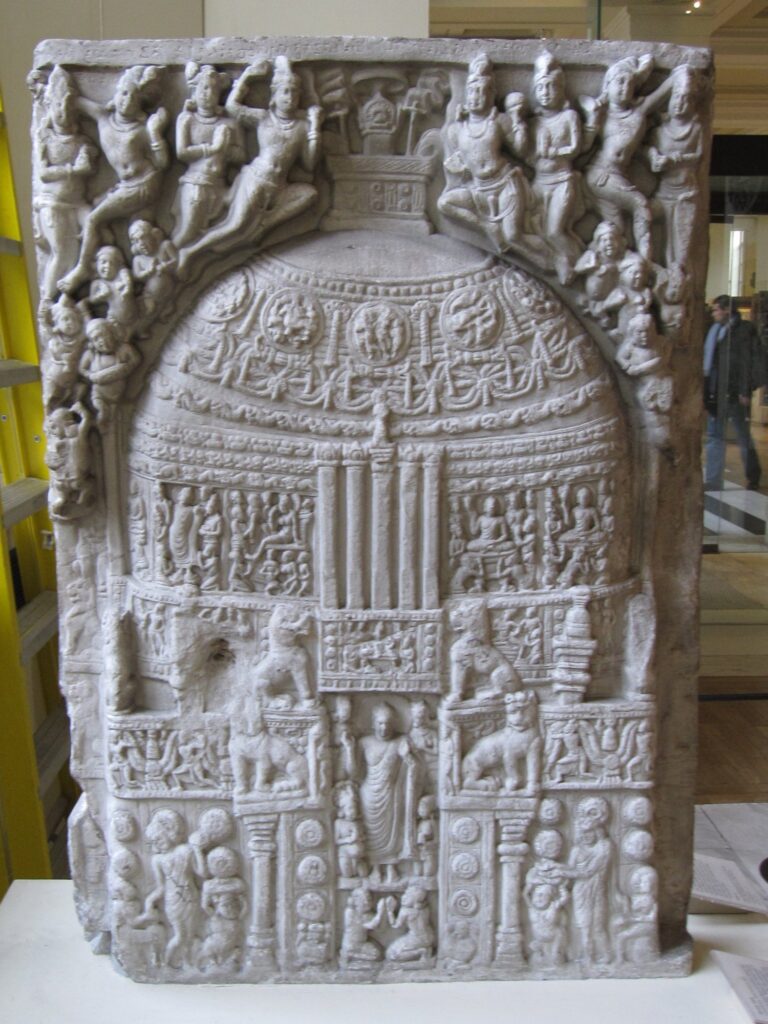
The Satavahanas were the great post-Mauryan power of the Deccan. Inscriptional evidence at Amaravati names monks, nuns, lay donors (upasakas and upasikas), guilds and royal women. King Gautamiputra Satakarni (early 2nd century CE) and his son Vasishthiputra Pulumavi were active patrons. The stupa was originally a smaller Mauryan-era structure, expanded several times under Satavahana sponsorship into a vast complex with a medhi (drum), railing (vedika), four gateways (toranas) and a hemispherical anda faced with carved limestone slabs.
Ikshvaku Period (3rd century CE)
After Satavahana decline, the Ikshvakus of Vijayapuri took over the lower Krishna valley. Their capital, Nagarjunakonda, became a parallel centre, but the Amaravati stupa continued to receive Ikshvaku gifts and embellishment. By this period, the iconography had largely shifted from aniconic to anthropomorphic — see our companion article on the empty seat in Buddhist iconography.
The Amaravati School of Sculpture
What distinguishes the Amaravati school technically and stylistically?
Material and Technique
- White limestone slabs, locally quarried, allowed deep undercutting.
- High relief with figures often three-dimensionally modelled and detached from the background.
- Drum slabs and railing pillars were the main surfaces, carved on both faces.
Compositional Hallmarks
- Dynamic, swirling crowds. Panels are densely packed with overlapping figures in motion, often arranged in concentric or radial patterns around a central element (the stupa, a tree, a wheel, or an empty seat).
- Elongated, slender figures with narrow waists and exaggerated tribhanga (three-bend) poses.
- Strong narrative continuity. A single slab may contain multiple episodes of a Jataka tale read in sequence around the relief.
- Lavish detail in costume and jewellery. Female figures (shalabhanjikas and donors) are particularly elaborate.
Iconographic Vocabulary
Amaravati reliefs depict the standard Buddhist repertoire: scenes from the Buddha’s life, Jataka stories, worshippers, donors, mythological figures and architectural representations of stupas themselves. The “stupa-on-stupa” composition — a relief slab showing the very stupa it adorns — is uniquely characteristic of Amaravati.
Aniconic to Anthropomorphic Transition
Early Amaravati reliefs (2nd–1st century BCE) are purely aniconic, using the empty seat, bodhi tree, wheel and footprints. Later Amaravati reliefs (2nd–3rd century CE) freely depict the Buddha in human form, often combined with aniconic markers in the same panel. The site is therefore the single most important laboratory for studying the transition.
Walter Elliot and Colonial Discovery
The Amaravati stupa was already in ruins by the time the East India Company arrived. Local zamindar Vasireddy Venkatadri Naidu reportedly took stones from the mound in the late 18th century for his new town. Colonel Colin Mackenzie, the first Surveyor General of India, visited and recorded the site in 1797 and 1816.
The major archaeological work was done by Sir Walter Elliot, Commissioner of Guntur, who excavated the site in 1845. Elliot lifted dozens of marble slabs, many of which were shipped to Madras and eventually to London. James Fergusson published them in 1868 in his Tree and Serpent Worship, bringing the school to international scholarly attention.
The British Museum and Chennai
Today, the largest collections of Amaravati stupa sculpture are split between:
- The British Museum, London — the “Amaravati marbles”, roughly 120 slabs from Elliot’s excavations, displayed in the Asahi Shimbun Gallery.
- The Government Museum, Chennai (Egmore) — the largest in-country collection.
- The Site Museum, Amaravati — locally retained pieces.
- The National Museum, New Delhi — selected key panels.
The dispersal of the Amaravati stupa marbles is one of the standard case studies in debates over the return of colonial-era cultural artefacts.
Propagation to Sri Lanka and Southeast Asia
Buddhist contact between the lower Krishna valley and the wider Indian Ocean world meant that the Amaravati style travelled far beyond its home delta.
- Sri Lanka: The Buddha images of Anuradhapura, especially the Samadhi Buddha (4th century CE), bear clear Amaravati influence in their drapery and serenity.
- Mon Burma: Early Mon Buddhist art at Thaton and Pegu shows Amaravati-style features.
- Dvaravati Thailand: Wheel-and-deer compositions reflect the lower Krishna model.
- Cham Vietnam and Central Java: Borobudur’s narrative panel tradition has direct compositional debts to Amaravati.
The Amaravati stupa thus functions in art history rather like a hub airport — most of the early Buddhist art of Southeast Asia passes through it.
Decline and Re-Discovery
By the 14th century the stupa was in active ruin. Local agriculturalists had begun to use the marbles as building material, lime kilns and even temple flooring. The 19th-century excavations rescued what was left, but much had already been burnt for lime. Modern conservation under the Archaeological Survey of India has stabilised the mound and built a site museum. The stupa is on India’s tentative list for UNESCO World Heritage inscription.
Architecture of the Stupa
The reconstructed plan of the Amaravati stupa is the largest in southern India. Key features:
- Anda (dome): roughly 50 metres in diameter at the base, originally rising to about 30 metres in height. The dome was solid masonry encased in carved limestone slabs.
- Medhi (drum): a circular terrace 4–5 metres high at the dome’s base, faced with narrative reliefs. This is the surface that yielded most of the great Amaravati panels.
- Vedika (railing): a circular stone enclosure around the dome, with carved coping, uprights and crossbars.
- Toranas (gateways): four entrance gateways on the cardinal directions, on the Sanchi model. Most of the Amaravati toranas are now lost.
- Ayaka pillars: a distinctive feature of southern Indian stupas, including Amaravati and Nagarjunakonda — sets of five carved pillars projecting from the medhi at each of the four cardinal directions, often representing key episodes in the Buddha’s life.
The Amaravati stupa thus combines the standard Mauryan-Sunga stupa vocabulary with regional southern innovations like the ayaka pillars, which are not found at Bharhut or Sanchi.
Inscriptions
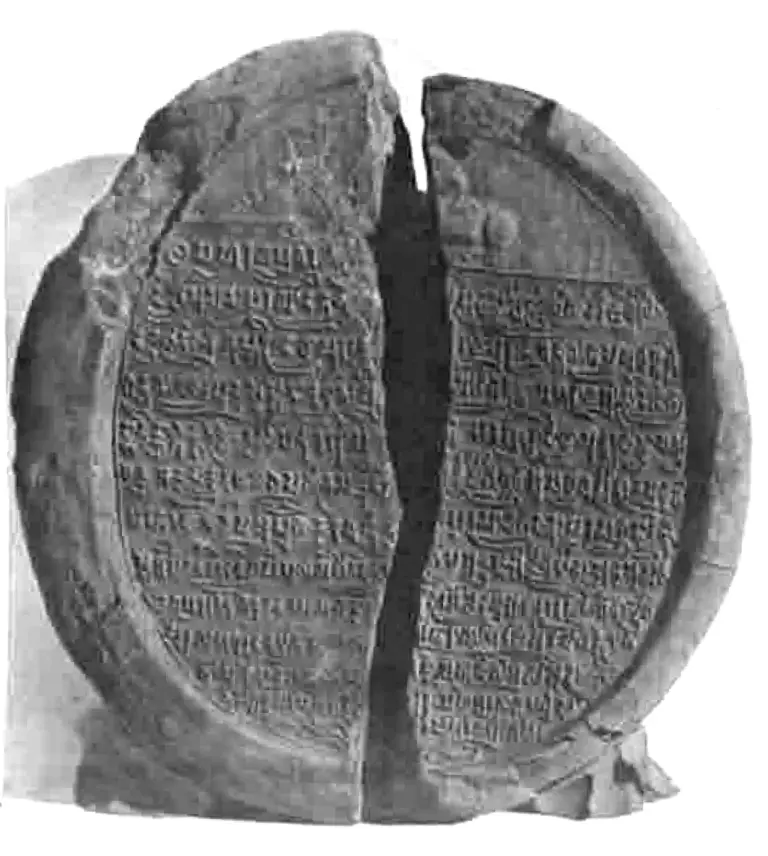
Hundreds of donative Brahmi inscriptions in Prakrit have been recovered from the Amaravati stupa. They name monks, nuns, merchants, royal women, guilds (sreni) and ordinary lay donors. The breadth of patronage is striking — and confirms that the stupa was a community project as much as a royal one.
Why the Amaravati Stupa Matters for UPSC
GS-I Art and Culture questions on the Amaravati stupa typically test:
- Patron dynasties (Satavahana and Ikshvaku).
- The white limestone medium and its compositional consequences.
- Aniconic-to-anthropomorphic transition.
- Walter Elliot and the dispersal of the marbles.
- Influence on Sri Lankan and Southeast Asian Buddhist art.
Prelims-level facts: located on the Krishna river in Guntur district; anda (dome), medhi (drum), vedika (railing), torana (gateway) terminology; British Museum and Chennai Government Museum collections.
Comparing Amaravati with Gandhara and Mathura
A clean compare-and-contrast is one of the most frequently asked GS-I questions:
- Material: Gandhara uses grey-blue schist; Mathura uses the spotted red sandstone of Sikri; Amaravati stupa uses the white Palnad limestone.
- Period: Gandhara — Kushan (1st–4th c. CE); Mathura — Kushan onwards; Amaravati — Satavahana–Ikshvaku (2nd c. BCE – 3rd c. CE).
- Influences: Gandhara absorbs Hellenistic and Roman models; Mathura is indigenous and continues Yaksha sculpture traditions; Amaravati is also indigenous but in dialogue with maritime Southeast Asia.
- Buddha figure: Gandhara — serene, classical, wavy hair, monastic himation; Mathura — robust, smiling, transparent drapery, indigenous turban; Amaravati — elongated, elegant, swaying, with the snail-shell curls and elongated earlobes that became the canonical Buddha image.
- Compositions: Gandhara — frieze panels, classical scene-construction; Mathura — single iconic figures dominant; Amaravati — densely populated narrative roundels and rectangular slabs.
The three schools developed in parallel from roughly the 1st century CE. By the Gupta period (4th–6th c. CE) their innovations were synthesised in the great Sarnath and Mathura Buddha images of classical India.
The Quiet Survival of a Crowded Style
The Mathura school gave us serenity. The Gandhara school gave us classical poise. The Amaravati stupa gave us movement — the rolling, jostling, narrative density that became the dominant grammar of Buddhist art in maritime Asia. Even today, walking through the Egmore galleries in Chennai, you can read the choreography of those crowds: hands raised, garments swirling, the Buddha sometimes present in human form and sometimes still suggested by a quiet, empty seat.
Frequently Asked Questions
Where is the Amaravati stupa located?
The Amaravati stupa is at Amaravati village (ancient Dharanikota) in Guntur district, Andhra Pradesh, on the south bank of the Krishna river in the lower delta.
Who built the Amaravati stupa?
The stupa was initiated in the Mauryan period and substantially enlarged under the Satavahana dynasty, with continued patronage by the later Ikshvakus of Vijayapuri.
What material was used in Amaravati sculpture?
A fine-grained white limestone — the u0022Palnad marbleu0022 — locally quarried. Its quality allowed the deep undercutting and high relief that defines the Amaravati school.
What is unique about the Amaravati school of sculpture?
Dynamic, densely populated compositions, elongated figures with exaggerated tribhanga poses, lavish detail in costume and jewellery, and a unique u0022stupa-on-stupau0022 iconography.
Who was Walter Elliot?
Sir Walter Elliot was the Commissioner of Guntur who excavated the Amaravati stupa in 1845. His excavations sent dozens of marble slabs to Madras and London, where they form major museum collections.
Where are the Amaravati marbles today?
Major collections are at the British Museum London, the Government Museum Chennai, the site museum at Amaravati, and the National Museum New Delhi.
Did Amaravati art influence Sri Lanka and Southeast Asia?
Yes. The Samadhi Buddha at Anuradhapura, early Mon and Dvaravati Buddhist art, and the narrative tradition of Borobudur all carry direct Amaravati influence.
How does Amaravati compare with Gandhara and Mathura?
Gandhara is Hellenistic-influenced and classical; Mathura is robust and indigenous with red sandstone; Amaravati is dynamic, slender and crowded, using white limestone. Aniconic-to-figural transition is best studied at Amaravati.
Tell Google you want more of this.
Add Anantam IAS as a preferred sourceOne tap, and this site shows up more often in your own Top Stories, AI Overviews and AI Mode. Remove it any time.