Satellite Internet in India: LEO, GEO and the Starlink Era (UPSC Science & Tech)
UPSC guide on satellite internet covering LEO vs GEO, Starlink, OneWeb, Project Kuiper, JioSpaceFiber, regulatory challenges and 2024-26 updates.
Satellite internet beams broadband signals directly from orbit to user terminals on the ground, bypassing fibre or mobile towers. With the Indian Space Policy 2023 and the Telecommunications Act 2023, India has opened the doors to players such as Starlink, Eutelsat OneWeb, Amazon Project Kuiper and JioSpaceFiber. For UPSC GS Paper III, satellite internet ties together space, telecommunications, digital inclusion and cybersecurity.
What Is Satellite Internet?
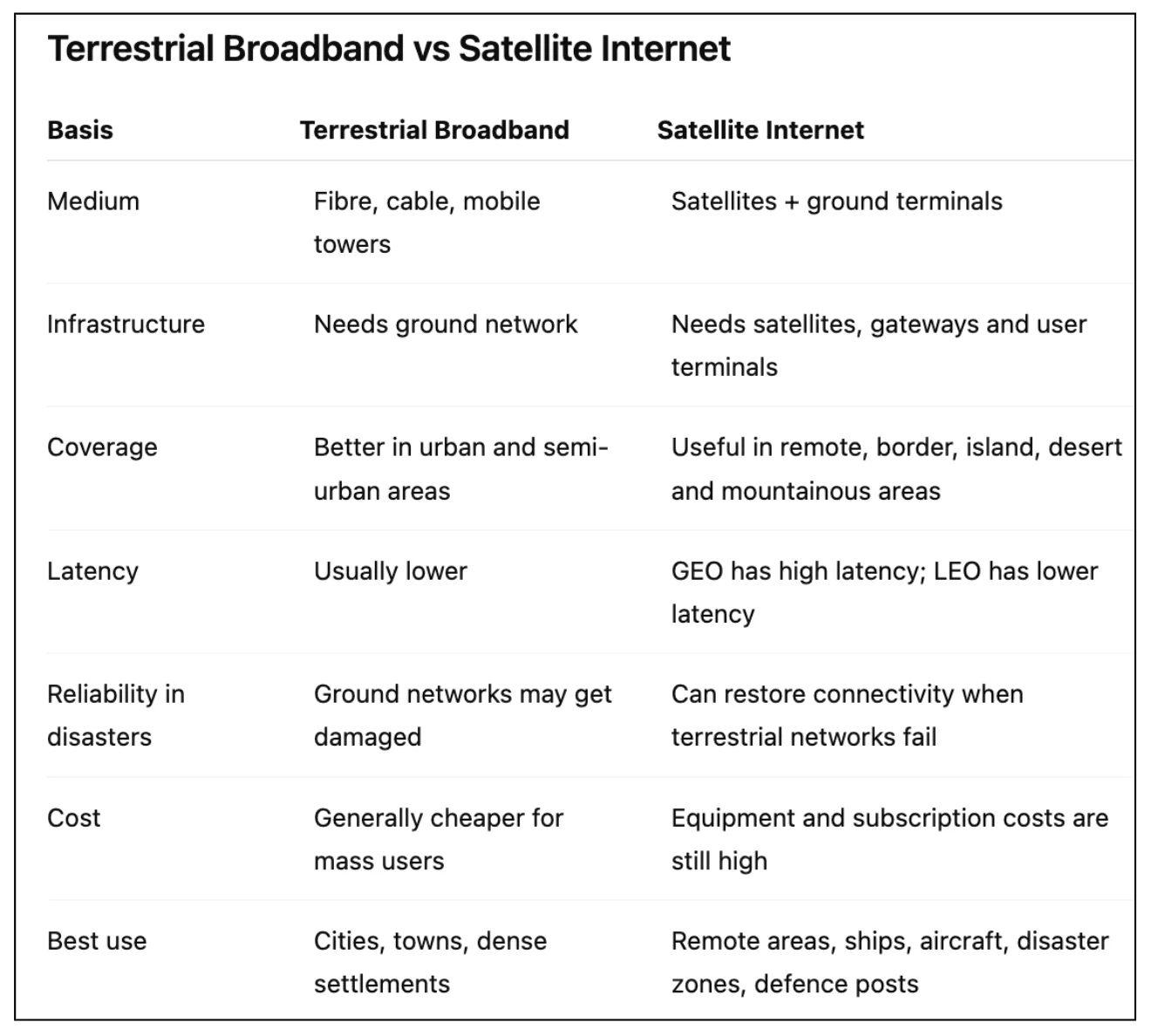
Satellite internet is wireless internet beamed from satellites — either Low Earth Orbit (LEO) or Geostationary (GEO) — to user terminals via small dishes or antennas. It promises connectivity across remote terrain (Himalayan valleys, Andaman islands, aspirational districts), disaster zones and moving platforms like ships and aircraft, where fibre and cell towers are infeasible.
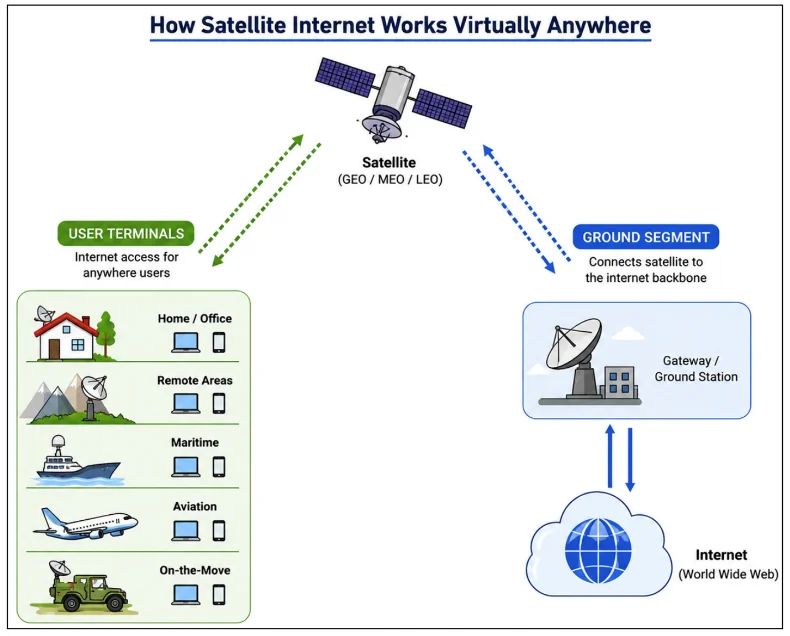
Internet from Low Earth Orbit Satellites
- Altitude: 500-2,000 km.
- Latency: 20-40 milliseconds — comparable to terrestrial broadband.
- Signal strength: Higher because of proximity.
- Speed: Competitive with fibre for typical use cases.
Constellation Economics
LEO satellites travel at around 27,000 km/h and orbit Earth every 90-120 minutes. Each satellite is in line-of-sight of a given user for only a few minutes. Continuous service requires massive constellations — Starlink operates over 6,000 LEO satellites (as of 2024), OneWeb over 600, with Kuiper targeting more than 3,200. This drives large capital expenditure and satellite internet remains the most expensive of the three broadband mediums (fibre, spectrum, satellite).
Internet from Geostationary Satellites
- Altitude: 35,786 km above the equator.
- Orbital speed: About 11,000 km/h; one revolution per Earth rotation, appearing stationary.
- Coverage: Three to four satellites can cover the entire Earth.
- Latency: Around 600 milliseconds — unsuitable for real-time applications.
- Easier connectivity because satellites appear stationary to dishes.
Key Initiatives and Players
- Starlink (SpaceX) — over 6,000 LEO satellites; global coverage expanding.
- Eutelsat OneWeb — partnered with Bharti in India; 600+ LEO satellites; "Five to 50" service providing connectivity above 50 degrees north latitude.
- Amazon Project Kuiper — 3,236 satellites planned; prototypes launched in 2023.
- JioSpaceFiber — Jio's partnership with Luxembourg-based SES, using Medium Earth Orbit satellites.
- Google Loon — high-altitude balloon project, discontinued in 2021.
- ISRO / NSIL initiatives — GSAT-series GEO satellites and a potential indigenous LEO constellation.
Indian Regulatory Framework
- Indian Space Policy 2023 permits foreign entities to set up infrastructure and offer satellite services after IN-SPACe clearance.
- Telecommunications Act 2023 mandates administrative allocation of satellite spectrum (rather than auction), a policy choice that favours satellite operators and has been debated intensely.
- TRAI recommendations (2024) on satellite spectrum pricing and sharing are being finalised.
- DoT licensing — operators require GMPCS (Global Mobile Personal Communication by Satellite) and other licenses.
Challenges Associated with Satellite Internet
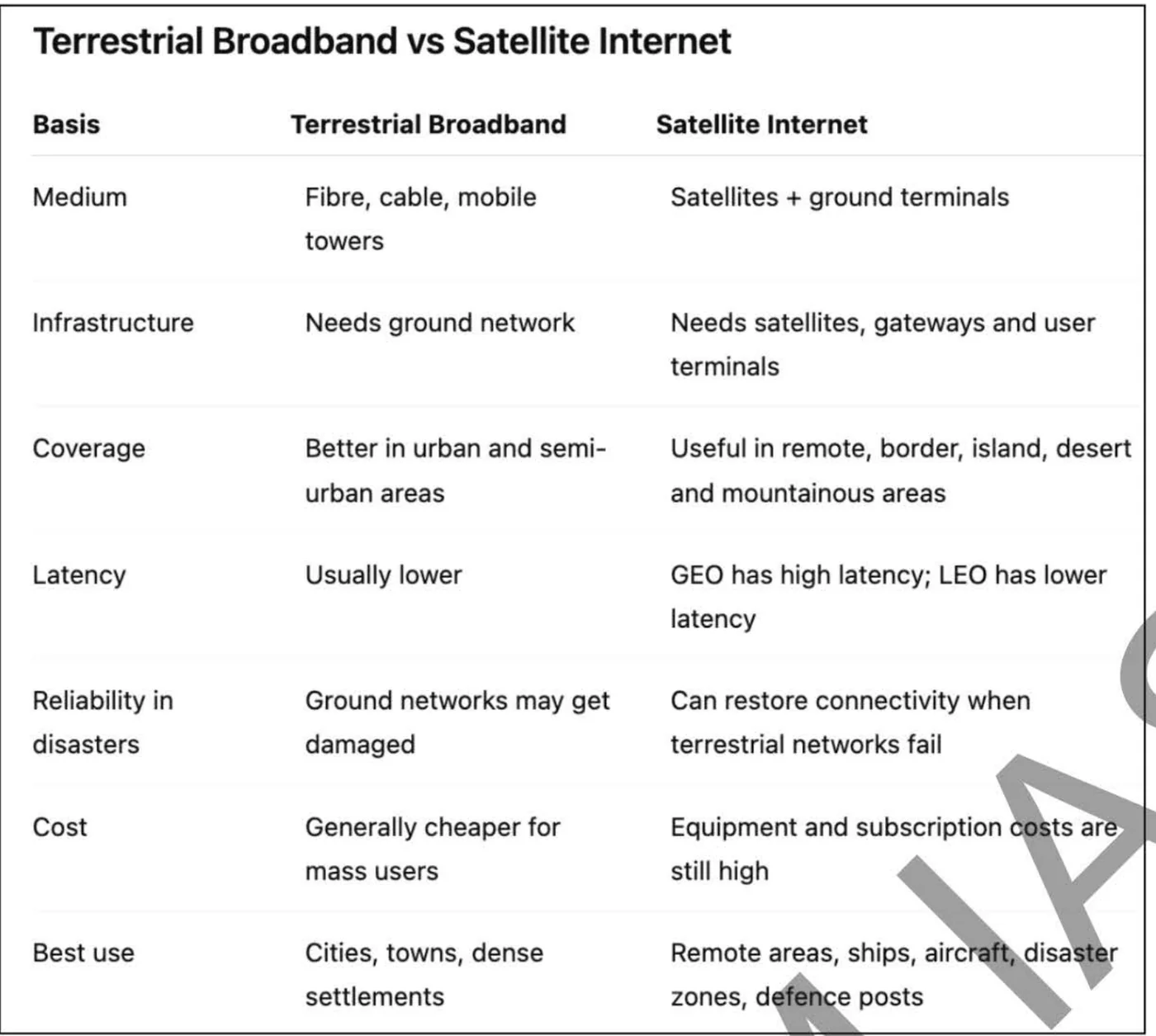
- Limited coverage in dense urban canyons or forested terrain without line-of-sight.
- Higher latency than terrestrial broadband; problematic for gaming and real-time applications over GEO links.
- Affordability — user terminals cost hundreds of dollars, beyond reach for mass rural users.
- Logistical challenges in launching mega-constellations.
- Astronomical interference — LEO satellites reflect sunlight, leaving trails across telescope images; also radio interference.
- Signal interruptions between overlapping orbital layers.
- Space junk — over 1 million objects larger than 1 cm in orbit; mega-constellations dramatically raise debris risk.
- Cybersecurity — satellites are vulnerable to jamming, spoofing and cyber-attacks.
- Regulation complexity — multi-national private operators challenge India's TRAI-centric regulatory model.
Ethical and Policy Concerns
- Digital sovereignty — foreign operators providing critical internet raise concerns about lawful interception, localisation and outage risk.
- Data privacy — routing through foreign gateways must comply with the DPDP Act.
- Equitable access — pricing is important so that satellite internet remains accessible to remote and marginalised users, not merely premium customers.
- Sustainability of orbit — the Kessler syndrome and the global commons of orbital space.
- Radio astronomy and dark skies — protecting science from mega-constellation pollution.
Applications and Importance for India
- Bridging the rural-urban digital divide in Himalayas, islands and Left-Wing Extremism-affected districts.
- Defence communications — resilient alternative to terrestrial networks.
- Disaster response — rapid reconnectivity after floods, cyclones and earthquakes.
- Maritime and aviation — in-flight and ship-borne internet.
- Backhaul for 5G in remote areas.
Latest Developments (2024-26)
- AI Action Summit, Paris (February 2025) — satellite internet discussed as enabler of AI services in remote regions.
- India Semiconductor Mission — creates capacity for ground terminal electronics manufacturing.
- Chandrayaan-4 and Gaganyaan — deep-space communications architecture being developed will share technologies with commercial satellite internet.
- National Quantum Mission — space-based QKD piggybacks on LEO constellation architectures.
- DPDP Act obligates satellite operators on consent, data fiduciary roles and cross-border transfer norms.
- Starlink, OneWeb, Jio-SES and Project Kuiper have received in-principle approvals from DoT/IN-SPACe; commercial services expected across 2025-26.
- Indian Space Association (ISpA) and industry have pushed for sandbox pilots in aspirational districts.
- BSNL satellite-to-mobile service with Viasat demonstrated in India in 2024.
UPSC Relevance
For Prelims, remember LEO vs GEO altitudes, the key constellations (Starlink, OneWeb, Kuiper, JioSpaceFiber), GMPCS licensing and the administrative allocation of satellite spectrum under the Telecommunications Act 2023. For GS III Mains, satellite internet ties into digital inclusion, national security, space governance and infrastructure. Ethics and essay questions can explore equity, sovereignty and sustainability of the orbital commons. Satellite internet is a living policy battleground — spectrum pricing and licensing norms continue to evolve.