
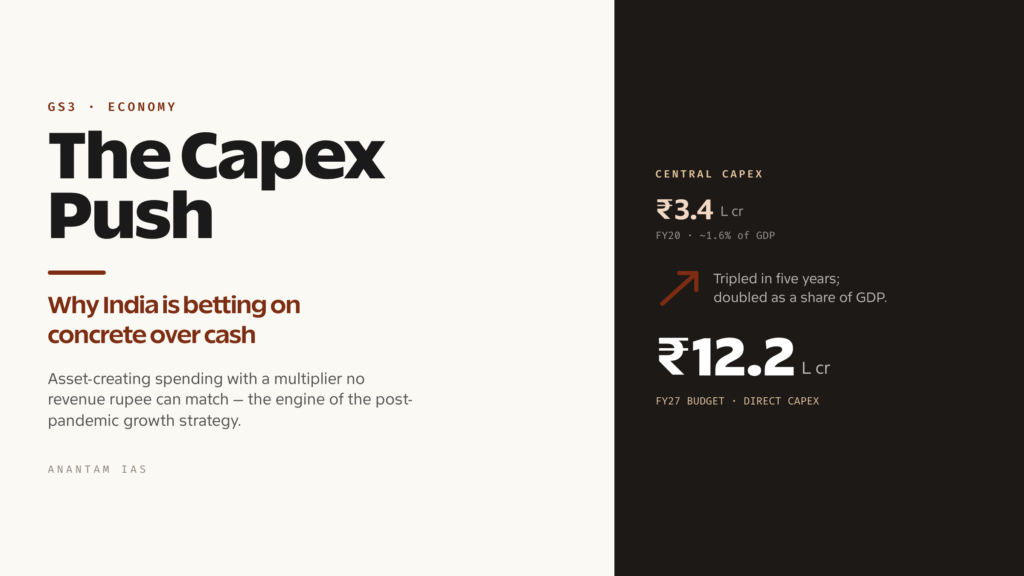
Picture two ways a government can spend a lakh crore rupees. It can hand the money out as wages, pensions, interest and subsidies — spending that keeps the lights on but leaves nothing standing once the year ends. Or it can pour the same money into concrete and steel: a new freight corridor, a port, a power line, a hospital that will still be working in 2050. Both are spending. Only one builds an asset. That single distinction — between revenue and capital expenditure — is the hinge on which India’s entire post-pandemic growth strategy turns.
Since the Covid shock, the Union government has bet, year after year, that the second kind of spending is the better engine. It has pushed central capital expenditure — capex — from roughly Rs 3.4 lakh crore in FY20 to over Rs 12 lakh crore in the latest Budget, one of the sharpest sustained increases in Indian fiscal history. For a GS Paper III aspirant, the capex story is where fiscal policy, growth theory, infrastructure strategy and macro-stability all meet — and it carries a live debate about whether public money can keep doing the heavy lifting that private investment was supposed to take over.
What Capital Expenditure Actually Is
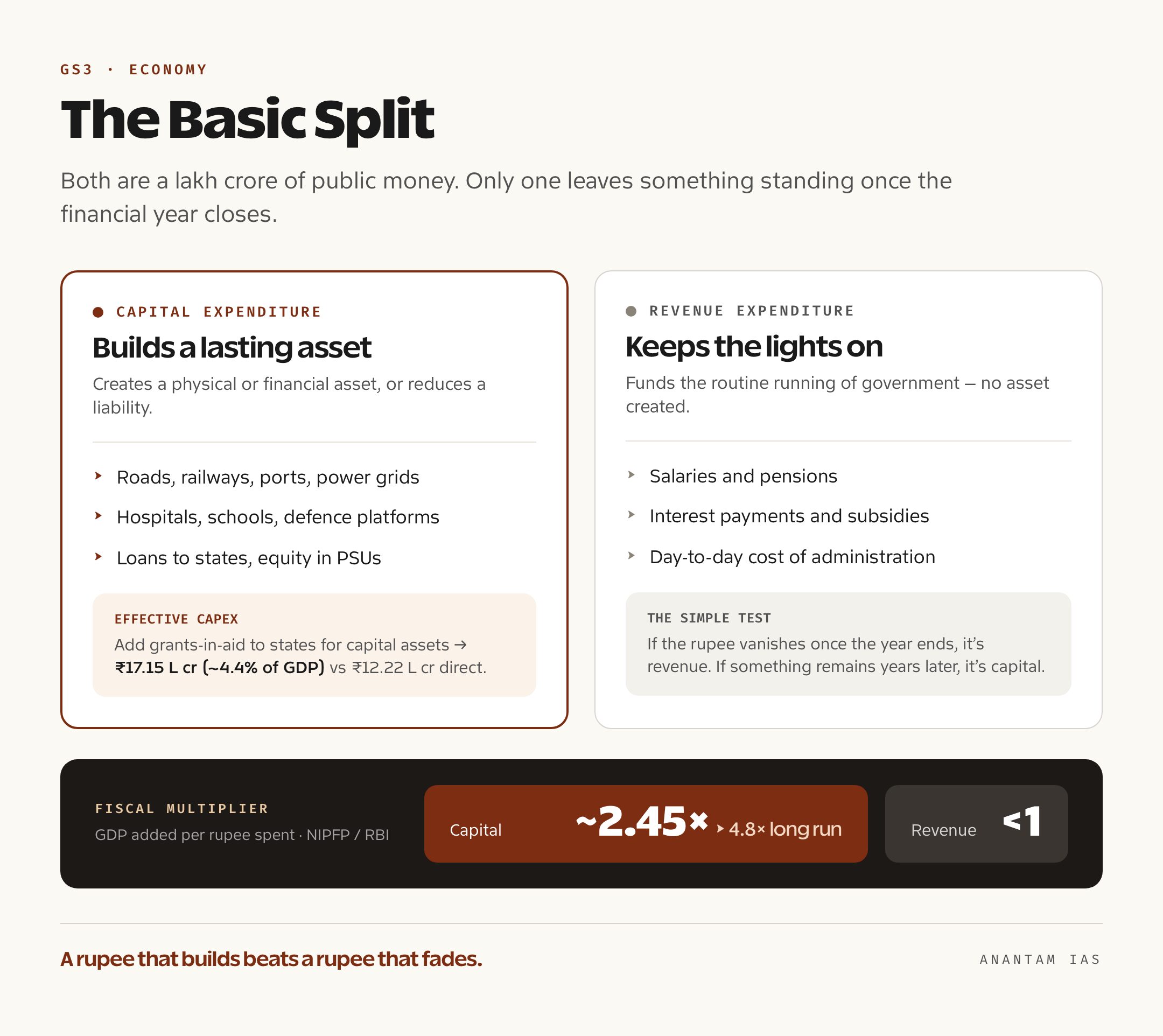
Let’s define it cleanly, because examiners reward candidates who keep the two apart. Capital expenditure is spending that either creates a lasting physical or financial asset or reduces a liability — building roads, railways, ports, power grids, schools, hospitals and defence platforms, plus loans the Centre gives to states and equity it puts into public enterprises. Revenue expenditure is spending on the routine running of government that creates no asset — salaries, pensions, interest payments, subsidies and the day-to-day cost of administration. The simplest test: if the rupee leaves behind something you could point to years later, it’s capital; if it vanishes once the financial year closes, it’s revenue.
There’s a refinement worth carrying into the exam hall, because the government itself leans on it. Not all asset-creating money shows up as the Centre’s own capex. When the Union government gives states grants specifically earmarked for building capital assets — under the head “grants-in-aid for creation of capital assets” — that money also builds roads and bridges, even though it sits in the revenue account on the Centre’s books. Add those grants to the Centre’s direct capital outlay and you get what the Budget calls “effective capital expenditure,” a wider and more honest measure of how much public money is actually going into asset creation. In the latest Budget, effective capex was pegged at about Rs 17.15 lakh crore — roughly 4.4% of GDP — against direct capex of Rs 12.22 lakh crore. Aspirants who can name both figures and explain the gap signal that they’ve read the Budget, not a coaching summary.
Why does the distinction matter so much for policy? Because the two kinds of spending behave completely differently in the economy. Revenue spending supports demand today and then it’s gone. Capital spending leaves behind a productive asset that keeps generating output, jobs and tax revenue for decades. So when a government wants growth that compounds rather than fades, it tilts the mix toward capex — and that tilt is exactly what India has been engineering since FY21.
The Capex Climb and the Multiplier Behind It
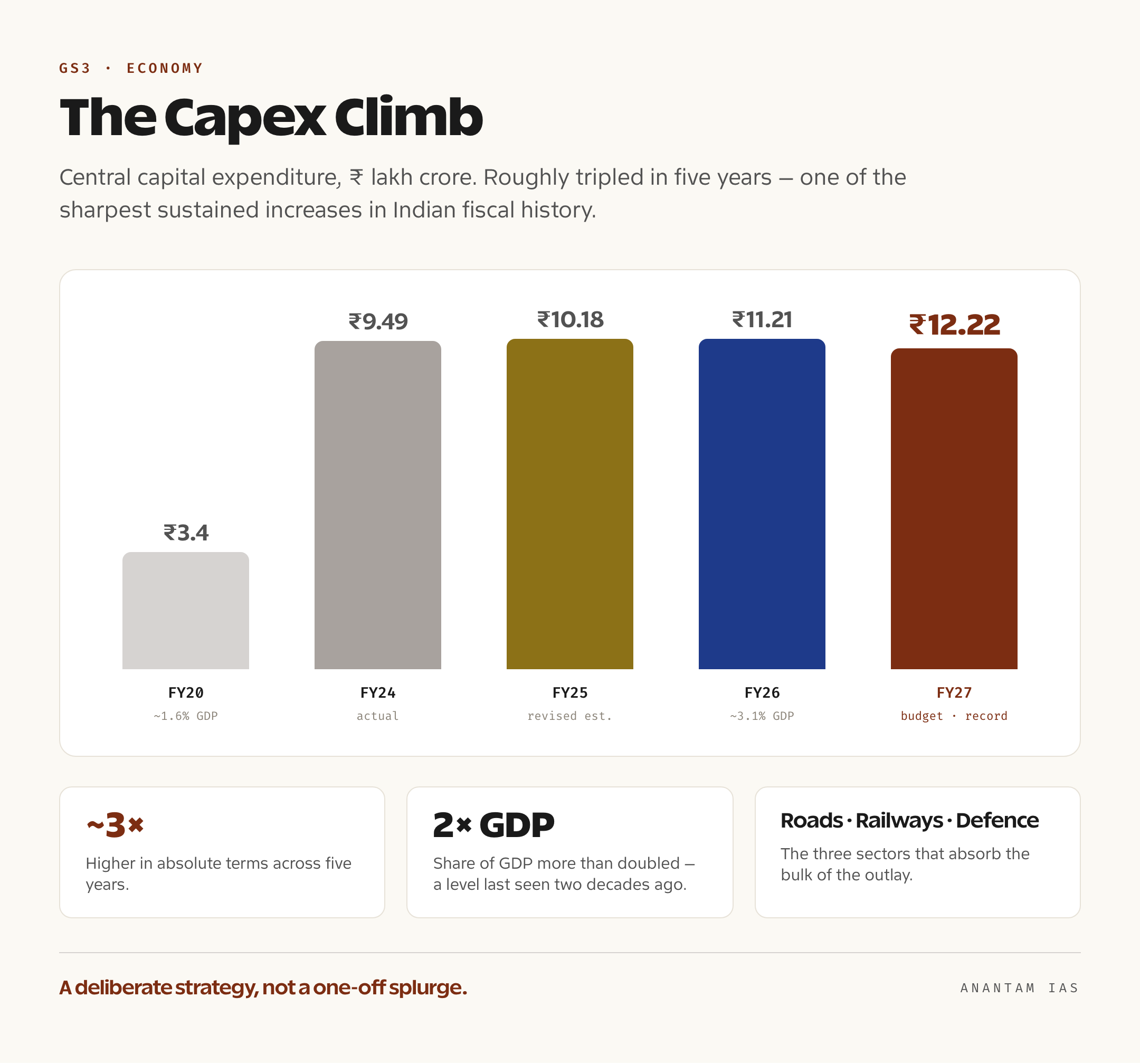
The numbers tell the story of a deliberate strategy, not a one-off splurge. Central capital expenditure was around Rs 3.4 lakh crore in FY20, near 1.6% of GDP. By FY24 the actual spend had risen to roughly Rs 9.49 lakh crore; the FY25 revised estimate came in around Rs 10.18 lakh crore; the FY26 Budget set it at a record Rs 11.21 lakh crore, about 3.1% of GDP; and the latest Union Budget, for FY27, has pushed direct capex to Rs 12.22 lakh crore. So capex has roughly tripled in five years and more than doubled as a share of GDP — a level last seen two decades ago. The growth was concentrated in roads, railways and defence, the three sectors that absorb the bulk of the central capital outlay.
But why bet so heavily on capex rather than on cash transfers or subsidies? The answer is the fiscal multiplier — how much extra GDP each rupee of spending eventually generates. And here the evidence is striking. A widely cited study by economists at the National Institute of Public Finance and Policy (NIPFP) found that capital expenditure carries a multiplier of about 2.45 in the short run, rising to roughly 4.8 over the longer term, while revenue expenditure returns less than one — closer to 0.98-0.99. In plain terms: a rupee spent on a road or a railway line can add Rs 2.45 to GDP fairly quickly and as much as Rs 4.8 over several years, whereas a rupee of routine revenue spend barely returns itself. The RBI has reached similar conclusions in its own work. That single gap — a multiplier above two against one below one — is the entire economic case for the capex push.
There are three further reasons the strategy makes sense. First, infrastructure is labour-intensive: building it creates direct jobs for semi-skilled workers and pulls in demand for cement, steel and logistics. Second, public assets reduce the cost of doing business and de-risk private projects, which is meant to “crowd in” corporate investment — the idea that a state-built highway makes a nearby private factory viable. Third, India simply has a vast infrastructure gap to close if it wants to hold a high growth path, and long-gestation assets like ports and grids are precisely the things private finance alone struggles to fund. The Economic Survey has repeatedly argued that durable growth needs an investment-led rather than a consumption-led model, and the Budget has internalised that view.
Pulling States and Private Capital In
The Centre cannot build the country alone, and it knows it. States together spend more on capital assets than the Union government does, so a national capex push has to drag state spending up with it. The main lever for that is the Scheme for Special Assistance to States for Capital Investment, or SASCI — launched in 2020-21 as a Covid-recovery measure and since made a permanent fixture. Under it, the Centre offers states 50-year interest-free loans earmarked strictly for capital projects: roads, bridges, irrigation, water supply, power, health and education. Crucially, the loans are interest-free and run for half a century, so they barely strain a state’s finances. Part of the allocation is unconditional; the rest is tied to reform milestones such as land-record digitisation, urban reforms or hitting the state’s own capex-growth targets. The FY26 Budget set the SASCI envelope at Rs 1.5 lakh crore, and disbursements through the year ran into tens of thousands of crores. It’s a clever piece of fiscal federalism — the Centre using cheap long-term credit to nudge states toward both investment and reform at once.
The harder question is the private sector, because the whole logic of “crowding in” rests on it. The plan was always that public capex would prime the pump and then private corporate investment would take over as the main driver. That handover has been slower and patchier than hoped. India’s first official Forward-Looking Survey on Private Sector Capex Investment Intentions, run by the National Statistical Office, found intended private capex jumping to about Rs 6.56 lakh crore in FY25 — a 55% rise on the previous year — which looked like the long-awaited turn. But the same survey showed firms planning to pull capex back to around Rs 4.89 lakh crore in FY26, a 25% drop in intentions. So private investment is recovering, but in fits and starts, held back by uncertain demand, global trade tensions and the caution of boards that remember idle capacity. Corporate balance sheets are healthy and bank credit is available; what’s missing is the confident, broad-based animal spirits that would let public capex finally step back.
This is the central tension of the whole strategy. Five years in, public money is still doing most of the lifting that private capital was supposed to assume. As long as that’s true, the government cannot ease off without risking a growth wobble — which means the “temporary” capex push has quietly become a semi-permanent feature of the Budget, with all the fiscal pressure that implies.
The Strains and Limits of a Capex-Led Model
A strong strategy is best judged by its weak points, so here they are without flinching. The first is absorptive capacity — the unglamorous reality that announcing capex is far easier than spending it well. Capital projects need land acquisition, environmental clearances, inter-departmental coordination and years of disciplined execution, and when something goes wrong, capex is usually the first item cut to protect routine spending. The problem is sharpest at the state level. By February of FY26, with barely a month of the year left, 22 states had collectively used only about 55% of their combined capital outlay of over Rs 10 lakh crore — meaning nearly half the year’s investment promise was at risk of going unspent. Performance varied wildly: states like Haryana, Himachal Pradesh and Bihar had spent most of their budgets, while West Bengal, Meghalaya and even large states like Uttar Pradesh and Maharashtra lagged well behind. Money allocated is not money built.
The second strain is quality of spend, not just quantity. A rupee of capex only delivers that 2.45 multiplier if it goes into a productive asset that actually gets used; a half-finished bridge or a road to nowhere returns very little. Analysts have begun pushing a “productive-capital-to-invested-capital” ratio to capture how much of a state’s accumulated investment is genuinely generating activity, and the spread across states is large — some convert investment into output far more efficiently than others. So the next frontier of the capex debate is shifting from “how much” to “how well.”
The third concern is the fiscal arithmetic. A capex push financed by heavy borrowing can, in theory, push up interest rates and crowd out the very private investment it’s trying to crowd in. India has managed this so far by walking a careful consolidation path: the fiscal deficit came down to about 4.8% of GDP in FY25 and to 4.4% in FY26, fulfilling the commitment to get below 4.5% — and policymakers have now shifted the long-term anchor from the deficit to the debt-to-GDP ratio, aiming to bring central government debt down toward 50% of GDP by around 2031. The bet is that fast-growing GDP, partly powered by capex itself, will shrink the debt ratio even as borrowing continues. And there’s a genuine welfare trade-off underneath all of this: every rupee channelled into a highway is a rupee not available for health, education or direct support to poorer households, whose living standards capex lifts only slowly and indirectly.
What Should Come Next
The capex push has been correctly prioritised — the multiplier evidence alone justifies it — but sustaining it now depends on fixing the parts that volume cannot. The first priority is execution: PM Gati Shakti’s integrated planning has to translate into faster clearances and fewer stalled projects, and states need handholding on project preparation so that SASCI loans actually convert into assets rather than unspent allocations. The second is engineering the handover to private capital — improving ease of doing business, deepening long-tenor infrastructure finance through institutions like the National Bank for Financing Infrastructure and Development, and using tools like asset monetisation to recycle capital into fresh projects without fresh borrowing. The third is protecting fiscal space on the revenue side: pruning inefficient subsidies and broadening the tax base so that capex doesn’t have to compete with welfare in a zero-sum way.
So the honest verdict is a two-handed one, which is exactly what a good answer should be. India’s capex push is sound economics and the right macro bet for a country with a yawning infrastructure gap. But its success from here hinges less on bigger headline numbers and more on three quieter things — spending the money well, getting private investment to finally take the baton, and holding the fiscal line while doing both. The volume battle has largely been won. The efficiency battle is the one that’s still on.
For Your Mains Answer
Capital expenditure maps squarely onto GS Paper III — “Government Budgeting,” “mobilization of resources,” “growth and development,” and “infrastructure.” It also touches GS Paper II on fiscal federalism, through the SASCI loans and the Centre-state capex relationship. The smart approach is to treat the capex push as a single thread that lets you weave together fiscal policy, the multiplier, infrastructure and the public-versus-private investment debate — and to show the examiner you can praise the strategy and critique its execution in the same answer.
How to Build the Answer
Open by defining capital versus revenue expenditure in one crisp sentence, then state the economic logic — the multiplier of about 2.45 against below one for revenue — because that gap is the whole case in miniature. Establish the scale with one or two anchor figures, pivot to how the Centre pulls in states (SASCI) and is meant to pull in private capital, and then turn critical: absorptive capacity, quality of spend, the fiscal trade-off. Close on the shift from volume to efficiency. That arc — definition, logic, scale, mechanisms, limits, way forward — fits almost any framing of the question.
Common Mistakes to Avoid
Don’t blur capital and revenue expenditure, or forget the “effective capex” refinement — both are easy marks. Don’t present the capex push as an unqualified success; the absorptive-capacity and private-investment problems are where the analysis lives. Don’t quote the multiplier without attributing it (NIPFP/RBI), and don’t claim private capex has “fully recovered” when the evidence shows it’s still patchy. And don’t ignore the welfare trade-off — acknowledging it signals balance.
A Compact Answer Spine
Capex = asset-creating spend, revenue = routine spend → effective capex adds grants for capital assets → strategy: tripled capex from ~Rs 3.4 lakh cr (FY20) to over Rs 12 lakh cr (latest Budget) → logic: multiplier ~2.45 (NIPFP/RBI) vs <1 for revenue, plus jobs, crowding-in, infra gap → mechanisms: SASCI 50-year interest-free loans to states; meant to crowd in private capex → problems: low absorptive capacity (states used ~55% of outlay), quality of spend, fiscal/welfare trade-off, tepid private investment → fiscal context: deficit down to 4.4%, debt-to-GDP now the anchor → way forward: execution, private handover, fiscal space → conclusion: volume battle won, efficiency battle on.
Diagram or Flowchart Idea
Draw a simple flow: a box marked “Public Capex (multiplier ~2.45)” feeding three arrows — “jobs + demand,” “lower business costs,” and “de-risked projects” — all pointing to a box labelled “Crowding-in of Private Investment,” which loops back as “sustained growth.” Mark the weak link with a dotted arrow on the private-investment box and label it “the handover that’s still stalling.” A diagram that shows both the mechanism and its weak point earns marks fast.
A Balanced-Conclusion Line
A serviceable closer: “India’s capex-led strategy rests on sound economics — a multiplier no revenue spending can match — but five years in, its real test has moved from how much the government spends to how well it spends and whether private capital will finally take the baton, so that public investment can step back without the growth story stumbling.”
How to Use Data Without Cramming
Carry just four numbers and deploy them precisely: the capex climb (about Rs 3.4 lakh crore in FY20 to over Rs 12 lakh crore in the latest Budget); the multiplier (around 2.45 short-run, attributed to NIPFP/RBI); the SASCI tenure (50-year interest-free loans); and the absorptive-capacity figure (states using only about 55% of their capital outlay). Attribute them in-prose and you’ll read as someone who has worked through the Budget, not memorised a sheet.
FAQ
What is the difference between capital and revenue expenditure? Capital expenditure creates a lasting asset or reduces a liability — building roads, railways, ports, hospitals, or giving loans to states. Revenue expenditure funds the routine running of government — salaries, pensions, interest and subsidies — and leaves no asset behind once the year ends. The Budget also reports “effective capital expenditure,” which adds the grants the Centre gives states specifically to build capital assets.
Why has the government pushed up capital expenditure so sharply? Because capital spending has a much larger multiplier effect on the economy. NIPFP and RBI research estimates that a rupee of capex generates around Rs 2.45 of GDP in the short run and as much as Rs 4.8 over the long run, while a rupee of revenue spending returns less than itself. Capex also creates jobs, helps close India’s infrastructure gap, and is meant to crowd in private investment.
What is the SASCI scheme? The Scheme for Special Assistance to States for Capital Investment offers states 50-year interest-free loans earmarked only for capital projects. Launched in 2020-21 and since made permanent, part of it is unconditional and part is tied to reforms. The FY26 Budget set its envelope at about Rs 1.5 lakh crore. It is the Centre’s main tool for raising state-level capex.
What are the main criticisms of the capex push? Three stand out. Absorptive capacity is weak — by early FY26, states had used only about 55% of their combined capital outlay, so much of the money goes unspent. Quality of spend matters as much as quantity, since only productive assets deliver the full multiplier. And there’s a fiscal and welfare trade-off, because money put into infrastructure isn’t available for health, education or direct support, while private investment — the intended successor to public capex — remains tepid.
Practice Questions
Prelims MCQs
- With reference to the Union Budget, which of the following is the correct description of “effective capital expenditure”?
(a) The Centre’s direct capital outlay alone
(b) The Centre’s direct capital outlay plus grants-in-aid to states for the creation of capital assets
(c) Total expenditure minus interest payments
(d) Capital expenditure adjusted for inflation
Answer: (b) — Effective capital expenditure adds the grants the Centre gives states specifically to build capital assets to its own direct capital outlay, giving a wider measure of public money going into asset creation. - Consider the following items of government spending:
1. Interest payments on public debt 2. Construction of a national highway 3. Loans given by the Centre to state governments 4. Payment of pensions.
Which of the above are classified as capital expenditure?
(a) 1 and 4 only
(b) 2 and 3 only
(c) 2, 3 and 4 only
(d) 1, 2 and 3 only
Answer: (b) — Highway construction creates an asset and loans to states are financial assets, so both are capital expenditure; interest payments and pensions are revenue expenditure. - The Scheme for Special Assistance to States for Capital Investment (SASCI) provides assistance to states primarily in which of the following forms?
(a) Outright grants with no repayment
(b) 50-year interest-free loans earmarked for capital projects
(c) Equity investment by the Centre in state public enterprises
(d) Tax-free bonds issued by states
Answer: (b) — Under SASCI the Centre offers states 50-year interest-free loans strictly for capital expenditure, with part unconditional and part tied to reforms. - As per NIPFP and RBI research, how do the fiscal multipliers of capital and revenue expenditure in India compare?
(a) Both are above 2
(b) Both are below 1
(c) Capital expenditure is around 2.45 while revenue expenditure is below 1
(d) Revenue expenditure is higher than capital expenditure
Answer: (c) — Capital expenditure carries a multiplier of roughly 2.45 in the short run, while revenue expenditure returns less than one, which is the core economic case for the capex push. - India has shifted its long-term fiscal anchor in recent Budgets from the fiscal deficit to which of the following?
(a) The revenue deficit
(b) The primary deficit
(c) The debt-to-GDP ratio
(d) The current account deficit
Answer: (c) — After bringing the fiscal deficit below 4.5% of GDP, the government has moved to anchoring fiscal policy on a declining debt-to-GDP ratio, targeting roughly 50% by around 2031.
Mains Practice Questions
- Distinguish between capital and revenue expenditure, and explain why the fiscal multiplier makes capital expenditure central to India’s recent growth strategy. (10 marks, 150 words)
- “India’s capex push has succeeded in raising allocations but struggles to raise outcomes.” Critically examine, with reference to absorptive capacity and quality of spending. (15 marks, 250 words)
- Discuss the role of the Scheme for Special Assistance to States for Capital Investment (SASCI) in promoting cooperative fiscal federalism. (10 marks, 150 words)
- The crowding-in of private investment was meant to allow public capital expenditure to step back. Evaluate why this handover has been slow, and what it implies for India’s fiscal strategy. (15 marks, 250 words)
- Examine how India can sustain its capital-expenditure push while remaining on a credible fiscal-consolidation path. What complementary reforms are needed? (15 marks, 250 words)
Tell Google you want more of this.
Add Anantam IAS as a preferred sourceOne tap, and this site shows up more often in your own Top Stories, AI Overviews and AI Mode. Remove it any time.