Section 3(d) of the Patents Act, 1970: India’s Anti-Evergreening Shield Explained
A complete UPSC GS-III explainer on Section 3(d) of the Indian Patents Act, 1970. Covers the anti-evergreening rationale, the Novartis-Glivec verdict, the legal text, what counts as a new form, judicial interpretation, comparative IP frameworks, and why Section 3(d) matters for affordable medicine in India.
A patent is a bargain. The state grants the inventor a monopoly for a fixed period, usually twenty years, in exchange for full disclosure of how the invention works. When the period ends, the knowledge enters the public domain and anyone can manufacture, improve, or build on it. The bargain is supposed to balance two things: the inventor’s incentive to invent, and society’s interest in cheap and widespread access. In pharmaceuticals, where an off-patent drug can fall to a tenth of its branded price within months, that balance is sharply visible.
The pharmaceutical industry has long understood the value of stretching the bargain. A company holding the patent on a profitable molecule can, in the year before expiry, file a new patent on a slightly modified form of the same drug, claim that the new form is a separate invention, and extend the monopoly by years or even decades. The technique is called evergreening, and India’s Patents Act of 1970, after its 2005 amendment, contains the world’s most prominent statutory shield against it. That shield is Section 3(d).
For UPSC purposes, Section 3(d) intersects intellectual property rights in India, the National IPR Policy, the TRIPS framework, compulsory licensing, and the broader story of India’s generic-pharmaceutical industry. It is one of the most cited and most contested provisions in modern Indian patent law. This article explains the text, the rationale, the case law, and the implications.
Quick Facts on Section 3(d)
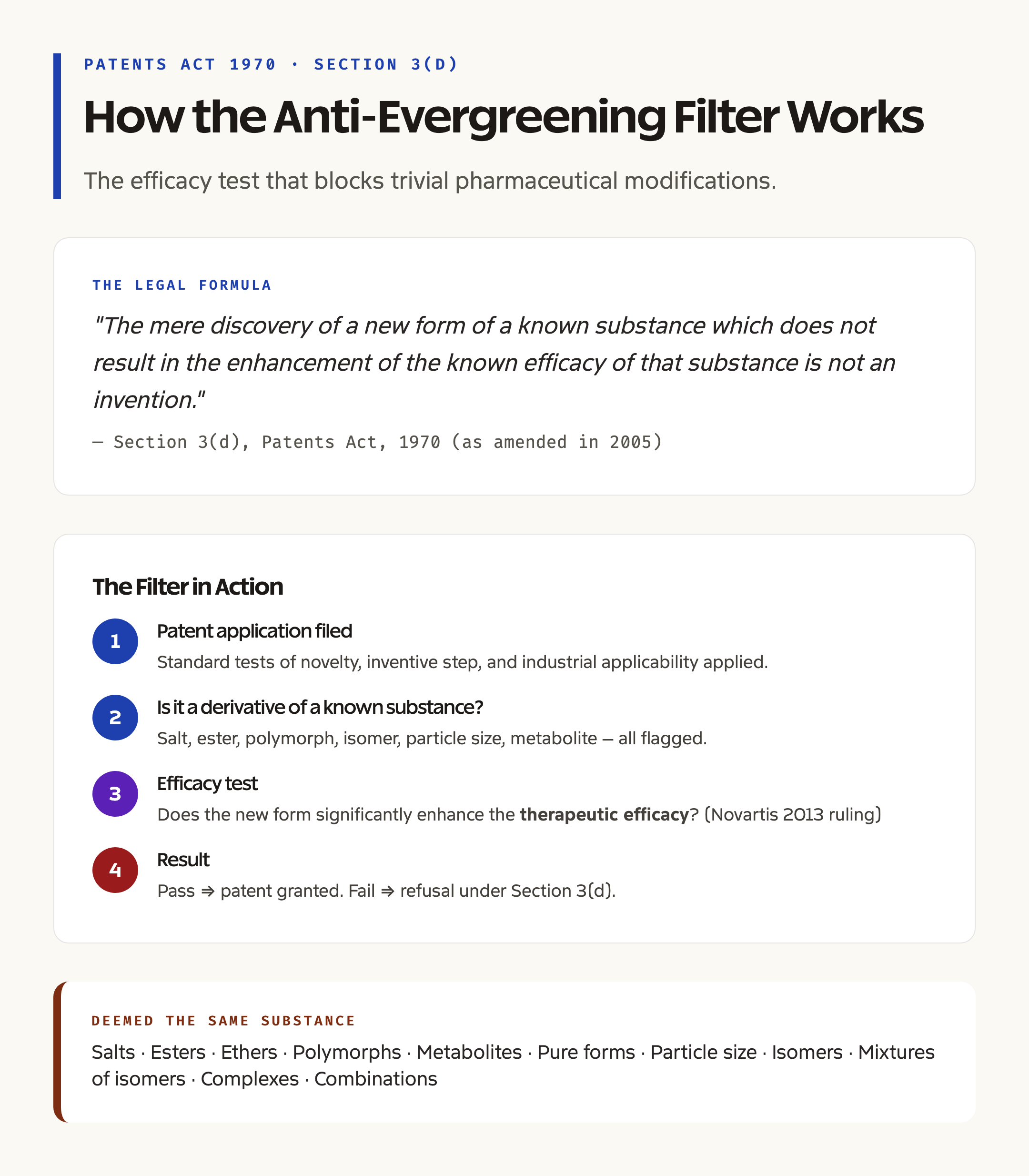
Section 3(d) of the Patents Act, 1970, sits within the chapter that lists what is not an invention and therefore not patentable. The section was introduced through the Patents (Amendment) Act, 2005, which brought India’s patent law into compliance with the World Trade Organization‘s TRIPS agreement by recognising product patents in pharmaceuticals for the first time.
The provision states that the mere discovery of a new form of a known substance, which does not result in the enhancement of the known efficacy of that substance, is not an invention. It also clarifies that the mere discovery of a new property or new use for a known substance, or the mere use of a known process, machine, or apparatus, is also not an invention unless that process results in a new product or employs at least one new reactant.
An explanation appended to the section lists the kinds of derivatives that are deemed to be the same substance unless they differ significantly in properties with regard to efficacy. The list includes salts, esters, ethers, polymorphs, metabolites, pure forms, particle size, isomers, mixtures of isomers, complexes, combinations, and other derivatives.
The clause is unique in international patent law for its explicit efficacy threshold. The 2013 Supreme Court ruling in Novartis AG vs Union of India, dealing with the cancer drug imatinib mesylate sold as Glivec, interpreted efficacy as therapeutic efficacy and held that increased bioavailability alone, without therapeutic benefit, does not meet the threshold.
What Section 3(d) Actually Does
The section operates as a filter. A pharmaceutical patent application reaches the Patent Office. The examiner runs the standard tests of novelty, inventive step, and industrial applicability. The application also has to pass Section 3(d). If the claimed invention is a derivative of a known substance, the applicant must show that the derivative’s efficacy has been significantly enhanced compared to the parent. If the applicant cannot demonstrate this, the patent is refused, regardless of how new or non-obvious the modification might be.
The point of the filter is not to ban incremental innovation. It is to direct innovation effort toward changes that actually improve patient outcomes. A genuinely better salt of an existing drug, with measurably better efficacy in the clinic, can still be patented. A salt that just happens to be more soluble in water, or a polymorph that crystallises more easily, cannot.
The provision is sometimes described as raising the patentability bar above the TRIPS minimum. TRIPS requires member countries to grant patents in all fields of technology if the invention is new, involves an inventive step, and is capable of industrial application. India has chosen to add an additional substantive test in pharmaceuticals. Whether this is TRIPS-compliant has been the subject of long debate, but the provision has not been formally challenged at the WTO and is accepted as within the policy space available to a developing country.
Background and Historical Context
India’s Patents Act of 1970 was a landmark piece of legislation. It abolished product patents in pharmaceuticals and food, granted only process patents in those fields, and capped the term of process patents at seven years. The result was a generic-pharmaceutical industry that could legally reverse-engineer and manufacture any drug invented anywhere in the world by developing a different process for the same molecule. Indian companies became the largest suppliers of cheap generics to the developing world, particularly for HIV antiretrovirals and tuberculosis drugs.
The TRIPS agreement of 1995 forced a change. As a WTO member, India had ten years to bring its patent law into compliance, including the recognition of product patents in pharmaceuticals. Parliament passed the Patents (Amendment) Act, 2005, which restored product patents and extended them to twenty years from the filing date.
Civil society, the generic industry, and public health groups raised an alarm. A straightforward reintroduction of product patents would, they argued, lock millions of patients out of essential medicines and let multinational pharmaceutical companies extend their monopolies indefinitely through evergreening. Section 3(d), in its 2005 form, was the legislative response. It was negotiated through the parliamentary process by then health and commerce ministries with input from technical experts and patient advocates.
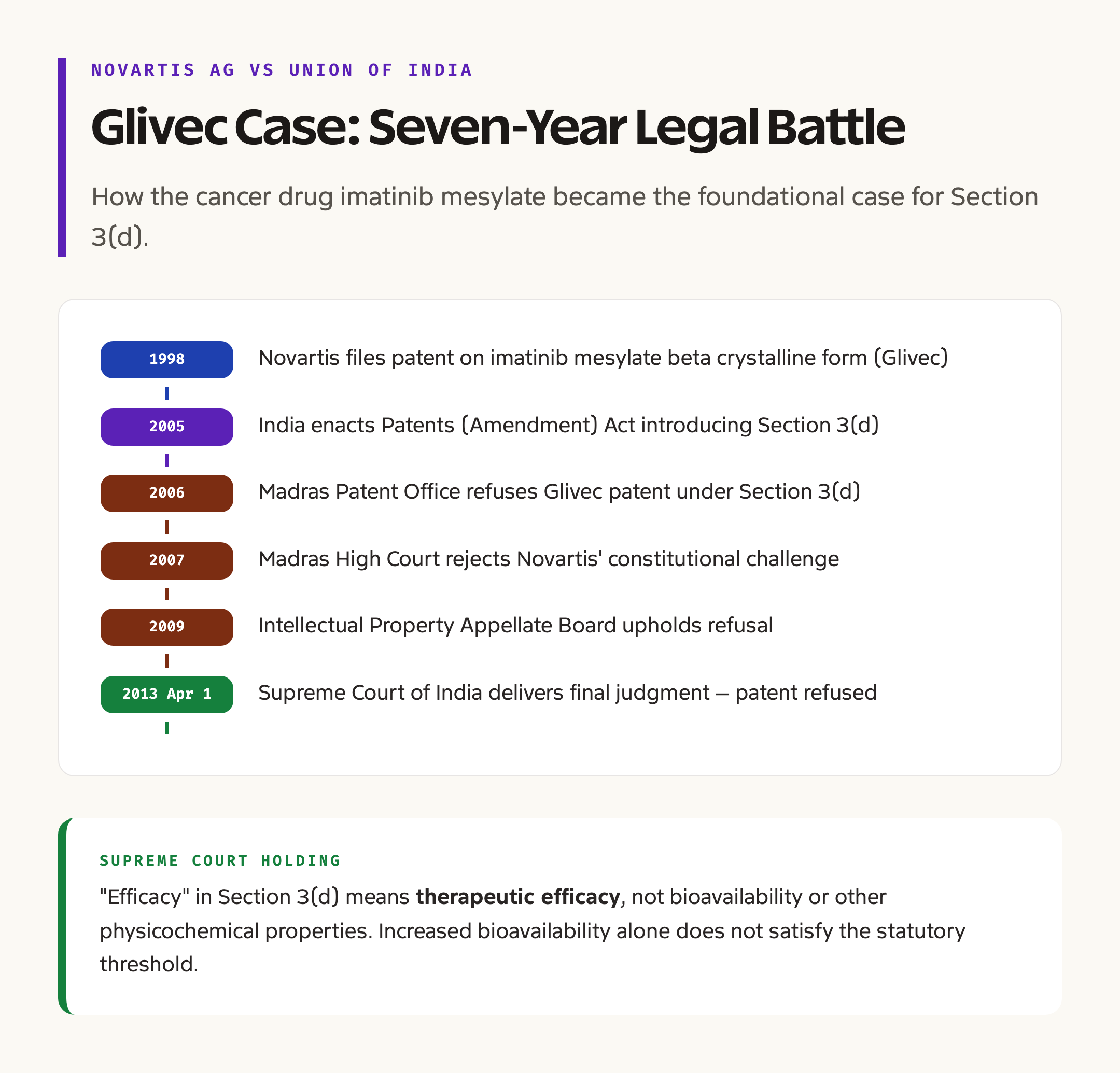
The first major test came almost immediately. Novartis, a Swiss pharmaceutical company, had filed a patent application for the beta crystalline form of imatinib mesylate, the active ingredient in Glivec, a leukaemia drug. The Madras Patent Office refused the application in 2006 on Section 3(d) grounds. Novartis challenged both the refusal and the constitutional validity of Section 3(d). After seven years of litigation, the Supreme Court of India delivered its 2013 ruling, upholding the section and refusing the patent.
Key Features of the Section
The wording is precise. The mere discovery of a new form of a known substance is not patentable unless it results in the enhancement of the known efficacy of that substance. Three elements stand out.
First, the substance must be known. If a molecule is already in the public domain or already covered by an earlier patent, any derivative of it falls under Section 3(d) scrutiny.
Second, the new form must enhance efficacy. The Novartis ruling clarified that efficacy here means therapeutic efficacy, not other properties such as solubility, stability, or bioavailability, unless those translate clearly into therapeutic benefit.
Third, the explanation lists the suspect derivatives by name. The list is not exhaustive but it captures the standard repertoire of patent extensions. A salt is a chemical pairing of an acid and a base. An ester is a derivative formed from the reaction of an acid and an alcohol. A polymorph is a different crystalline form of the same molecule. A metabolite is a downstream product of the body’s processing of the original drug. The legislative intent was clear. Each of these is presumptively the same substance unless the applicant proves a real efficacy difference.
The provision is also retrospective in effect. Patents granted in other jurisdictions before 2005 cannot simply be filed in India. The mailbox applications submitted in India between 1995 and 2005, awaiting the introduction of product patents, were all subjected to the Section 3(d) filter when they were taken up after the amendment.
Why Section 3(d) Matters
The most direct effect is on access to medicines. Without Section 3(d), most major branded pharmaceuticals would have been able to extend their monopolies through trivial modifications, keeping prices high and limiting the entry of generic competitors. With Section 3(d), generic manufacturers can begin work on a drug as soon as the original product patent expires, without facing a second wave of patents on the same molecule.
The downstream effect on the developing world is significant. India is the largest supplier of generic medicines to low and middle-income countries, particularly for HIV, hepatitis C, tuberculosis, and increasingly for cancer therapy. The Indian generic industry’s ability to manufacture and export depends on the absence of evergreened patents that would otherwise create infringement risk in destination countries that import Indian generics.
A second-order effect is on innovation strategy. Multinational pharmaceutical companies operating in India must direct their patent claims toward genuinely new molecules and toward derivatives that they can demonstrate are therapeutically better. The bar is higher than in jurisdictions like the United States, where any non-obvious chemical modification can be patented even if the therapeutic benefit is marginal.
Section 3(d) also sits within India’s wider IP architecture. It complements the compulsory licensing regime, which allows the Patent Office to authorise generic production of a patented drug when public-interest conditions are met. It works with the parallel-import provisions, the patent-opposition system that permits pre-grant and post-grant challenges, and the pricing controls under the National Pharmaceutical Pricing Authority.
Detailed Analysis: The Novartis Glivec Case
The Novartis case is the foundational interpretation of Section 3(d). Novartis had filed a patent application in India for imatinib mesylate beta crystalline form, claiming that the new form had thirty per cent better bioavailability than the freebase imatinib that had been disclosed in earlier patents and publications. The Madras Patent Office refused the application. The pre-grant opposition was led by the Cancer Patients Aid Association and several Indian generic manufacturers, including Cipla, Ranbaxy, Hetero, and Natco.
Novartis appealed to the Intellectual Property Appellate Board, which upheld the refusal but on different grounds. Novartis then approached the Madras High Court, challenging Section 3(d) itself as unconstitutional and as inconsistent with TRIPS. The High Court rejected the constitutional challenge in 2007. The TRIPS-compliance issue was held to be outside the High Court’s domain.
The substantive challenge moved to the Supreme Court. After extensive arguments, the court delivered its judgment on 1 April 2013. It made several findings. The beta crystalline form was a new form of a known substance, the freebase imatinib. Increased bioavailability did not, by itself, demonstrate enhancement of therapeutic efficacy. The applicant had not produced clinical data showing that the new form treated leukaemia significantly better than the parent. The patent was therefore refused under Section 3(d).
The judgment defined therapeutic efficacy narrowly. It rejected the claim that any improved physical or chemical property qualifies as enhanced efficacy. It read the explanation listing salts, polymorphs, and other derivatives as a substantive policy choice by Parliament, not a drafting accident. The ruling has been cited in dozens of subsequent Indian decisions and has shaped how applicants frame their applications in pharmaceuticals.
Comparative View: India vs Other Jurisdictions
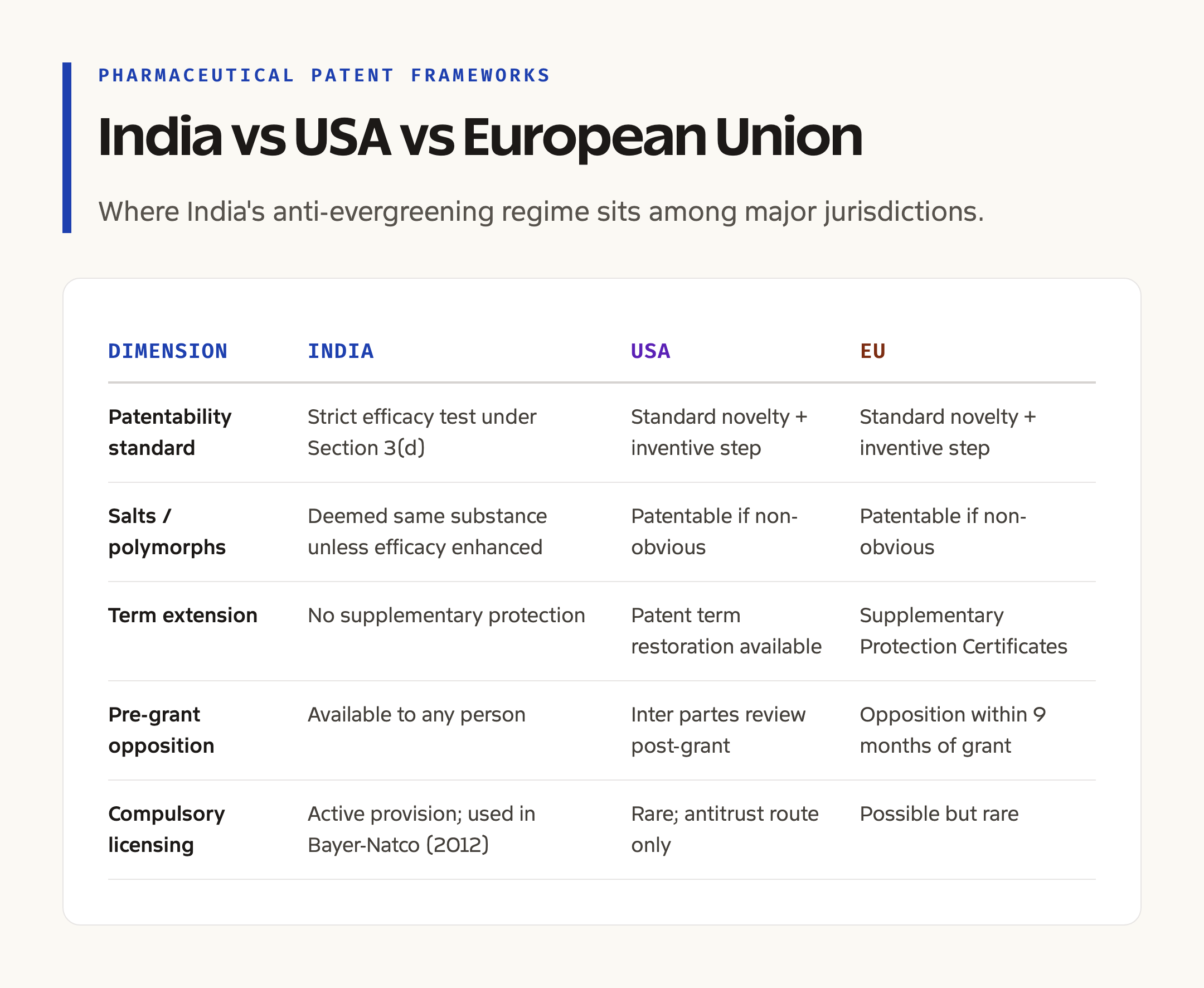
The United States operates the most permissive pharmaceutical patent regime among major economies. Any non-obvious chemical modification can be patented, including salts, polymorphs, and minor structural variants. The patent term can be extended through patent-term restoration to compensate for regulatory delay, and additional exclusivity flows from data exclusivity and orphan-drug provisions.
The European Union has tighter rules through the European Patent Office. The EPO requires inventive step in chemical patents, which has restricted some kinds of polymorph claims. Supplementary protection certificates can extend pharmaceutical exclusivity beyond the basic patent term, but the underlying patentability standard is broadly similar to the US.
Brazil and Argentina have followed India’s example on selected provisions. Brazil’s National Industrial Property Institute applies a strict examination of inventive step in pharmaceuticals, and Argentina’s patent guidelines explicitly disfavour polymorph and salt claims. South Africa’s draft IP policy of 2018 cited Section 3(d) as a model.
China and Japan grant pharmaceutical patents on a standard inventive-step test, with no equivalent of Section 3(d). Their generic industries are still developing, and they have yet to adopt an explicit anti-evergreening provision.
The result is that India’s framework is one of the toughest in the world on pharmaceutical evergreening, but it is not isolated. A growing group of developing countries has begun to study and selectively adopt similar provisions.
Challenges and Criticisms
Pharmaceutical companies argue that Section 3(d) discourages investment in incremental innovation in India. The argument is that many genuine improvements in drug delivery, formulation, and patient compliance are incremental in nature, and that a strict efficacy threshold ignores the value of such improvements.
Trade negotiators in some countries have flagged Section 3(d) as a non-tariff barrier and have asked India to soften it in bilateral free-trade agreements. India has so far resisted, citing public health and access objectives.
Within India, examination quality is uneven. The Patent Office has expanded but still faces backlogs, and applicants sometimes complain of inconsistent treatment of the efficacy test across different jurisdictions and examiners. Strengthening examiner training and producing detailed examination guidelines specifically for Section 3(d) is an ongoing administrative task.
Generic manufacturers have raised a different concern. Even when Section 3(d) refuses a primary patent, secondary patents on processes, formulations, or combinations can still be granted. The 2014 Patent Office Guidelines on the examination of pharmaceutical patent applications addressed some of these issues but did not eliminate them.
Prelims Pointers
Section 3(d) was inserted by the Patents (Amendment) Act, 2005, not 1970. The mere discovery of a new form of a known substance is not patentable unless it results in the enhancement of the known efficacy. Efficacy was interpreted in the Novartis ruling as therapeutic efficacy, not bioavailability or solubility. The explanation lists salts, esters, ethers, polymorphs, metabolites, pure forms, particle size, isomers, mixtures of isomers, complexes, and combinations as deemed the same substance unless proven otherwise. The Novartis vs Union of India judgment was delivered by the Supreme Court on 1 April 2013. The drug at issue was Glivec, generic name imatinib mesylate, used to treat chronic myeloid leukaemia. The 2005 amendment was driven by India’s TRIPS obligations under the WTO. Section 3(d) does not ban incremental innovation; it bans incremental innovation without significant enhancement of therapeutic efficacy.
Mains Practice Questions
- Section 3(d) of the Patents Act, 1970, has been called India’s anti-evergreening shield. Examine the rationale, the legal mechanism, and the impact of this provision on access to medicines in the developing world. (250 words)
- The 2013 Supreme Court ruling in Novartis vs Union of India has shaped India’s pharmaceutical patent regime. Discuss the key holdings of the case and their implications for the balance between intellectual property protection and public health. (250 words)
- India’s pharmaceutical patent framework, including Section 3(d), compulsory licensing, and pre-grant opposition, is among the most distinctive in the world. Critically assess this framework and suggest reforms. (250 words)
Way Forward
Section 3(d) has held up well under more than two decades of pressure. It has survived a Supreme Court challenge, multiple bilateral trade negotiations, and continuous lobbying by global pharmaceutical companies. The provision should be retained in its current form, with administrative improvements rather than statutory amendments.
Strengthening examination is the immediate task. The Patent Office should publish detailed and regularly updated examination guidelines for Section 3(d), train examiners on the evolving body of case law, and improve consistency across the Mumbai, Delhi, Kolkata, and Chennai branches. Public access to examination decisions, including reasoned refusals, would also help applicants and opponents calibrate their strategies.
Aligning Section 3(d) with the wider National IPR Policy is the second step. The policy framework should treat Section 3(d) not as an exception to be defended but as a template for how a developing country can shape its IP regime to balance innovation incentives with public access.
Finally, the provision should be paired with continuing investment in domestic pharmaceutical research and manufacturing. Section 3(d) creates the policy space for a strong generic industry. Whether that industry moves up the value chain into novel-molecule research depends on funding, talent, and regulatory infrastructure, all of which sit outside the patent law itself.
Frequently Asked Questions
What does Section 3(d) of the Indian Patents Act do?
Section 3(d) declares that the mere discovery of a new form of a known substance is not a patentable invention unless that new form results in the enhancement of the known efficacy of the substance. It is the most prominent statutory anti-evergreening provision in any major patent system.
When was Section 3(d) introduced?
Section 3(d) in its current form was inserted into the Patents Act, 1970, through the Patents (Amendment) Act, 2005, which also reintroduced product patents in pharmaceuticals to comply with the WTO TRIPS agreement.
What is evergreening?
Evergreening is the practice of extending the effective life of a pharmaceutical patent by filing new patents on minor modifications, such as a different salt, polymorph, or particle size, of an existing drug. The new patents extend the monopoly beyond the original twenty-year term and delay the entry of generic competitors.
What was the Novartis Glivec case?
The Novartis Glivec case is the leading Indian Supreme Court ruling on Section 3(d). Novartis had sought a patent on the beta crystalline form of imatinib mesylate, the cancer drug Glivec. The Supreme Court refused the patent in April 2013, holding that the new form did not show enhanced therapeutic efficacy over the parent compound.
Does Section 3(d) ban all pharmaceutical incremental innovation?
No. The section does not ban incremental innovation. It allows it if the applicant can demonstrate that the new form significantly enhances therapeutic efficacy. It only excludes trivial modifications that do not improve patient outcomes.
Is Section 3(d) compatible with TRIPS?
Section 3(d) has not been formally challenged at the WTO. India argues that the provision falls within the policy space TRIPS gives to member states to define inventive step and patentable subject matter in line with public-interest considerations. Most legal scholarship treats the provision as TRIPS-compatible.
What are salts, polymorphs, and isomers in this context?
Salts are chemical pairings of an acid and a base, often used to improve a drug’s solubility. Polymorphs are different crystalline forms of the same molecule. Isomers are molecules with the same atomic composition but different spatial arrangements. Section 3(d) deems each of these to be the same substance as the parent unless the applicant shows enhanced efficacy.
Who can challenge a pharmaceutical patent in India?
Any interested party, including patient groups, public-health organisations, and competing generic manufacturers, can file pre-grant opposition under Section 25(1) and post-grant opposition under Section 25(2) of the Patents Act. The Cancer Patients Aid Association and several generic manufacturers were active opponents in the Novartis case.
How does Section 3(d) affect drug prices?
By preventing trivial extensions of pharmaceutical patents, Section 3(d) allows generic manufacturers to enter the market once the original patent expires. This typically reduces prices by seventy to ninety per cent, and the savings flow to patients in India and to importing countries that rely on Indian generics.
Has any country adopted a similar provision?
Brazil, Argentina, and Philippines have adopted variations of an enhanced efficacy or strict inventive-step requirement in pharmaceuticals. South Africa’s 2018 draft IP policy explicitly cited Section 3(d) as a model. The provision is increasingly studied as an example of how developing countries can shape their IP frameworks within the TRIPS space.