Sectors of the Indian Economy Notes — Class 10 NCERT Revision (UPSC Economy)
These sectors of the indian economy class 10 notes are built for revision — not first reading.
The Indian economy is divided into three sectors by economic activity — the primary sector (agriculture, mining, forestry, fishing), the secondary sector (manufacturing, construction, utilities) and the tertiary or services sector. Class 10 NCERT (Chapter 2) also classifies it by conditions of work (organised vs unorganised) and by ownership (public vs private).
These sectors of the indian economy class 10 notes are built for revision — not first reading. If you’ve already gone through NCERT Class 10 Chapter 2 (Economics, Sectors of the Indian Economy) and want a fast, point-format consolidation with FY 2024-25 numbers, you’re in the right place. The 2026 examiners are testing primary-secondary-tertiary share with the latest data — older notes citing 2018-19 numbers will cost you marks. This is the revision-grade version. Six minutes. Skim, mark, move on.
What are the sectors of the Indian economy?
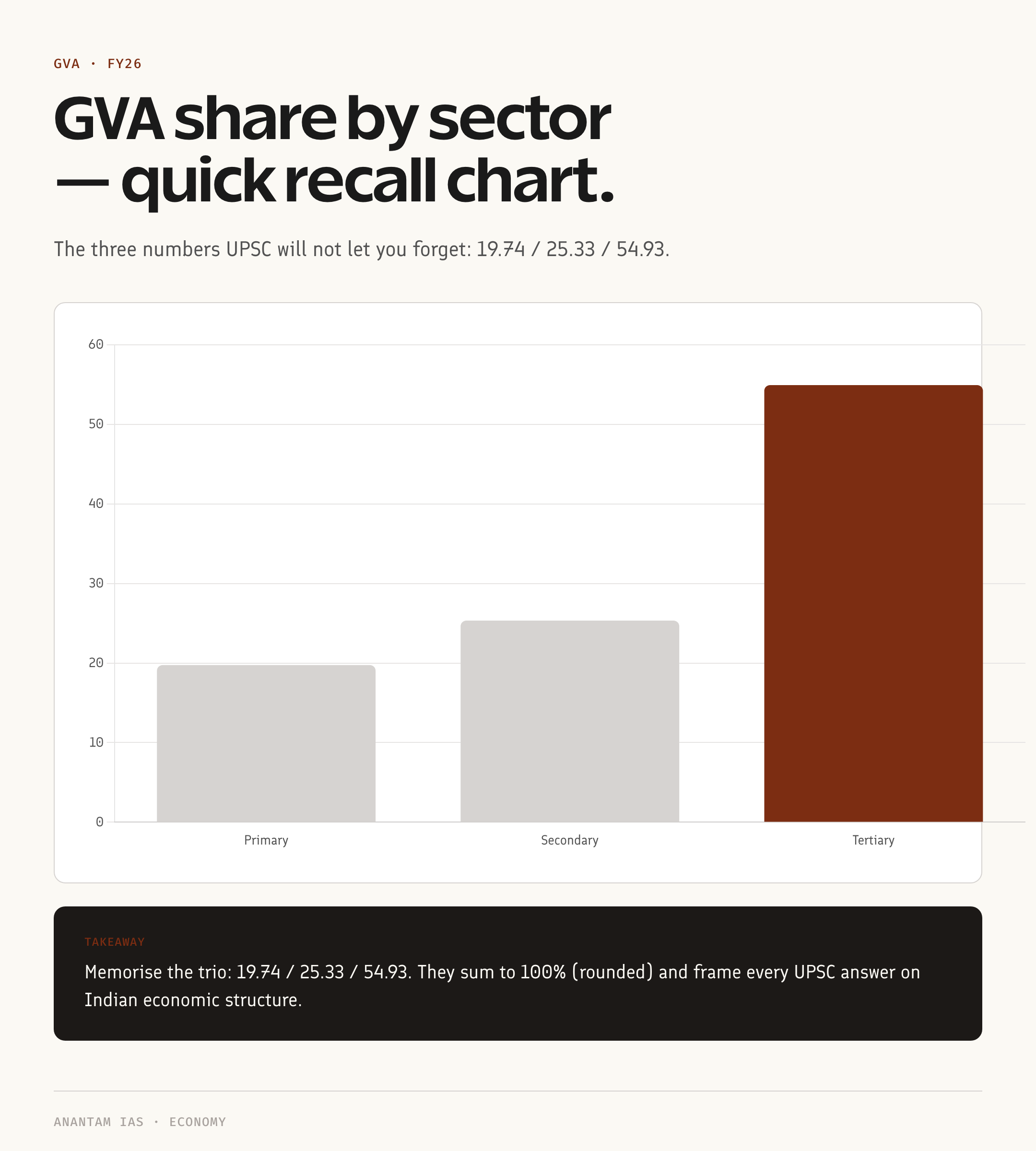
The Indian economy has three main sectors classified by activity — Primary (agriculture, mining, fishing, forestry), Secondary (manufacturing, construction, utilities), and Tertiary (services like banking, IT, education, transport). The tertiary sector contributes 54.93% of GVA, secondary 25.33%, and primary 19.74% in FY 2024-25 (MoSPI provisional estimates).
- Primary sector — extracts raw materials from nature
- Secondary sector — converts raw materials into finished goods
- Tertiary sector — provides services, no physical production
- Quaternary sector — knowledge-based (IT, R&D, education) — sometimes carved out of tertiary
- Quinary sector — top-level decision-making (government, top management) — rarely tested in Class 10

NCERT Class 10 Chapter 2 — concept map at a glance
Class 10 NCERT Sectors of the Indian Economy covers six classifications. Aspirants confuse them. Here’s the full map.
By nature of activity:
- Primary sector — agriculture, dairy, fishing, mining, forestry
- Secondary sector — manufacturing, electricity, gas, water, construction
- Tertiary sector — trade, transport, banking, communication, education, health
By conditions of work:
- Organised sector — registered, regulated, formal contracts, social security
- Unorganised sector — unregistered, informal, no social security, ~85% of India’s workforce
By ownership:
- Public sector — government-owned (Indian Railways, ONGC, BHEL)
- Private sector — owned by individuals/companies (Reliance, TCS, Infosys)
The Class 10 syllabus tests all three classifications. Don’t memorise just one.
Primary sector — quick notes
Definition: Activities that produce goods by exploiting natural resources directly.
Examples:
- Agriculture — wheat, rice, pulses cultivation
- Animal husbandry — dairy, poultry, livestock
- Fishing — marine and inland
- Forestry — timber, non-timber forest produce
- Mining and quarrying — coal, iron ore, bauxite
Data (FY 2024-25):
- GVA share: 19.74%
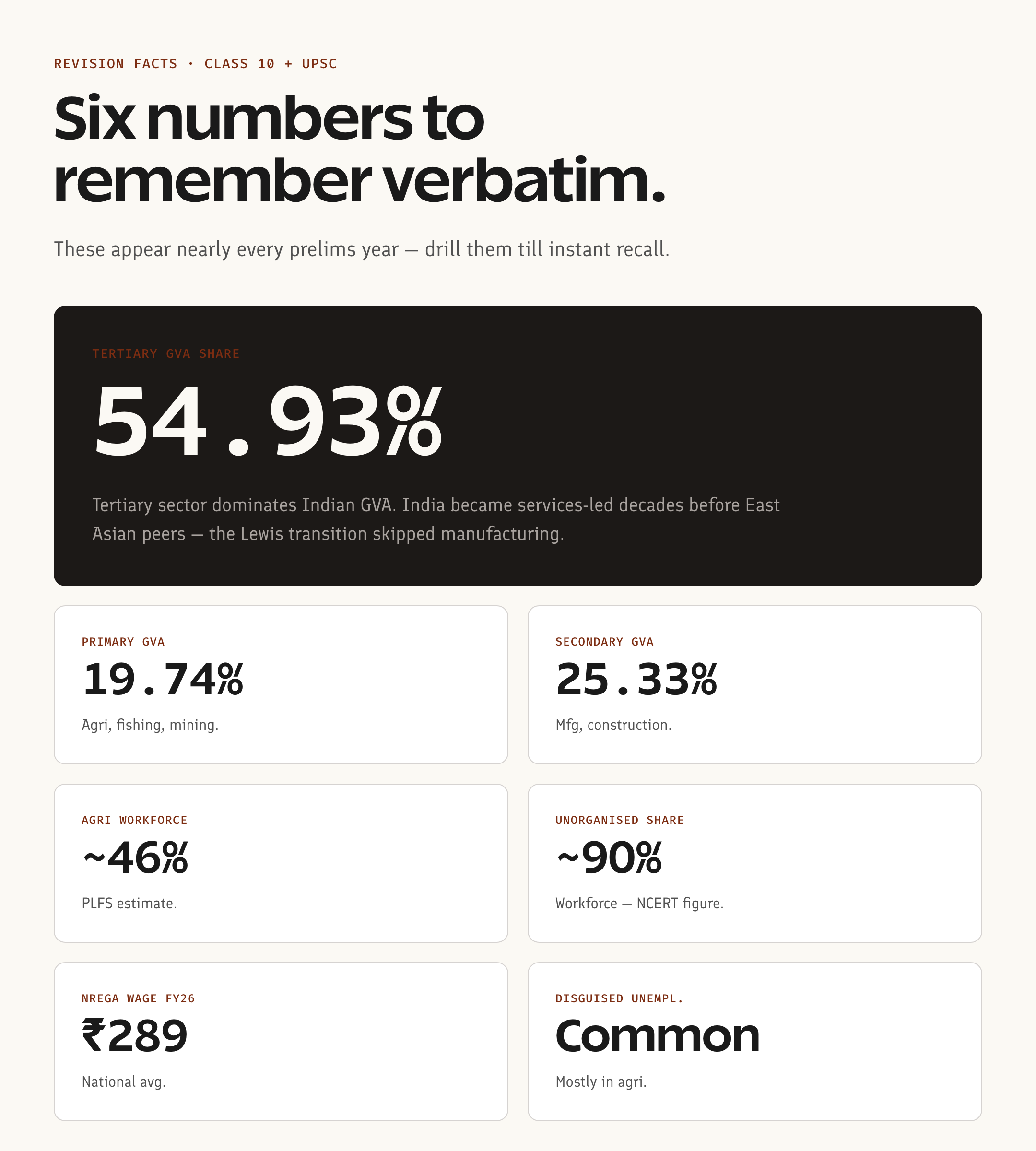
- Employment share: ~45% (PLFS 2024)
- Real growth (FY26 advance estimate): 3.1%
- Largest sub-sector: agriculture and allied activities
Key features:
- Most labour-intensive of the three
- Output highly weather-dependent
- Land reform link — see Reorganisation of Agriculture
- Includes dairying — India is the world’s largest milk producer (~24% of global output)
Class 10 must-know term: disguised unemployment. When more people work on a piece of land than is needed — typical of Indian agriculture. Removing some workers wouldn’t reduce output. NCERT example: a 5-person farm where 2 are surplus.
Secondary sector — quick notes
Definition: Activities that transform raw materials from the primary sector into finished goods through manufacturing or processing.
Examples:
- Manufacturing — textiles, automobiles, steel, cement
- Electricity, gas, water supply — utilities
- Construction — roads, buildings, infrastructure
- Mining processing — refining ores into metals (overlap with primary in some classifications)
Data (FY 2024-25):
- GVA share: 25.33%
- Employment share: ~24%
- Real growth (FY26 advance estimate): manufacturing + construction at 7.0% combined
- Year-on-year GVA growth: 6.1%
Key features:
- Higher capital intensity than primary
- Drives industrial growth
- Government schemes — PLI (Production Linked Incentive), Make in India
- See Manufacturing Sector in India for depth
Class 10 must-know: Why has India’s manufacturing share been stuck around 15-17% of GDP for two decades? The Class 10 textbook hints at infrastructure, skilling, and capital cost issues. The 2026 reality — PLI is starting to move the needle, but slowly.
Tertiary sector — quick notes
Definition: Activities that provide services rather than producing goods. Also called the services sector.
Examples:
- Trade — wholesale and retail
- Transport — road, rail, air, water
- Communication — telecom, postal services
- Banking, finance, insurance
- Education and healthcare
- IT and IT-enabled services (ITeS)
- Tourism, hospitality
- Public administration
Data (FY 2024-25):
- GVA share: 54.93% (the dominant sector)
- Employment share: ~31%
- Real growth (FY26 advance estimate): 7.2%
Key features:
- Largest by GVA contribution
- Includes both high-productivity (IT services) and low-productivity (small retail) sub-sectors
- Major export earner — India’s services exports cross $400 billion annually
- See Services Sector Led Growth for the FY26 deep-dive
Class 10 must-know: Why has the tertiary sector grown so much? NCERT lists three reasons — basic services demand, agriculture/industry support services, rising income demands new services like tourism and education.
The structural shift — what’s happening to India’s economy
This is where the rank-9 and rank-40 articles diverge. Class 10 NCERT presents the three-stage model:
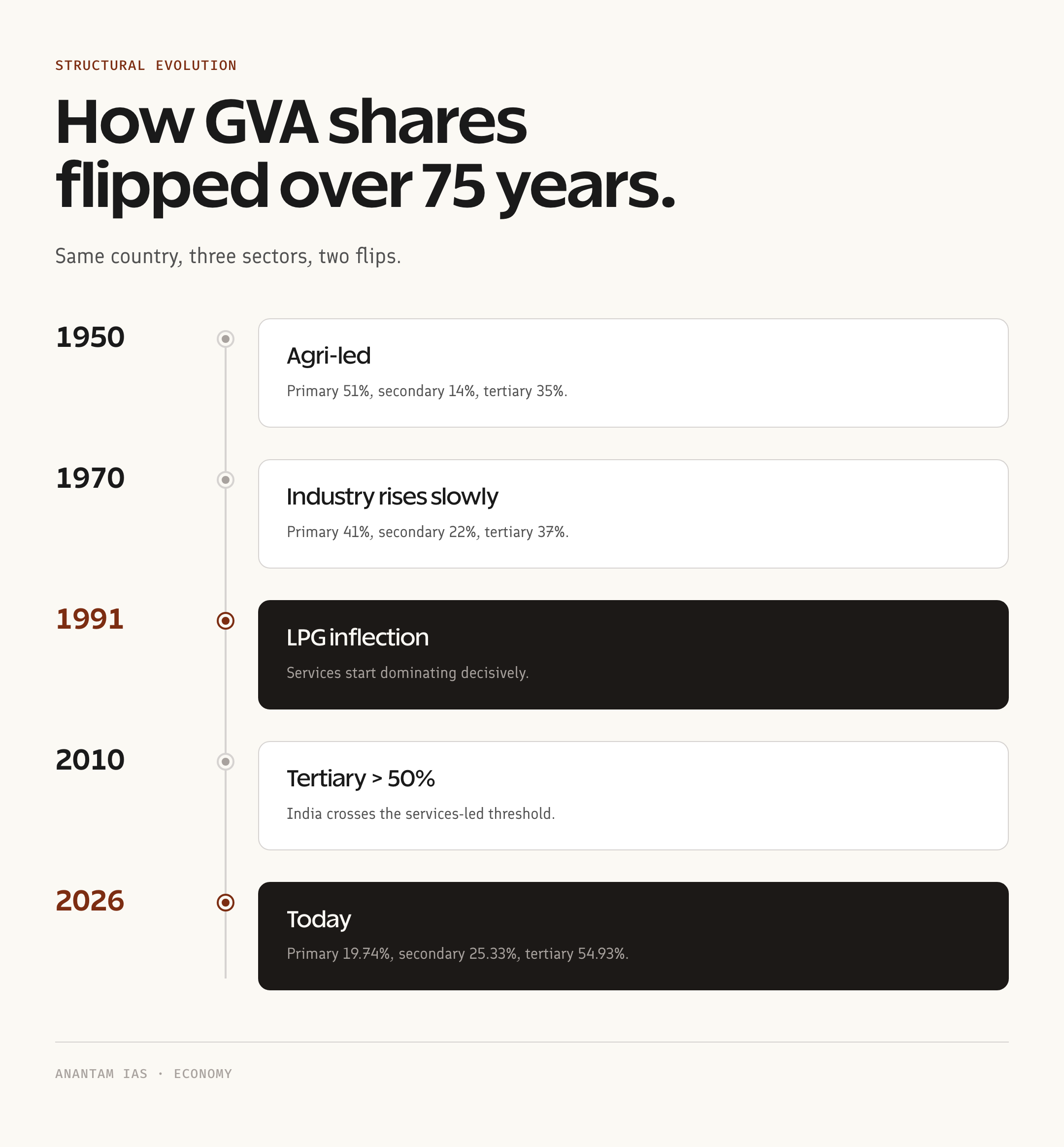
Stage 1: Agrarian — primary sector dominates GVA and employment. India in 1950 fit this — agriculture was 50%+ of GDP.
Stage 2: Industrial — secondary sector takes over. Most developed economies passed through this in the 19th-20th centuries.
Stage 3: Service-led — tertiary sector dominates. India has skipped or compressed Stage 2.
India’s odd path — from 50%+ agriculture (1950) directly to 55% services (2025), without a strong industrial intermediate. This is unusual. Examiners ask why.
Reasons NCERT and standard textbooks cite:
- Post-1991 IT services boom
- English-speaking workforce advantage
- Lower capital requirement than industry
- Manufacturing constrained by labour laws, land acquisition, infrastructure
- Global services demand favoured Indian wages
The downside of this skipped industrial stage — manufacturing employs fewer people than agriculture once did, leaving 45% of workers in low-productivity primary work.
Organised vs unorganised sector — the Class 10 staple
NCERT Chapter 2 spends significant pages here. Memorise the table.
| Parameter | Organised Sector | Unorganised Sector |
|---|---|---|
| Registration | Mandatory under govt regulations | Mostly unregistered |
| Working hours | Fixed (8 hours), overtime paid | Flexible, often unpaid overtime |
| Job security | Permanent, formal contracts | Casual, no contracts |
| Social security | PF, gratuity, paid leave, medical | Largely absent |
| Wages | Above minimum wage typically | Often below minimum wage |
| Examples | Govt offices, large factories, banks, IT companies | Street vendors, daily wage workers, small workshops |
| Share of workforce | ~15% | ~85% |
That 85% number is the headline statistic Class 10 expects students to know. Despite India’s services boom, most workers remain in informal jobs.
Why this matters in 2026: the Pradhan Mantri Shram Yogi Maan-Dhan, e-Shram portal, and Code on Social Security 2020 are recent attempts to extend formal benefits to unorganised workers. NCERT-edition updates flag these. Older notes don’t.
Public vs private sector — fast notes
Public sector:
- Owned and operated by government (central, state, or local)
- Examples: Indian Railways, BHEL, ONGC, SBI (majority govt-owned), AIIMS
- Purpose: services where private sector won’t operate (rural electrification, public health) or strategic industries
Private sector:
- Owned by individuals or companies, profit-motivated
- Examples: Reliance, TCS, Infosys, HDFC Bank, Tata Motors
- Drives most of India’s innovation and employment growth post-1991
Why the public sector still matters:
- Provides services in remote/loss-making areas (railways to NE)
- Strategic industries (defence, atomic energy)
- Employment in non-economic-shock periods
- Welfare delivery infrastructure
Why the private sector dominates GDP growth:
- Higher capital and labour productivity
- Faster decision-making
- Global competitiveness in IT, pharma, autos
NREGA — the protective umbrella for the unorganised
Class 10 NCERT Chapter 2 highlights MGNREGA as the cornerstone of unorganised-sector protection.
Quick facts:
- Full name: Mahatma Gandhi National Rural Employment Guarantee Act, 2005
- Guarantees: 100 days of wage employment per rural household per year
- Wage rate (2025-26): varies by state, average around ₹260-310/day
- Coverage in 2025-26: ~5.6 crore households worked under MGNREGA
- Implementing ministry: Ministry of Rural Development
Why Class 10 examiners love it: It connects sectors, employment classification, and government policy in one frame. Expect a 5-mark short answer on MGNREGA’s role.
Why this matters for UPSC (and beyond Class 10)
These sectors of indian economy class 10 notes feed three exam systems.
- CBSE Class 10 board exam — Chapter 2 is one of three economics chapters; 8-12 marks of question paper
- UPSC Prelims — sectoral GVA share, organised/unorganised data, public sector enterprise classifications
- UPSC Mains GS-III — services-led growth, manufacturing constraints, employment-output mismatch
- State PSCs — almost identical questions, slightly easier framing
For UPSC aspirants, treat Class 10 as foundation, not destination. After this, move to NCERT Class 11 Indian Economic Development and then a standard textbook like Ramesh Singh or Sanjeev Verma. See NCERT Books for UPSC for the full reading order.
Common misconceptions
Myth 1: “Primary = agriculture only.” Wrong. Primary includes mining, fishing, forestry, animal husbandry. Agriculture is the largest sub-sector but not the only one.
Myth 2: “Tertiary sector creates the most jobs.” No. Primary sector still employs ~45% of workforce despite contributing under 20% of GVA. Tertiary is largest by output, not by jobs.
Myth 3: “Public sector is always loss-making.” Not true. ONGC, NTPC, Coal India have been consistently profitable. Many “Maharatna” PSEs are profit-makers.
Myth 4: “Unorganised = illegal.” No. Unorganised means unregistered or informal — selling vegetables on a street is unorganised but completely legal.
Myth 5: “Quaternary sector is included in Class 10 syllabus.” No. Class 10 NCERT focuses on the three-sector model (primary-secondary-tertiary). Quaternary appears in Class 12 or college economics.
How to revise this in 30 minutes
For board exam revision:
- 5 min — Memorise sectoral GVA shares: Primary 19.7%, Secondary 25.3%, Tertiary 54.9% (FY 2024-25)
- 5 min — Examples of each sector (3 per sector minimum)
- 5 min — Organised vs Unorganised table — six rows
- 5 min — Public vs Private — definition + 2 examples each
- 5 min — MGNREGA quick facts (year, days guaranteed, wage range)
- 5 min — Read the Economic Survey 2025-26 sectoral chapter 1-page summary
Source priority: NCERT Class 10 Chapter 2 → MoSPI press releases → Economic Survey Volume 2 (statistical appendix).
Frequently Asked Questions
: How many sectors are there in the Indian economy according to Class 10 NCERT?
NCERT Class 10 covers three sectors classified by activity — primary, secondary, and tertiary. It also classifies sectors by employment conditions (organised/unorganised) and ownership (public/private), making six classification categories total.
: What is the largest sector of the Indian economy?
The tertiary (services) sector is the largest by GVA contribution at 54.93% in FY 2024-25. The primary sector is the largest by employment at approximately 45% of the workforce.
: What is disguised unemployment?
Disguised unemployment occurs when more people are engaged in an activity than is required — common in Indian agriculture. Removing some workers wouldn’t reduce the total output. The textbook example is a family farm with surplus labour.
: What is the difference between organised and unorganised sectors?
Organised sector workers have formal contracts, fixed hours, social security (PF, gratuity), and registered employers. Unorganised sector workers have informal employment, no social security, and unregistered employers. About 85% of India’s workforce is in the unorganised sector.
: Why is the tertiary sector becoming more important in India?
Three reasons NCERT cites — basic services like transport and education are needed regardless of income; agriculture and industry require services; rising income drives demand for services like tourism, healthcare, and entertainment. India’s IT-services boom post-1991 accelerated this trend.
: How is MGNREGA related to the sectors of the Indian economy?
MGNREGA (2005) provides 100 days of guaranteed wage employment per rural household per year, primarily benefiting unorganised sector workers in the primary (agriculture) sector. It bridges the gap left by the unorganised sector’s lack of social security.
: Which sector contributes the most to India’s GDP?
The tertiary or services sector contributes the most to India’s GDP at 54.93% of GVA in FY 2024-25 (MoSPI provisional estimates). The secondary sector contributes 25.33% and the primary sector 19.74%.