Shubhanshu Shukla Space Mission — India’s First ISS Astronaut & Axiom-4 UPSC Guide
Guide to Shubhanshu Shukla's Axiom-4 mission to the ISS, his background, India-US space cooperation, Gaganyaan link, and significance for UPSC Science & Tech.
India’s space programme reached a historic milestone when Group Captain Shubhanshu Shukla became the first Indian astronaut to travel to the International Space Station (ISS) aboard the Axiom-4 (Ax-4) mission. This mission represents a significant chapter in India-US space cooperation and is directly linked to India’s broader human spaceflight ambitions under the Gaganyaan programme. For UPSC aspirants, this topic straddles Science & Technology, International Relations, and current affairs.
Who Is Shubhanshu Shukla?
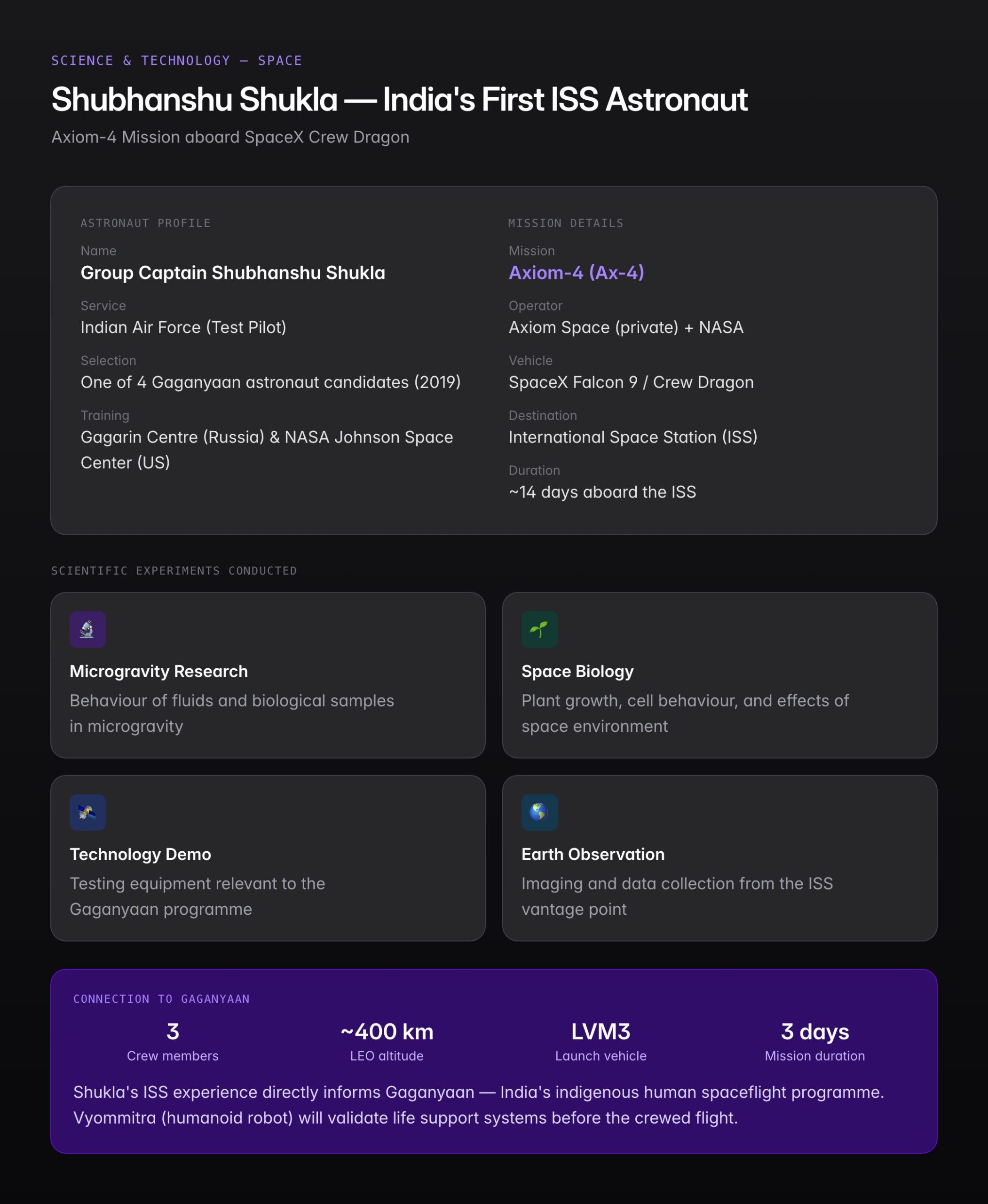
Shubhanshu Shukla is an Indian Air Force (IAF) test pilot and astronaut-designate selected for India's human spaceflight programme.
| Detail | Information |
|---|---|
| Full Name | Group Captain Shubhanshu Shukla |
| Service | Indian Air Force |
| Role | Test pilot; astronaut-designate for Gaganyaan |
| Selection | Selected as one of four Gaganyaan astronaut candidates by ISRO and IAF |
| Training | Trained at the Yuri Gagarin Cosmonaut Training Centre (Russia) and NASA's Johnson Space Center (US) |
| Mission | Axiom-4 (Ax-4) to the International Space Station |
| Launch Vehicle | SpaceX Crew Dragon |
| Launch Site | Kennedy Space Center, Florida, USA |
Shukla was among four IAF pilots chosen by ISRO in 2019 for astronaut training. The group underwent initial training in Russia and was subsequently trained at Indian facilities. Shukla's selection for the Axiom-4 mission was announced as part of a broader India-US space cooperation framework.
The Axiom-4 Mission
Axiom Space is a private American company that organises commercial missions to the ISS in partnership with NASA. The Axiom missions use SpaceX's Crew Dragon spacecraft for transportation.
Mission Details
| Parameter | Details |
|---|---|
| Mission Name | Axiom-4 (Ax-4) |
| Operator | Axiom Space (private), in partnership with NASA |
| Launch Vehicle | SpaceX Falcon 9 / Crew Dragon |
| Destination | International Space Station (ISS) |
| Duration | Approximately 14 days aboard the ISS |
| Crew | International crew including Shubhanshu Shukla (India) |
| Launch Year | 2025 |
Scientific Experiments
During his stay on the ISS, Shukla conducted a series of scientific experiments prepared by ISRO and Indian research institutions. These experiments covered areas such as:
- Microgravity research: Behaviour of fluids and biological samples in microgravity.
- Space biology: Studies on plant growth, cell behaviour, and the effects of the space environment on biological systems.
- Technology demonstration: Testing equipment and materials relevant to the Gaganyaan programme.
- Earth observation: Imaging and data collection from the ISS vantage point.
These experiments are significant because they provide India with first-hand experience in conducting research aboard an orbital station — experience that will be directly applicable to Gaganyaan and India's planned space station.
Connection to the Gaganyaan Programme
The Gaganyaan mission is India's indigenous human spaceflight programme, managed by ISRO. It aims to send a three-member crew to Low Earth Orbit (LEO) for a period of three days aboard an Indian-built spacecraft launched on the LVM3 (GSLV Mk III) rocket.
| Gaganyaan Parameter | Details |
|---|---|
| Objective | Demonstrate Indian human spaceflight capability |
| Crew | 3 astronauts (Indian-selected, IAF pilots) |
| Orbit | Low Earth Orbit (~400 km) |
| Duration | Up to 3 days |
| Launch Vehicle | LVM3 (formerly GSLV Mk III) |
| Crew Module | Indian-designed, tested in uncrewed missions first |
Shukla's experience aboard the ISS is directly relevant to Gaganyaan:
- It provides hands-on training in living and working aboard an orbital platform.
- The scientific experiments inform the design and operation of Gaganyaan's crew module.
- It demonstrates India's readiness to participate in international human spaceflight missions.
Key fact: Before Gaganyaan's crewed flight, ISRO has planned uncrewed test flights, including the G1 mission (uncrewed orbital test) and a flight test with the humanoid robot Vyommitra to validate life support systems.
India-US Space Cooperation
The Axiom-4 mission is a product of deepening India-US space cooperation, which has accelerated significantly in recent years.
Key Milestones
| Year | Development |
|---|---|
| 2023 | NASA-ISRO Synthetic Aperture Radar (NISAR) satellite jointly developed; launched in 2024 |
| 2023 | Artemis Accords signed by India, committing to principles for peaceful exploration of the Moon |
| 2023 | Joint statement on human spaceflight cooperation during PM Modi's state visit to the US |
| 2024-25 | Shubhanshu Shukla trains at NASA's Johnson Space Center and flies on Axiom-4 |
| Ongoing | Cooperation on satellite navigation, Earth observation, and space situational awareness |
Artemis Accords: India became a signatory to the Artemis Accords in June 2023, joining a US-led framework of principles for the exploration and use of outer space, including the Moon, Mars, and asteroids. The accords are not a treaty but a set of non-binding principles based on the Outer Space Treaty of 1967.
India's Space Programme — Broader Context
Shukla's mission should be understood within the larger trajectory of India's space achievements:
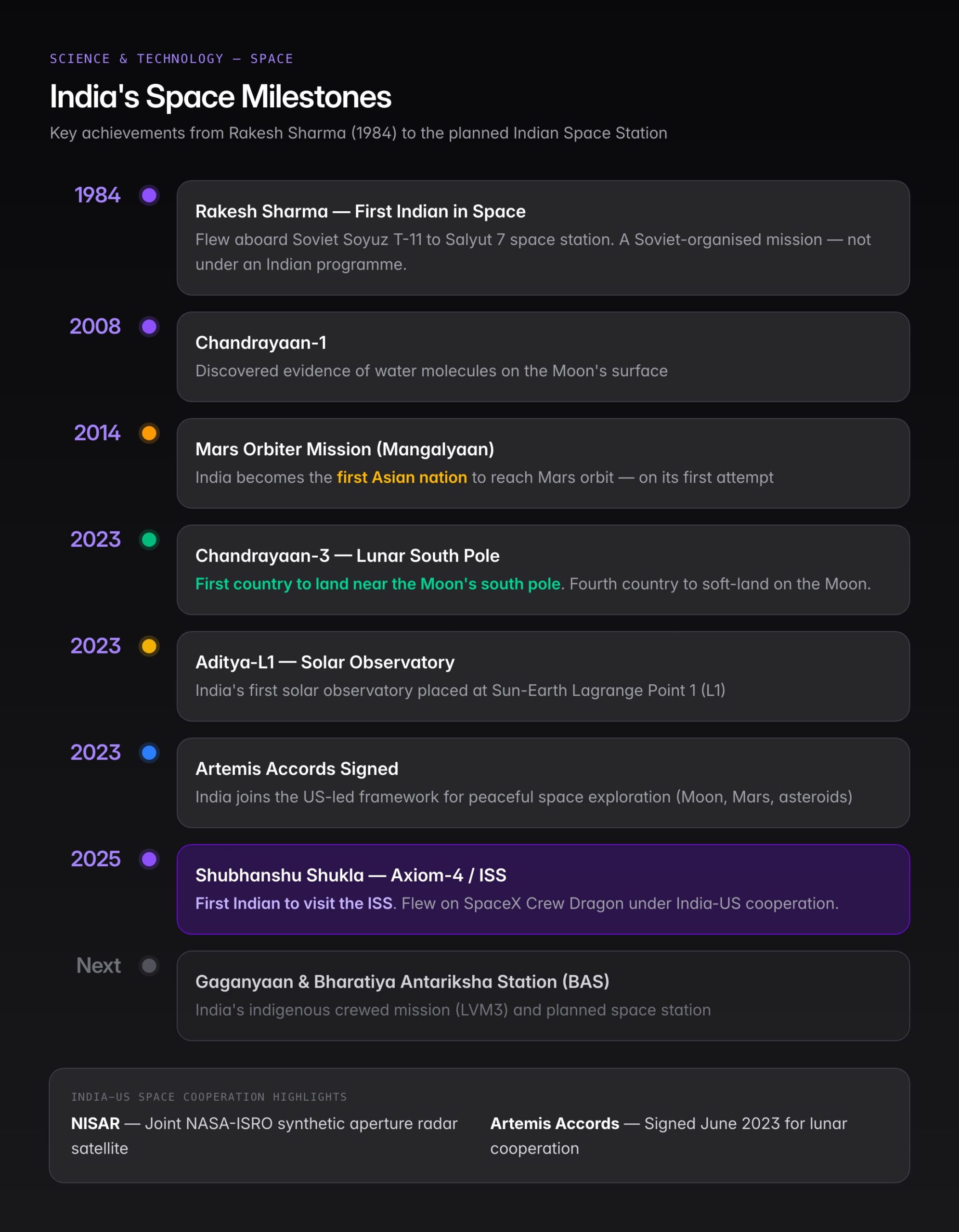
- 1984: Rakesh Sharma became the first Indian in space, flying aboard the Soviet Soyuz T-11 to the Salyut 7 space station. However, this was a Soviet-organised mission — Sharma flew as a cosmonaut, not under an Indian programme.
- 2008: Chandrayaan-1 discovered evidence of water on the Moon.
- 2014: India became the first Asian nation to reach Mars orbit (Mangalyaan/Mars Orbiter Mission).
- 2023: Chandrayaan-3 successfully soft-landed near the Moon's south pole, making India the fourth country to land on the Moon and the first to land near the south pole.
- 2023: Aditya-L1, India's first solar observatory, was placed at the Sun-Earth Lagrange Point 1 (L1).
- Upcoming: Gaganyaan crewed mission, Indian Space Station (Bharatiya Antariksha Station — BAS).
Significance of the Mission
The Axiom-4 mission carries significance on multiple levels:
- First Indian on the ISS: While Rakesh Sharma flew to a Soviet station in 1984, Shukla is the first Indian to visit the ISS and the first to fly under an Indian-associated programme to an international station.
- India's human spaceflight readiness: Demonstrates that Indian astronauts are trained and ready for the rigours of orbital spaceflight, building confidence ahead of Gaganyaan.
- Geopolitical signal: India's partnership with the US on human spaceflight, alongside the Artemis Accords, signals strategic alignment in space exploration.
- Scientific capability: The experiments conducted by Shukla establish India's ability to perform meaningful research in microgravity.
- Inspiration and outreach: The mission has a significant aspirational impact, encouraging STEM education and careers in India.
UPSC Relevance
GS Paper Mapping:
- Prelims: Axiom-4 mission details, Gaganyaan programme, NISAR satellite, Artemis Accords, ISRO milestones.
- GS Paper II (Mains): India-US bilateral relations — space cooperation as a pillar of the strategic partnership.
- GS Paper III (Mains): Science and Technology — developments in space, indigenisation, awareness in space technology.
Key Prelims Facts:
- Shubhanshu Shukla is the first Indian astronaut to visit the International Space Station.
- He flew on the Axiom-4 mission aboard a SpaceX Crew Dragon spacecraft.
- Shukla is one of four astronaut-designates selected for the Gaganyaan programme.
- Rakesh Sharma was the first Indian in space (1984, aboard Soviet Soyuz T-11 to Salyut 7).
- Gaganyaan aims to send a 3-member crew to LEO aboard the LVM3 rocket.
- India signed the Artemis Accords in June 2023.
- NISAR is a joint NASA-ISRO synthetic aperture radar satellite.
- Chandrayaan-3 made India the first country to soft-land near the Moon's south pole (2023).
- India's planned space station is called the Bharatiya Antariksha Station (BAS).
- Vyommitra is a humanoid robot designed by ISRO for Gaganyaan test flights.