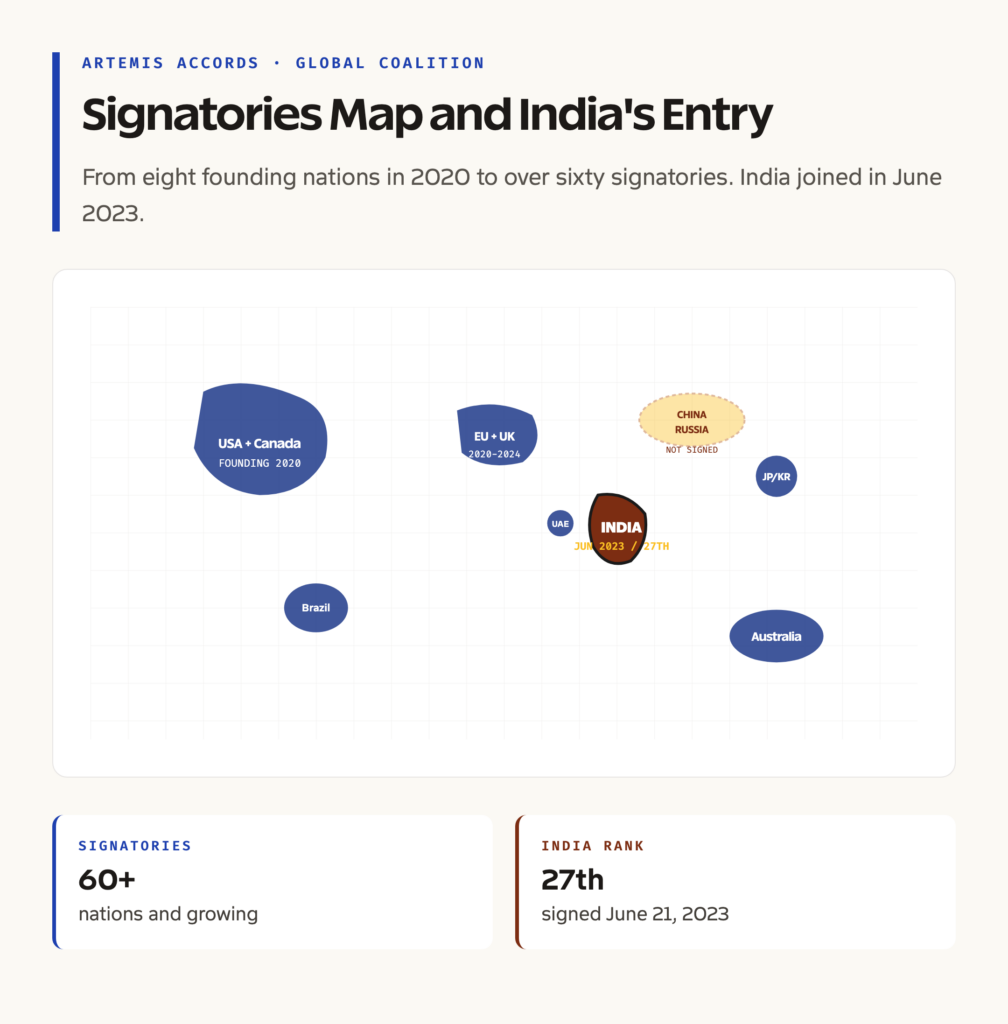
The return of human beings to the Moon, more than half a century after the last Apollo landing, has reopened a set of legal questions that the Cold War era never fully settled. Who owns what is mined on the lunar surface? What happens when a private company drives a rover within a kilometer of another country’s lander? How does the existing space treaty regime, written for a two-superpower world, accommodate dozens of state and commercial actors at once? The Artemis Accords are the United States-led answer to these questions, and they have moved from a niche document signed by eight nations in 2020 to a near-global framework with India among its most consequential signatories.
The Accords are not a treaty in the strict legal sense. They are a set of non-binding political principles that signatory nations commit to follow when they conduct civil space exploration, particularly on and around the Moon. The framework is grounded in the 1967 Outer Space Treaty but extends it to cover topics that the parent treaty either left vague or did not anticipate, including the commercial extraction of space resources, the registration of objects in orbit and on the lunar surface, and the establishment of safety zones around active operations.
For Indian readers, the Accords matter on three levels. The first is strategic. By signing in June 2023 during Prime Minister Narendra Modi’s state visit to Washington, India aligned its civil space programme with the most influential lunar coalition of the next decade. The second is commercial. Several of the Accords’ principles, especially on resource use and interoperability, frame the conditions under which Indian private space companies can plan lunar logistics, mining, or scientific service contracts. The third is legal, because the Accords sit at the centre of an unresolved global debate about what rules should govern the new lunar economy.
Quick Facts on the Artemis Accords
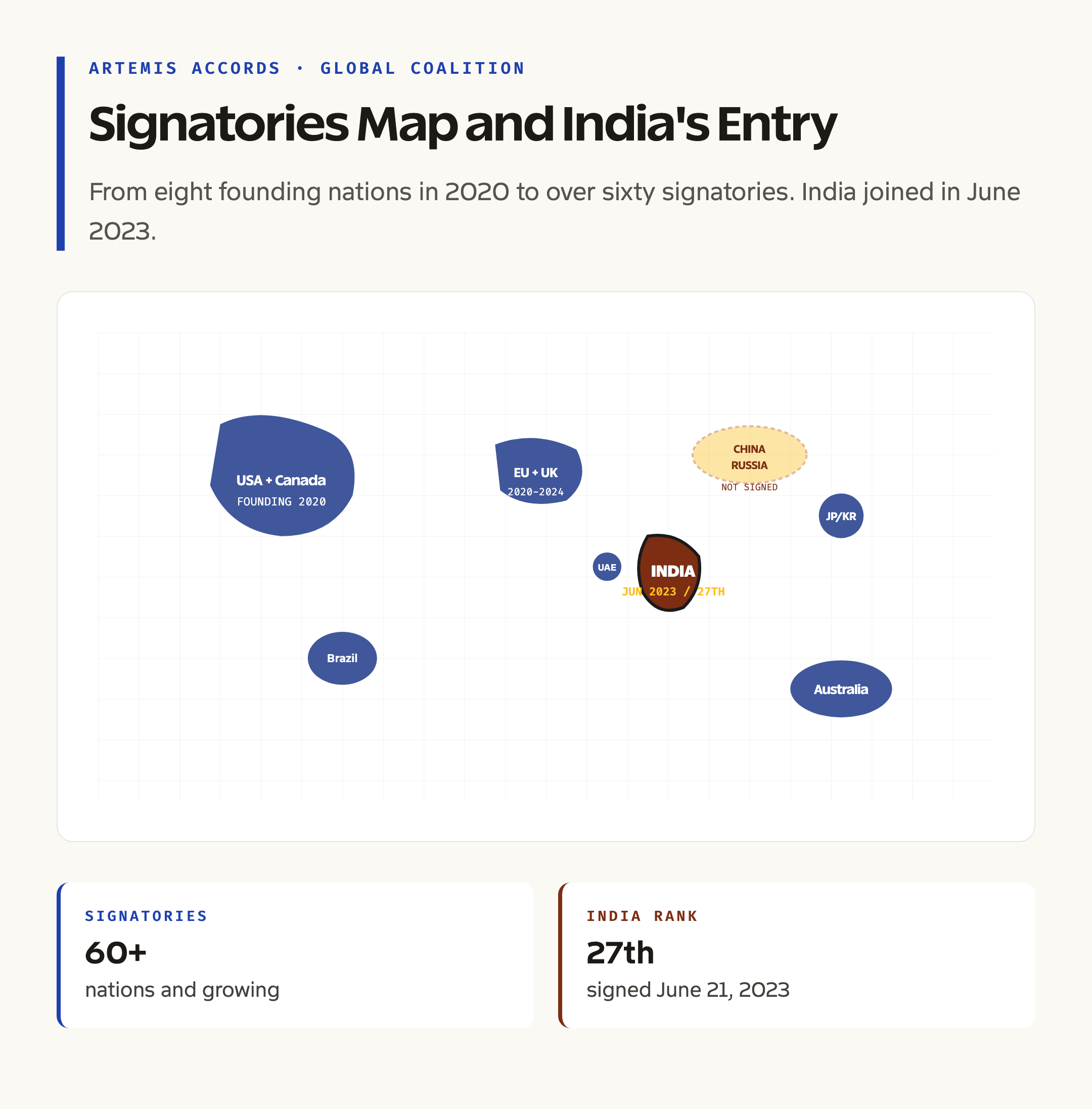
The Artemis Accords were launched by NASA in October 2020 with eight founding signatories: the United States, the United Kingdom, Canada, Japan, Italy, Australia, Luxembourg, and the United Arab Emirates. They are administered by the United States Department of State on the political side and NASA on the technical side, not by the United Nations.
The Accords are explicitly tied to the United Nations Outer Space Treaty of 1967, which is the foundational document of international space law. The Accords add ten operational principles built on top of that treaty. Each signing state issues a separate, identical letter of commitment, which is why the framework is sometimes described as a coalition of bilateral political commitments rather than a single multilateral treaty.
India became the twenty-seventh nation to join when it signed the Accords on June 21, 2023. As of the writing of this primer, the framework has crossed sixty signatories, including most of Europe, Japan, South Korea, Singapore, Brazil, Mexico, Argentina, Saudi Arabia, Israel, Nigeria, and Rwanda. China and Russia have not signed and are leading a parallel lunar effort, the International Lunar Research Station programme, with their own coalition.
What the Artemis Accords Actually Are
The Accords are best understood as an interpretive layer over the Outer Space Treaty. The 1967 treaty, written when only two countries were active in space, established four core ideas: outer space is the province of all mankind, no nation may claim sovereignty over the Moon or any other celestial body, states are responsible for the activities of their nationals in space, and the use of weapons of mass destruction in space is prohibited. The treaty is short, principle-heavy, and silent on commercial activity.
Background and Historical Context
The need for an updated framework grew out of two parallel developments. The first was the United States’ political decision to return astronauts to the Moon, originally announced as Project Constellation under President George W. Bush, restructured under President Barack Obama, and then formally renamed and accelerated as the Artemis programme under President Donald Trump in 2017. The Artemis programme aimed for a crewed lunar landing in the mid-2020s and a sustained human presence by the end of the decade, supported by the Lunar Gateway space station in cislunar orbit.
The second was the rise of commercial space activity. SpaceX, Blue Origin, Astrobotic, Intuitive Machines, and several smaller companies began offering or planning lunar landing and cargo services. National laws passed in the United States in 2015 and in Luxembourg in 2017 explicitly authorized private companies to own resources extracted from celestial bodies. These national laws sat uneasily with the Outer Space Treaty’s appropriation prohibition, depending on how that prohibition was read.
The 1979 Moon Treaty, formally the Agreement Governing the Activities of States on the Moon and Other Celestial Bodies, had attempted to settle the resource question by declaring lunar resources the common heritage of mankind, with benefits to be shared internationally. The treaty was never accepted by any major space-faring power. The United States, Russia, and China did not sign. India signed in 1982 but did not ratify. Without these powers, the Moon Treaty effectively failed.
The Artemis Accords were drafted to fill the gap. By coupling the Outer Space Treaty with a fresh set of operational principles, the United States built a coalition that could move forward on the new lunar economy without waiting for an unlikely global treaty.
The Ten Principles in Detail
The Accords list ten principles. They are short and quotable, and worth knowing by name for the prelims and for any mains question on space governance.
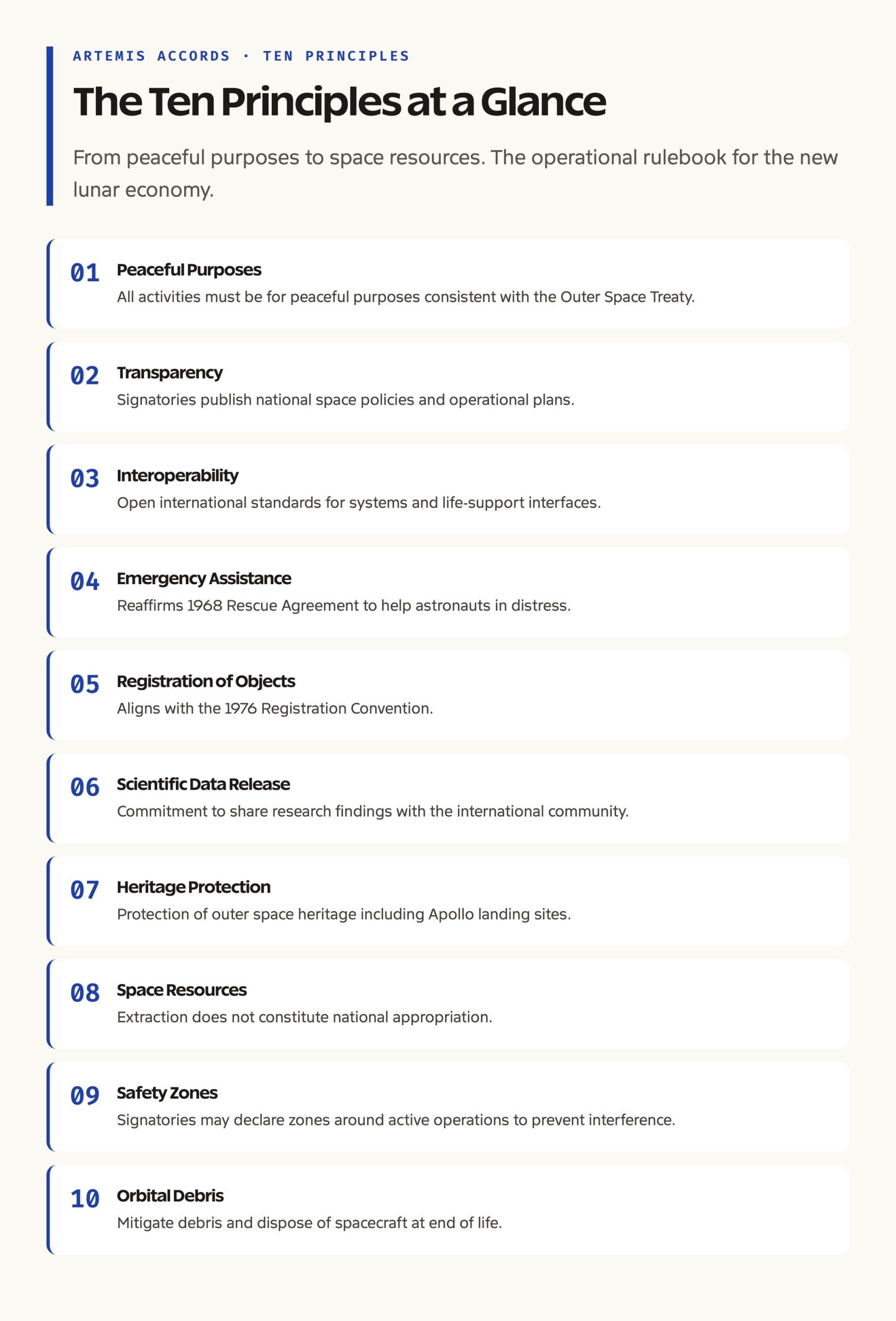
The first principle is peaceful purposes. All activities under the Accords must be conducted for peaceful purposes consistent with the Outer Space Treaty. The second is transparency. Signatories commit to publish their national space policies and to be open about their plans. The third is interoperability. Signatories commit to using open international standards for systems, including communications, fuel transfer, and life-support interfaces, so that nations can support each other in emergencies and on shared infrastructure.
The fourth principle is emergency assistance. It reaffirms the obligation under the 1968 Rescue Agreement to render help to astronauts in distress. The fifth is registration of space objects, in line with the 1976 Registration Convention. The sixth is the release of scientific data, with a commitment to share research findings with the international community.
The seventh, and most discussed, is the protection of heritage. Signatories agree to protect outer space heritage sites, including the Apollo landing sites, from disturbance. The eighth concerns space resources. The Accords explicitly state that the extraction and utilization of space resources does not, by itself, constitute national appropriation under the Outer Space Treaty. This is the most legally consequential principle and the one that hostile commentators have argued bends the parent treaty.
The ninth principle covers conflict deconfliction through safety zones. Signatories may establish safety zones around active lunar operations to prevent harmful interference, with the size of the zone proportional to the operation. Other signatories must respect those zones and coordinate before approaching them. The tenth principle is orbital debris and spacecraft disposal, with a commitment to mitigate debris and dispose of spacecraft at end of life.
Why India Signed
India’s accession in June 2023 was both a symbolic and a substantive step. Symbolically, it placed India inside the most active civil space coalition of the decade and pushed back gently against the perception that India hedges between the United States, Russia, and China. The signing followed a sustained period of ISRO mission success and came shortly before Chandrayaan-3 made a soft landing near the lunar south pole, the first such landing globally and a credibility marker for India’s deep-space capability.
Substantively, the Accords give India access to several practical benefits. The first is data sharing. Signatories share scientific results and orbital data. As Indian missions like Chandrayaan-3 and the planned Chandrayaan-4 sample return generate large datasets, the framework opens reciprocal access to data from American, Japanese, and European missions. The second is interoperability for future Indian astronauts and rovers, including potential participation in the Lunar Gateway and in joint logistics operations. The third is alignment with a permissive resource-use regime that fits India’s expanding private space sector.
Critics within India have raised concerns about whether signing aligns India too closely with a US-led framework on a topic where the global majority is not yet bound. The official Indian position is that the Accords are non-binding, are consistent with India’s own interpretation of the Outer Space Treaty, and do not preclude future engagement with parallel frameworks.
Detailed Analysis: Artemis Accords Versus the Moon Treaty
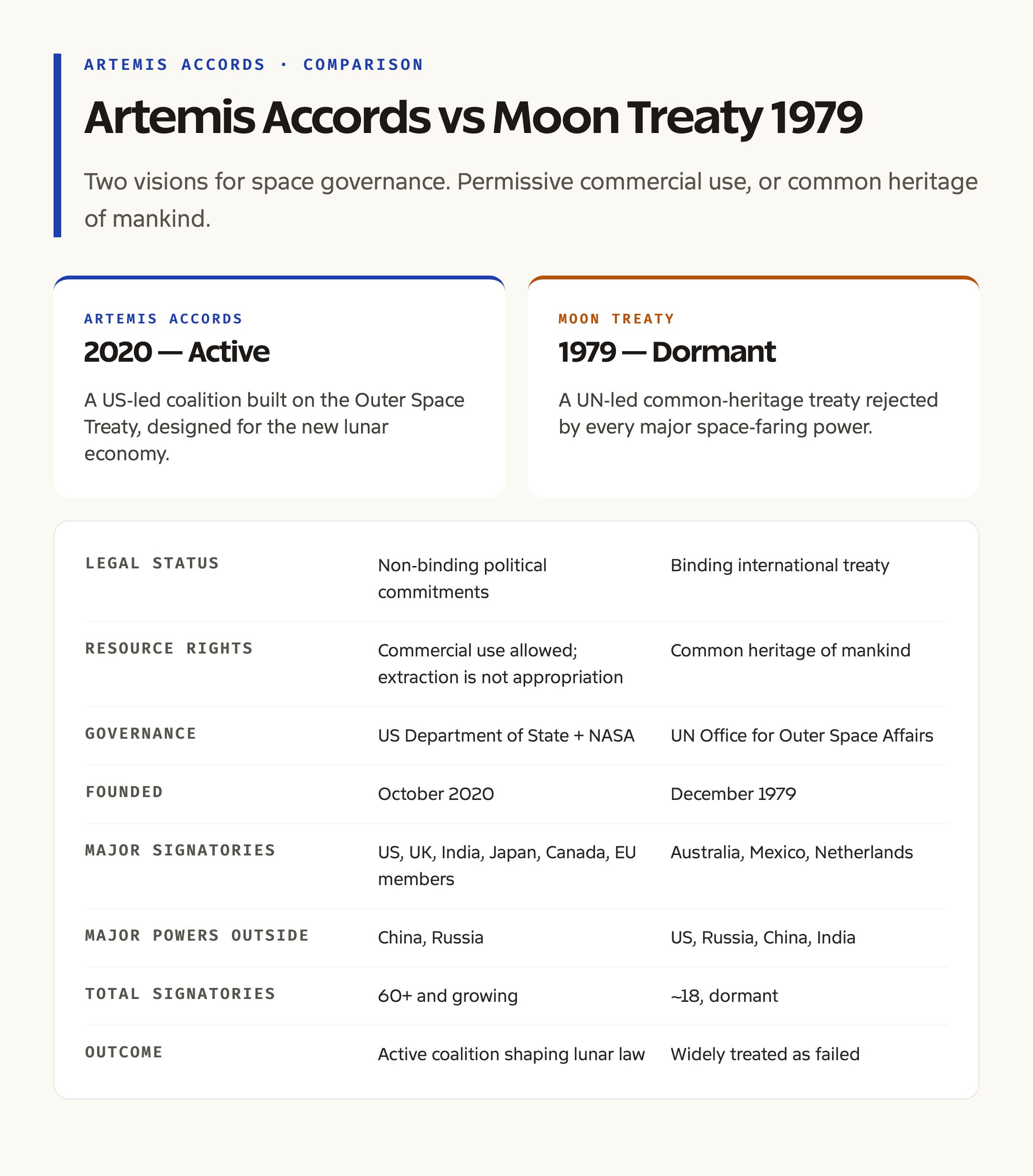
The contrast between the Accords and the Moon Treaty captures the deeper tension in modern space law: should resources be a commons, or should commercial extraction be permitted under state authorization?
| Feature | Artemis Accords (2020) | Moon Treaty (1979) |
|---|---|---|
| Legal status | Non-binding political commitments | Binding international treaty |
| Resource rights | Commercial use allowed; extraction is not appropriation | Common heritage of mankind; equitable benefit sharing |
| Governance | US Department of State and NASA | UN Office for Outer Space Affairs |
| Major signatories | US, UK, Japan, Canada, India, EU members | Australia, Mexico, Netherlands, a few others |
| Major non-signatories | China, Russia | US, Russia, China, India, all major space powers |
| Outcome | Active and growing | Dormant; widely treated as failed |
The Accords took the practical position that, given the failure of the Moon Treaty, the way to govern modern space activity is to build a coalition of like-minded states around principles that signatory governments are willing to enforce on their own nationals. The Moon Treaty took the principled position that resources beyond Earth belong to humanity collectively. Both positions have a defensible legal grounding in the Outer Space Treaty, depending on how the treaty’s appropriation clause is read.
Comparative Snapshot: The Three Lunar Coalitions
The lunar landscape now has three rough coalitions. The first is the Artemis Accords coalition, anchored by the United States, NASA’s Artemis programme, and the Lunar Gateway. India sits inside this coalition, along with most of Europe, Japan, South Korea, and a growing list of emerging space-faring states.
The second is the International Lunar Research Station coalition, led jointly by China and Russia, with target operations near the lunar south pole and a planned construction phase between 2030 and 2035. Members and partners include Pakistan, Belarus, Venezuela, South Africa, Egypt, Thailand, and a small number of others. Russia has positioned the ILRS framework as an alternative to the Accords on resource governance.
The third is the United Nations track. The UN Committee on the Peaceful Uses of Outer Space has set up working groups on space resources and on long-term sustainability. These groups operate by consensus and move slowly, but they remain the only forum in which all space-faring states sit at one table. India participates actively in the UN track in parallel with its accession to the Accords.
The three-coalition reality is likely to persist through the 2020s. Most observers expect that some form of UN-level convergence will eventually emerge, but the practical rules for the next lunar decade will be set inside the Accords coalition.
Challenges and Open Questions
The first challenge is the legal status of safety zones. Critics argue that allowing nations to declare exclusion-style zones around their lunar operations is a soft form of appropriation, prohibited by the Outer Space Treaty. The Accords’ defenders reply that safety zones are temporary, operation-specific, and subject to coordination, not permanent claims to territory. The dispute is unlikely to be settled until the first overlapping operation actually occurs.
The second challenge is the resource clause. The Accords’ position that extraction is not appropriation moves into territory that the Outer Space Treaty itself does not address. Russia, China, and several developing-country space agencies argue that this stretch is impermissible and should be settled through a multilateral treaty under United Nations auspices.
The third challenge is enforcement. Because the Accords are non-binding, compliance depends on each signatory’s domestic law and political will. There is no court or arbitration tribunal that can adjudicate disputes between signatories. The first serious incident on the lunar surface, whether collision, contamination, or interference, will be a stress test for the framework.
The fourth challenge is geopolitical fragmentation. The split between the Accords coalition and the China and Russia ILRS coalition risks producing two parallel sets of standards for lunar operations, which would raise costs and complicate interoperability for missions that touch both blocs.
Prelims Pointers
- The Artemis Accords are a set of non-binding principles for civil space exploration, launched by NASA in October 2020.
- The Accords are grounded in the Outer Space Treaty of 1967 and extend it for modern operations.
- India signed the Accords on June 21, 2023, becoming the twenty-seventh signatory.
- The signing took place during Prime Minister Modi’s state visit to Washington.
- Founding members were the United States, United Kingdom, Canada, Japan, Italy, Australia, Luxembourg, and the United Arab Emirates.
- The Accords explicitly state that extraction of space resources does not constitute national appropriation.
- Safety zones may be declared by signatories around their active lunar operations.
- The 1979 Moon Treaty, with its common-heritage approach, was not accepted by any major space-faring power and is widely treated as failed.
- China and Russia are leading the parallel International Lunar Research Station programme.
- The Accords reaffirm the 1968 Rescue Agreement obligation to assist astronauts in distress.
Mains Practice Questions
- Examine the principal features of the Artemis Accords and discuss the implications of India’s accession in June 2023 for its civil space programme and its space diplomacy.
- Compare the Artemis Accords with the Moon Treaty of 1979 on the question of space resource rights. Critically assess whether either framework adequately protects the principles of the Outer Space Treaty.
- The lunar economy will require new rules. Discuss the gaps in the existing space-law regime and evaluate the role of the Artemis Accords, the International Lunar Research Station, and the United Nations track in filling these gaps.
Way Forward
India’s path inside the Artemis Accords now needs three things. First, a domestic legal regime that clarifies the rights of Indian private space companies to extract and use space resources, in line with the Indian Space Policy 2023 and the recent legislative push on commercial space activity. Without domestic legal clarity, Indian firms cannot raise the capital needed for lunar logistics or mining ventures. Second, sustained engagement on the United Nations track, particularly in the Committee on the Peaceful Uses of Outer Space working groups, so that India’s interpretation of the Outer Space Treaty contributes to whatever multilateral consensus eventually emerges. Third, selective bilateral agreements with non-Accords states such as Russia, where India has long-standing space cooperation, to prevent fragmentation of standards from constraining Indian missions. The lunar economy will not wait for a perfect treaty. India’s best position is to be inside the most active coalition while keeping the door open to the broader settlement that will eventually come.
Frequently Asked Questions
What are the Artemis Accords?
The Artemis Accords are a set of ten non-binding principles for civil space exploration, launched by NASA in October 2020. They build on the Outer Space Treaty of 1967 and cover topics including peaceful purposes, transparency, interoperability, emergency assistance, registration of space objects, scientific data sharing, heritage protection, space resources, safety zones, and orbital debris.
When did India sign the Artemis Accords?
India signed the Artemis Accords on June 21, 2023, during Prime Minister Narendra Modi’s state visit to Washington. India became the twenty-seventh signatory and the largest emerging space-faring state to join the framework at that time.
Are the Artemis Accords legally binding?
No. The Accords are political commitments, not a binding international treaty. Each signatory issues a separate letter of commitment, which is why the framework is sometimes described as a coalition of bilateral political commitments rather than a single multilateral treaty. The legally binding obligations come from the Outer Space Treaty of 1967, which the Accords reference and build upon.
How are the Artemis Accords different from the Moon Treaty?
The Artemis Accords permit the commercial extraction of space resources and treat such extraction as not amounting to national appropriation. The Moon Treaty of 1979, by contrast, treats lunar resources as the common heritage of mankind, with benefits to be shared internationally. The Accords are non-binding political commitments with over sixty signatories. The Moon Treaty is a binding treaty that no major space-faring power has accepted, and it is widely treated as failed.
Why did India sign the Artemis Accords?
India signed for strategic, commercial, and scientific reasons. Strategically, the Accords align India with the most active lunar coalition of the decade. Commercially, they create a permissive regime for Indian private space companies. Scientifically, they unlock data sharing with American, Japanese, and European missions, which is valuable as ISRO expands its lunar and deep-space programme.
Have China and Russia signed the Artemis Accords?
No. China and Russia are not signatories. They are leading a parallel framework, the International Lunar Research Station programme, with target operations in the lunar south pole region and a planned construction phase in the 2030s.
What are safety zones under the Artemis Accords?
Safety zones are areas around an active lunar operation that signatories may declare to prevent harmful interference. The size of the zone is meant to be proportional to the operation, and other signatories are expected to coordinate before approaching them. Critics argue that safety zones come close to a soft form of territorial claim, while defenders argue that they are temporary, operation-specific, and subject to mutual coordination.
Do the Artemis Accords allow private companies to own moon resources?
The Accords state that the extraction and utilization of space resources does not constitute national appropriation under the Outer Space Treaty. This creates a permissive framework under which signatory governments may, through their domestic law, grant rights of use over extracted resources to private companies. The United States and Luxembourg have already passed such laws.
Is India still part of the Outer Space Treaty after signing the Accords?
Yes. India remains a state party to the Outer Space Treaty of 1967, which it ratified in 1982. The Artemis Accords build on that treaty and do not displace it. India’s signing does not change any of its existing treaty obligations.
How many countries have signed the Artemis Accords?
As of the writing of this primer, more than sixty countries have signed the Accords. The list grows as new states join the coalition, and the United States Department of State maintains the official roster.
Tell Google you want more of this.
Add Anantam IAS as a preferred sourceOne tap, and this site shows up more often in your own Top Stories, AI Overviews and AI Mode. Remove it any time.