

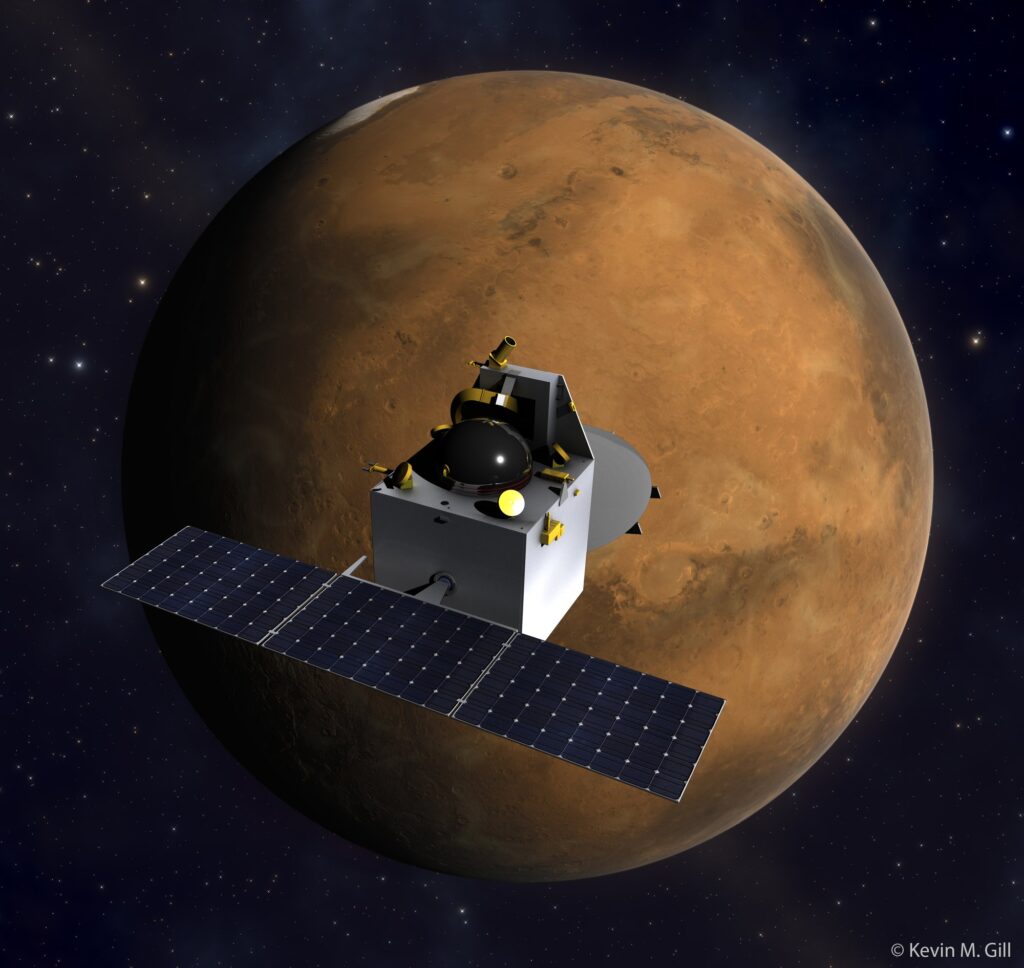
The Mangalyaan Mars Orbiter Mission turned India into an interplanetary spacefaring nation overnight. Launched by ISRO on 5 November 2013 aboard the PSLV-XL and inserted into Martian orbit on 24 September 2014, the Mangalyaan Mars Orbiter Mission made India the first Asian country to reach Mars and the only nation in the world to do so on its very first attempt. Its total cost — about ₹450 crore, roughly $74 million — was less than the production budget of the Hollywood film Gravity, making Mangalyaan the cheapest Mars mission ever flown. The mission concluded in October 2022 after almost a decade of orbit operations, eight years beyond its six-month design life. India has since approved the next-generation Mars Orbiter Mission 2 (MOM-2 or Mangalyaan-2) to build on this legacy.
For UPSC, the Mangalyaan Mars Orbiter Mission spans GS-III science and technology, GS-II international relations and current affairs. It is one of the most-tested topics in Prelims and a frequent Mains case study in frugal engineering and national soft power.
Mangalyaan at a Glance
| Parameter | Detail |
|---|---|
| Mission | Mars Orbiter Mission (MOM / Mangalyaan) |
| Agency | ISRO |
| Launch | 5 November 2013, PSLV-XL (C25), Sriharikota |
| Mars Orbit Insertion | 24 September 2014 |
| Total cost | ~₹450 crore (~$74 million) |
| Payloads | 5 — MCC, MSM, TIS, LAP, MENCA (15 kg) |
| Design life vs actual | 6 months planned; ~8 years achieved |
| Mission end | October 2022 |
| Distinction | First Asian nation to reach Mars; first country worldwide to succeed on its first attempt |
| Successor | MOM-2 / Mangalyaan-2 (approved 2024, LVM-3 launcher) |
Background: Why a Mars Mission
Mars exploration is dominated by NASA, with multiple successful orbiters, landers and rovers. The Soviet Union, the European Space Agency and Japan all attempted Mars missions; many failed at the Mars orbit insertion phase, which is notoriously difficult. By the early 2010s only two non-Soviet, non-American agencies had even attempted Mars — ESA (success) and JAXA (Japan’s Nozomi, failure). China’s Yinghuo-1 was lost in 2011 when its Russian carrier rocket failed.
Strategic Drivers
ISRO’s leadership saw a narrow window. A Mars mission would demonstrate three new Indian capabilities — deep-space navigation, long-duration spacecraft autonomy, and trans-planetary trajectory design. It would also place India ahead of China in the Mars race, an important geopolitical positioning. And it would prove the PSLV-XL launcher could throw a small payload onto an interplanetary trajectory.
Approval and Timeline
The Mangalyaan Mars Orbiter Mission was approved by the Manmohan Singh government in August 2012 with a budget of ₹450 crore. Design, fabrication, integration and testing were completed in just 15 months — an unprecedented pace for an interplanetary mission. The launch window — when Earth and Mars are favourably aligned — opened in November 2013, and ISRO hit it on the first try.
Mission Profile
The Mangalyaan Mars Orbiter Mission is a triumph of trajectory engineering.
Launch — 5 November 2013
The Mangalyaan spacecraft lifted off at 14:38 IST on 5 November 2013 aboard the PSLV-XL (the C25 variant) from Sriharikota. The PSLV-XL was chosen over the more powerful but less reliable GSLV because ISRO needed certainty. The PSLV did not have enough energy to inject the spacecraft directly toward Mars, so the mission used a clever workaround.
Earth-Bound Phase
The PSLV placed Mangalyaan into a 246 x 23,000 km elliptical Earth orbit. Over the next 23 days, ISRO performed six orbit-raising manoeuvres using the spacecraft’s own 440 N liquid engine, progressively stretching the apogee from 23,000 km to over 192,000 km. Each manoeuvre added velocity by firing at perigee — a technique called the Oberth effect, where engine burns are most efficient deep in a gravity well.
Trans-Mars Injection — 1 December 2013
On 1 December 2013, the Mangalyaan spacecraft fired its main engine for 23 minutes at perigee, leaving Earth’s gravity well and beginning a 300-day coasting trajectory to Mars. Four trajectory correction manoeuvres along the way kept the spacecraft on course.
Mars Orbit Insertion — 24 September 2014
The make-or-break moment came on 24 September 2014. After 300 days in interplanetary space, with the engine cold and unused for ten months, ISRO commanded the spacecraft to perform a 24-minute braking burn at Mars to enter a 421 x 76,993 km elliptical Martian orbit. The burn worked flawlessly. India became the first country to successfully orbit Mars on its first attempt.
Cost — Why So Cheap
The Mangalyaan Mars Orbiter Mission cost ₹450 crore, roughly $74 million at 2014 exchange rates. Comparable Mars missions cost ten times as much — NASA’s MAVEN, which arrived at Mars two days earlier, cost $671 million. Three factors explain the cost gap. First, ISRO designed the spacecraft small (475 kg dry mass) and reused proven hardware from the Chandrayaan-1 platform. Second, salaries and infrastructure in India are a fraction of US costs. Third, ISRO accepted a six-month nominal mission life rather than building for a multi-year design. The frugal approach became a global case study in cost-effective space engineering.
The Payloads
The Mangalyaan Mars Orbiter Mission carried five scientific instruments totalling 15 kg.
- Mars Colour Camera (MCC) — captured stunning full-disk images of Mars from apoapsis, only possible because of Mangalyaan’s elongated orbit. MCC produced more than 1,000 images of Mars including some of the best-known full-disk shots, the Martian moon Phobos, and atmospheric phenomena.
- Methane Sensor for Mars (MSM) — designed to detect atmospheric methane, considered a possible biosignature. MSM did not detect methane during the mission, contributing to the global debate on Martian methane variability.
- Thermal Infrared Imaging Spectrometer (TIS) — mapped surface composition and temperature.
- Lyman-Alpha Photometer (LAP) — measured atomic hydrogen and deuterium in the upper Martian atmosphere, important for understanding how Mars lost its water.
- Mars Exospheric Neutral Composition Analyser (MENCA) — sampled the exosphere, the outermost atmospheric layer.
Scientific Contributions
Mangalyaan produced peer-reviewed research on the Martian dust storms of 2018, the seasonal variation of carbon dioxide in the upper atmosphere, the deuterium-to-hydrogen ratio (a key clue to ancient Martian water loss), and the topography of Phobos. The MCC images of Mars from a unique elongated orbit have appeared on the National Geographic cover and in NASA publications, becoming the most widely circulated images of Mars from any non-US mission.
Why Mars Orbit Insertion is Hard
The Mangalyaan Mars Orbiter Mission’s defining moment — Mars Orbit Insertion (MOI) — explains why most countries fail. The spacecraft must approach Mars at the exact angle and velocity to be captured by Martian gravity. Approach too fast or at the wrong angle and the spacecraft sails past into solar orbit forever. Approach too slow or steep and it crashes. The braking engine must fire on time, for the precise duration, at a distance from Earth where a one-way radio signal takes about twelve minutes. There is no live correction possible; the spacecraft must execute the manoeuvre autonomously. About half of all Mars missions in history have failed at this phase — India succeeded on the first try.
Mission End — October 2022
The Mangalyaan Mars Orbiter Mission ended in October 2022 after almost eight years of operations — far beyond its six-month design life. ISRO announced that the spacecraft had run out of propellant for attitude control and could no longer be commanded for science manoeuvres. The mission cost per day was the lowest of any interplanetary mission ever flown.
What Happened at the End
The spacecraft entered a long eclipse in April 2022 — periods when it passed behind Mars and lost solar power for hours at a time. Its batteries, designed for 100-minute eclipses, could not handle the longer ones. Combined with propellant exhaustion, this ended the mission. ISRO formally announced loss of communication in October 2022.
Strategic and Cultural Impact
The Mangalyaan Mars Orbiter Mission’s impact extended well beyond its scientific output.
Soft Power and Geopolitics
The 2014 success made India the first Asian country to reach Mars and the first nation in history to do so on its first attempt. Prime Minister Narendra Modi was at ISTRAC Bengaluru with ISRO Chairman K Radhakrishnan when the orbit insertion succeeded. The Reserve Bank of India later printed an image of the Mangalyaan spacecraft on the new 2,000-rupee note (later demonetised), and India released a commemorative postage stamp.
Inspiring a Generation
The mission inspired thousands of Indian students to pursue STEM careers and was credited with a measurable jump in space-engineering admissions at the IITs and the Indian Institute of Space Science and Technology. The famous photograph of women scientists at ISTRAC celebrating the successful orbit insertion went viral worldwide and reshaped the visual narrative of Indian science.
Industrial Spinoffs
The Mangalyaan Mars Orbiter Mission anchored over 500 Indian industries supplying components — composites, sensors, propulsion subsystems, ground station hardware. These vendors went on to support Chandrayaan-2, Aditya-L1, Chandrayaan-3 and now Gaganyaan.
MOM-2 (Mangalyaan-2)
ISRO has approved the second-generation Mars Orbiter Mission, alternately called MOM-2 or Mangalyaan-2. Announced in 2024, MOM-2 will use the more powerful LVM-3 launcher to put a much larger payload into a tighter, lower Mars orbit. It will carry a refreshed suite of instruments including a high-resolution camera, a radar for subsurface ice mapping, and an improved methane sensor.
A Mars Lander Mission
ISRO has also signalled longer-term ambitions for a Mars lander — possibly with a small rover — sometime in the 2030s, building on the descent technology demonstrated by Chandrayaan-3.
Why the Mangalyaan Mars Orbiter Mission Matters for UPSC
The Mangalyaan Mars Orbiter Mission is among the most heavily examined ISRO topics in UPSC.
Prelims Facts to Memorise
- Launch date — 5 November 2013, PSLV-XL (C25)
- Mars Orbit Insertion — 24 September 2014
- Total cost — about ₹450 crore (~$74 million)
- Five payloads — MCC, MSM, TIS, LAP, MENCA
- Design life — six months; actual operations — almost eight years
- Mission end — October 2022
- First Asian country to reach Mars; first nation to succeed on first attempt
Mains Angles
- Frugal engineering and indigenous capability
- Mars orbit insertion difficulty and ISRO autonomy
- Soft power and global perception of India
- Comparative analysis — MAVEN ($671 million) versus Mangalyaan (₹450 crore)
- Industrial and educational spinoffs
- Pathway to MOM-2 and a future Mars lander
Frequently Asked Questions
When was Mangalyaan launched?
The Mangalyaan Mars Orbiter Mission was launched on 5 November 2013 at 14:38 IST from Sriharikota aboard the PSLV-XL (C25). It used an Earth-bound phase with six orbit-raising manoeuvres before the trans-Mars injection burn on 1 December 2013.
When did Mangalyaan reach Mars?
Mangalyaan entered Martian orbit on 24 September 2014 after a 24-minute braking burn. India became the first country in history to successfully orbit Mars on its very first attempt and the first Asian nation to reach Mars.
How much did the Mars Orbiter Mission cost?
The Mangalyaan Mars Orbiter Mission cost approximately ₹450 crore (about $74 million in 2014). This was less than the production budget of the Hollywood film Gravity and roughly one-tenth the cost of NASA’s contemporaneous MAVEN mission, making Mangalyaan the cheapest Mars mission ever flown.
Why is Mars orbit insertion so difficult?
Mars orbit insertion requires firing a braking engine at the precise time, duration and angle, with a one-way radio delay of about twelve minutes from Earth. The spacecraft must execute the manoeuvre autonomously and any error sends it crashing into Mars or sailing past into solar orbit. Roughly half of all Mars missions in history have failed at this phase — India succeeded on its first attempt with Mangalyaan.
What did Mangalyaan discover on Mars?
Mangalyaan returned over 1,000 images including iconic full-disk views of Mars, mapped the seasonal carbon dioxide variation in the upper atmosphere, measured the deuterium-to-hydrogen ratio (a clue to Martian water loss), studied the 2018 dust storms, and imaged the Martian moon Phobos. Its methane sensor did not detect atmospheric methane during the mission.
How long did the Mars Orbiter Mission operate?
The Mangalyaan Mars Orbiter Mission was designed for a six-month nominal life but operated for almost eight years. ISRO announced loss of communication in October 2022 after the spacecraft ran out of propellant for attitude control and entered prolonged eclipses that drained its batteries beyond recovery.
What was Mangalyaan’s launch vehicle?
Mangalyaan was launched aboard the PSLV-XL (C25), the extended variant of India’s Polar Satellite Launch Vehicle. The PSLV did not have enough energy to inject Mangalyaan directly toward Mars, so the spacecraft used six orbit-raising burns of its own engine over 23 days before performing the trans-Mars injection burn on 1 December 2013.
What is MOM-2 or Mangalyaan-2?
MOM-2 (also called Mangalyaan-2) is the planned successor to the Mangalyaan Mars Orbiter Mission, approved by ISRO in 2024. It will use the more powerful LVM-3 launcher to place a larger payload into a tighter Martian orbit, carrying a refreshed instrument suite including a high-resolution camera, a subsurface-ice radar and an improved methane sensor.
Tell Google you want more of this.
Add Anantam IAS as a preferred sourceOne tap, and this site shows up more often in your own Top Stories, AI Overviews and AI Mode. Remove it any time.






