Social Consequences of Urbanization in India: UPSC Indian Society Guide
UPSC GS-I guide on social consequences of urbanization in India — family, caste, gender, culture, slums, mental health, climate, governance — with 2024-26 data and case studies.
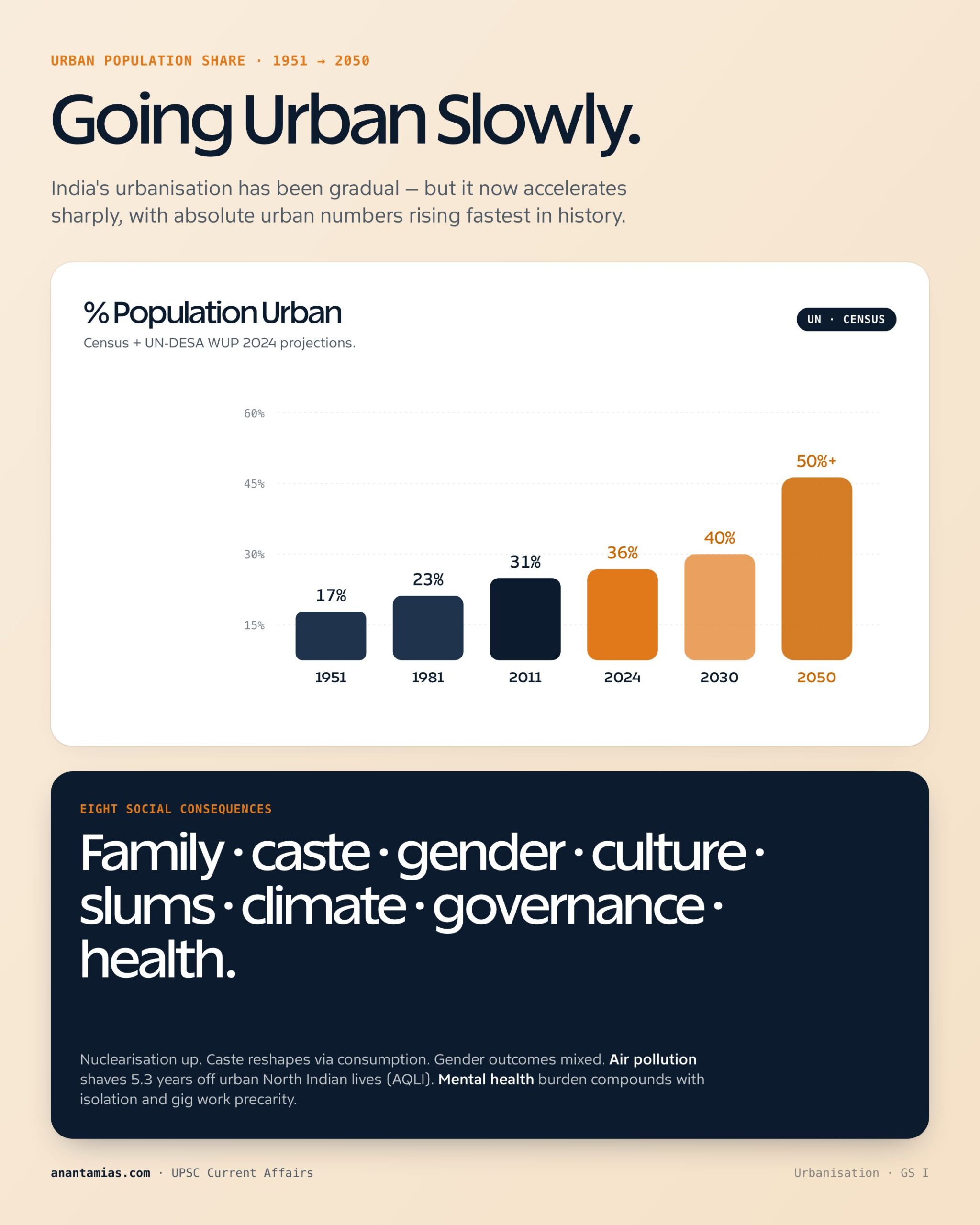
By 2031, India will have over 600 million urban dwellers, up from 377 million in Census 2011, and by 2050, over 50% of Indians will live in cities (UN World Urbanization Prospects 2018). Indian urbanisation is not just a demographic shift — it is a profound social transformation. It reorganises the family, caste, gender, culture, polity, and ecology. UPSC GS-I (society, urbanisation, salient features) and GS-II/III (urban governance, infrastructure, climate) treat urbanisation as a master driver of social change in 21st-century India.
This guide tracks urbanisation's causes, sociological theory, eight social consequences, the constitutional-legal architecture, government schemes, the data picture in 2024-26, challenges, and the way forward.
What Is Urbanisation?
Urbanisation is the process of an increasing proportion of population living in urban areas, accompanied by structural shifts from agriculture to industry/services, and from rural to urban occupations and lifestyles.
Census Definition
- Statutory town: Notified Municipality, Corporation, Cantonment, etc.
- Census town: Population ≥5,000; ≥75% male workforce in non-agriculture; density ≥400/sq km.
- Urban Agglomeration: Continuous urban spread of one or more towns.
Key Indicators (Census 2011 → 2024 estimates)
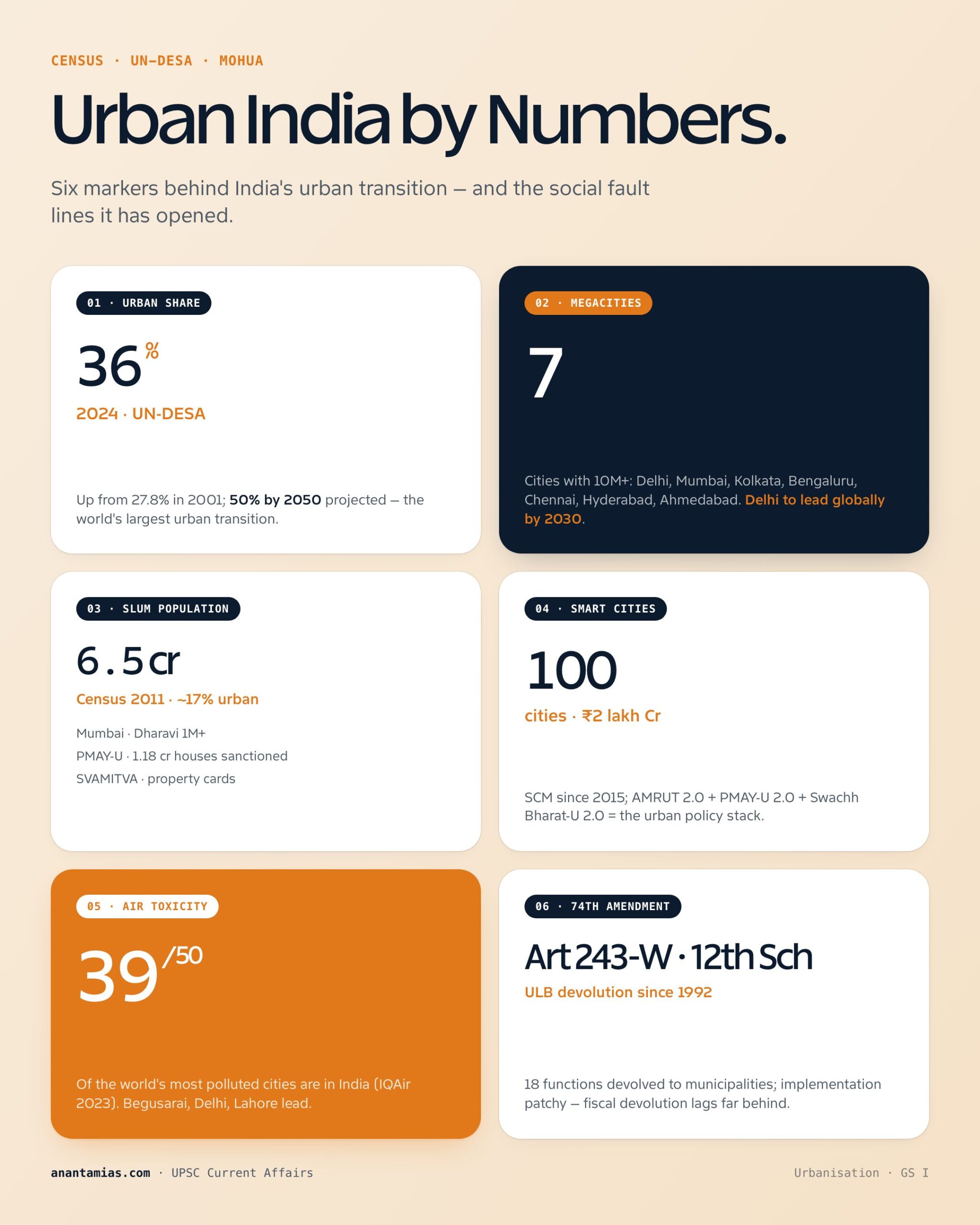
- Urban share: 31.16% (Census 2011) → ~36-37% (UN/World Bank 2024 estimates).
- Urban population: 377 million (2011) → ~~520 million (2024 estimate).
- Number of statutory towns: 4,041; census towns: 3,894.
- Slum population: 65.5 million (Census 2011); ~17% of urban population.
Sociological Lens
- Émile Durkheim: Urbanisation shifts solidarity from mechanical (likeness) to organic (interdependence).
- Ferdinand Tönnies: From Gemeinschaft (community) to Gesellschaft (association).
- Louis Wirth (Urbanism as a Way of Life, 1938): Urban life = density + heterogeneity + size → impersonal, segmental relations.
- Max Weber: City as a centre of rational-legal authority, market exchange.
- Manuel Castells: Network society, "space of flows" replacing "space of places".
- Saskia Sassen: Global cities (Mumbai, Bengaluru as second-tier global cities).
- M.S.A. Rao: Urbanisation in India is non-classical — informal sector dominates.
- Ashish Bose: Coined "BIMARU" states; pioneered Indian urban demography.
Drivers of Indian Urbanisation
| Driver | Mechanism |
|---|---|
| Push factors | Agrarian distress, droughts, fragmenting holdings, debt |
| Pull factors | Jobs, education, healthcare, lifestyle |
| Industrialisation | Manufacturing clusters (Pune, Surat, Chennai) |
| Services boom | IT, BPO, fintech (Bengaluru, Hyderabad, Gurugram) |
| Reclassification | Census towns from rural settlements |
| Policy | SEZs, Smart Cities, AMRUT, industrial corridors |
| Climate-driven migration | Coastal erosion, drought, floods |
Eight Social Consequences of Urbanization
1. Family Structure: From Joint to Nuclear
- Mean household size fell from 5.5 (NFHS-1, 1992-93) to 4.4 (NFHS-5, 2019-21).
- Nuclear-household share is ~52% in NFHS-5 (50% in NFHS-4).
- Functional jointness persists via remittances, calls, joint property, marriage networks (A.M. Shah).
- Intergenerational strain: gerontocratic norms vs. youth autonomy.
- Elderly isolation: 20% of urban elderly live alone (LASI 2020).
- Rise of dual-income families in metros.
2. Caste: Identity Reshapes, Hierarchy Persists
- Caste endogamy weakens in metros (still ~10% inter-caste marriage, Lok-Oxford).
- Caste-based occupations dilute; occupational mobility increases.
- Class identity strengthens in middle-class urban professionals.
- Dalit middle class emergence — Sukhadeo Thorat, Surinder Jodhka studies.
- Caste in IT: Recent disclosures (Cisco discrimination case 2020 in US, California SB 403 ruled in 2023) and Equality Labs surveys indicate caste persists in tech.
- Bihar Caste Survey 2023 + Census 2027 caste enumeration will deepen the data picture.
3. Status of Women: Mixed Outcomes
- Female LFPR rose from 23.3% (PLFS 2017-18) to 41.7% (PLFS 2023-24) — driven partly by urban service jobs.
- Women's mean age at marriage rose from 17.2 (NFHS-1) to 22 (NFHS-5).
- White-collar work expands women's social/economic status.
- Yet gender pay gap: Women earn 27% less than men in urban India (Oxfam 2023).
- Crimes against women in metros: NCRB 2022 — Delhi tops Tier-1 cities.
- Public space and safety: Nirbhaya Fund (₹10,000+ crore allocated since 2013).
4. Culture: Cosmopolitan and Hybrid
- Cities are melting pots — linguistic, religious, regional diversity.
- Hybrid food (Desi Chinese, sushi-thali), dress, music (Indie/EDM-fusion), festivals.
- Rise of micro-cultures: K-pop fan clubs, anime societies, queer collectives.
- Linguistic shift: English + Hindi as urban link languages; vernacular in private domain.
- Glocalisation: McDonald's Aloo Tikki burger; Spotify regional playlists.
5. Slums and Informality
- 65.5 million slum dwellers (Census 2011) — likely ~120 million today.
- Mumbai's Dharavi (~10 lakh residents) — redevelopment project under way (Adani-led 2023).
- Informal sector absorbs ~80% of urban workforce (PLFS 2023-24).
- Street vendors: ~30 lakh; Street Vendors Act 2014 + PM SVANidhi (2020) — credit support.
- Affordable housing gap: ~1.7 crore houses (MoHUA estimate).
6. Health: Urban Penalty and Premium
- Urban India faces a double burden: NCDs (diabetes, hypertension) + slum infectious diseases (TB, dengue).
- Mental health: 13.7% lifetime prevalence; urban rates higher (NMHS 2015-16).
- Air pollution: 39 of world's 50 most polluted cities are Indian (IQAir 2023).
- Urban heat island: Delhi, Ahmedabad heat-action plans.
- Ayushman Bharat + PM-ABHIM (2021, ₹64,180 crore) for urban primary health.
7. Crime and Anomie
- Higher crime rates in metros: Delhi tops crime/lakh among Tier-1 cities (NCRB 2022).
- Cybercrime booming: 65,893 cases (NCRB 2022); IT cities lead.
- Anomie (Durkheim): Normlessness in transition; mental health crisis.
- Communal flashpoints: 272 communal riot cases in 2022 (NCRB).
8. Environmental and Climate Stress
- 90% of urban India relies on private mobility; PM2.5 above WHO limits in most cities.
- Water stress: Bengaluru 2024 crisis; Chennai 2019 "Day Zero".
- Solid waste: ~62 million tonnes/year, 70% collected, ~12% scientifically processed.
- Climate-driven displacement to cities.
- Net Zero by 2070 commitment requires urban transformation.
Constitutional and Legal Framework
| Provision | Coverage |
|---|---|
| 74th Amendment (1992) | Constitutional status to ULBs |
| Article 243-W + 12th Schedule | 18 functions devolved to municipalities |
| 243-X, 243-Y | Finance Commission, taxation |
| Article 19, 21 | Right to livelihood (Olga Tellis 1985) |
| Street Vendors Act 2014 | Vending zones, certificates |
| Real Estate Regulation Act 2016 | RERA — buyer protection |
| Solid Waste Management Rules 2016 | MoEFCC |
| National Urban Transport Policy 2014 | |
| Model Building Bye-Laws 2016 |
Government Initiatives
| Scheme | Year | Outlay/Coverage |
|---|---|---|
| Smart Cities Mission | 2015 | 100 cities; ~₹2 lakh crore projects |
| AMRUT 2.0 | 2021 | ₹2.99 lakh crore for water, sewerage |
| PMAY-Urban | 2015; 2.0 in 2024 | 1.18 crore houses sanctioned (PMAY-U); PMAY-U 2.0 with 1 crore additional |
| Swachh Bharat Mission – Urban 2.0 | 2021 | ₹1.41 lakh crore — garbage-free cities |
| PM SVANidhi | 2020 | Credit for street vendors |
| HRIDAY | 2015 | Heritage city development |
| DAY-NULM | 2013 | Urban livelihoods |
| National Urban Digital Mission | 2021 | Smart governance |
| e-Mobility schemes: FAME-II, PM e-Bus Sewa | 2023 | EV transition |
| PM Surya Ghar (Muft Bijli) | 2024 | Rooftop solar in 1 crore households |
Data Snapshot (2024-26)
| Indicator | Value | Source |
|---|---|---|
| Urban share | ~36-37% (2024 est.) | UN/World Bank |
| Slum population | 65.5 million (Census 2011) | Census |
| Female LFPR | 41.7% | PLFS 2023-24 |
| Mean household size | 4.4 | NFHS-5 |
| Crimes against women | 4,45,256 (2022) | NCRB |
| Cybercrime cases | 65,893 (2022) | NCRB |
| Urban poverty (Tendulkar 2011-12) | 13.7% | NSO |
| Air pollution (Indian cities in world top 50) | 39 | IQAir 2023 |
| Affordable housing gap | ~1.7 crore | MoHUA |
| Inter-caste marriage share | ~10% | Lok-Oxford |
| Urban TFR | 1.6 | NFHS-5 |
Sociological Perspectives Applied
| Theorist | Concept | India Application |
|---|---|---|
| Louis Wirth | Urbanism as way of life | Anonymity, secondary contacts in metros |
| Tönnies | Gemeinschaft → Gesellschaft | Joint to nuclear family |
| Durkheim | Anomie | Mental health, crime |
| Castells | Network society | IT cities — Bengaluru, Hyderabad |
| Sassen | Global city | Mumbai, Delhi, Bengaluru |
| M.S.A. Rao | Non-classical urbanisation | Informal sector dominance |
| Patrick Geddes | Conservative surgery | Urban planning of Indian cities |
Challenges
- Slums and inequality — 17% live in informal settlements.
- Affordable housing gap — 1.7 crore deficit.
- Urban governance fragmentation — 74th Amendment incomplete.
- Air, water, waste crises.
- Mental health epidemic.
- Migrant precarity — exposed by COVID-19; e-Shram registers 30+ crore informal workers.
- Gender insecurity in public spaces.
- Caste-religion ghettoisation.
- Climate vulnerability — heat, floods, cyclones.
- Fiscal stress — ULBs' revenue gap; Finance Commission devolution still inadequate.
Way Forward
- 74th Amendment in spirit: Empower mayors, devolve all 18 functions.
- Urban Master Plans 2.0: NITI Aayog Reforms for Land and Master Planning (2023).
- Inclusive urbanisation: PMAY-U 2.0; in-situ slum redevelopment with land rights.
- Climate-resilient cities: NDMA Heat Action Plans; Sponge cities; AMRUT 2.0 water management.
- Public transport priority: Metro, e-buses, NMT, walkability.
- Gender-safe public spaces: Nirbhaya Fund, Safe City projects.
- Mental health: Tele MANAS, Urban PHCs, workplace mental health.
- Data infrastructure: Census 2027 + e-Shram + PLFS quarterly + ULB data portals.
- Federal-fiscal reform: 16th Finance Commission devolution to ULBs.
- Glocalisation as cultural strategy: protect linguistic-cultural diversity in urban migration.
Mains Hook
"Indian urbanization is not a transition from rural to urban; it is a renegotiation of family, caste, gender, and culture in a single generation." Critically examine the social consequences of urbanization in India, with reference to data from NFHS-5, PLFS 2023-24, and recent Smart Cities/AMRUT outcomes. (GS-I, 250 words, 15 marks)
Prelims Pointers
- 74th Amendment: 1992; 12th Schedule lists 18 functions.
- Census town definition: Pop ≥5,000; ≥75% male non-agri workforce; density ≥400/sq km.
- Urban share: 31.16% (2011); ~36-37% (2024 estimates).
- Smart Cities Mission: 2015; 100 cities.
- AMRUT 2.0: 2021; ₹2.99 lakh crore.
- PMAY-Urban 2.0: 2024; 1 crore additional houses.
- Olga Tellis v. BMC: 1985 — right to livelihood under Article 21.
- Street Vendors Act: 2014.
- Mean household size: 4.4 (NFHS-5).
- Urban TFR: 1.6 (NFHS-5).
- Wirth's "Urbanism as a Way of Life": 1938.
- Female LFPR: 41.7% (PLFS 2023-24).
Urbanisation in India is the macro-process of our era — and its social consequences are not side-effects but the substantive content of GS-I society. UPSC answers should integrate demographic data + sociological theory + scheme architecture + recent legal/judicial moves for full-spectrum credit.