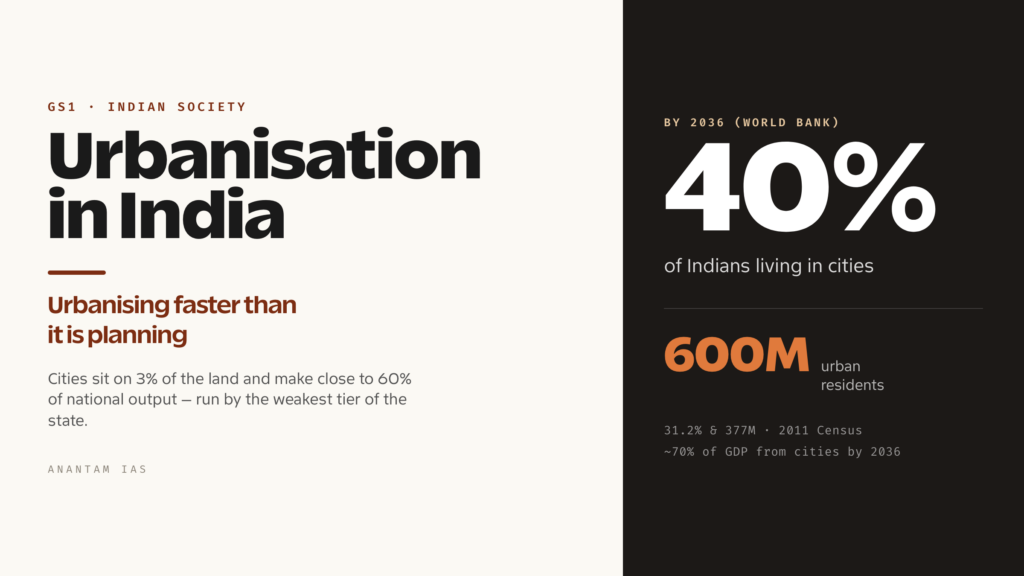
Pick any growing Indian city and you will find the same paradox on a single street. A glass office tower that helps the country chase a USD 5-trillion economy stands beside a settlement that has no piped sewerage, and the local government meant to fix that gap collects barely enough tax to pay its own staff. India’s towns and cities occupy roughly 3% of its land and yet generate close to 60% of national output. That is the deal urbanisation offers — extraordinary productivity from a tiny footprint — and it is the deal India keeps signing without reading the fine print.
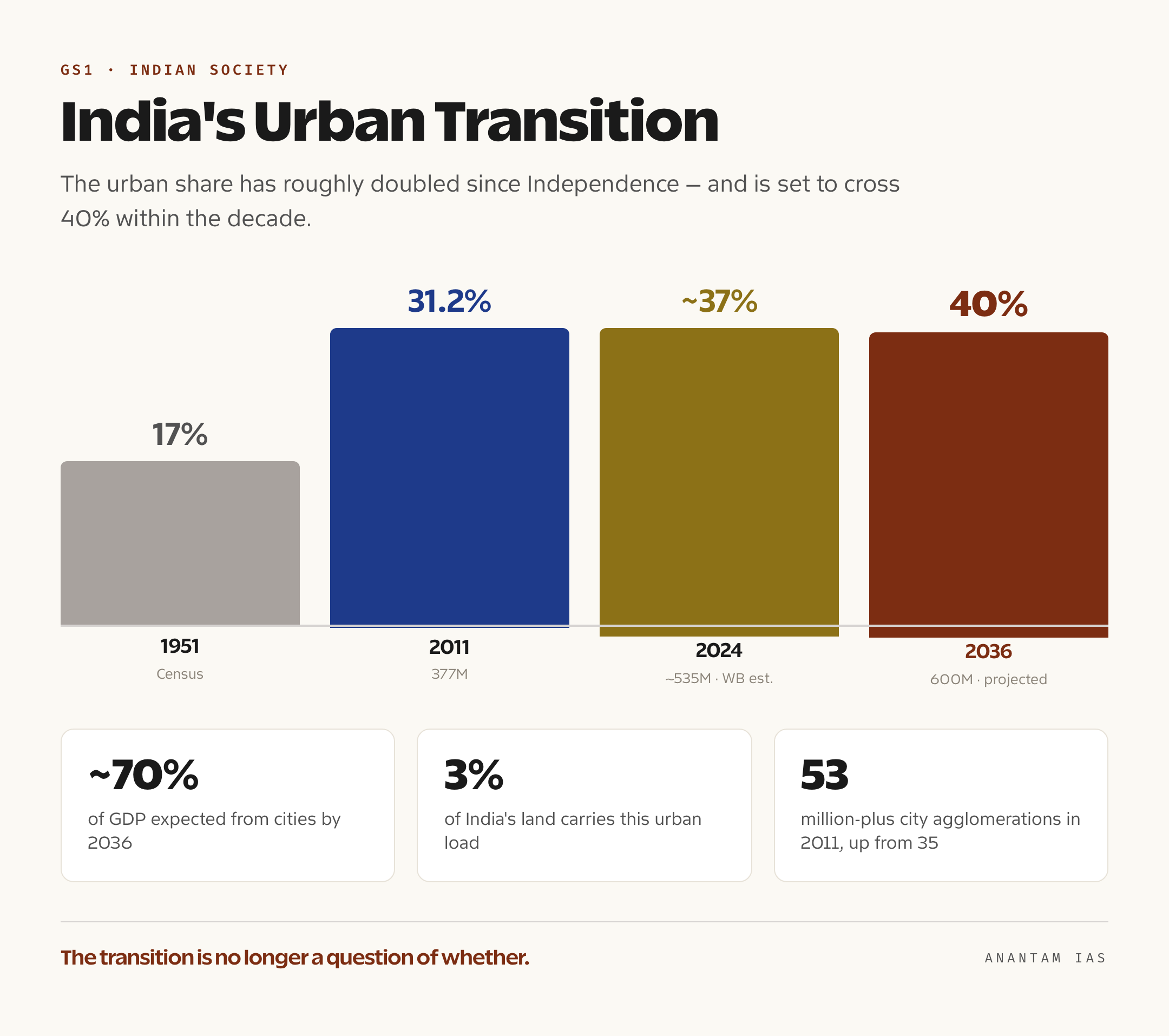
The fine print is governance. India is urbanising faster than it is planning for, financing, or governing its cities. The World Bank expects 600 million people, about 40% of Indians, to be living in urban areas by 2036, up from 377 million and 31.2% at the 2011 Census. So the question is no longer whether India will become an urban country. It already is becoming one. The question is whether the city it builds will be a ladder out of poverty or a permanent waiting room — and the answer depends almost entirely on the unglamorous machinery of master plans, municipal budgets and the 74th Amendment.
What Counts as “Urban” in India
Before the data makes sense, the definitions have to. And in India “urban” is not one thing — it is two, decided by the Census of India, and the gap between them explains a lot of the trouble.
The first kind is the statutory town: any place with a municipal corporation, municipality, cantonment board or notified area committee. These are urban because the law says so. The second kind is the census town, which has no urban local government at all but still behaves like a town on three tests — a population of at least 5,000, a density of at least 400 people per square kilometre, and more than 75% of the male workforce in non-farm work. A census town looks, works and crowds like a small city, but on paper it is still a village, run by a panchayat.
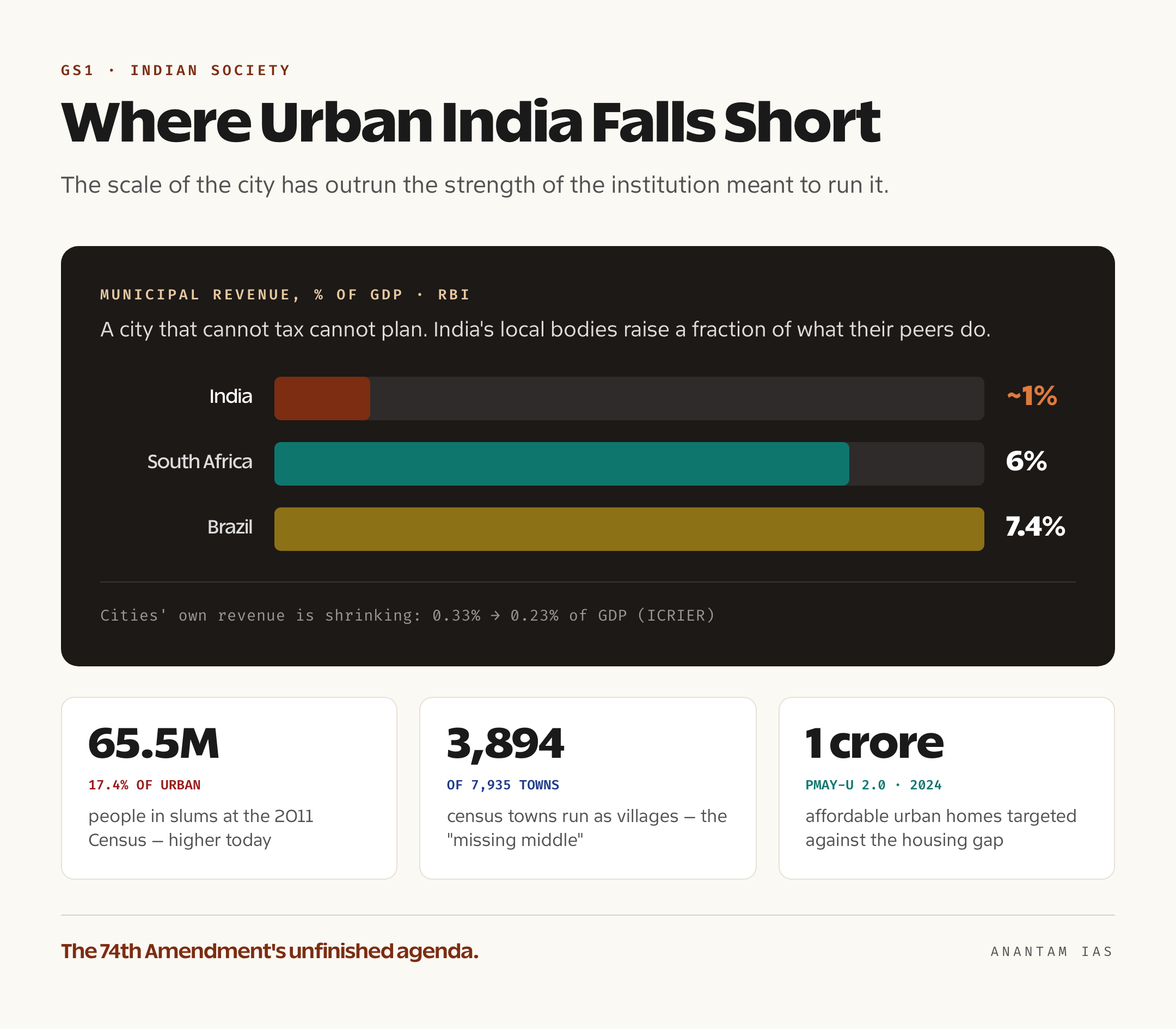
That distinction sounds like accounting trivia. It isn’t. At the 2011 Census, India had 7,935 towns, of which 4,041 were statutory and 3,894 were census towns — and the census-town count had nearly tripled in a single decade. So a huge slice of India’s recent urban growth happened outside the urban governance system entirely, in places that draw municipal-scale crowds but get gram-panchayat-scale services and budgets. Demographers call this the “missing middle”: one IndiaSpend analysis found roughly 24,000 large villages housing about 190 million people who live urban lives without urban status. It is the single clearest sign that India’s urbanisation is running ahead of its administrative imagination.
The Landscape: How Urban Is India Really
Start with the headline and then complicate it. The 2011 Census put India’s urban share at 31.2% — about 377 million people. By the World Bank’s reckoning, that share had climbed to roughly 37% by 2024, or about 535 million people, and the trajectory points to 600 million and 40% by 2036. By then cities are expected to produce nearly 70% of GDP. So even on the official count, urban India is already larger than the entire population of the United States and most of Western Europe combined.
But the official count almost certainly undercounts. Because the census-town test is strict and the last Census was in 2011 — the 2021 round was postponed and only recently set in motion — planners have been steering a fast-moving country with a fifteen-year-old map. Satellite and night-lights studies have repeatedly suggested India’s true urban share is higher than the Census reports, partly because so much growth is hiding inside those census towns and large villages. So when people say India is “only” a third urban, that figure is best read as a floor, not a ceiling.
The shape of urban India matters as much as the size. Growth is concentrating in the biggest places — a process called metropolitisation. The 2011 Census counted 53 urban agglomerations with a million or more people, up from 35 a decade earlier, and these million-plus cities now hold a large share of the urban total. Mumbai, Delhi, Bengaluru, Kolkata, Chennai, Hyderabad and Ahmedabad anchor the economy, while smaller cities and towns absorb a quieter, less-serviced share of the migration. This is where the terms over-bounded and under-bounded cities come in: an over-bounded city’s municipal limits sweep in rural land it doesn’t really service, inflating its area; an under-bounded city’s economic footprint spills far past its legal boundary, so its real population and pressures are larger than its budget assumes. Bengaluru and the National Capital Region are textbook under-bounded sprawls — the city the planners govern is smaller than the city people actually live in.
What Is Driving It
Three forces push the curve up, and it helps to separate them because they call for different responses.
The first is natural increase — cities growing from within as their own residents have children and live longer, helped by better urban healthcare and falling infant mortality. A surprisingly large share of India’s urban growth comes from this internal momentum rather than from new arrivals, which is why even a city that stopped all migration tomorrow would keep expanding.
The second is rural-to-urban migration, the classic engine. People move because the village pushes and the city pulls. Agrarian distress, fragmented landholdings and underemployment push; better wages, schooling, healthcare and the simple density of opportunity pull. The 2011 Census recorded over 450 million internal migrants in total, and the Periodic Labour Force Survey continues to track distress-driven and circular migration — the worker who spends the harvest in the village and the lean months on a city construction site. The COVID-19 reverse-migration of 2020 was a brutal reminder of how provisional that urban foothold can be.
The third is reclassification and agglomeration. As economic activity clusters, villages quietly cross the census-town threshold and get counted as urban without anyone moving at all. Industrial corridors, IT hubs and the Smart Cities programme accelerate this by seeding jobs that pull settlement around them. So a chunk of India’s “urbanisation” is really the countryside turning into town under the planners’ feet — which loops straight back to the missing-middle problem.
Where It Falls Short
This is the heart of the matter, and the honest version is uncomfortable: India is getting the growth without building the institutions to absorb it. Six pressure points recur in almost every Indian city.
Affordable housing and slums. The 2011 Census found 65.5 million people — about 17.4% of the urban population — living in slums, and the real number today is higher. Land is scarce, formal housing is priced far beyond what a migrant earns, and the result is informality at scale.
Water, sanitation and the environment. Many cities still cannot supply piped water around the clock or treat the bulk of their sewage; a large share flows untreated into rivers and drains. Layer on urban flooding — Chennai in 2015, Bengaluru in 2022 — heat islands and dangerous air, and the environmental bill of unplanned density comes due fast.
Urban transport. Private vehicle numbers have outrun road and transit capacity, so congestion and pollution rise together even as metro networks expand past 900 km. The mismatch between where people can afford to live and where the jobs are turns into hours lost in traffic every day.
Weak planning. A large share of statutory towns still expand without an enforceable, up-to-date master plan, so growth happens first and infrastructure chases it — the most expensive sequence possible.
Census towns outside the system. Those 3,894 census towns and thousands of urbanising villages keep growing under panchayat administration, with neither the powers nor the budgets to lay urban-grade water, sewerage or roads.
Municipal finance and the 74th Amendment’s unfinished agenda. This is the deepest fault line. The 74th Constitutional Amendment of 1992 was meant to make urban local bodies a genuine third tier of government, with devolved functions, finances and functionaries. Three decades on, the devolution is partial almost everywhere. The RBI’s Report on Municipal Finances found municipal revenue stuck at roughly 1% of GDP — against about 7.4% in Brazil and 6% in South Africa — and an ICRIER study found cities’ own revenue actually shrinking as a share of GDP, from 0.33% to 0.23% over a recent five-year window. So the tier of government closest to the fastest-growing part of the economy is also its weakest and most dependent. A city that cannot tax cannot plan, and a city that cannot plan cannot serve.
The Way Forward
None of this is destiny. The fixes are known; the gap is in execution and political will. A pragmatic agenda runs roughly in this order.
- Finish the 74th Amendment. Devolve the planning, finance and staffing functions to urban local bodies in substance, not just in statute. Empower State Finance Commissions, modernise property-tax systems with GIS mapping, and let creditworthy cities raise municipal bonds — Indore, Ahmedabad and others have shown it can be done.
- Bring the missing middle inside the tent. Reclassify qualifying census towns and large villages as statutory urban bodies so they get urban planning, urban budgets and urban services before, not after, the crisis.
- Plan before you build. Make statutory, regularly updated and enforceable master plans the norm, with transit-oriented development clustering homes and jobs along metro and bus-rapid-transit corridors.
- Treat housing as supply, not just subsidy. Pair PMAY-U 2.0 with rental housing, in-situ slum upgrading and the release of locked public land, so affordable homes actually reach migrants and the urban poor.
- Build for climate. Design for heat, flooding and water security from the start — permeable surfaces, restored wetlands, urban forests, circular-economy waste systems — rather than retrofitting after the disaster.
- Strengthen rural towns too. Schemes like the Shyama Prasad Mukherji Rurban Mission that deliver urban-grade services in rural clusters can take pressure off the metros and make distress migration a choice rather than a compulsion.
The model the Economic Survey and most planners keep returning to is straightforward: cities are not a problem to be managed but the country’s primary engine of prosperity — provided the institution running them is given the money and the mandate to match the scale.
For Your Mains Answer
Urbanisation is one of the most reliably examined themes on the GS map. It sits in GS Paper 1 under “urbanisation, their problems and their remedies” within Indian Society; in GS Paper 2 under local self-government and the 74th Amendment; and in GS Paper 3 under infrastructure, inclusive growth and the environment. It is also a recurring Essay prompt on cities, planning and development.
How to Build the Answer
Open with the paradox — small footprint, outsized output — then state the real problem in one line: India is urbanising faster than it is planning. Define the statutory-versus-census-town distinction early, because it lets you make the “missing middle” point that separates a top answer from an average one. Move through drivers, then challenges, then a forward-looking reform package anchored on the 74th Amendment and municipal finance. Close on balance, not despair.
Common Mistakes to Avoid
Don’t treat urbanisation as purely a problem; examiners reward candidates who frame it as an opportunity that is being squandered by weak institutions. Don’t list schemes without outcomes — anyone can name AMRUT; few can say its money is stuck because cities can’t co-finance. Don’t ignore municipal finance and the 74th Amendment’s unfinished agenda, which is the analytical core. And don’t drown the answer in dates; two or three anchors are enough.
A Compact Answer Spine
Cities on 3% of land, ~60% of GDP → 31.2% urban in 2011, heading to 40% and 600 million by 2036 → statutory vs census towns and the “missing middle” → drivers: natural increase, migration, reclassification → challenges: slums (65.5 million), water and sanitation, transport, weak plans, and above all municipal finance stuck at ~1% of GDP → way forward: devolve under the 74th Amendment, fix city finances, plan before building, climate-proof → cities as engines, if empowered.
Diagram or Flowchart Idea
Draw a simple two-column balance: on the left, “What cities give” (3% of land, ~60% of GDP, 40% of people by 2036); on the right, “What cities get” (municipal revenue ~1% of GDP, partial 74th-Amendment devolution, no enforceable master plans). The visual imbalance makes your central argument in one glance.
A Balanced-Conclusion Line
“India’s urban future is not in doubt; its urban governance is. The task is to give the city the same constitutional and fiscal seriousness we have long reserved for the Union and the states.”
How to Use Data Without Cramming
Carry four numbers and deploy them precisely: 31.2% urban (2011), 40% / 600 million by 2036, 65.5 million slum dwellers, and municipal revenue at ~1% of GDP versus 7%-plus abroad. Each one anchors a different paragraph — scale, trajectory, equity, governance — so four figures cover the whole answer without a single one feeling crammed in.
FAQ
What percentage of India’s population lives in urban areas? The 2011 Census put India’s urban share at 31.2%, about 377 million people. The World Bank estimates it had risen to roughly 37% by 2024, and projects 600 million people — about 40% of Indians — living in urban areas by 2036, when cities are expected to generate nearly 70% of GDP.
What is the difference between a statutory town and a census town? A statutory town has an urban local government — a municipal corporation, municipality, cantonment board or notified area committee. A census town has no urban government and is still administered as a village, but qualifies as urban on three Census tests: at least 5,000 people, density of at least 400 per square kilometre, and over 75% of male workers in non-farm jobs. At the 2011 Census, 3,894 of India’s 7,935 towns were census towns.
Why is urban local body finance such a big problem? The 74th Constitutional Amendment of 1992 was meant to make cities a strong third tier of government, but the devolution of money and powers remains partial. The RBI found municipal revenue stuck at about 1% of GDP — far below Brazil’s 7.4% or South Africa’s 6% — leaving cities too cash-starved to plan, build or maintain at the scale their populations demand.
What are the major government missions for India’s cities? The main programmes are the Smart Cities Mission (100 cities), AMRUT and AMRUT 2.0 (water, sewerage, transport and green spaces, with an outlay near Rs 2.99 lakh crore), PMAY-U 2.0 (launched in 2024 to build one crore affordable urban homes, with about Rs 10 lakh crore in investment and Rs 2.30 lakh crore in subsidy), the Swachh Bharat Mission-Urban for sanitation, and a National Urban Policy framework to tie them together.
Practice Questions
Prelims MCQs
- With reference to the classification of urban settlements by the Census of India, which of the following are criteria for a “census town”? 1. A population of at least 5,000.
2. A density of at least 400 persons per square kilometre.
3. More than 75% of the male workforce in non-farm work.
(a) 1 and 2 only
(b) 2 and 3 only
(c) 1 and 3 only
(d) 1, 2 and 3
Answer: (d) — A census town must satisfy all three tests yet has no urban local government and is still administered as a village by a panchayat, unlike a statutory town defined by its municipal status. - Consider the following about India’s urban transition. At the 2011 Census, India’s urban share was about 31.2%, and the World Bank projects which figure by 2036?
(a) 35% and 450 million
(b) 40% and 600 million
(c) 50% and 700 million
(d) 45% and 550 million
Answer: (b) — The 2011 Census recorded 31.2% (about 377 million); the World Bank projects 600 million people, around 40%, in urban areas by 2036, when cities are expected to produce nearly 70% of GDP. - The terms “over-bounded” and “under-bounded” cities, used in urban studies, refer to which of the following?
(a) Cities that exceed or fall short of pollution norms
(b) The mismatch between a city’s municipal limits and its actual economic footprint
(c) Cities with surplus or deficit municipal budgets
(d) Planned versus unplanned cities
Answer: (b) — An over-bounded city’s municipal limits sweep in rural land it does not service, while an under-bounded city, such as Bengaluru or the NCR, spills its economic footprint far beyond its legal boundary and budget. - The “missing middle” in India’s urbanisation debate refers to which phenomenon?
(a) The shrinking urban middle class
(b) Large villages and census towns that live urban lives but lack urban governance and budgets
(c) Mid-sized cities losing population to metros
(d) The gap between rural and urban incomes
Answer: (b) — It describes roughly 24,000 large villages housing about 190 million people who behave like towns but are run as villages, the clearest sign that urbanisation has outrun administrative status. - The 74th Constitutional Amendment, 1992, is central to India’s urban governance debate primarily because
(a) it created the Census town category
(b) it intended to make urban local bodies a genuine third tier of government, but devolution remains partial
(c) it transferred municipal finance to the Finance Commission
(d) it mandated master plans for all cities
Answer: (b) — The amendment sought to devolve functions, finances and functionaries to ULBs, yet three decades on devolution is incomplete, leaving municipal revenue stuck at about 1% of GDP against 7.4% in Brazil and 6% in South Africa.
Mains Practice Questions
- “India is urbanising faster than it is planning, financing or governing its cities.” Critically examine this statement in the light of India’s urban transition. (15 marks, 250 words)
- Distinguish between statutory towns and census towns, and explain how the “missing middle” complicates urban governance and service delivery in India. (15 marks, 250 words)
- Discuss the principal drivers of urbanisation in India — natural increase, rural-to-urban migration and reclassification — and the differing policy responses each demands. (15 marks, 250 words)
- Municipal finance and the unfinished agenda of the 74th Constitutional Amendment form the deepest fault line in Indian urban governance. Analyse. (15 marks, 250 words)
- “Cities are not a problem to be managed but the country’s primary engine of prosperity.” Discuss the major challenges confronting Indian cities and suggest a reform agenda to realise this potential. (15 marks, 250 words)
Tell Google you want more of this.
Add Anantam IAS as a preferred sourceOne tap, and this site shows up more often in your own Top Stories, AI Overviews and AI Mode. Remove it any time.