SpaDeX Space Docking Experiment: How ISRO Joined the Docking Club and Why It Matters
A complete UPSC GS-III explainer on ISRO's SpaDeX mission. Covers the twin-satellite design, autonomous rendezvous and docking sequence, the Bharatiya Docking System, the strategic value for Bharatiya Antariksh Station and Chandrayaan-4, and the global context of orbital docking.
Space docking is the technology that turns space exploration from a series of one-shot missions into a continuous human presence in orbit. Every space station, every crewed lunar mission, every fuel-depot architecture in the post-Apollo era depends on it. Two spacecraft launched separately must find each other in orbit, close the distance with millimetre precision, line up their docking ports, and connect mechanically and electrically without spilling fuel, breaking seals, or destroying equipment that took years to build.
Until December 2024, only three nations had demonstrated autonomous orbital docking — the United States, the Soviet Union and Russia, and China. The Space Docking Experiment, abbreviated SpaDeX, made India the fourth. The PSLV-C60 mission lifted off from Sriharikota on 30 December 2024, carrying two small satellites that would, over the following weeks, perform a controlled rendezvous and dock in low Earth orbit. The successful docking on 16 January 2025 was the first by any new spacefaring nation in more than a decade.
For UPSC GS-III, SpaDeX is a single demonstration mission with disproportionate strategic weight. Without docking, the Bharatiya Antariksh Station planned for the 2030s cannot be assembled, the Chandrayaan-4 lunar sample return cannot be executed, and several proposed in-orbit servicing and propellant transfer missions remain on paper. This article walks through what SpaDeX is, how the docking sequence worked, the Bharatiya Docking System hardware that made it possible, the secondary experiments carried on board, the strategic missions that depend on this capability, and the global context of orbital docking technology.
Quick Facts on SpaDeX
SpaDeX was an experimental twin-satellite mission funded by ISRO to demonstrate autonomous space rendezvous, docking, and undocking technology in low Earth orbit. The full name, Space Docking Experiment, was abbreviated SpaDeX in mission documents and ISRO press releases.
The launch vehicle was the PSLV-C60, an extended variant of the Polar Satellite Launch Vehicle. Lift-off was from the Satish Dhawan Space Centre at Sriharikota on 30 December 2024 at 22:00 IST. The two spacecraft, designated SDX01 and SDX02, were placed in a circular orbit at roughly 470 kilometres altitude with a 55-degree inclination. The first docking attempt was performed on 16 January 2025 and was declared successful. A second docking and undocking sequence followed in March and April 2025 to validate repeatability.
The total mass of each spacecraft was around 220 kilograms, built on a modified version of the IMS-1 small-satellite bus that ISRO has used for several earlier missions. The mission was designed and integrated at the U R Rao Satellite Centre in Bengaluru, with the docking system developed at the Vikram Sarabhai Space Centre in Thiruvananthapuram. The total mission cost was about 125 crore rupees, roughly 15 million US dollars, a figure that ISRO has pointed to as evidence of the cost advantage of Indian space hardware.
Why Docking Matters for Spaceflight
Docking is the joining of two spacecraft in orbit. It allows astronauts to transfer between vehicles, cargo to be delivered to a space station, propellant to be refilled in orbit, and large structures to be assembled from smaller modules launched separately. Without docking, every space station would have to fit on a single launch vehicle, every crewed mission would have to carry all its supplies from launch, and the modular space architectures that have defined the post-1970s era would not exist.
The International Space Station was assembled from more than thirty modules launched between 1998 and 2011, each docking with the existing station after launch. The Chinese Tiangong station, the Soviet-era Mir, and the Russian segment of the ISS all relied on docking for assembly and resupply. Crew transport, from Apollo to Soyuz to SpaceX Crew Dragon, depends on docking. Lunar exploration architectures, from Apollo 11 to the Artemis programme, rely on docking between the spacecraft that travels to lunar orbit and the lander that descends to the surface.
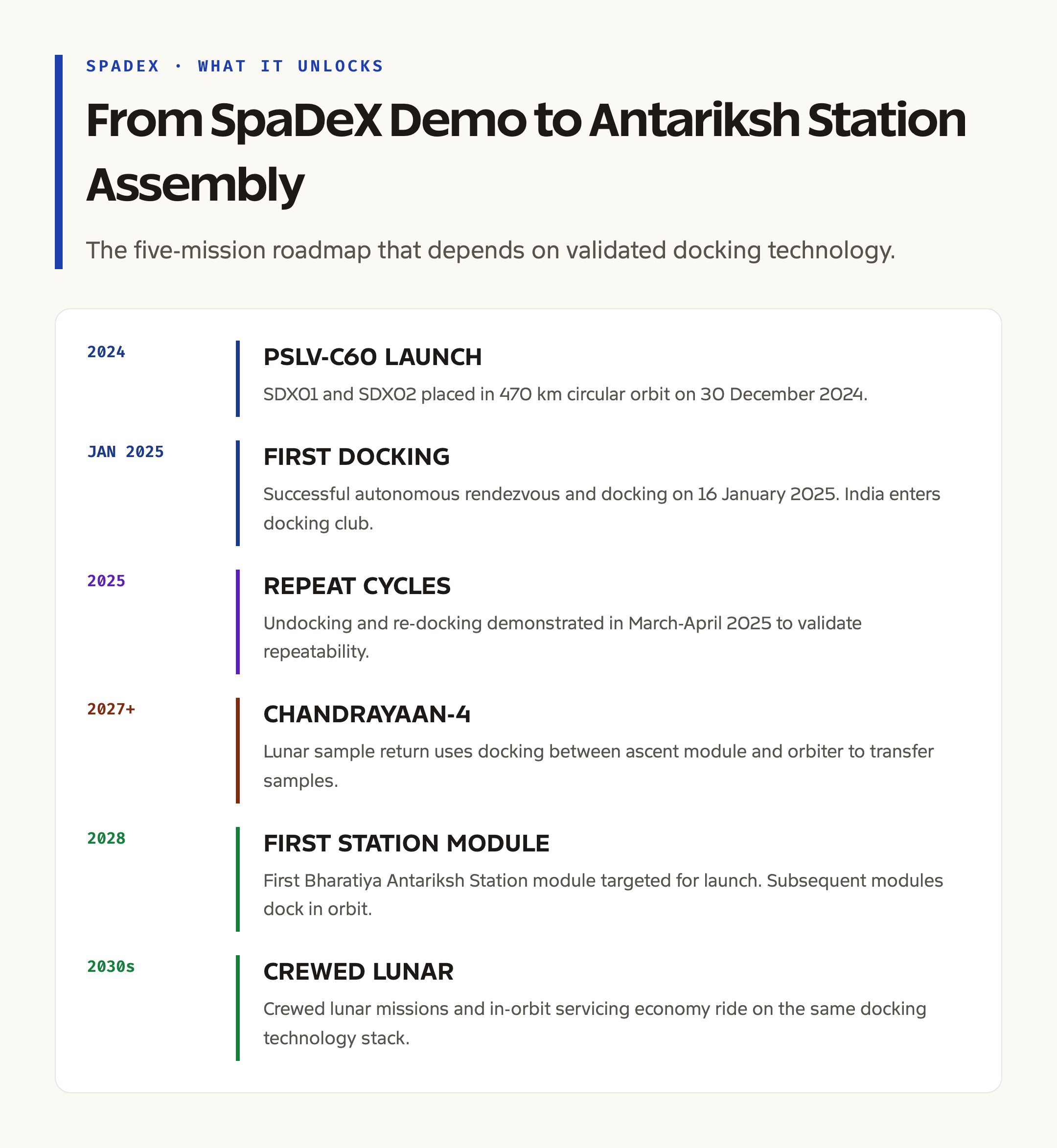
For India, docking unlocks four mission classes. Crewed station assembly, planned for the Bharatiya Antariksh Station from 2028 onward, requires docking. The lunar sample return planned in the Chandrayaan-4 mission requires docking between the orbiter and the ascent module that returns the samples from the surface. Crewed lunar missions, planned for the 2030s, will need it too. In-orbit servicing, refuelling, and assembly missions, an emerging commercial market, are all docking-dependent.
Inside SDX01 and SDX02
The two SpaDeX spacecraft were designated SDX01 (Chaser) and SDX02 (Target). Both were built on the IMS-1 small-satellite bus with modifications for the docking demonstration. Each carried roughly 220 kilograms of mass, including the docking hardware, propulsion system, navigation sensors, and a small payload of secondary experiments.
The chaser, SDX01, was the active partner in the docking. It carried the manoeuvring thrusters and the navigation sensors needed to close in on the target, line up the docking port, and execute the final approach. The target, SDX02, was largely passive. It carried a docking interface compatible with SDX01’s port and a navigation beacon that the chaser used to determine its relative position and orientation. Both spacecraft were power-equipped with deployable solar arrays and used standard ISRO command and telemetry systems.
The most novel piece of hardware was the Bharatiya Docking System, the indigenous androgynous docking port designed by VSSC. Androgynous means each port can act as either chaser or target, so two identical spacecraft can dock with each other. The mechanical interface uses a low-impact docking ring with capture latches, retractable hooks, and electrical connectors for power and data transfer between the two vehicles. The design draws on lessons from international docking systems but is fully indigenous, a strategic priority for ISRO.
The Docking Sequence Step by Step
The docking sequence took place over several weeks because rendezvous in low Earth orbit is constrained by orbital mechanics. The two spacecraft cannot simply turn toward each other and fire engines. They have to use a sequence of orbital manoeuvres that exploit the relative motion of two objects in nearly identical orbits.
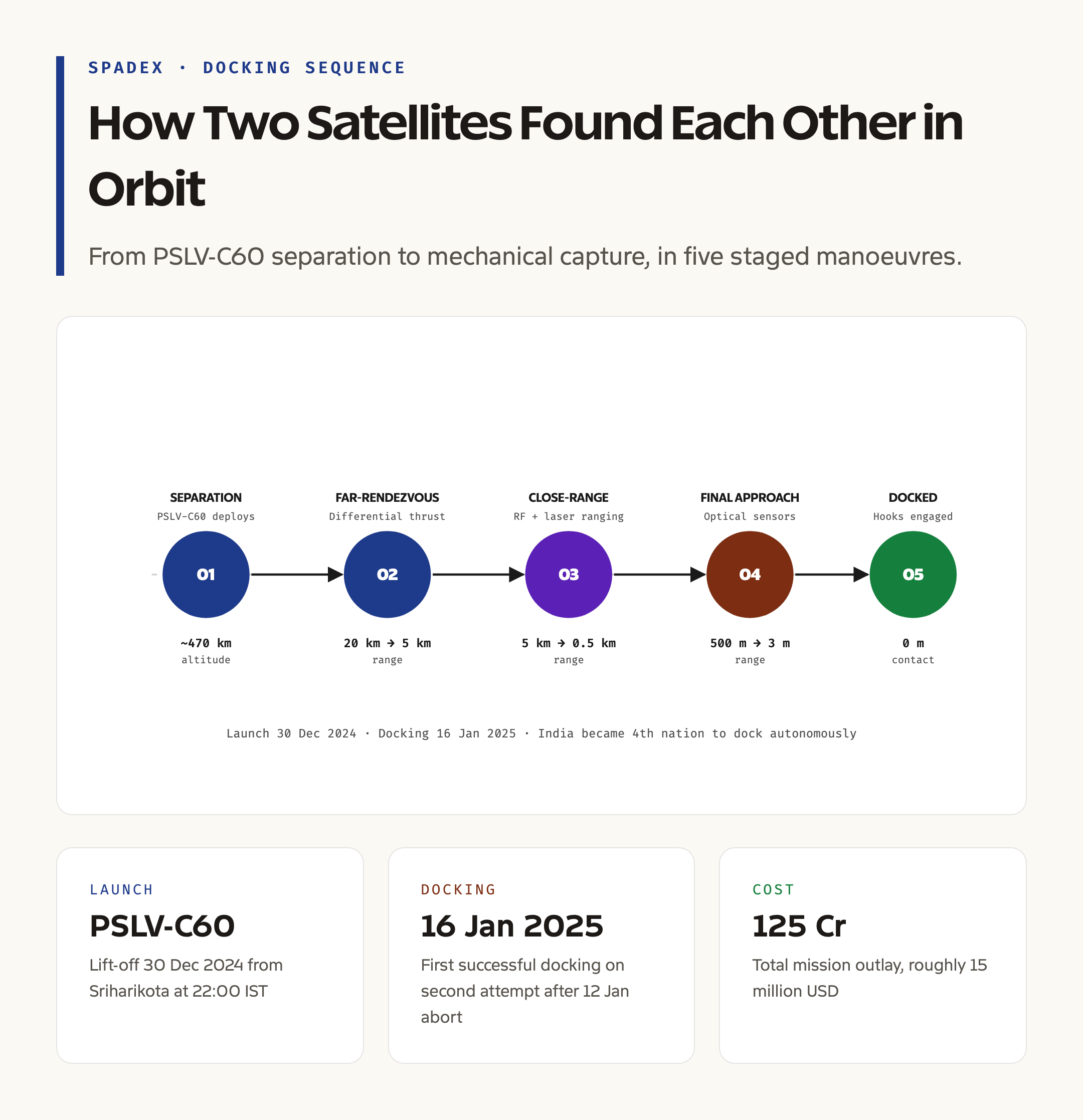
After launch, PSLV-C60 placed both spacecraft in the same orbit. The two satellites separated, with SDX01 deployed first and SDX02 a short interval later. Differential drag caused them to drift apart over the following days until they were roughly twenty kilometres apart, the planned starting distance for the docking sequence.
The far-rendezvous phase used differential thrusting to close the distance. Small thrusters on SDX01 fired to lower its orbit slightly, increasing its orbital velocity relative to SDX02 in a way that, after several orbits, brought it closer. Ground controllers verified the trajectory at each step using ranging data and onboard navigation telemetry.
The close-rendezvous phase began at roughly five kilometres separation. SDX01 used radio-frequency ranging and laser ranging sensors to lock onto SDX02 and continued the approach autonomously, with ground operators monitoring but not directly steering. At a few hundred metres, the chaser switched to optical and proximity sensors for the final approach. At a few metres, it aligned its docking port with the target’s port and made gentle contact. The capture latches engaged, the mechanical hooks closed, and the rigid docking was confirmed by sensor readouts on both spacecraft.
The full sequence, from far-rendezvous to docked configuration, took several hours of active operations spread across the days from 12 to 16 January 2025. The first attempt on 12 January was paused after sensor anomalies, and ISRO took several days to refine the approach trajectory before re-attempting on 16 January.
The Bharatiya Docking System
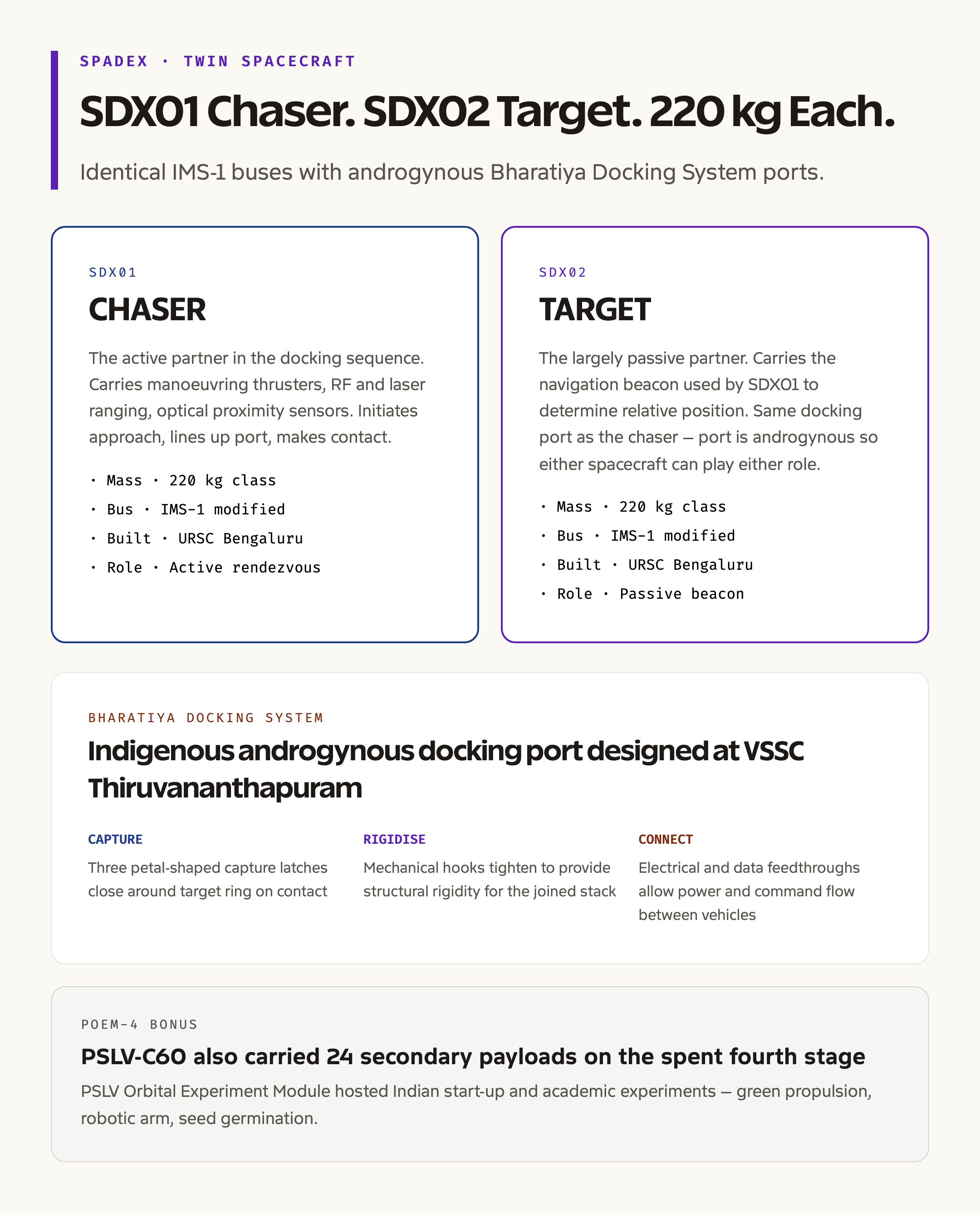
The Bharatiya Docking System, the indigenous docking port designed by VSSC for SpaDeX, is the piece of hardware that makes the rest of India’s docking-dependent missions possible. The system is androgynous and uses a low-impact mechanical capture sequence designed to minimise the energy of the docking event so that the joined spacecraft do not experience a structural shock.
The docking ring at the front face of each spacecraft has three petal-shaped capture latches. As the chaser approaches, the latches contact the target’s docking ring and close around it, achieving soft capture. A set of hooks then closes to provide structural rigidity, and the docking interface produces a hard mechanical and electrical connection. The interface includes electrical and data feedthroughs that allow power and command flow between the joined vehicles.
The reason an indigenous docking system matters is that international docking standards, while well-defined, come with technology-transfer restrictions that have constrained ISRO’s options. The International Docking System Standard, published by the ISS partners, defines a common interface but is not freely licensed for non-partner nations. The Russian APAS docking ports are not exported. China’s docking system is proprietary. Building a domestic system, even at the cost of a couple of years of development, gives India full control over how the technology is used in future missions and clears the path for export to friendly partners.
Secondary Payloads and POEM-4
PSLV-C60 also carried the PSLV Orbital Experiment Module, POEM-4, the latest in a series of orbital platforms built from the spent fourth stage of the PSLV. POEM-4 hosted twenty-four secondary experimental payloads contributed by Indian start-ups, academic institutions, and government laboratories. The payloads ranged from green-propulsion thruster demonstrations to space-based seed-germination experiments and a robotic arm test.
The POEM platform is itself part of ISRO’s broader strategy. By turning the spent upper stage into an orbital experimental platform, ISRO gives Indian start-ups and universities low-cost access to space without the expense of a dedicated launch. POEM-1 in 2022 hosted six payloads, POEM-3 in 2024 hosted nine, and POEM-4 with twenty-four payloads has now established the platform as a recurring part of PSLV missions.
The two SpaDeX satellites also carried a few small secondary payloads of their own, including a radiation experiment and a sensor calibration package, though the primary mission was the docking demonstration.
What SpaDeX Unlocks: Antariksh Station and Chandrayaan-4
The Bharatiya Antariksh Station, India’s planned crewed space station, is a multi-module facility intended to operate at low Earth orbit from the early 2030s. The first module is targeted for launch by 2028. Subsequent modules will dock with the first to form the full station, and crewed Gaganyaan missions will dock with it for crew rotations and experiments. None of this is possible without a working docking capability. SpaDeX validates the technology a full half-decade before the first station module flies. For more on the crewed lunar and station ambitions, see our explainer on the Gaganyaan mission.
Chandrayaan-4 is the lunar sample return mission targeted for the second half of the decade. The mission architecture, as ISRO has described it, involves multiple spacecraft launched separately, an orbiter that stays around the Moon, a descent module that lands and collects samples, an ascent module that returns the samples from the lunar surface to the orbiter, and a return module that brings the samples back to Earth. Two of the inter-stage transfers depend on docking, the ascent module docking with the orbiter to transfer samples, and a similar transfer to the return module. SpaDeX is the technology demonstrator for those manoeuvres.
A third class of mission is in-orbit servicing. The 2023 Indian Space Policy, profiled in our explainer on India’s space technology ecosystem, opens the satellite servicing market to private operators. Refuelling depots, life-extension missions for ageing satellites, and on-orbit assembly of large structures are emerging commercial categories worldwide. Indian start-ups are now positioning to enter this market on the back of validated docking technology.
Global Context: The Docking Club
Four nations have now demonstrated autonomous orbital docking. The United States and the Soviet Union were the first, with crewed docking achieved during the Apollo and Soyuz programmes in the 1960s and 1970s. China demonstrated its first crewed docking with Shenzhou-8 to Tiangong-1 in 2011. India’s SpaDeX docking in January 2025 made it the fourth.
Cargo and crew docking is a routine operation in the present era. Russian Progress, Soyuz, and Chinese Tianzhou cargo flights dock multiple times a year. SpaceX Crew Dragon and Cargo Dragon dock with the ISS regularly. Boeing Starliner has demonstrated the same. The Lunar Gateway, planned under the Artemis programme, will involve repeated docking by Orion crew vehicles and Human Landing System landers.
The strategic value of an indigenous docking capability is that India can now plan crewed and uncrewed mission architectures without dependency on foreign docking standards or technology transfers. It also positions ISRO as a service provider for partner nations that want to participate in the Bharatiya Antariksh Station or other Indian-led space efforts.
What to Watch Going Forward
Three things will mark the maturity of India’s docking capability over the next five years. The first is repeatability. SpaDeX has demonstrated docking, undocking, and re-docking, but routine operational use will require many more cycles in different orbital and lighting conditions. The second is the scale-up to larger spacecraft. SpaDeX docked two 220-kilogram satellites; the Antariksh Station modules will weigh several tonnes each, and the dynamics of docking heavier spacecraft are different. The third is crewed-rated certification. A docking system that joins two uncrewed spacecraft is one thing; a system that admits humans through the docking tunnel is another, with much stricter sealing, redundancy, and emergency-undocking requirements.
For UPSC, the testable elements are the mission identifiers (PSLV-C60, SDX01 chaser, SDX02 target, January 2025 docking), the strategic context (fourth nation, station and lunar mission enabler), and the institutional architecture (VSSC for the docking system, URSC for spacecraft integration, SDSC for launch). The 2024 launch and 2025 docking dates are likely to appear in current-affairs questions for several years.
Frequently Asked Questions
What is SpaDeX in simple terms?
SpaDeX is the Space Docking Experiment, a 2024-2025 ISRO mission that demonstrated India’s ability to join two spacecraft in orbit. PSLV-C60 launched two small satellites, SDX01 and SDX02, into a 470-kilometre orbit. The two satellites separated, drifted apart, and then carried out an autonomous rendezvous and docking on 16 January 2025.
Why is space docking important for India?
Docking is the technology that allows space stations to be assembled in orbit from multiple launches, lunar sample return missions to transfer cargo between spacecraft, and crew vehicles to dock with stations. Without docking, India cannot build the Bharatiya Antariksh Station, cannot execute Chandrayaan-4 sample return, and cannot run any modular crewed mission architecture.
Who else has demonstrated orbital docking?
The United States, the Soviet Union and now Russia, and China demonstrated autonomous orbital docking before India. SpaDeX in January 2025 made India the fourth nation in the docking club.
What is the Bharatiya Docking System?
The Bharatiya Docking System is the indigenous androgynous docking port designed by the Vikram Sarabhai Space Centre. Androgynous means the same docking interface can act as either chaser or target, so two identical spacecraft can dock with each other. The system uses capture latches and retractable hooks for soft capture followed by hard mechanical and electrical mating.
How does SpaDeX connect to Bharatiya Antariksh Station and Chandrayaan-4?
The Bharatiya Antariksh Station, India’s planned crewed station targeted for launch from 2028, will be assembled in orbit from multiple modules that have to dock with each other. Chandrayaan-4, the lunar sample return mission, requires docking between the ascent module returning from the lunar surface and the orbiter. SpaDeX is the technology demonstrator for both architectures.