Statutory Organizations in India — Definition, Examples, Issues, Reforms (UPSC Polity)
UPSC guide to statutory organizations: meaning, examples (NHRC, NCW, NCM, CIC, NGT), constitutional vs statutory bodies, common issues, and 2024-26 reform agenda.
A statutory organization is a body created by an Act of Parliament or a State Legislature — neither directly mandated by the Constitution (like the Union Public Service Commission under Article 315) nor purely an executive creation (like the NITI Aayog). Statutory organizations occupy the middle space of Indian institutional architecture: they have legal personality, defined mandates, and statutory protections, but they remain dependent on the parent ministry for funding, staff, and political backing.
For UPSC, statutory organizations are a high-frequency GS-II topic. The syllabus explicitly mentions "statutory, regulatory, and various quasi-judicial bodies." Recent examination patterns ask candidates to compare constitutional vs statutory bodies, discuss the autonomy of specific bodies (NHRC, CIC, ECI), and propose reforms for institutions criticised for being "toothless tigers" — a phrase the Supreme Court itself used about the NHRC.
This guide explains what statutory organizations are, distinguishes them from constitutional and executive bodies, surveys the major statutory organizations in India, lays out the common issues that recur across all of them — functional weakness, executive interference, appointment opacity, parliamentary apathy — and proposes the reform agenda based on NCRWC, 2nd ARC, Law Commission, and Supreme Court directions through 2024-26.
What is a statutory organization?
A statutory organization is created by a specific Act of Parliament or a State Legislature.
| Source | Examples |
|---|---|
| Constitutional bodies | UPSC (Art 315), CAG (Art 148), ECI (Art 324), Finance Commission (Art 280), Attorney General (Art 76), SC of India (Art 124), HC (Art 214) |
| Statutory bodies | NHRC (PHRA 1993), CIC (RTI Act 2005), NGT (NGT Act 2010), Lokpal (Lokpal Act 2013), SEBI (SEBI Act 1992), TRAI (TRAI Act 1997) |
| Executive bodies | NITI Aayog (Cabinet resolution 2015), Planning Commission (Cabinet, 1950), CBI (DSPE Act 1946) |
| Quasi-judicial bodies | NCLT, NGT, NCDRC, CAT, ITAT |
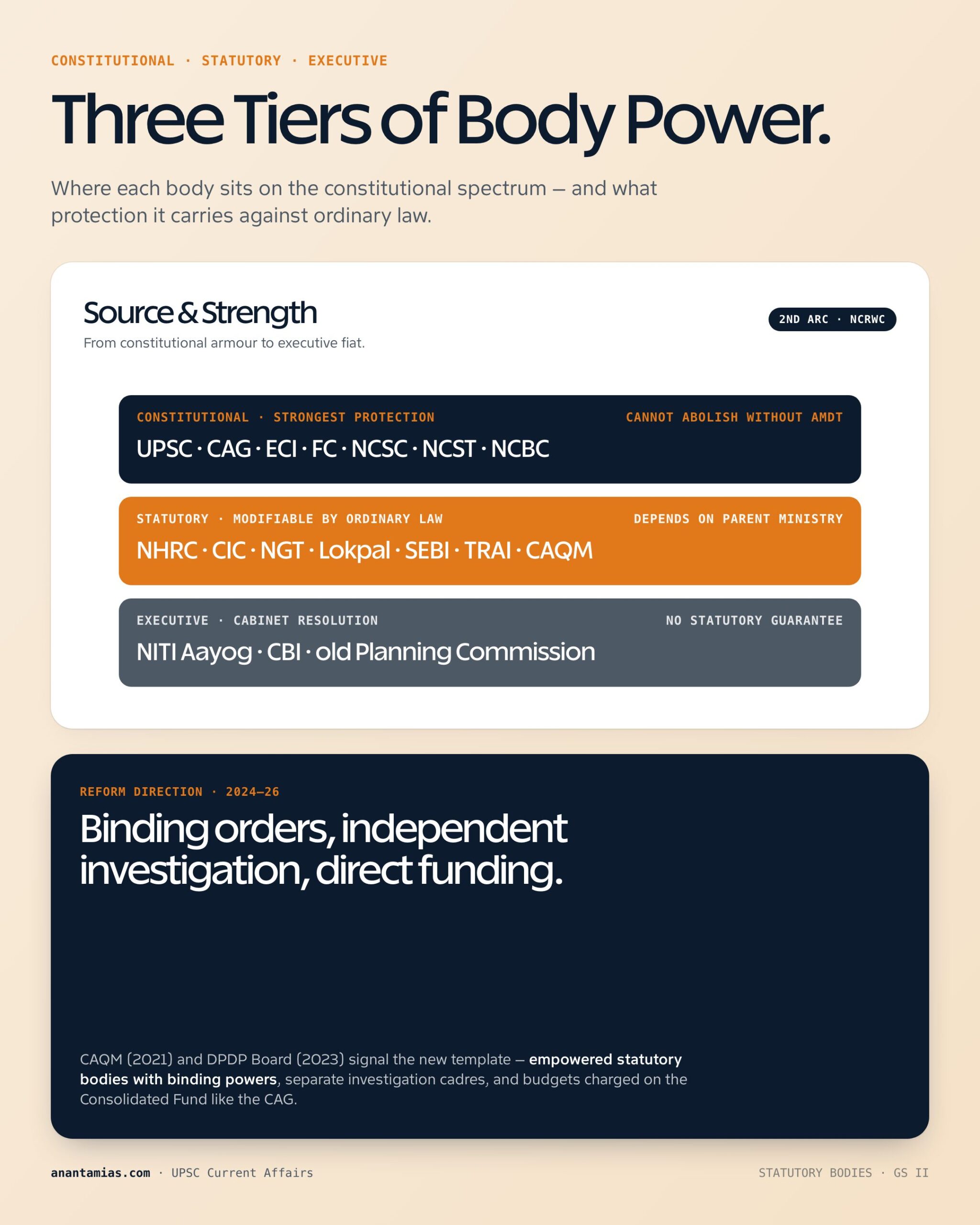
Key distinction: Constitutional bodies have constitutional protection — Parliament cannot abolish them through ordinary legislation. Statutory bodies can be modified, restructured, or even dissolved by Parliament through a simple amendment.
Why statutory organizations exist
- Specialised expertise — economic regulation (SEBI), telecom (TRAI), environment (NGT) needs domain knowledge that ministries lack.
- Independence from political cycle — autonomous decision-making removed from short-term political calculus.
- Quasi-judicial functions — disputes between citizens and state, between citizens, between regulated entities.
- Speedy and inexpensive remedy — alternative to overburdened civil courts.
- Implementation of statutes — Lokpal implements Lokpal Act; NHRC implements PHRA.
- Public participation — many bodies have civil society representation.
Major statutory organizations — a survey
Human rights and social justice
| Body | Statute | Year | Key function |
|---|---|---|---|
| NHRC | Protection of Human Rights Act, 1993 | 1993 | Investigate human rights violations |
| State HRCs | PHRA, 1993 | Various | State-level human rights |
| NCW | National Commission for Women Act, 1990 | 1990 | Women's rights |
| NCM | National Commission for Minorities Act, 1992 | 1992 | Minorities welfare |
| NCBC | NCBC (Constitutional) Act, 2018 | 2018 | OBC welfare (now constitutional under 102nd Amendment) |
| NCSC, NCST | Constitutional bodies under Art 338 / 338A | 2003 | SC/ST welfare |
| NCPCR | Commission for Protection of Child Rights Act, 2005 | 2005 | Child rights |
| CCPD | Rights of Persons with Disabilities Act, 2016 | 2017 | Disability rights |
Regulatory bodies
| Body | Statute | Year | Domain |
|---|---|---|---|
| SEBI | SEBI Act, 1992 | 1992 | Capital markets |
| TRAI | TRAI Act, 1997 | 1997 | Telecom |
| IRDAI | IRDAI Act, 1999 | 1999 | Insurance |
| PFRDA | PFRDA Act, 2013 | 2013 | Pension |
| CCI | Competition Act, 2002 | 2003 | Competition |
| FSSAI | FSS Act, 2006 | 2006 | Food safety |
| CERC | Electricity Act, 2003 | 2003 | Electricity tariffs |
Anti-corruption / accountability
| Body | Statute | Year |
|---|---|---|
| CVC | CVC Act, 2003 | 2003 |
| Lokpal | Lokpal and Lokayuktas Act, 2013 | 2014 |
| CIC | RTI Act, 2005 | 2005 |
| State Information Commissions | RTI Act, 2005 | Various |
Environment / specialised tribunals
| Body | Statute | Year |
|---|---|---|
| NGT | NGT Act, 2010 | 2010 |
| CPCB | Water Act, 1974; Air Act, 1981 | 1974 |
| CAQM | Commission for Air Quality Management Act, 2021 | 2021 |
Sectoral / professional
- MCI / NMC (National Medical Commission Act, 2019).
- BCI (Advocates Act, 1961).
- ICAI, ICSI, ICAI-Cost (respective professional Acts).
- AICTE (AICTE Act, 1987).
- UGC (UGC Act, 1956).
Constitutional vs statutory bodies — comparison
| Feature | Constitutional Body | Statutory Body |
|---|---|---|
| Source | Constitution | Act of Parliament/Legislature |
| Strength of protection | Cannot be abolished without constitutional amendment | Can be modified/abolished by ordinary legislation |
| Examples | UPSC, ECI, CAG, FC, NCSC, NCST, NCBC | NHRC, CIC, NGT, Lokpal, SEBI |
| Removal of head | Specified procedure in Constitution | Specified in parent Act |
| Funding | Charged on Consolidated Fund | Generally voted by Parliament |
| Autonomy | Higher | Variable |
| Reporting | To President; tabled in Parliament | To parent ministry; tabled in Parliament |
General issues with statutory organizations
The Compass extract identifies four clusters of recurring problems. Each one is well-documented in NCRWC, 2nd ARC, and Supreme Court rulings.
Functional issues
- Only recommendatory powers — most statutory bodies (NHRC, NCW, NCM) cannot enforce their orders. They can name and shame, but cannot punish.
- Political interference — appointments, transfers, budget allocations are channels of executive control.
- Funding dependent on parent ministry — for example, NHRC depends on Home Ministry; CIC depends on DoPT. The body that the regulator regulates often controls its purse.
- Lack of independent investigation staff — NHRC depends on police forces it is investigating. CIC depends on government departments for compliance.
- Overlapping functions — NHRC, NCW, NCM, NCPCR, NCSC have overlapping jurisdictions on, say, a Dalit woman's rights. Coordination is poor.
- Backlog and pendency — CIC has 30,000+ pending appeals; NGT has rising backlog; NCW has multi-month delays.
- Lack of staff — almost every statutory body reports significant vacancies in investigative and administrative cadres.
Appointment issues
- Prerogative of the executive — most statutory bodies have heads appointed by a committee dominated by the executive.
- Frequent removal and reappointment — particularly post-2014 in some bodies.
- No laid-down objective criteria — for "eminent persons", "outstanding ability", "long experience".
- Politically motivated appointments — retired civil servants close to the ruling party form a disproportionate share.
- Personnel mainly from government — retired bureaucrats and judges; civil society representation thin.
- Delays in filling vacancies — CIC ran without a Chief for months in 2019; NHRC chairperson position similarly.
Parliamentary apathy
- Delay in tabling reports — annual reports often tabled 1-2 years late.
- Action Taken Reports not obligatory — government can ignore recommendations.
- Time lag between report submission and Parliamentary discussion.
- No statutory committee to scrutinise statutory body performance.
Operational issues
- Bureaucratic style of functioning — government office culture migrates with retired bureaucrats.
- No Citizen's Charter in many bodies.
- Inaccessibility — most are headquartered in Delhi, regional benches few.
- Language — proceedings often in English, not in regional languages.
Specific case studies
NHRC — "toothless tiger"
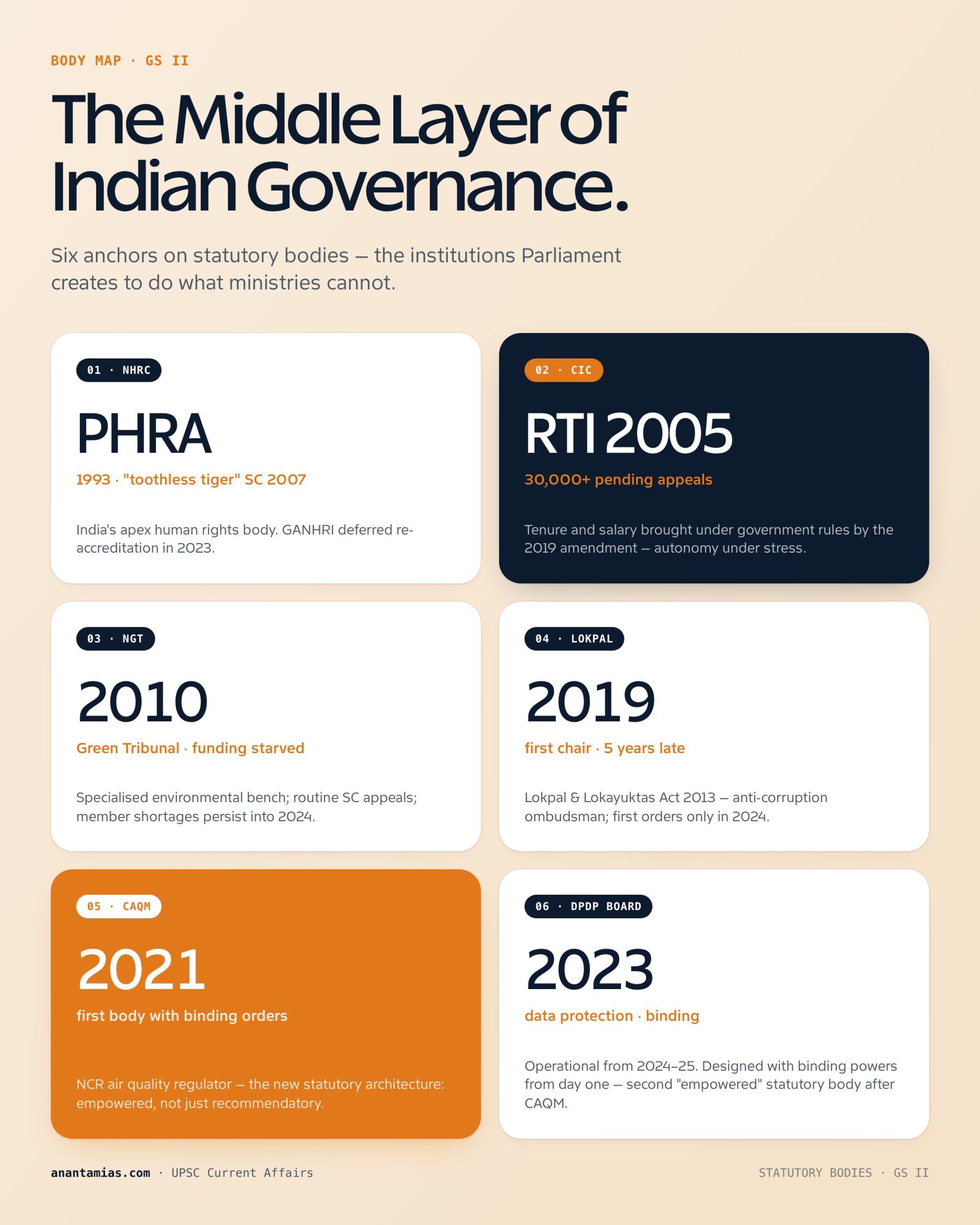
The Supreme Court itself in 2007 called the NHRC a "toothless tiger." Its orders are recommendatory; it cannot direct action against police forces; it cannot summon armed forces personnel; it lacks independent investigation cadre; vacancies in commissioner posts are common.
CIC — eroding autonomy
The RTI (Amendment) Act, 2019 brought the tenure and salary of CIC under government rule-making power, weakening fixed tenure security. Multiple commissioner posts have remained vacant.
NGT — funding starvation
The National Green Tribunal has heard landmark environmental cases but suffers from acute member shortage and funding constraints. Its judgments are appealed to Supreme Court routinely.
Lokpal — slow start
The Lokpal, set up in 2019 (5 years after the 2013 Act), has investigated few cases in its first 5 years. Its orders depend on cooperation of CBI and other investigative agencies.
Reform agenda
| Reform | Detail |
|---|---|
| Empower with binding orders | At least in narrow, specified categories |
| Independent investigation cadre | Separate from line departments |
| Direct funding | Charged on Consolidated Fund, like CAG |
| Time-bound appointments | Statutory deadline for filling vacancies |
| Eminent-persons selection committee | Bipartisan, with civil society |
| Mandatory ATR | Statutory deadline; consequences for non-compliance |
| Parliamentary Standing Committee on Statutory Bodies | Annual review of all statutory bodies |
| Performance metrics | Citizen's Charter, public dashboard |
| Regional benches | Decentralisation |
| Umbrella Human Rights Commission | Merge NHRC, NCW, NCM, NCPCR, NCSC, NCST into one with separate divisions (debated) |
Recent developments (2024-26)
- NHRC chairperson appointed (2024) — Justice V. Ramasubramanian, former SC judge.
- CIC vacancies — multiple commissioner positions filled in 2024-25.
- Lokpal cases (2024) — first set of orders in cases involving public servants.
- CAQM Act, 2021 — strengthened air pollution governance for NCR; first body specifically designed with binding orders.
- DPDP Act, 2023 — operational from 2024-25; created Data Protection Board (statutory body) with binding powers.
- NMC — National Medical Commission performance review by Standing Committee, 2024.
- Telecom Regulatory Authority — Digital Telecom Act, 2023 — modernised TRAI's mandate.
Mains-style answer hook
"India's statutory organizations are the connective tissue between the Constitution's normative promise and ground-level governance. NHRC, CIC, NGT, CCI, Lokpal — each was born of a syllabus of reform. But the structural architecture remains uneven: recommendatory powers, executive-dominated appointments, dependent funding, and parliamentary apathy reduce their effectiveness. The 2024-26 trajectory — NHRC and CIC reactivation, the Data Protection Board, CAQM with binding powers — suggests the reform direction: empower with binding orders, ensure independent investigation cadres, secure tenure and funding, and create a Parliamentary Standing Committee for annual scrutiny. Without this, India will continue to manufacture institutions and manage their irrelevance."
Prelims pointers
- Statutory body — created by Act of Parliament/Legislature.
- Constitutional body — created directly by the Constitution.
- NHRC — PHRA, 1993; SC called it "toothless tiger" (2007).
- CIC — RTI Act, 2005; tenure under government rules post-2019 amendment.
- NGT — NGT Act, 2010.
- Lokpal — Lokpal Act, 2013; first chairperson 2019.
- NCBC — became constitutional body via 102nd Amendment, 2018.
- CAQM — CAQM Act, 2021; binding orders for NCR air quality.
FAQ
What is the difference between statutory and regulatory bodies?
All regulatory bodies are statutory (created by law), but not all statutory bodies are regulatory. NHRC is statutory but not regulatory; SEBI is both statutory and regulatory.
Why are most statutory bodies u0022toothlessu0022?
Their parent statutes confer only recommendatory powers; they depend on parent ministry for funding and staff; their orders are not directly enforceable.
Can a statutory body be abolished by ordinary law?
Yes — statutory bodies can be amended or abolished by an ordinary Act, unlike constitutional bodies.
Which statutory body has binding powers?
CAQM, CCI (in part), and the Data Protection Board (DPDP Act, 2023) are examples of statutory bodies with binding orders. Most others remain recommendatory.
Related: NHRC, Lokpal and Lokayukta, Independent Regulatory Bodies, Election Commission.