On 1 October 2025, the Union Public Service Commission entered its centenary year, marking a hundred years since the first Public Service Commission of British India was constituted on 1 October 1926 under the chairmanship of Sir Ross Barker. The centenary milestone closes in October 2026, and the year ahead has prompted a sustained conversation about the institution that recruits the country’s “steel frame” and what its next century should look like.
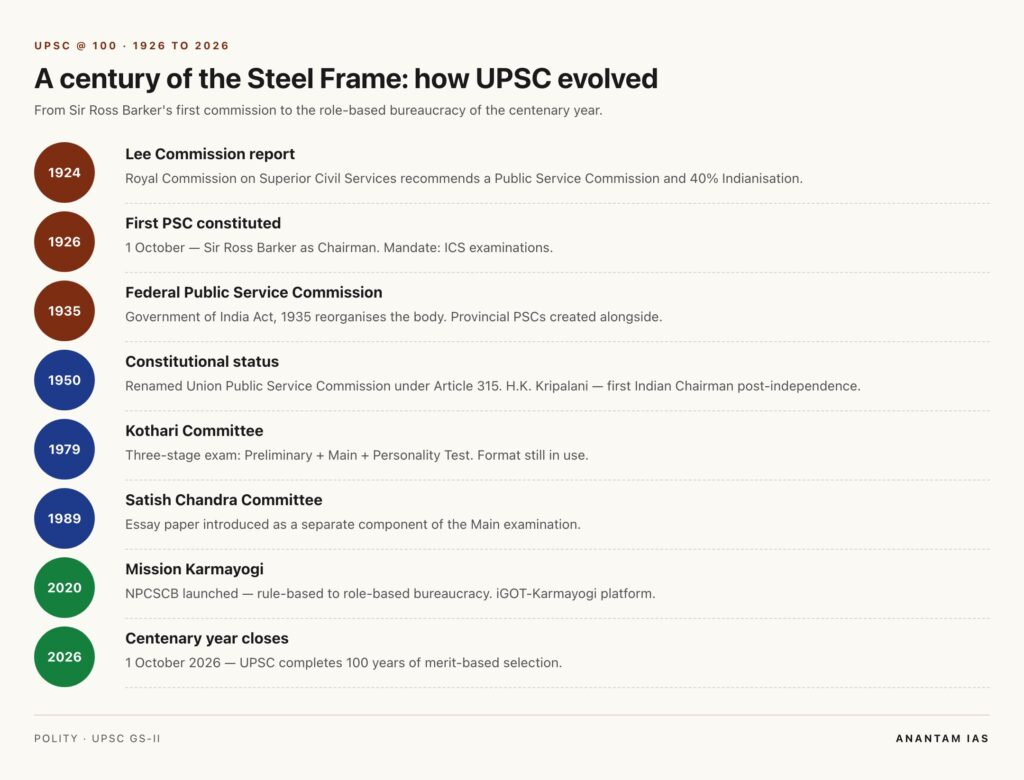
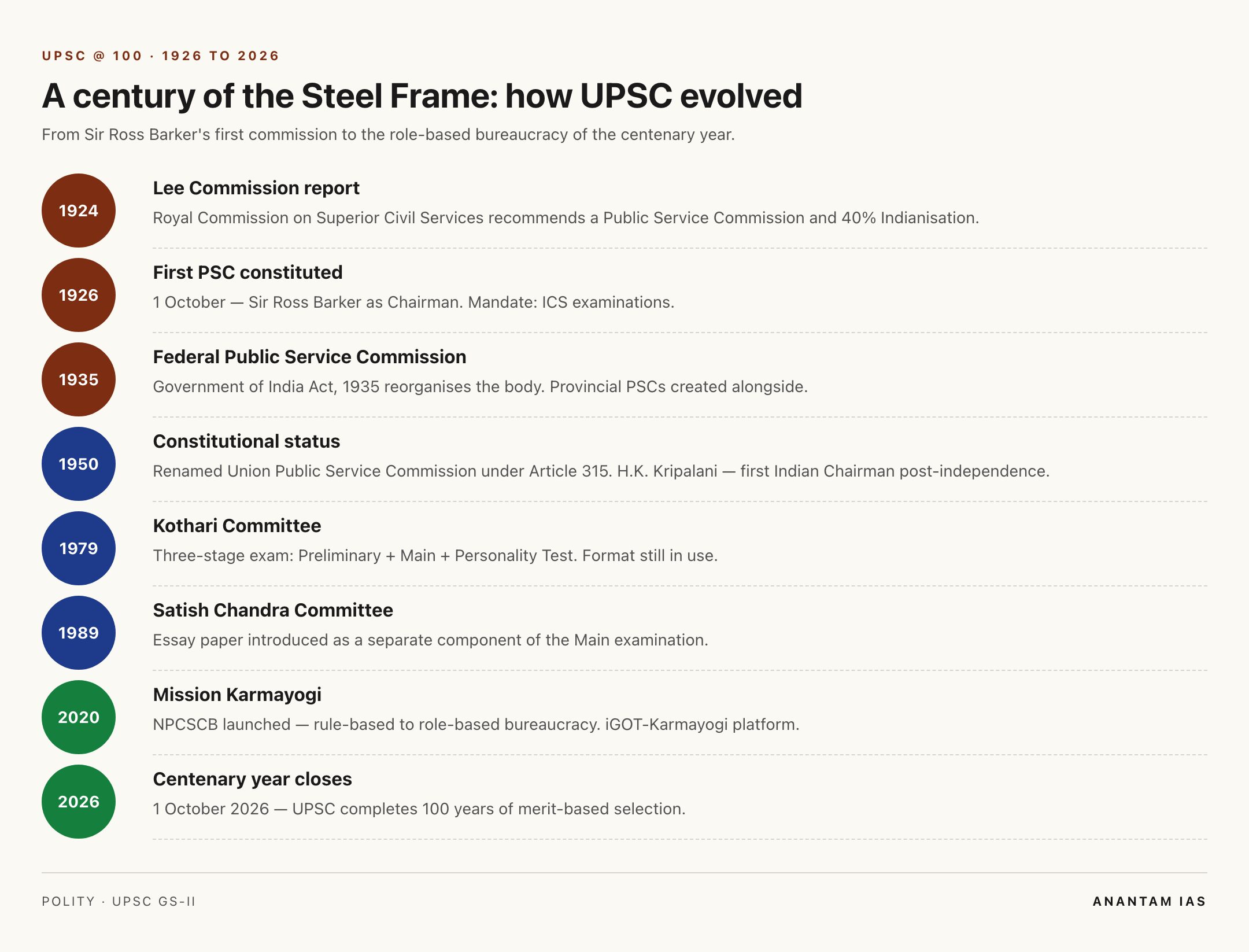
The arc from 1926 to 2026 maps almost perfectly on to the arc of modern Indian governance. The 1926 commission had a narrow remit, conducting examinations for the Indian Civil Service. The Government of India Act, 1935 reorganised it as the Federal Public Service Commission with a wider mandate and created Provincial Public Service Commissions alongside. The Constitution of 1950 elevated it to a constitutional body under Article 315, renaming it the Union Public Service Commission and giving it a position in Indian polity that no executive recruitment authority enjoys in most major democracies. The Kothari Committee in 1979 introduced the three-stage selection format that defines the Civil Services Examination today. The Satish Chandra Committee in 1989 introduced the essay paper. And the Mission Karmayogi framework launched in 2020 is currently rewriting the post-recruitment training architecture.
This guide walks through the constitutional position of the UPSC, its composition and independence, its functions, and the major reforms that shape the civil services in the centenary year and beyond.
Quick Facts on UPSC at 100
The first Public Service Commission was constituted on 1 October 1926 under Sir Ross Barker, on the recommendation of the Lee Commission, 1924. It was reorganised as the Federal Public Service Commission under the Government of India Act, 1935. Under the Constitution of India, 1950, it became the Union Public Service Commission under Article 315. UPSC is a constitutional body. Its members are appointed by the President of India under Article 316. The tenure is six years or until the age of 65, whichever is earlier. The chairman and members are removable only by the President on the recommendation of the Supreme Court. UPSC’s annual report is laid before both Houses of Parliament under Article 323. UPSC entered its centenary year on 1 October 2025 and the centenary closes on 1 October 2026.
What UPSC Is
The Union Public Service Commission is the central recruiting agency for the all-India services and the central services in the Government of India. It conducts examinations for the Indian Administrative Service, the Indian Police Service, the Indian Foreign Service, the Indian Forest Service and over twenty other Group A and Group B central services. It also advises the government on recruitment methods, promotions, transfers, disciplinary matters, and pension-related claims of civil servants.
Background and Historical Context
The recommendation for an Indian public service commission goes back to the Lee Commission of 1924, formally known as the Royal Commission on the Superior Civil Services in India. The Lee Commission recommended that 40 percent of all higher civil service posts should be reserved for Indians, that the recruitment process should be Indianised, and that a Public Service Commission should be set up to conduct examinations and oversee appointments.
The recommendation took two years to translate into action. On 1 October 1926, the first Public Service Commission was constituted under Sir Ross Barker as chairman. Its mandate was narrow: it conducted examinations for the Indian Civil Service and a limited set of central services. It did not have the wide advisory role that today’s UPSC enjoys.
The Government of India Act, 1935 reorganised the body as the Federal Public Service Commission and also provided for separate Provincial Public Service Commissions for each province. The 1935 Act gave the FPSC a wider mandate, including advisory functions on recruitment methods, promotions and disciplinary matters. After independence, the FPSC continued to function until the Constitution came into force on 26 January 1950, when it was renamed the Union Public Service Commission and given constitutional status under Article 315. The first Indian Chairman after independence was H.K. Kripalani.
Constitutional Status: Articles 315 to 323
For the wider constitutional canvas, see our Indian Polity notes, the Constitution of India book guide, and the basic structure doctrine explainer. The UPSC is constituted under Article 315, which provides for a Public Service Commission for the Union and a Public Service Commission for each state. Two or more states may agree to have a Joint State Public Service Commission, which is created by Parliament by law on the request of the state legislatures. Article 316 deals with appointment and term. Members are appointed by the President of India. The tenure is six years from the date of entering office or until the age of 65 years, whichever is earlier. Article 316 also requires that at least half the members of the UPSC must be persons who have held office for at least ten years under the Government of India or a state government, ensuring that the body has substantial public administration experience embedded in it.
Article 317 governs removal and provides one of the strongest tenure protections in the Constitution. The chairman or any other member can be removed only by the President, and only on the ground of proven misbehaviour or incapacity, after the Supreme Court has been asked to inquire and has reported back. The President may also suspend a member during the inquiry. Article 318 deals with the President’s power to determine the conditions of service and the size of the commission. Article 319 imposes post-tenure restrictions: the chairman of UPSC is not eligible for any further employment under the Government of India or any state government, and other members are eligible only to be appointed as chairman of UPSC or chairman of a state PSC.
Article 320 lists the functions of the commission. Article 322 makes the expenses of UPSC, including salaries and allowances of members, a charge on the Consolidated Fund of India, which means they are not subject to vote in Parliament. Article 323 requires UPSC to submit an annual report on the work done to the President, which is then laid before both Houses of Parliament along with a memorandum explaining the cases where the advice of the commission was not accepted.
Composition and Tenure
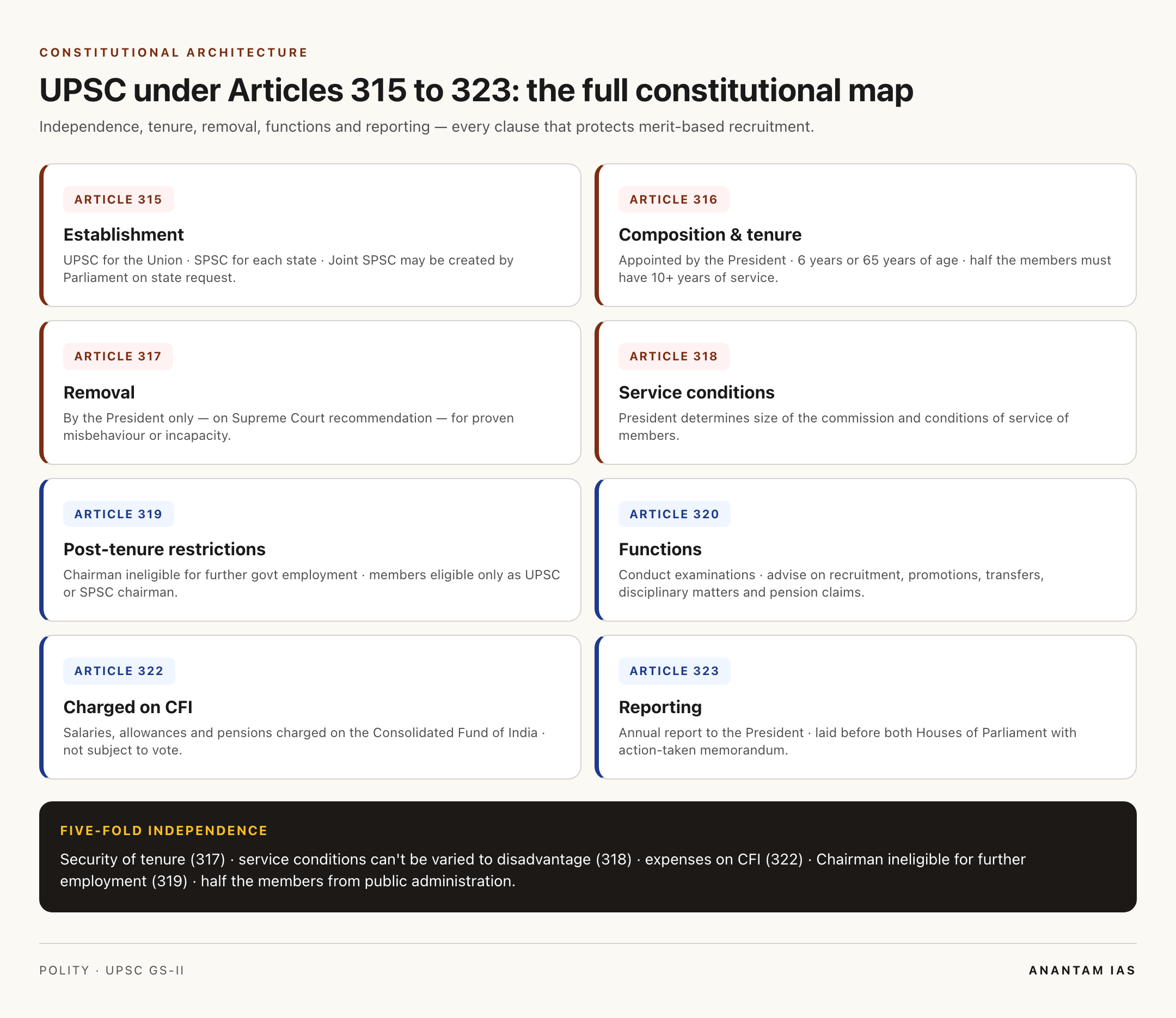
The Constitution does not fix the size of the UPSC. The President determines it from time to time. As of 2026, UPSC has a chairman and a number of other members, typically nine or ten in total. At least half the members must have a minimum of ten years of experience under the Government of India or a state government.
The tenure protection under Article 316 and the removal protection under Article 317 are deliberately strong. They shield the commission from political pressure and align it with the protections enjoyed by judges of the higher judiciary. The combination of fixed tenure, restricted removal, post-tenure employment restrictions, and expenses charged on the Consolidated Fund of India is the institutional design that gives UPSC its independence.
Independence of UPSC
Five features insulate UPSC from political interference. Security of tenure under Article 317. Conditions of service that cannot be varied to a member’s disadvantage after appointment. Expenses charged on the Consolidated Fund of India under Article 322. The chairman’s ineligibility for further employment under Article 319. And the requirement that at least half the members come with significant public administration experience.
These provisions are modelled on the protections given to the higher judiciary and the Comptroller and Auditor General. The intent was to make UPSC’s recommendations on recruitment and disciplinary matters credible enough to be respected by the executive while leaving the executive with the final say.
Functions of UPSC Under Article 320
Article 320 lists the consultative functions of UPSC. The government must consult UPSC on methods of recruitment to civil services and civil posts, on principles to be followed in making appointments and in promotions and transfers, on disciplinary matters affecting civil servants, on claims by civil servants for legal expenses incurred in defending themselves in legal proceedings, and on claims for pension awards in respect of injuries sustained while on duty.
UPSC is also responsible for conducting examinations for appointments to the all-India services, the Central Services Group A, and Central Services Group B. It assists states with framing schemes of joint recruitment when two or more states make such a request.
The Constitution makes UPSC’s role advisory in most areas, except in actual recruitment through examinations where the commission’s selection list is operationally final. Even so, the President may exclude certain matters from UPSC consultation under Article 320(3), and the government may reject UPSC’s advice in any case provided the reasons are placed before Parliament.
Why UPSC’s Centenary Matters
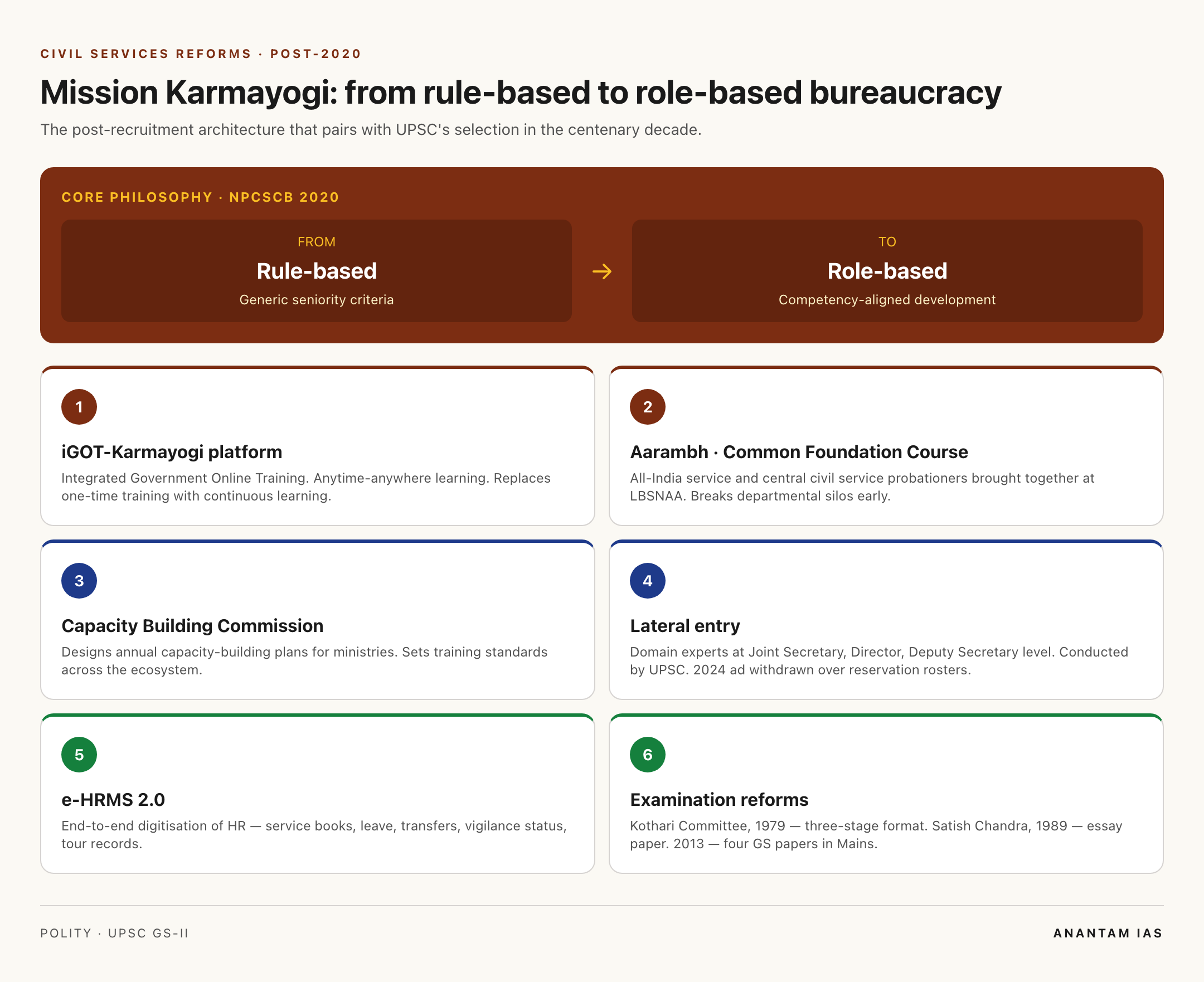
The centenary is more than a ceremonial milestone. It coincides with three structural shifts that will define the civil services in the coming decade. The first is the Mission Karmayogi framework, which is rewriting how civil servants are trained and how their careers are managed. The second is the lateral entry programme, which is bringing domain experts into the senior bureaucracy directly without going through the standard examination route. The third is the digitisation of HR processes through e-HRMS 2.0 and the integration of AI-driven tools into examinations and selections.
For UPSC itself, the centenary is also a moment to consider whether its examination format, designed in 1979 by the Kothari Committee, remains the best way to identify the leadership cohort that will run the country in the era of climate transition, AI, and global geopolitical realignment.
Key Examination Reforms
Two committees frame the modern UPSC examination. The Kothari Committee in 1979 introduced the three-stage structure of preliminary, main and personality test that the Civil Services Examination still follows today. The committee made the preliminary stage objective with two papers, the main examination subjective with descriptive papers, and the personality test interview-based. The Satish Chandra Committee in 1989 introduced the essay paper as a separate component of the main examination, recognising that civil servants need the ability to communicate complex ideas in long-form writing.
Subsequent committees have made calibrations within this framework. The Y.K. Alagh Committee in 2001 reviewed optional subjects and pattern. The S.K. Khanna Committee and others have looked at the marking scheme, the role of the personality test, and the inclusion of new subjects. The 2013 reforms reduced the weight of the optional subject from two papers to one and added four general studies papers in the main examination, aligning the GS papers with broader administrative skills.
Civil Services Reforms: Mission Karmayogi and iGOT-Karmayogi
The Mission Karmayogi framework, launched in September 2020 as the National Programme for Civil Services Capacity Building, NPCSCB, is the most ambitious post-recruitment reform of the Indian bureaucracy in decades. The core philosophy is a transition from a rule-based bureaucracy to a role-based one, where civil servants are evaluated and developed against the specific competencies required for their roles, rather than against generic seniority criteria.
Mission Karmayogi is anchored by the Capacity Building Commission, an autonomous body that designs annual capacity building plans for ministries and departments, and sets standards for the training ecosystem. The iGOT-Karmayogi platform, the Integrated Government Online Training portal, is the digital backbone, hosting thousands of courses for civil servants at all levels, from Group A officers to Group C clerks. iGOT replaces the older one-time training model with an anytime-anywhere continuous learning approach, where civil servants can take courses, earn certifications, and update their skill profiles on an ongoing basis.
Aarambh, the Common Foundation Course, brings probationers of all-India services and central civil services together at the Lal Bahadur Shastri National Academy of Administration in Mussoorie for a shared induction programme that breaks departmental silos early in a civil servant’s career. e-HRMS 2.0 digitises HR processes end to end, including service books, leave, transfers, vigilance status and tour records.
Lateral Entry: A Parallel Recruitment Stream
Lateral entry is the direct recruitment of domain experts from the private sector, academia, public sector undertakings and non-governmental organisations into senior positions in the central government, typically at the level of joint secretary, director and deputy secretary. UPSC conducts the lateral entry recruitment process. The objective is to bring fresh ideas, specialised domain knowledge, and a competitive edge that the generalist civil service is not always positioned to deliver.
Lateral entry has been controversial. The most recent advertisement in 2024 was withdrawn by the Centre after objections that the recruitment did not include reservation rosters, with critics arguing that lateral entry bypassed the constitutional commitment to representation for SCs, STs and OBCs. The debate is unresolved. Proponents argue that domain expertise at senior levels is critical for sectors such as climate, technology, finance and health. Critics argue that without reservation rosters, lateral entry weakens the constitutional commitment to inclusive representation.
Comparative Approach: Civil Service Models Globally
Civil service models around the world differ substantially. The United Kingdom runs a generalist civil service with a strong fast-stream programme that recruits graduates and trains them across departments. France runs the École Nationale d’Administration, now replaced by the Institut national du service public, which trains a cohort of senior administrators in a structured residential programme. The United States combines a competitive examination system for some federal positions with a substantial system of political appointments for senior posts. Japan runs a highly competitive examination-based career civil service with strong promotion-from-within norms. India’s UPSC-led model sits closer to the British and Japanese end of the spectrum, with a competitive examination filter, a generalist orientation, and strong tenure protection for the recruited cadre.
Challenges Facing UPSC at 100
Five challenges define the centenary moment. First, the time taken from notification to final allotment in the Civil Services Examination, which routinely runs to 14 to 16 months, is long compared to peer recruitment systems. Second, the optional subject system in the main examination has long been criticised for unequal scoring across subjects. Third, the personality test continues to face questions about subjectivity and the weight it carries in the final selection. Fourth, the lateral entry framework needs to be reconciled with constitutional reservation requirements. Fifth, the post-recruitment training and career management framework, despite Mission Karmayogi’s promise, still depends on a state-level training infrastructure that varies sharply in quality.
Prelims Pointers
The first Public Service Commission was set up on 1 October 1926 on the recommendation of the Lee Commission of 1924, under Sir Ross Barker. The Government of India Act, 1935 reorganised it as the Federal Public Service Commission and created Provincial PSCs. UPSC is established under Article 315. Members are appointed by the President under Article 316. The tenure is six years or 65 years of age, whichever is earlier. Members are removable only by the President on the recommendation of the Supreme Court under Article 317. The chairman of UPSC is ineligible for further government employment under Article 319, except as chairman of UPSC or a state PSC. UPSC’s expenses are charged on the Consolidated Fund of India under Article 322. UPSC submits an annual report under Article 323. The Kothari Committee in 1979 introduced the three-stage examination structure. The Satish Chandra Committee in 1989 introduced the essay paper. Mission Karmayogi was launched in September 2020.
Mains Practice Questions
- “UPSC has been the steel frame’s filter for a hundred years. The next century will demand a different filter.” Critically evaluate the relevance of the current UPSC examination format and suggest reforms. (GS Paper 2, 250 words)
- Discuss the constitutional provisions that guarantee the independence of UPSC. To what extent are these protections adequate in the current political context? (GS Paper 2, 250 words)
- The lateral entry framework seeks to bring domain expertise into senior positions in the central government. Examine the rationale, design and constitutional concerns associated with lateral entry. (GS Paper 2, 250 words)
- Mission Karmayogi attempts to transition Indian bureaucracy from a rule-based to a role-based model. Evaluate its design and implementation challenges. (GS Paper 2, 150 words)
Way Forward
A centenary reform agenda for UPSC needs four threads. First, a tighter examination cycle that reduces the 14 to 16 month duration without compromising integrity, possibly through computer-based testing for the preliminary stage and digitised evaluation for the main. Second, a calibrated lateral entry framework that explicitly incorporates reservation rosters where applicable and is run as a parallel stream rather than an ad hoc exercise. Third, a substantive integration of UPSC with Mission Karmayogi, so that recruitment standards are designed in light of the role-based competencies that the Capacity Building Commission has identified. Fourth, a periodic review of the optional subject system and the personality test, with a credible expert panel reviewing both every five to seven years.
The deeper vision for the centenary is to position UPSC not just as a recruiting body but as the steward of a competency-based public service that meets the governance demands of the next quarter century. The institutional foundations laid in 1926 and reinforced in 1950 are robust enough to carry that ambition. The reform agenda has to make the architecture fit for the new century.
Frequently Asked Questions
When was the first Public Service Commission of India set up?
The first Public Service Commission was constituted on 1 October 1926 under the chairmanship of Sir Ross Barker, on the recommendation of the Lee Commission of 1924. It was reorganised as the Federal Public Service Commission under the Government of India Act, 1935, and became the Union Public Service Commission under the Constitution in 1950.
Under which constitutional article is UPSC established?
UPSC is established under Article 315 of the Constitution of India, which provides for a Public Service Commission for the Union and a Public Service Commission for each state, as well as the possibility of a Joint State Public Service Commission for two or more states acting together.
What is the tenure of UPSC members?
The tenure of UPSC members is six years from the date of entering office or until the age of 65 years, whichever is earlier, under Article 316 of the Constitution. The Constitution does not allow reappointment as a member of UPSC after the term ends.
How is a UPSC chairman or member removed?
A chairman or member of UPSC can be removed only by the President of India, and only on the ground of proven misbehaviour or incapacity, after a reference to the Supreme Court for an inquiry and the Court’s report under Article 317. The President may suspend the member during the inquiry. This protection is similar to that available to higher judiciary judges.
Can a UPSC chairman take up another government job after retirement?
No. Under Article 319, the chairman of UPSC is not eligible for any further employment under the Government of India or any state government after retirement. Other members are eligible only for appointment as chairman of UPSC or chairman of a state Public Service Commission.
Are UPSC’s recommendations binding on the government?
UPSC’s role under Article 320 is largely advisory. The government may reject UPSC’s advice, but it must place the reasons before Parliament along with the annual report under Article 323. Selection lists from UPSC examinations, however, are operationally treated as final for actual recruitment.
What is Mission Karmayogi?
Mission Karmayogi is the National Programme for Civil Services Capacity Building, NPCSCB, launched in September 2020. It aims to transition Indian bureaucracy from a rule-based system to a role-based system, in which officers are developed and evaluated against the specific competencies their roles demand. The iGOT-Karmayogi platform is the digital backbone, hosting continuous online learning for civil servants.
What is lateral entry?
Lateral entry is the direct recruitment of domain experts from outside the regular civil service, typically from the private sector, academia and public sector undertakings, into senior positions such as joint secretary, director and deputy secretary in the central government. UPSC conducts the recruitment process. The 2024 lateral entry advertisement was withdrawn by the Centre over concerns about the absence of reservation rosters.
Which committee introduced the three-stage UPSC examination?
The Kothari Committee in 1979 recommended the three-stage structure of preliminary examination, main examination and personality test that the Civil Services Examination follows today. The Satish Chandra Committee in 1989 subsequently introduced the essay paper as a separate component of the main examination.
What is the difference between Article 315 and Article 320?
Article 315 establishes the institution of the Public Service Commission for the Union and the states. Article 320 lays out the consultative functions of those commissions, including consultation on recruitment methods, principles for appointments and promotions, disciplinary matters, legal expense claims and pension claims of civil servants.
Tell Google you want more of this.
Add Anantam IAS as a preferred sourceOne tap, and this site shows up more often in your own Top Stories, AI Overviews and AI Mode. Remove it any time.