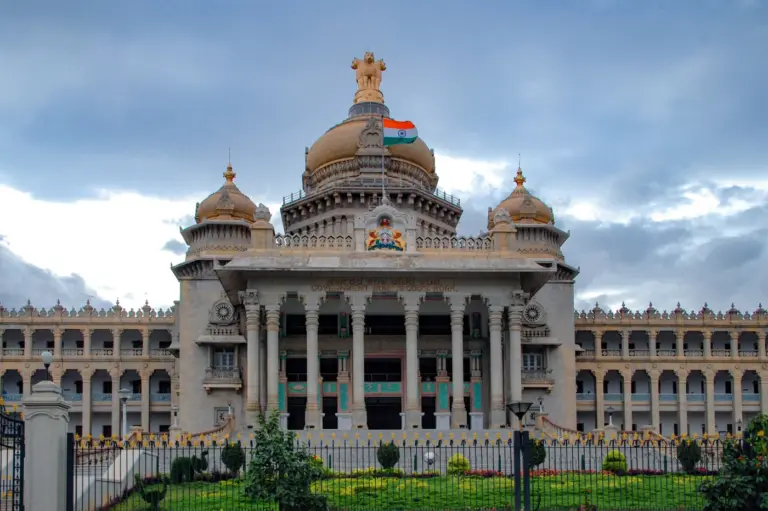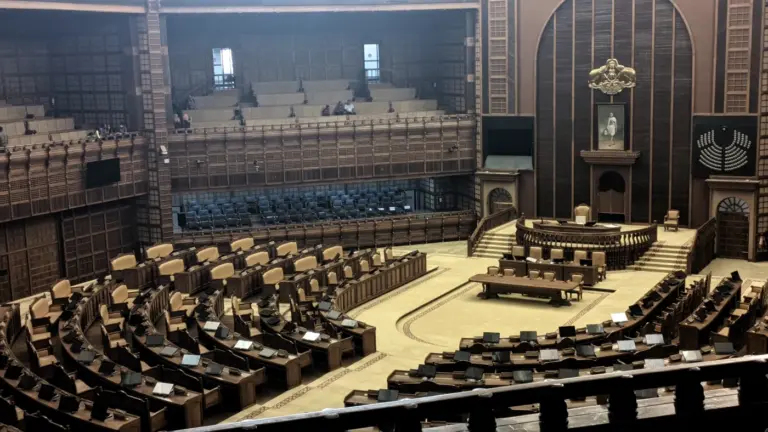

The National Human Rights Commission (NHRC) is India's apex statutory body for the protection and promotion of human rights. Established under the Protection of Human Rights Act, 1993 (PHRA), it gave institutional shape to a long-standing demand following India's accession to international human rights instruments — including the Universal Declaration of Human Rights (1948), the International Covenant on Civil and Political Rights (1966), and the Paris Principles (1993) that the UN adopted as the gold standard for national human rights institutions.
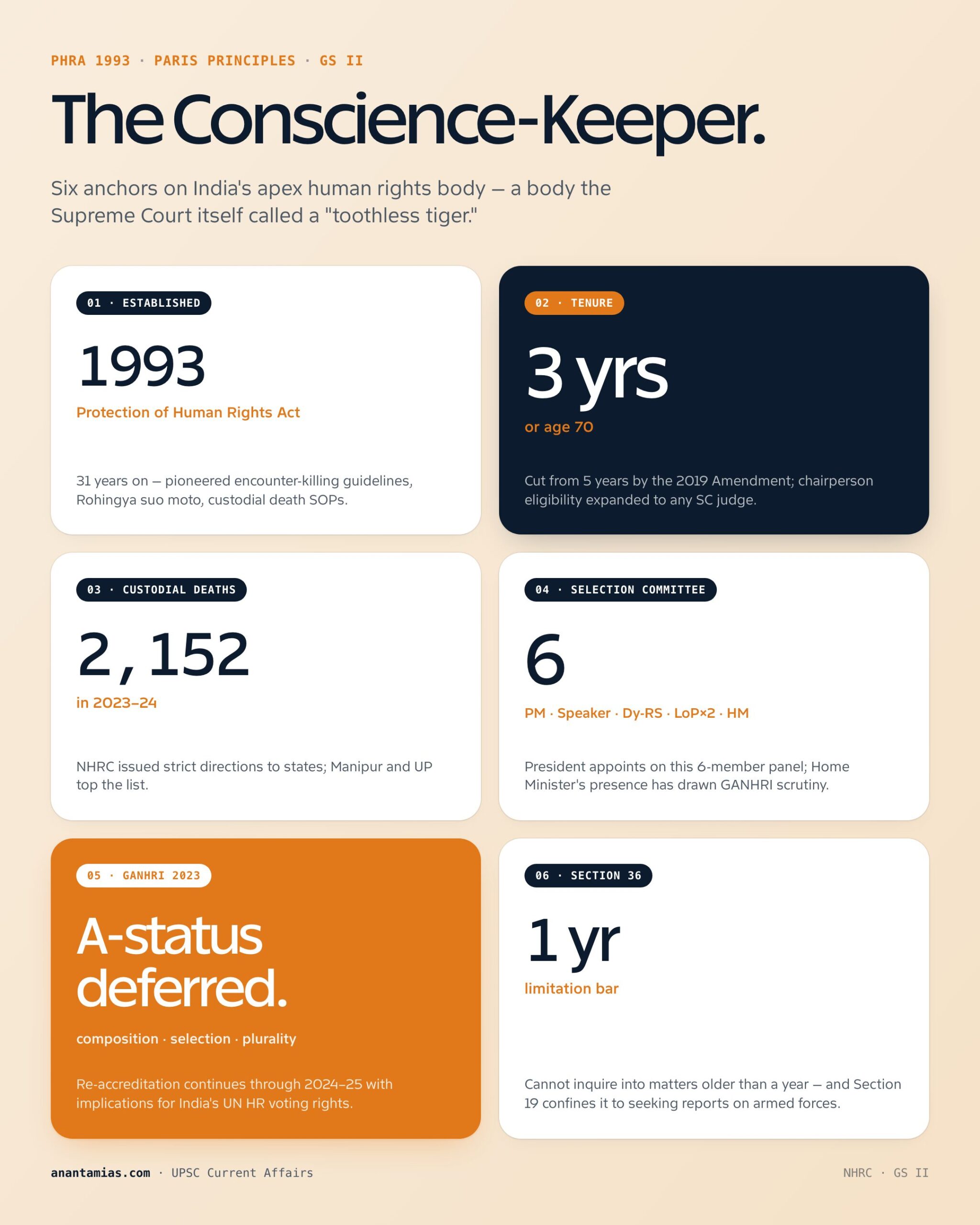
NHRC turned 30 years old in 2023. Its record is mixed. On one side: pioneering encounter-killing guidelines, awareness creation, the Rohingya deportation suo moto, the Manipur extra-judicial killings probe. On the other: the Supreme Court called it a "toothless tiger" (2007), GANHRI deferred its A-status accreditation in 2023, and complaints continue to mount faster than it can dispose them.
For UPSC, NHRC is a recurring GS-II topic at the intersection of fundamental rights, statutory bodies, and India's international human rights obligations. The 2024-26 context — new chairperson Justice V. Ramasubramanian (June 2024), the GANHRI re-accreditation review, the BNSS regime, and digital surveillance debates — adds fresh layers.
Constitutional and statutory basis
- Article 21 — Right to Life and Personal Liberty; the constitutional bedrock for human rights.
- Articles 14, 15, 16, 17, 19, 20, 21, 22, 23, 24, 25-28 — Fundamental Rights.
- Article 51(c) — Directive Principle: foster respect for international law.
- Protection of Human Rights Act, 1993 — establishing statute.
- Protection of Human Rights (Amendment) Act, 2006 — composition tweaks.
- Protection of Human Rights (Amendment) Act, 2019 — tenure reduced from 5 to 3 years; expanded eligibility for chairperson.
NHRC is also the body that operationalises India's Paris Principles commitments — independence, plural composition, broad mandate, adequate resources, cooperative powers.
Composition of NHRC
After the PHRA Amendment Act, 2019:
- Chairperson — A person who has been Chief Justice of India OR a Judge of the Supreme Court. (Pre-2019: only retired CJI was eligible.)
- One member — A serving or retired Judge of the Supreme Court.
- One member — A serving or retired Chief Justice of a High Court.
- Three members — Persons having knowledge or practical experience in matters relating to human rights. At least one must be a woman.
- Ex-officio members (Deemed members):
- Chairperson, National Commission for SCs.
- Chairperson, National Commission for STs.
- Chairperson, National Commission for Women.
- Chairperson, National Commission for Minorities.
- Chief Commissioner for Persons with Disabilities.
- Chairperson, National Commission for Backward Classes.
- Chairperson, National Commission for Protection of Child Rights.
Appointment
- By the President of India on the recommendation of a 6-member committee:
- Prime Minister (Chairperson)
- Speaker of Lok Sabha
- Deputy Chairman of Rajya Sabha
- Leader of Opposition in Lok Sabha
- Leader of Opposition in Rajya Sabha
- Union Home Minister
Tenure
- 3 years OR until age 70, whichever is earlier (post-2019 amendment).
- Eligible for reappointment after the 2019 amendment.
Removal
- By the President on grounds of proven misbehaviour or incapacity.
- Reference must be made to the Supreme Court for inquiry.
- Removal procedure similar to that of a Supreme Court Judge.
Powers and functions
Functions under Section 12 of PHRA
| Function | Detail |
|---|---|
| Inquiry | Suo moto or on petition into human rights violations |
| Court intervention | Intervene in court proceedings involving human rights |
| Visit institutions | Visit jails, detention centres |
| Review safeguards | Review constitutional and statutory safeguards |
| Research | Research in human rights |
| Awareness | Spread human rights literacy |
| Recommend | Recommendations to government |
| NGO encouragement | Promote NGO activity in HR field |
Powers of a civil court
NHRC has powers of a civil court under the Code of Civil Procedure when inquiring:
- Summon witnesses.
- Receive evidence on affidavit.
- Requisitioning of public records.
- Issue commissions for examination of witnesses.
What NHRC cannot do
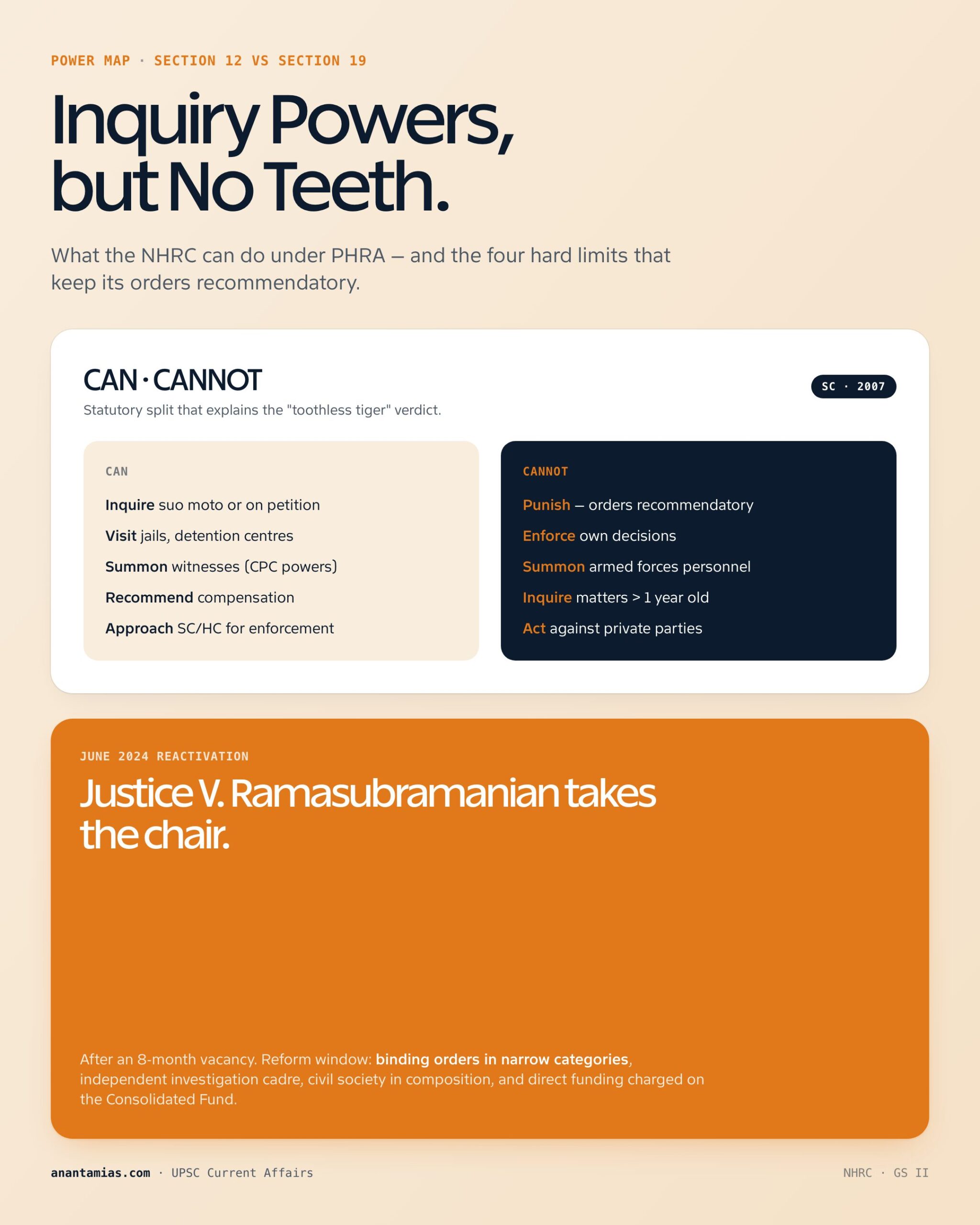
- Cannot punish — its orders are recommendatory.
- Cannot enforce — relies on government compliance.
- Limited armed forces jurisdiction — under Section 19, NHRC can only seek a report from the Centre and make recommendations on armed forces.
- One-year limitation — cannot inquire into matters more than one year old.
- No private actor jurisdiction in most cases — primarily focused on state action.
NHRC's successes
| Area | Achievement |
|---|---|
| Awareness creation | Human rights now part of school and college curriculum |
| Suo moto interventions | Rohingya deportation by MHA, Chakma community in Arunachal Pradesh, lynchings in 2017-19 |
| Encounter killings guidelines | 1997 and 2014 SOPs requiring magisterial inquiry, FIR registration, 48-hour reporting to NHRC; affirmed in PUCL v. Maharashtra (2014) |
| Custodial death guidelines | 24-hour reporting; 48-hour video deposition |
| Vocal opinion on laws | NHRC opposed POTA, TADA on grounds of misuse |
| Manipur AFSPA | Repeated reports on extra-judicial killings, including the 1,500 figures investigated by SC |
| Economic, social rights | Reports on extreme poverty in Kalahandi, Koraput |
| NRC and CAA monitoring | Statements on detention centres in Assam |
| Migrant workers (COVID) | Issued advisories during 2020 lockdown |
| D.K. Basu compliance | Monitors arrest procedure standards |
Issues with NHRC
Functional issues
- Recommendatory powers — NHRC cannot penalise authorities that ignore its directions.
- No enforcement of own orders — relies on civil court for compliance, which slows everything.
- Restricted jurisdiction over Armed Forces — Section 19 limits NHRC to seeking reports.
- Cannot summon armed forces personnel as witnesses.
- One-year limitation under Section 36 — many human rights violations come to light long after the event.
- Does not extend to J&K historically — though post-Article 370 abrogation (2019), this has changed.
- Cannot directly act on private parties — limited statutory backing for non-state HR violations.
Composition and appointment issues
- No proven record of HR experts required by statute — the eligibility framework was designed for retired judges.
- Bureaucratic dominance — many members are ex-civil servants, ex-judges; civil society representation thin.
- Vacancies — chairperson position vacant for over 8 months in 2024 before Justice Ramasubramanian appointed (June 2024).
Operational issues
- Bureaucratic style — staff drawn from government on deputation.
- Limited resources — budget grew slowly; investigative cadre thin.
- Majority decisions ask CG/SG to investigate — no independent investigation machinery.
- Backlog — 70,000+ complaints filed annually; pendency rises.
- Bureaucratic deputation — police officers investigating police violations creates conflict.
- Reports submission delays — Annual Reports tabled 1-2 years late.
Accreditation downgrade — GANHRI
In 2016, the Global Alliance of National Human Rights Institutions (GANHRI) retained NHRC's A-status but flagged concerns. In 2023, GANHRI deferred re-accreditation citing concerns about:
- Composition (bureaucrat-heavy).
- Selection process opacity.
- Plurality and independence.
- Civil society engagement.
This has implications for India's standing in UN human rights forums and voting rights at GANHRI.
Major recommendations and reforms
NHRC's own recommendations
- Decisions should be immediately enforceable.
- Extend jurisdiction to military and security forces.
- Composition reform — include civil society, human rights activists, women, minorities.
- Need an independent cadre of staff with appropriate experience.
- Culture of human rights through education.
2nd ARC recommendations
- Independent investigation wing with police powers.
- Statutory deadlines for compliance with NHRC recommendations.
- Stronger linkage with State Human Rights Commissions.
- Public hearings in cases of grave violations.
Justice A.S. Anand Committee (2002)
- Strengthen NHRC by giving binding powers.
- Reform Section 19 to give jurisdiction over armed forces (limited).
Umbrella Human Rights Commission
A debated reform — merge NHRC, NCW, NCM, NCPCR, NCSC, NCST, NCBC into a single umbrella body with separate divisions. Arguments:
- For: avoids duplication, faster action, single accountability point.
- Against: dilutes specialised focus on women, children, minorities, SC/ST.
Way forward
| Reform | Detail |
|---|---|
| Binding orders | Constitutional or statutory amendment for binding power in specified categories |
| Independent investigation cadre | At least 200-300 trained investigators, separate from police |
| Section 19 reform | Limited inquiry powers over armed forces |
| Section 36 reform | Extend or remove one-year limitation |
| Composition reform | Mandatory civil society, human rights expert representation |
| Direct funding | Charged on Consolidated Fund |
| Public hearings | For grave violations |
| Performance dashboard | Real-time complaint tracking |
| Stronger SHRC linkage | Integrate state-level structures |
| Engage with GANHRI | Restore A-status |
Recent developments (2024-26)
- Justice V. Ramasubramanian appointed Chairperson NHRC (June 2024) — former SC judge.
- GANHRI deferred re-accreditation (April 2023) — review continued through 2024-25.
- Manipur ethnic violence (2023-24) — NHRC reports, criticised for delayed response.
- BNSS regime (July 2024) — new procedural code; NHRC rolled out updated arrest and detention monitoring.
- DPDP Act, 2023 — operational from 2024-25; raises new privacy-rights questions for NHRC.
- Custodial death numbers — 2,152 in 2023-24; NHRC issued strict directions to states.
- Encounter killings — UP encounters under scrutiny; NHRC sought reports.
- Migrant workers compensation — NHRC monitors compensation under PM-Garib Kalyan.
- Internet shutdowns — NHRC has flagged proportionality concerns post-Anuradha Bhasin (2020).
State Human Rights Commissions
- Established under the same PHRA, 1993.
- Each state can establish its SHRC.
- Composition: Chairperson (former Chief Justice of HC) + 2 members.
- Jurisdiction: state-level human rights violations.
- Issues: many states have not constituted; vacancies frequent; limited budget.
Mains-style answer hook
"The NHRC is the most consequential statutory body for India's constitutional promise of dignified life under Article 21. In 31 years, it has built guidelines on encounter killings, custodial deaths, AFSPA areas, and lynching cases. But its statutory architecture — recommendatory powers, dependent investigation cadre, restricted armed forces jurisdiction, and a one-year limitation — limits it to being the conscience-keeper rather than the enforcer it was meant to be. The Supreme Court's 'toothless tiger' verdict in 2007, GANHRI's 2023 deferral of A-status, and the 2024 chairperson vacancy are all part of the same diagnosis. The reform agenda is clear: binding orders in narrow categories, independent investigation cadre, civil society in composition, direct funding, and time-bound action on recommendations. The 2024-26 reactivation under Justice Ramasubramanian creates the window."
Prelims pointers
- PHRA, 1993 — establishing statute.
- PHRA Amendment Act, 2019 — tenure 5→3 years; expanded chairperson eligibility.
- Chairperson — CJI or SC Judge (post-2019).
- Tenure — 3 years OR age 70.
- Selection committee — PM, Speaker LS, Dy Chairman RS, LoP LS, LoP RS, Home Minister.
- Section 19 — limited armed forces jurisdiction.
- Section 36 — 1-year limitation.
- GANHRI — Global Alliance; deferred A-status (2023).
- Encounter killing guidelines — 1997, 2014; affirmed in PUCL v Maharashtra.
- State HRCs also under PHRA, 1993.
FAQ
Who can become the Chairperson of NHRC?
Post-2019, any person who has been Chief Justice of India OR a Judge of the Supreme Court. Pre-2019, only a retired CJI was eligible.
Are NHRC orders binding?
No. NHRC's orders are recommendatory. It can approach the Supreme Court or High Court for enforcement.
Why is NHRC called a u0022toothless tigeru0022?
The Supreme Court used this phrase in 2007, citing limited enforcement powers, restricted armed forces jurisdiction, dependent investigation cadre, and one-year limitation.
Does NHRC cover armed forces?
Limited — under Section 19, NHRC can only seek a report from the Centre and make recommendations regarding armed forces personnel.
What is the GANHRI deferral?
The Global Alliance of National Human Rights Institutions deferred NHRC's A-status accreditation in 2023, citing composition, selection, and independence concerns.
Related: Statutory Organizations, Personal Liberty, Article 21, Lokpal and Lokayukta.
Tell Google you want more of this.
Add Anantam IAS as a preferred sourceOne tap, and this site shows up more often in your own Top Stories, AI Overviews and AI Mode. Remove it any time.