Our Constitution by Subhash Kashyap
Read Our Constitution by Subhash Kashyap for institutional understanding, verify the NBT edition and practice reasoning with constitutional text.
Our Constitution by Subhash Kashyap is useful when you can remember an institution’s name but struggle to explain why it exists or how it relates to the rest of the constitutional system. Read it for that connected understanding. Keep your primary UPSC polity source for systematic revision and question practice.
If you’re just starting, work through the relevant NCERT foundation first. If you’ve already read a standard polity book, choose one unresolved question and use Kashyap selectively. Reading a second book from cover to cover makes little sense when your actual gap is narrower.
Which Our Constitution Edition Is Listed?
National Book Trust’s current product page identifies the book as follows:
- Title: Our Constitution.
- Author: Subhash C. Kashyap.
- Publisher: National Book Trust, India.
- Edition and listing year: 5th edition, 2025.
- Pages: 416.
- ISBN: 9788123707341.
Check the National Book Trust listing for Our Constitution against the copy you’re considering. A retailer’s older reprint label doesn’t by itself identify the publisher’s current edition.
The publisher describes a study of the Constitution’s working and its development through judicial interpretation. That is a reason to read for institutional understanding. It doesn’t prove that a chapter covers every recent judgment or every detail needed for an examination.
Where the Book Fits in Your Preparation
Use it as a companion when a rule makes sense in isolation but its purpose remains unclear. The existing Indian polity book comparison can help you choose a primary source. Kashyap has a more focused role in this reading routine.
| Your Difficulty | Reading Question | Useful Output |
|---|---|---|
| Institutions feel disconnected | What problem does this institution address? | A relationship map |
| A rule looks arbitrary | Which responsibility or safeguard does it support? | A purpose-and-limit note |
| An amendment feels like a separate fact | What changed, and what stayed? | A before-and-after explanation |
| A judgment is reduced to a case name | What constitutional question was considered? | An issue-and-reasoning card |
Don’t turn these outputs into another full set of notes. Keep only the connection you couldn’t previously explain. The Constitution of India overview can orient the larger structure while you work on that particular gap.
A Worked Accountability Exercise
Use this original study prompt: ‘How is representative government different from accountable government?’ The first term asks who authorizes government. The second asks how government must explain and answer for its actions. They are related questions, but they aren’t identical.
Begin with a hypothetical example. A school club elects a committee. Election establishes who may act on the club’s behalf. It doesn’t explain how members can inspect the committee’s decisions, question its spending or replace office-holders. The analogy illustrates the distinction; it doesn’t reproduce the legal powers of Parliament.
Now work through a relevant institutional discussion in the book:
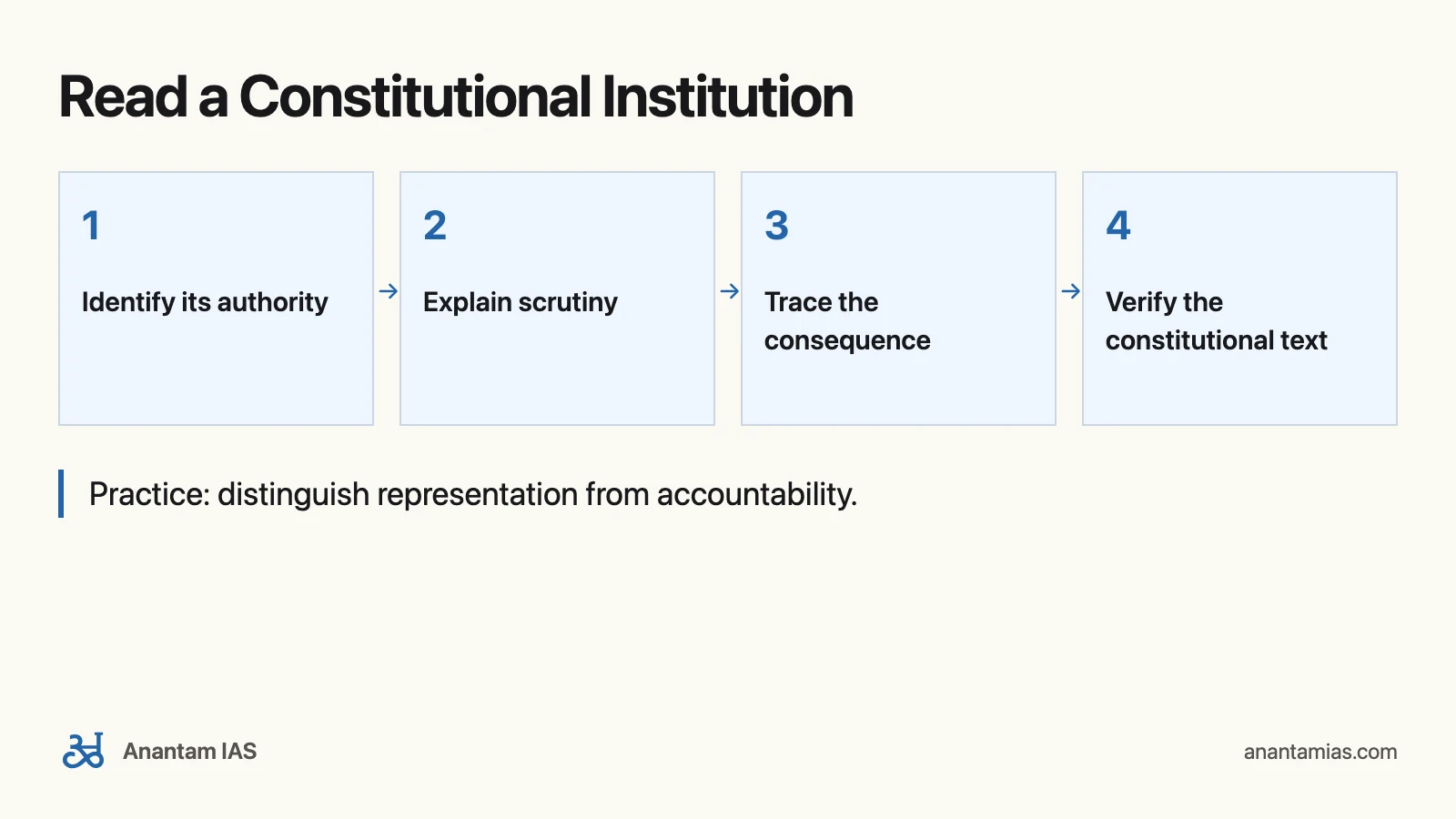
- Identify the actor exercising power and the institution to which it is answerable.
- Write the mechanism in an ordinary sentence: who asks, who explains and what may follow?
- Locate the relevant constitutional provision in the official Constitution rather than copying a remembered article number.
- Separate constitutional text, procedural rules and political practice in your notes.
Your finished note might have three fields: authority, scrutiny and consequence. A constitutional institution can appear in more than one field. The point is to explain the relationship, not to memorize a diagram as if it were law.
Reading With the Constitutional Text
Keep the Legislative Department’s Constitution of India page beside any secondary explanation. Use the official text to check the wording of a provision, its exceptions and its qualifications.
For a topic involving a judgment, distinguish the book’s explanation from the holding of the case and from later developments. Read an authoritative account of the relevant judgment before using a legal proposition in an answer. A familiar case name isn’t enough to establish what the court decided.
Useful notes separate these layers:
- Text: what the constitutional provision says.
- Explanation: why the arrangement matters.
- Practice: how an institution operates in the example being considered.
- Question: what remains uncertain or contested.
That separation prevents an author’s interpretation from becoming an invented constitutional rule in your revision notes.
A Selective Reading Plan
Use a 3-week cycle if you already have a polity foundation. Give each study session one question rather than a fixed page target.
- Week 1: choose two institutional relationships you find difficult. Draw their actors and responsibilities, then verify the relevant text.
- Week 2: study one rights or constitutional-change question. Write a short explanation with an explicit limit.
- Week 3: return to the first questions without the book. Explain them aloud and turn one into an answer outline.
If a section needs terms you don’t understand, pause and repair the prerequisite. That’s a sensible change of sequence, not a reason to abandon the book.
Keep Our Constitution if it helps you explain the connections your primary source leaves unclear. The next useful step is to finish one institutional explanation and test it against the constitutional text.
Frequently Asked Questions
What edition does NBT list?
The NBT product page lists the 5th edition, 2025, with 416 pages and ISBN 9788123707341. Match the actual copy and format to that record.
Can it replace a primary UPSC polity book?
Use it for institutional understanding and questions your primary source leaves unclear. Keep systematic syllabus revision and question practice in your main preparation plan.
Should I read it before NCERT?
If you lack a polity foundation, study the relevant NCERT first. Readers with a foundation can begin with a specific question rather than reading another book from the beginning.
Does a new edition cover every recent judgment?
Do not assume that. Check a relevant judgment and subsequent developments through authoritative current sources before using a legal proposition.
How should I make notes?
Separate constitutional text, explanation, practice and the question still unresolved. Keep the connection that improves your understanding rather than copying a whole section.