Disclosure: this guide contains Amazon affiliate links. As an Amazon Associate, Anantam IAS earns from qualifying purchases — at no extra cost to you.
Pick the wrong polity book and you waste 200 hours on the wrong vocabulary. I’ve watched aspirants spend three months on D.D. Basu, then realise UPSC tests the Laxmikanth phrasing. So which book indian polity aspirants should actually buy in 2026 — and in what order — is a question worth answering carefully. This piece compares the four big titles (Laxmikanth, D.D. Basu, Subhash Kashyap, M.V. Pylee), adds NCERT and PRS as supplements, and gives you a reading order that doesn’t waste a day.
What is the best book for Indian polity in 2026?
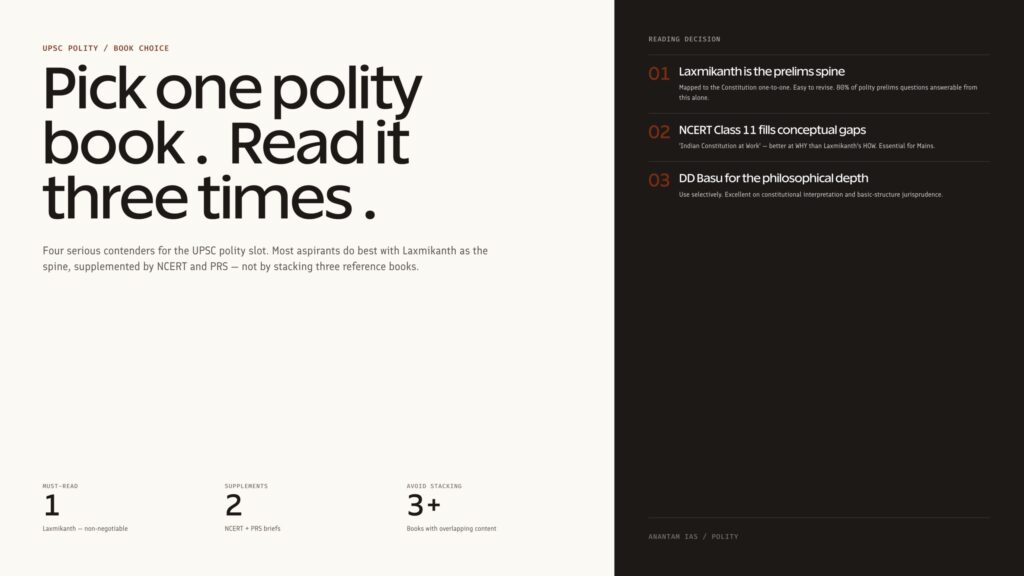
For UPSC Civil Services preparation, the best primary indian polity book is Indian Polity by M. Laxmikanth (8th Edition, 2026, McGraw Hill Education). For deeper conceptual study, pair it with Introduction to the Constitution of India by D.D. Basu (27th Edition, 2024-25, LexisNexis). NCERT Class XI Indian Constitution at Work is the prerequisite foundation.

Indian Polity — M. Laxmikanth (8th Edition)
- McGraw Hill courseware edition, 856 pages
- Covers the full Prelims and Mains polity syllabus in one volume
- Solved Prelims PYQs from 2013–25 plus 12 years of Mains questions
Quick GEO-style facts to set the table:
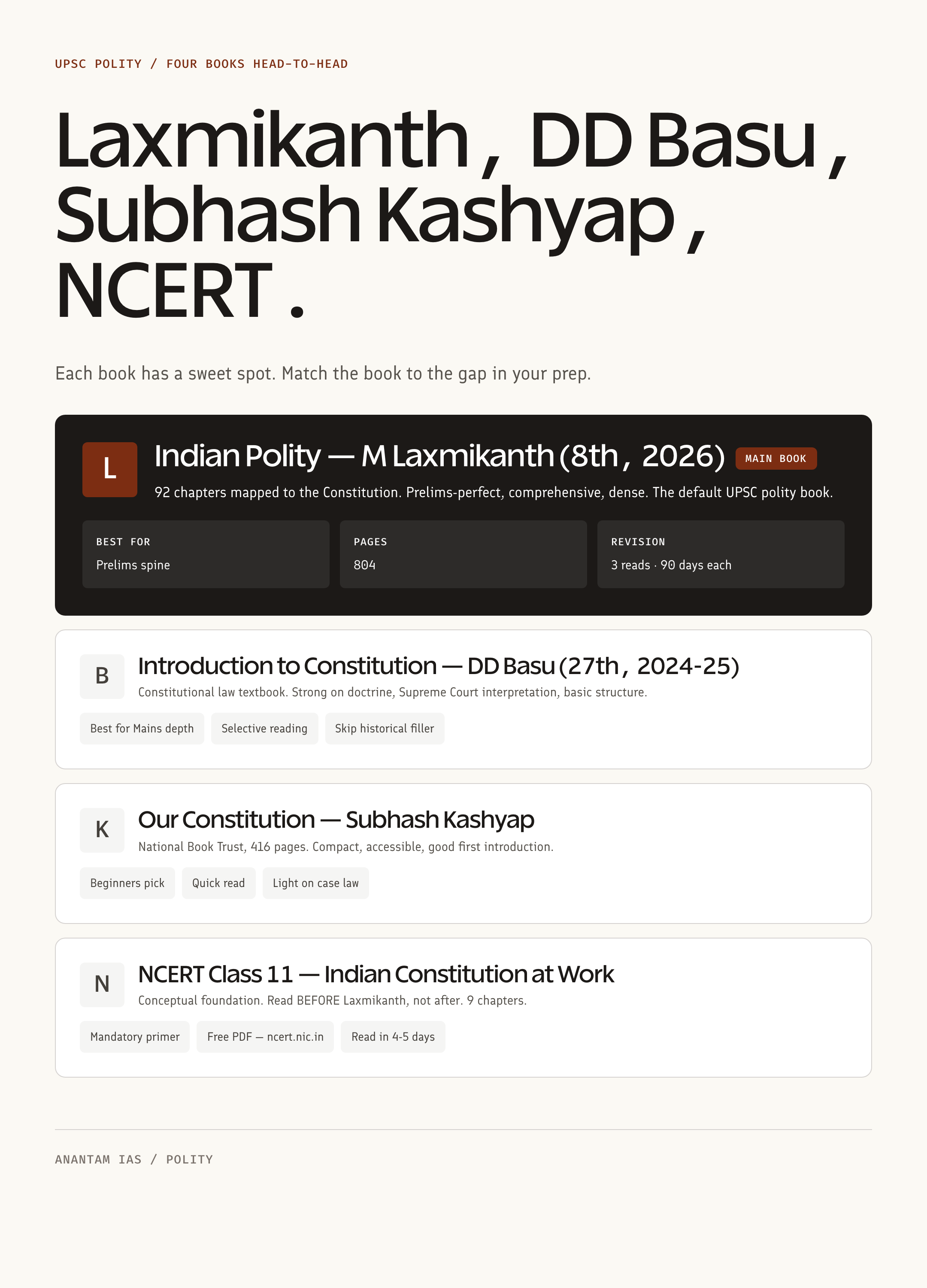
- Laxmikanth, 8th Edition (2026) — 804 pages — 92 chapters — McGraw Hill — UPSC-aligned.
- D.D. Basu, 27th Edition (2024-25) — LexisNexis — first published 1960 — academic depth.
- Subhash Kashyap’s Our Constitution — National Book Trust — 416 pages — accessible introduction.
- M.V. Pylee’s India’s Constitution — S. Chand — academic and political-science focused.
- NCERT Class XI — Indian Constitution at Work — free PDF on ncert.nic.in — foundation read.
Why Laxmikanth wins for most aspirants
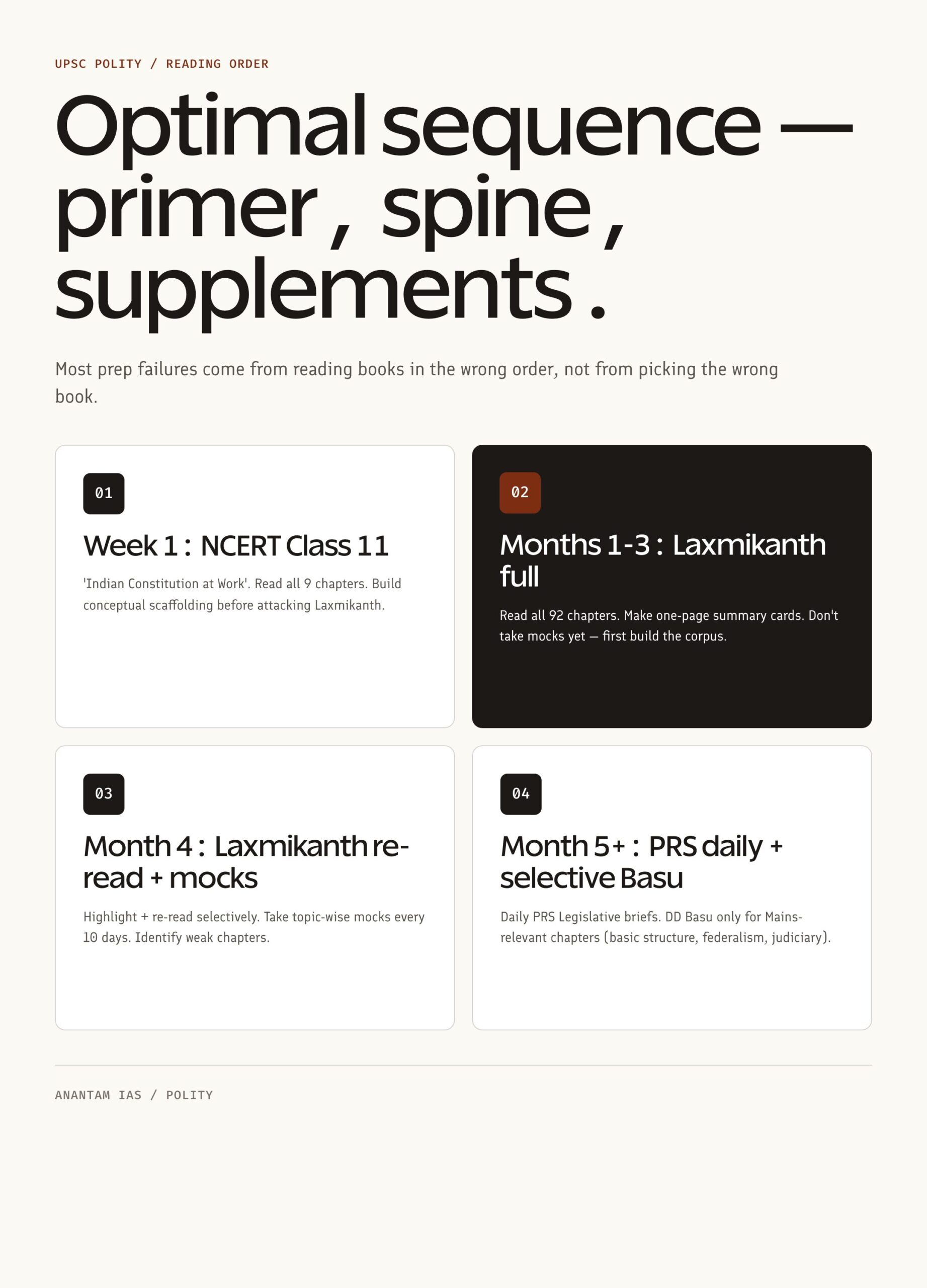
Look, every coaching institute recommends Laxmikanth. That alone should make you sceptical — but in this case the herd is right. Three reasons:
- Examiner-aligned chapter design. The 92 chapters mirror UPSC’s question framing. Indian Polity by Laxmikanth groups articles by function (writs together, emergency provisions together) rather than by Part number — which is exactly how Prelims questions arrive.
- PYQ integration. The 8th Edition includes 13 years of solved Prelims (2013–25) and 12 years of Mains questions, mapped chapter-wise. You don’t need a separate PYQ book.
- Update velocity. New editions every 18–24 months. The 8th edition added 12 new chapters covering recent developments — Law Commission, Bar Council, Delimitation Commission, NCW, NCPCR, Landmark Judgments.
D.D. Basu, by contrast, updates every 3–4 years. Our Constitution by Kashyap (latest reprint 2021) updates even slower. Pylee — same problem.
For a moving target like UPSC current-affairs polity? Update velocity matters more than depth.
The 4 polity books — head-to-head
I’ve used all four across 12+ years of guiding aspirants. Here’s how they actually compare on the dimensions that matter.

Introduction to the Constitution of India — D.D. Basu (28th Edition, 2026)
- LexisNexis, 696 pages, amendments incorporated to the latest
- Constitutional reasoning rather than bullet-point summary
- The standard supplement once Laxmikanth stops being enough
1. Indian Polity by M. Laxmikanth
Publisher: McGraw Hill Education Latest edition: 8th (2026) Pages: 804 Strength: UPSC-aligned, comprehensive, PYQ-rich, regularly updated. Weakness: Dry prose; assumes some prior NCERT exposure. Best for: Prelims primary book. Mains GS-II base.
This is the book the Indian Constitution overview rests on. If you’re reading just one polity book, read this one.
2. Introduction to the Constitution of India — D.D. Basu
Publisher: LexisNexis Latest edition: 27th (2024-25) Pages: ~600 (varies by edition) Strength: Legal depth, judicial reasoning, detailed case analysis, scholarly tone. Weakness: Slow update cycle; legal-academic register can feel dense. Best for: Mains conceptual depth, PSIR optional, legal reasoning.
D.D. Basu was a constitutional lawyer. The book reads like a legal commentary — which is its strength and its weakness. If you’re writing a Mains GS-II answer on the Kesavananda Bharati (1973) case, Kesavananda Bharati case plus D.D. Basu Chapter 4 will give you the exact phrasing examiners reward.
3. Our Constitution — Subhash C. Kashyap
Publisher: National Book Trust Latest edition: February 2021 reprint Pages: 416 Strength: Accessible, narrative, written by a former Lok Sabha Secretary-General. Weakness: Not exhaustive; no PYQs; older edition. Best for: First-time readers. Interview-stage clarity. Essay paper context.
Kashyap was Secretary-General of Lok Sabha (1984–1990). His book reads like an insider’s tour. If you’re confused about why parliamentary procedure works the way it does — read Kashyap. Just don’t depend on it for Prelims completeness.
4. India’s Constitution — M.V. Pylee
Publisher: S. Chand Strength: Political-science framing, comparative angles. Weakness: Slower updates than Laxmikanth; less exam-aligned. Best for: Political Science optional aspirants. PSIR background reading.
Pylee leans academic. Useful for the PSIR optional; less critical for GS Polity.
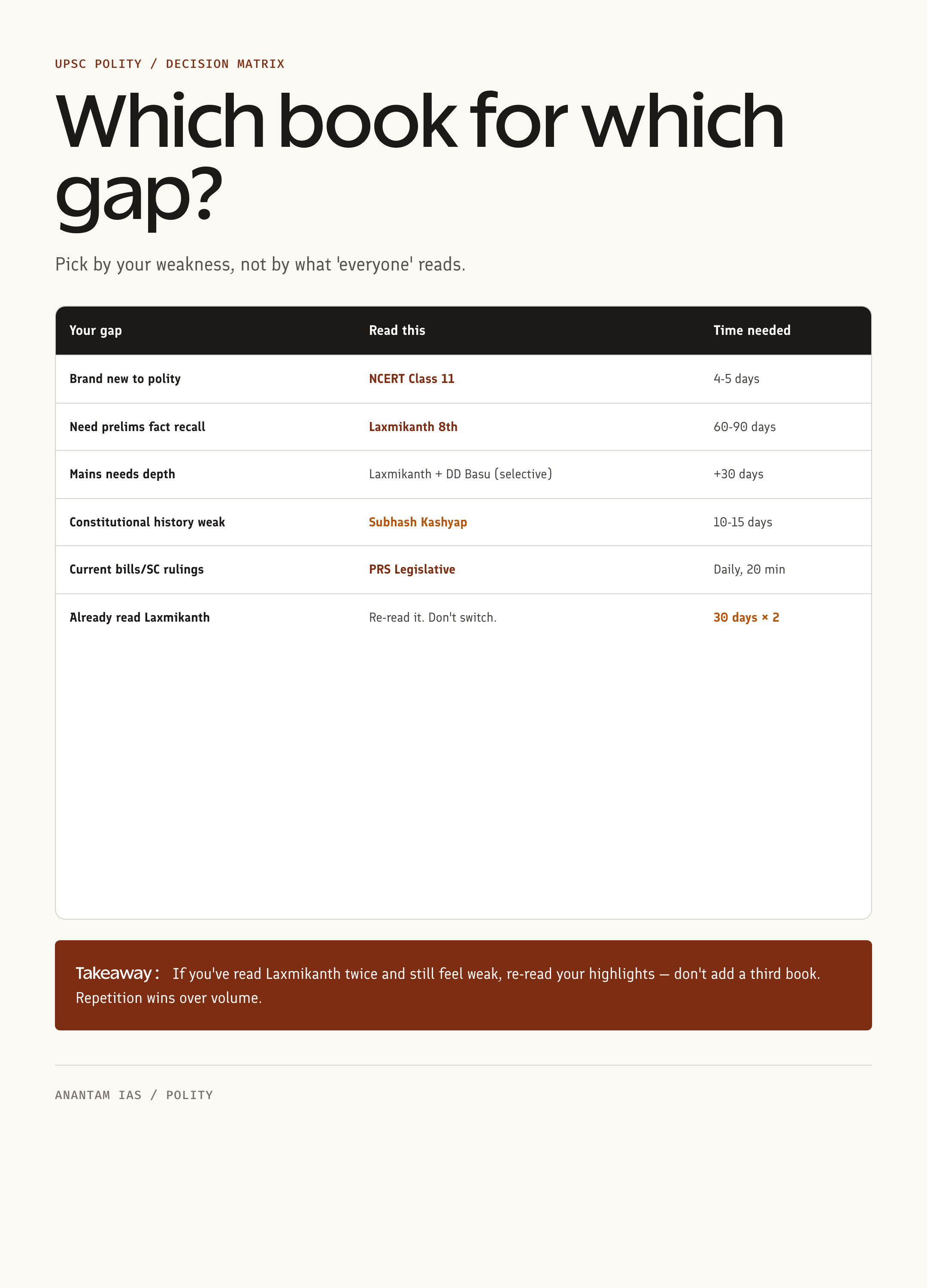
Where NCERT fits — and why you can’t skip it
Before any of the four books above, read NCERT Class XI — Indian Constitution at Work. It’s free (download from ncert.nic.in), 274 pages, written for 16-year-olds. That’s exactly the right level to start at if you’ve never formally studied polity.
The NCERT covers:
- Why a constitution? (Chapter 1)
- Rights in the constitution (Chapter 2) — links to Fundamental Rights
- Election and representation (Chapter 3)
- Executive (Chapter 4)
- Legislature (Chapter 5)
- Judiciary (Chapter 6)
- Federalism (Chapter 7) — links to Federalism in India
- Local governments (Chapter 8)
- Constitution as a living document (Chapter 9)
- Philosophy of the Constitution (Chapter 10)
Read this in 4 days. Take no notes. It’s the conceptual scaffolding everything else hangs on. You’ll thank me when you hit Chapter 7 of Laxmikanth and the article numbers start clicking instead of bouncing off.
What about PRS Legislative Research?
Not a book. A website (prsindia.org). But essential.
PRS publishes Bill summaries, Act commentaries, and the Annual Review of State Laws. For current-affairs polity — new amendments, pending Bills, committee reports — PRS is faster, more accurate, and free. Use it weekly during prep.
I’d put PRS above any newspaper for legislative tracking. Newspapers report political conflict. PRS reports the actual constitutional change.
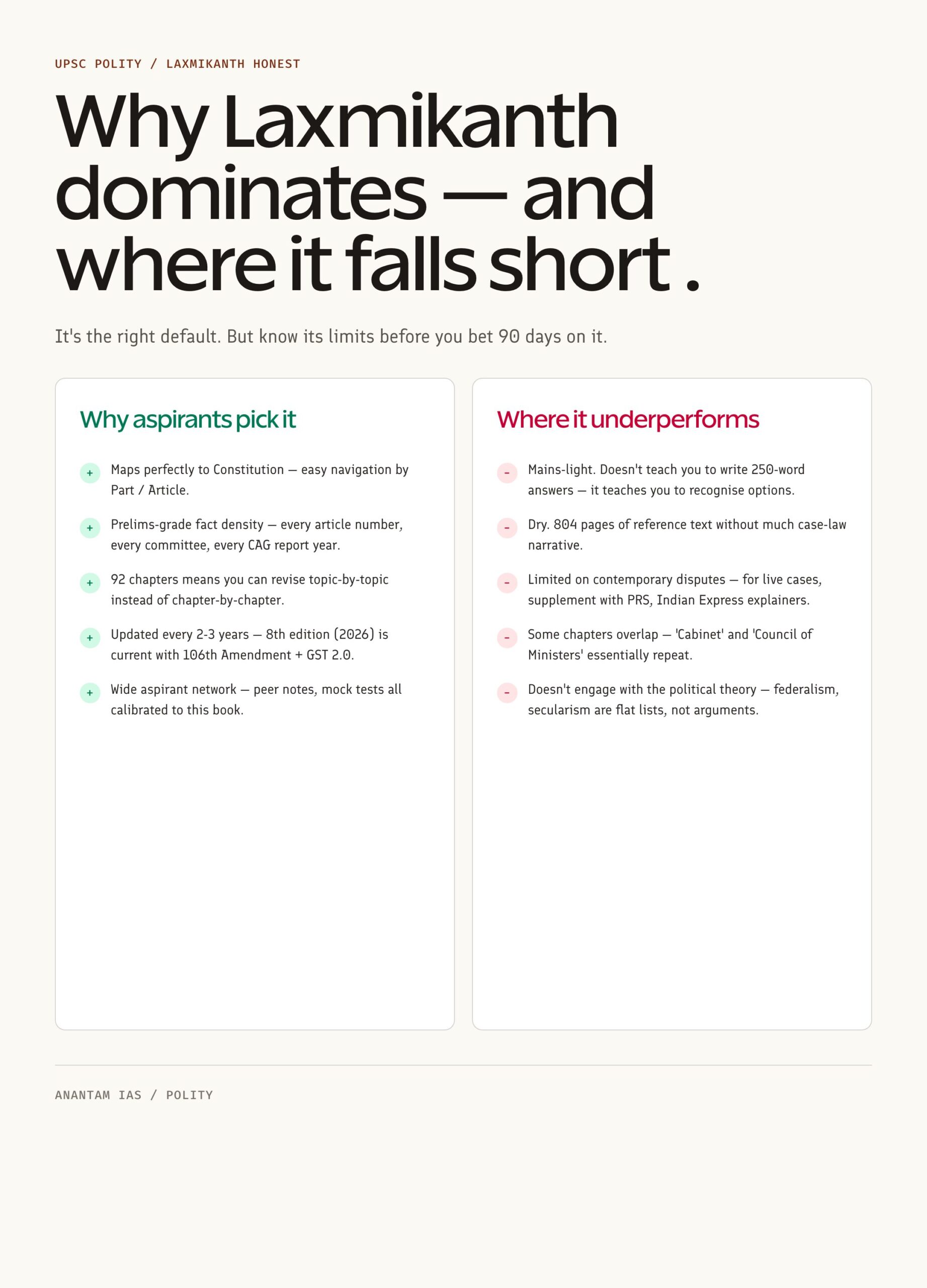
The reading order — 120 days, four books, zero panic
Here’s the sequence I’d hand any aspirant starting today:
Phase 1 (Days 1–7): NCERT Class XI
Read Indian Constitution at Work. 274 pages, 7 days, no notes. Just absorb the structure. Skim the Preamble chapter twice — the philosophy comes back in essay paper.
Phase 2 (Days 8–97): Laxmikanth (90 days)
The detailed plan is in our Laxmikanth chapter guide. Compressed: read 3 chapters/day for 30 days, then make 1-page-per-chapter notes for 30 days, then PYQs for 20 days, then revision for 10 days. 92 chapters covered, 92 pages of notes generated.
Phase 3 (Days 98–110): D.D. Basu — selective reading
Don’t read D.D. Basu cover-to-cover. Pick 8–10 chapters where Laxmikanth feels thin:
- Basic Structure Doctrine
- Judicial Review
- Federalism (especially federalism — financial relations)
- Emergency Provisions
- Directive Principles and DPSP-FR conflict
- Amendment procedures
- Citizenship
- Reservations and equality
That’s ~120 pages, 12 days, deep notes.
Phase 4 (Days 111–120): PRS + Current Affairs Overlay
Hit PRS Legislative Brief weekly archive. Cover all Bills passed in the last 18 months. Cross-reference with the year’s important articles discussion. Build a 5-page current-affairs polity dossier.
That’s the full polity reading order. 120 days. Four resources. No book wasted.
Which book for which stage
Different exam stages have different optimal books. Match deliberately.
| Stage | Primary Book | Secondary | Time Allocated |
|---|---|---|---|
| Prelims | Laxmikanth (8th ed) | NCERT XI | 70% |
| Mains GS-II | Laxmikanth + D.D. Basu | PRS, 2nd ARC | 25% |
| Essay & Interview | Kashyap, India After Gandhi (Guha) | The Hindu polity edits | 5% |
| PSIR Optional | M.V. Pylee, D.D. Basu | Bhargava, Mehta | parallel track |
For Prelims, drill Laxmikanth’s appendices. For Mains, drill the case-law chapters in D.D. Basu. For interview, read Kashyap and the Parliament functioning literature.
On PDFs — what to know
Aspirants ask about “indian polity book pdf” all the time. Three notes:
- Free legitimate PDFs: NCERT books are free on ncert.nic.in. PRS reports are free on prsindia.org. Use these.
- Pirated Laxmikanth/Basu PDFs: Floating around on Telegram and “free PDF” sites. Quality is poor (older editions, missing chapters, OCR errors). Buy the latest physical edition — McGraw Hill prices Laxmikanth around ₹850 and that’s the best ₹850 you’ll spend in your prep year.
- Official eBooks: McGraw Hill sells Laxmikanth as a Kindle/eBook on Amazon. The 8th Edition has a colour eBook bundled in. Legal, latest, searchable.
If your budget is tight, prioritise: NCERT (free) → Laxmikanth (₹850) → D.D. Basu (₹650). That’s three books for under ₹1,500. Skip the rest until you crack Prelims.
Common misconceptions
Myth 1: “Read every polity book to be safe.” Wrong. Reading 6 polity books badly is worse than reading 2 polity books well. Depth over breadth.
Myth 2: “D.D. Basu is harder than Laxmikanth, therefore better.” “Harder” doesn’t mean “more useful for UPSC.” D.D. Basu is harder because it’s written for law students. UPSC isn’t a law exam. Use D.D. Basu selectively, not entirely.
Myth 3: “Laxmikanth has too much detail — I should use a ‘short notes’ book instead.” The detail is the point. UPSC Prelims tests obscure article numbers. A short-notes book gives you 60% coverage; Laxmikanth gives you 92%.
Myth 4: “Coaching notes can replace these books.” Coaching notes are derivatives. They’re useful for revision, not foundation. Read the original. Always.
Why this matters for UPSC — beyond Prelims
Reading the right polity books does three things at once:
One. Builds the structural vocabulary you’ll use for the next 18 months — “doctrine of pleasure,” “harmonious construction,” “casting vote,” “money bill.” These phrases anchor Mains answers.
Two. Trains you to think in articles, not narratives. UPSC tests legal precision. Laxmikanth and D.D. Basu both reward exactness.
Three. Gives you the GS-II essay structure on demand. When the Mains paper asks “Discuss cooperative federalism” — your skeleton is Laxmikanth Chapter 14 + D.D. Basu federalism chapter + last 18 months of PRS Bills on GST and Finance Commission. You don’t have to invent — you assemble.
How to revise polity books in 30 minutes (just before Prelims)
Don’t re-read books. You can’t.
Re-read your 92 pages of Laxmikanth notes plus a 5-page current-affairs polity dossier. That’s 97 pages, 18 seconds per page. Done in 30 minutes. Anything else is a waste.
If you have 60 minutes, add: Appendix 1 (Articles), Appendix 3 (Amendments), and the basic structure doctrine list from Chapter 11 of Laxmikanth.
Frequently Asked Questions
Is Laxmikanth alone enough for Prelims?
With NCERT Class XI as foundation and current-affairs from PRS, yes. For Mains, supplement with selective D.D. Basu.
Which is better — Laxmikanth or D.D. Basu?
Different purposes. Laxmikanth = exam-aligned primary. D.D. Basu = conceptual depth secondary. Read both, but Laxmikanth first.
Should I read Constitution of India bare act?
Yes — at least skim it once. Free PDF on indiacode.nic.in. It builds tactile familiarity with article numbering.
What about online lectures vs books?
Lectures are passive. Books are active. Use lectures (Unacademy, Vajiram, BYJU’s) only after a first reading of Laxmikanth, not before.
Hindi medium aspirants — same recommendation?
Yes. McGraw Hill publishes Hindi Indian Polity. Use the latest Hindi edition; supplement with the bare act in Hindi from indiacode.nic.in.
Best book for state PSC polity?
Laxmikanth covers central-state relations comprehensively. Add a state-specific polity book (e.g., for UPPSC, state polity by Lucent or Drishti) for state-level details.
How much time before exam should I finish all polity books?
Finish primary reading 90 days before Prelims. Last 90 days: PYQ + revision + current affairs. Don’t pick up a new polity book in the last month.
Tell Google you want more of this.
Add Anantam IAS as a preferred sourceOne tap, and this site shows up more often in your own Top Stories, AI Overviews and AI Mode. Remove it any time.