Submarine Fleet of India: Diesel-Electric SSKs, Nuclear SSBNs, and the Path to an Indigenous SSN
A complete UPSC GS-III explainer on the submarine fleet of the Indian Navy. Covers the three diesel-electric classes (Kalvari, Sindhughosh, Shishumar), the Project-75 and Project-75I programmes, the Arihant-class nuclear ballistic missile submarines that complete the nuclear triad, the cleared Project 77 indigenous SSN line, current operational tonnage, and how the fleet sits in the Indo-Pacific balance of underwater forces.
A submarine is a warship that fights from below the surface. Its value lies in concealment. A surface ship can be tracked from satellites and aircraft. A submerged submarine cannot, until it gives itself away with sound or magnetism. This single property turns the submarine into the most strategic platform in any modern navy, capable of denying sea space to a much larger surface force, of striking unannounced from the deep, and in the case of nuclear-armed boats, of holding adversary cities at risk for as long as the patrol lasts.
The Indian Navy operates two distinct submarine fleets that solve two distinct problems. The conventional diesel-electric attack fleet, classified SSK, is the workhorse for sea denial in the Indian Ocean. It harasses adversary surface task forces, hunts opposing submarines, lays mines, and inserts special forces. The nuclear-powered ballistic missile fleet, classified SSBN, is the assured second strike of India’s nuclear triad. It carries submarine-launched ballistic missiles on long deterrent patrols. The two fleets are designed, built, and operated under separate logics.
For UPSC, the topic spans GS-III defence, internal security, and the broader question of indigenous capability. It also connects to the SSN versus SSBN distinction, the aircraft carriers of India, and the wider defence budget discussion. This article walks through every class in service, the major build programmes, and the cleared Project 77 SSN line.
What a Submarine Is and Why It Matters
A submarine submerges by flooding ballast tanks and surfaces by blowing them dry. The pressure hull, made of high-strength steel or specialised alloys, withstands several hundred metres of crushing depth. Propulsion can be a diesel engine running on the surface and a battery driving an electric motor when submerged, in which case the boat is an SSK. Propulsion can be a nuclear reactor, in which case the boat is nuclear-powered and can stay submerged indefinitely without surfacing for air or fuel. The reactor is the difference between a tactical platform that must surface periodically and a strategic platform that can remain hidden for the duration of its food and crew endurance.
The world’s submarine fleets are typically classified by the NATO designation system. SSK is a conventional attack submarine. SSN is a nuclear-powered attack submarine. SSBN is a nuclear-powered ballistic missile submarine. SSGN is a nuclear-powered guided-missile submarine. India operates SSKs and SSBNs and has a cleared programme for SSNs. The fleet does not currently include SSGNs.
The Three Diesel-Electric Classes
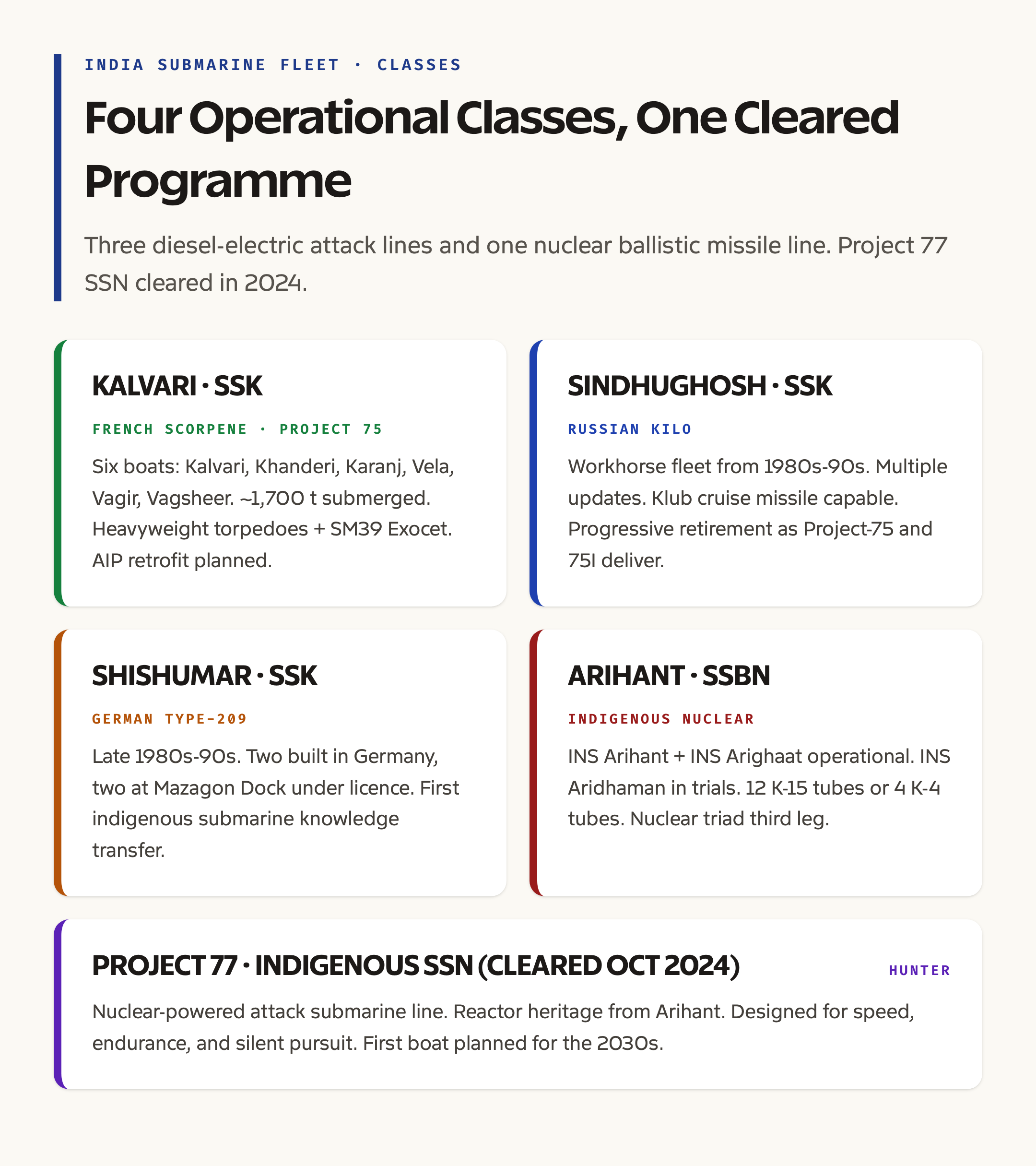
The Indian Navy currently operates three classes of diesel-electric attack submarines. They were inducted in successive decades and represent three different design lineages.
The Sindhughosh class is the largest. These are Russian Kilo-class submarines, ordered through the 1980s and 1990s, and updated in successive overhauls. The class is the workhorse of the conventional fleet. Several boats have been refitted to fire the Klub family of cruise missiles. The class is showing its age. The remaining boats face progressive retirement as Project-75 and Project-75I deliveries gather pace.
The Shishumar class consists of German Type 209 boats built in the late 1980s and early 1990s. Two were built in Germany and two were built under licence at Mazagon Dock Shipbuilders in Mumbai, the early indigenous transfer of submarine know-how. The class is small in number and old, but well maintained, and remains operational while replacements are inducted.
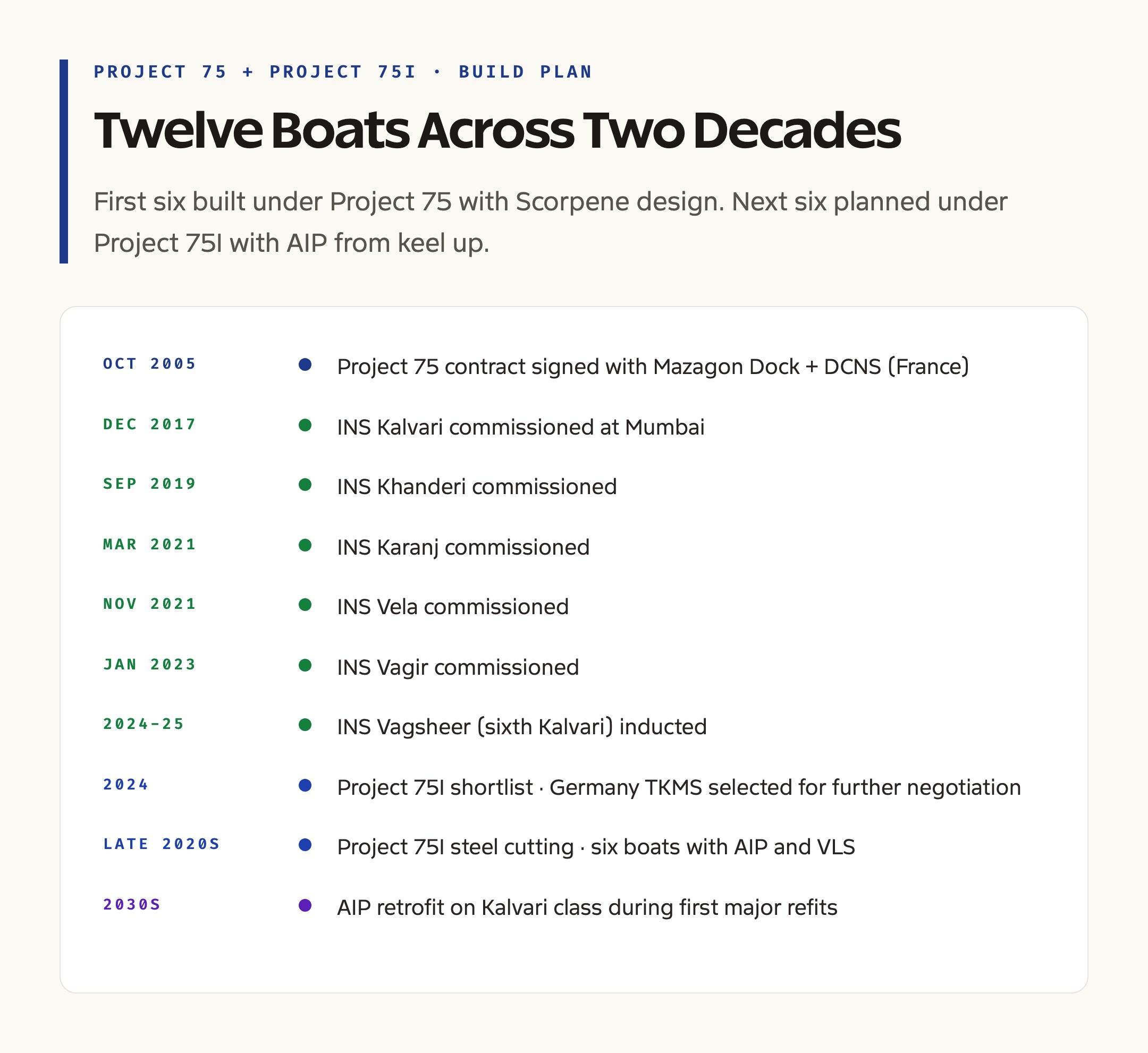
The Kalvari class is the newest. It is the Indian build of the French Scorpene design, executed under Project-75 with Mazagon Dock as the prime contractor. The first boat, INS Kalvari, was commissioned in December 2017. The class is six boats: Kalvari, Khanderi, Karanj, Vela, Vagir, and Vagsheer. All six have been launched. The last boat, Vagsheer, completes the planned series. Project-75 is widely regarded as a success in indigenous shipbuilding even though the design originated abroad, because the workshare in steel cutting, hull integration, and combat-system integration shifted progressively into Indian hands across the six boats.
Project-75 and the Six Kalvari Boats
Project-75 was contracted in 2005 and delivered the six boats over fifteen years. The class displaces approximately seventeen hundred tonnes submerged, has a length of about sixty-seven metres, and is armed with heavyweight torpedoes and the SM39 Exocet anti-ship cruise missile. The Scorpene design is acoustically quiet by Western standards, and the Indian boats incorporate steady upgrades in sensors, combat systems, and propulsion across the run.
The class does not yet incorporate air-independent propulsion, the technology that allows a diesel-electric boat to remain submerged for several weeks without surfacing to recharge its batteries. The DRDO has developed a fuel-cell-based AIP module that is to be retrofitted to the Kalvari boats during their first major refits. AIP is now the dividing line between modern conventional submarines and earlier-generation boats. Without AIP, a diesel-electric submarine must come to periscope depth roughly every few days to run a snorkel and recharge. With AIP, the same boat can remain submerged for two to three weeks. The retrofit programme will close that gap.
Project-75I and the Next Six
Project-75I, the follow-on programme, has been in procurement for over a decade. The intent is to build six new SSKs with foreign collaboration and indigenous content, equipped with AIP from the start. The shortlisted partners include German thyssenkrupp Marine Systems and Spanish Navantia, with German selection announced in late stages of the competition. Mazagon Dock is the likely prime in Mumbai. Construction is expected to begin once final contract signing is complete, with first deliveries deep in the next decade.
The Project-75I boats are intended to be larger than the Kalvari class, with greater endurance, better sensors, and a vertical launching system that allows the boat to fire land-attack cruise missiles such as the BrahMos and the Nirbhay without surfacing. This is a meaningful capability uplift over the Kalvari design, which fires its missiles through torpedo tubes.
Project 76: An Indigenous Conventional Submarine
The longer-term plan is to design the next conventional submarine entirely in India, under Project 76. This would draw on the experience of building the Kalvari and the Arihant classes, integrate Indian AIP and combat systems from the keel up, and be the first SSK with no foreign design lineage. The programme is at a paper stage and depends on the Department of Defence Production and the Naval Design Bureau completing the basic design before steel can be cut. The earliest realistic induction is in the next decade.
The Arihant Class and the Nuclear Triad
The strategic side of the fleet is a different story. India’s nuclear triad requires a sea-based deterrent that can survive a first strike. A land-based missile silo can be targeted. An air-launched weapon depends on aircraft surviving to take off. A submerged ballistic missile submarine, hidden under thousands of square kilometres of ocean, is the most survivable launch platform.
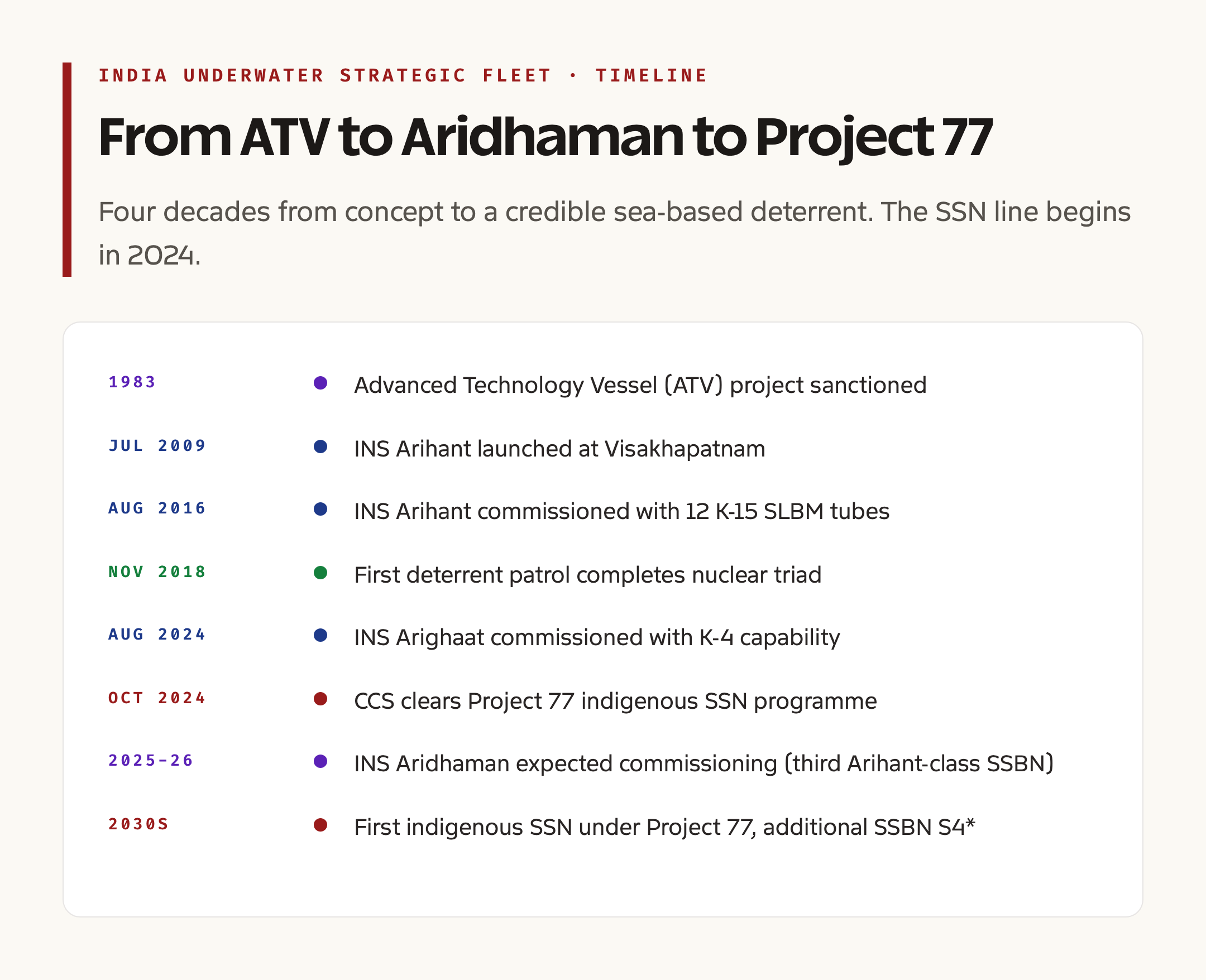
The Arihant class is the indigenous Indian SSBN line, developed under the Advanced Technology Vessel project that began in 1983. INS Arihant, the first boat, was launched in 2009 and commissioned in 2016. It carried out India’s first deterrent patrol in 2018, completing the nuclear triad. INS Arighaat, the second boat, was commissioned in August 2024 with improvements that reflect the experience of the lead boat. INS Aridhaman, the third boat, is launched and undergoing trials. A fourth boat, sometimes referred to as S4*, is reportedly in build.
The class is armed with submarine-launched ballistic missiles of the K-series. The K-15 Sagarika has a range of about seven hundred and fifty kilometres and is the operational SLBM on the early Arihant boats. The K-4 has a range of about three thousand five hundred kilometres and was test-launched from a submerged platform repeatedly across the late 2010s and early 2020s. The K-5 is in development with a longer range that would allow patrols closer to home base. The Arihant-class boats carry twelve K-15 tubes or four K-4 tubes in the missile compartment.
The SSBN Mission and Why It Is Different
An SSBN is not a fighter. It is a deterrent. The mission is to remain hidden for the duration of a patrol, typically several weeks to a few months, and to be ready to launch its missiles on receipt of an authenticated order. The boat avoids combat. It avoids contact. It minimises sound emission. The crew runs at a slower pace than on a conventional attack boat. The reactor produces electrical power continuously, so there is no need to surface to charge batteries.
The strategic logic is that the existence of an undetectable submerged SSBN at sea makes a first strike unprofitable for any adversary. Even if every land-based weapon is destroyed, the SSBN can retaliate. This is the assured second strike. India formally declared its no-first-use nuclear posture and the nuclear triad as the deterrent architecture, with the SSBN as the third leg.
Project 77 and the Indigenous SSN
For decades India has wanted to build its own SSN, a nuclear-powered attack submarine that can pursue surface task forces and other submarines without surfacing for fuel. An SSN is not a deterrent platform. It is a hunter, and the speed and endurance of nuclear propulsion make it the most capable hunter at sea.
In October 2024, the Cabinet Committee on Security cleared Project 77, the indigenous SSN programme. The plan is to build a class of nuclear-powered attack submarines, with the first boat in service in the next decade. The reactor heritage will draw on the Arihant programme. The hull and combat systems will be designed for the SSN mission, which prioritises speed and stealth over the volume needed for ballistic missile compartments.
INS Chakra, leased SSNs from Russia, gave the Indian Navy operational experience with nuclear propulsion across two distinct lease periods. The leased boats are not in service today. Project 77 will replace the lease with indigenous capability.
Tonnage, Capability, and the Indo-Pacific Balance
The Indian submarine fleet is small by Chinese or American standards but is large enough to threaten any conventional surface task force operating in the Indian Ocean. The current operational fleet is approximately sixteen to seventeen submarines: six Kalvari, six to seven Sindhughosh, two to four Shishumar, and two Arihant-class SSBNs. Add the Aridhaman after commissioning and the SSBN side becomes three.
The strategic context is the Chinese expansion of submarine operations into the Indian Ocean. PLA Navy SSNs have transited the Strait of Malacca and operated in the Bay of Bengal for years. The Yuan-class SSKs have been forward-deployed to Pakistan’s Karachi and Gwadar bases through visits and joint exercises. The undersea balance in the Indian Ocean is the central rationale for sustaining a robust SSK fleet, accelerating Project-75I, and bringing Project 77 to first-of-class delivery.
How the Fleet Connects to Other Capabilities
Submarines do not operate in isolation. The Indian Navy integrates them with its surface fleet, its long-range maritime patrol aircraft P-8I, the indigenous undersea surveillance grid, and the broader internal security architecture. The conventional fleet is exercised regularly with allied submarines from France, Australia, Japan, and the United States, particularly during the Malabar exercise. The strategic SSBN fleet operates under the Strategic Forces Command, which holds operational authority over all nuclear-armed delivery platforms.
The shipyard ecosystem includes Mazagon Dock for SSK construction, the Ship Building Centre at Visakhapatnam for SSBN construction, Larsen and Toubro for hull section and reactor compartment fabrication, and BARC for nuclear propulsion components. The vendor base for sensors, combat systems, and weapons spans BEL, BDL, and DRDO laboratories. The build cycle of a submarine is at least eight to ten years from steel cutting to commissioning, and the throughput of the system depends on parallel construction of multiple boats at the same yard.
Why It Matters for UPSC
The submarine fleet is a frequent UPSC topic because it touches indigenous defence production, nuclear triad credibility, the Indo-Pacific maritime balance, and the regulatory architecture that governs strategic forces. Prelims questions ask which class is which design origin, which is the lead boat of a class, and how many tubes a particular SSBN carries. Mains questions are more thematic. Discuss the role of the submarine fleet in India’s maritime strategy. Examine the gaps in conventional submarine capability and the steps to close them. Evaluate Project 77 in the context of the indigenous defence industrial base.
The set of facts is small. Three SSK classes, one SSBN class, and a cleared SSN programme. The thematic depth, however, runs through every part of GS-III and GS-II that touches defence or foreign policy.
Frequently Asked Questions
How many submarines does India operate?
Around sixteen to seventeen, including the Kalvari, Sindhughosh, Shishumar, and Arihant classes. The number changes with retirements and inductions.
What is the difference between an SSK and an SSBN?
An SSK is a diesel-electric attack submarine for tactical missions. An SSBN is a nuclear-powered ballistic missile submarine for strategic deterrence.
Which submarine completed India’s nuclear triad?
INS Arihant, after its first deterrent patrol in November 2018.
What is Project 75 and Project 75I?
Project 75 is the six-boat Kalvari-class build programme, based on the French Scorpene design. Project 75I is the planned six-boat follow-on with air-independent propulsion and likely German collaboration.
What does the K-15 Sagarika SLBM do?
It is the first-generation submarine-launched ballistic missile of the Indian Navy, with a range of about seven hundred and fifty kilometres. It arms the early Arihant-class boats.
What is Project 77?
The cleared Indian programme to build indigenous nuclear-powered attack submarines (SSNs), distinct from the Arihant SSBN line.
Did India ever operate an SSN?
Yes, on lease from Russia under the INS Chakra programme. The leased boats are not currently in service, and Project 77 will replace the capability with indigenous boats.