A submarine is the only major weapon system that wins by being unfindable. On the surface a warship is announced by its silhouette and its radar return. In the air an aircraft is announced by heat and noise and the radar pulse it cannot avoid. Under three hundred metres of seawater a submarine is announced by almost nothing. That single fact is why nuclear-powered submarines have been the most prized strategic asset of the great powers for sixty years.
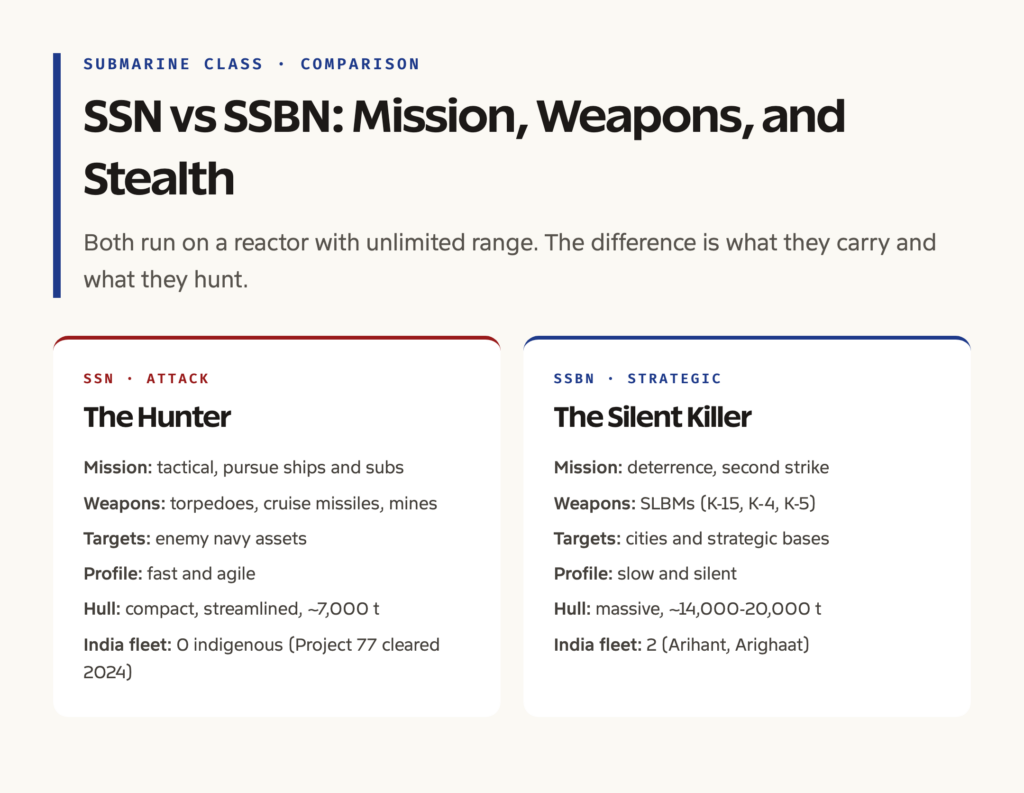
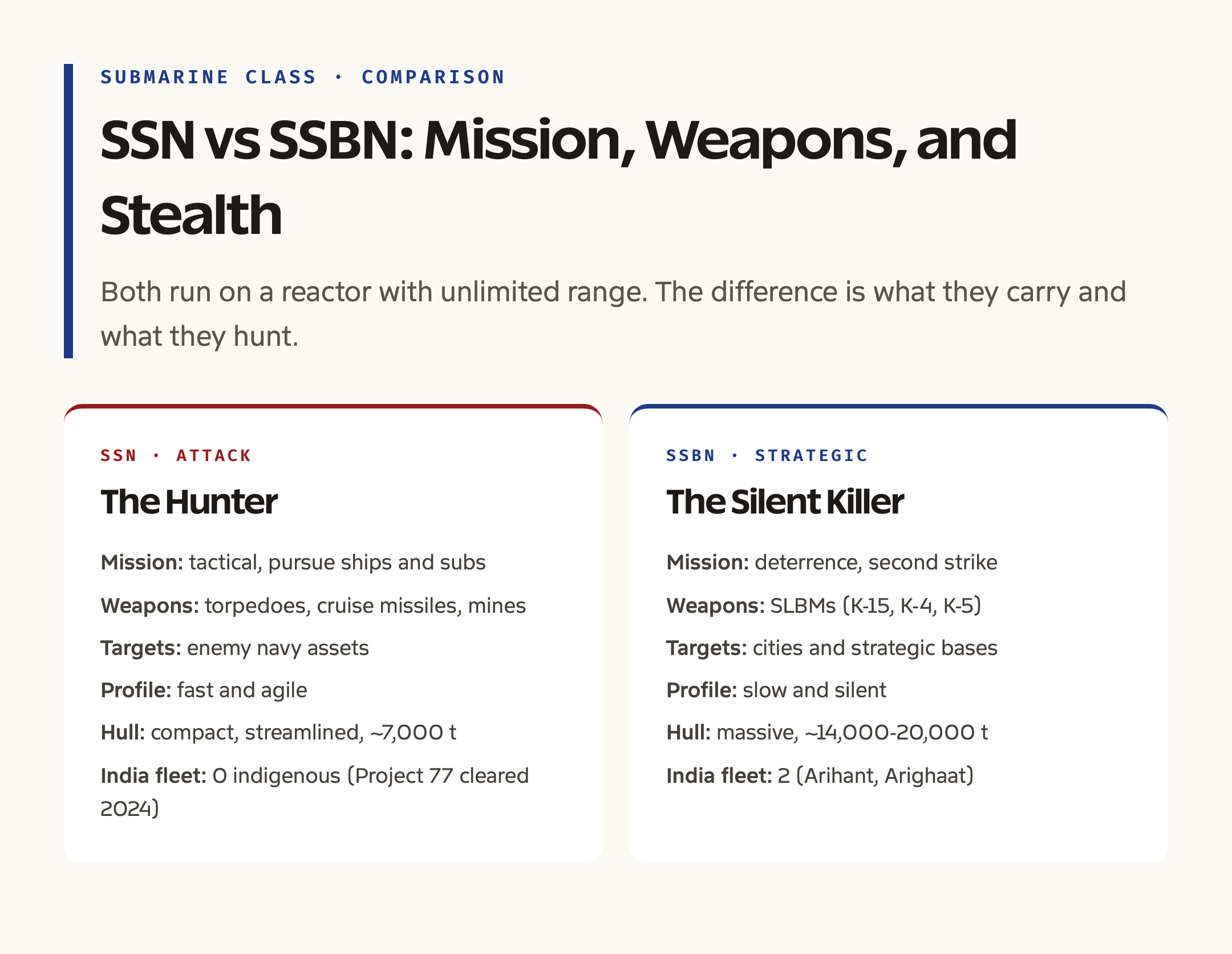
Within that family there are two classes that look superficially similar but do entirely different jobs. The SSN, or nuclear-powered attack submarine, is built to hunt. The SSBN, or nuclear-powered ballistic missile submarine, is built to hide. The first is a tactical instrument that goes looking for the enemy. The second is a strategic insurance policy that hopes never to be used. Both run on a reactor, both have unlimited submerged endurance, and both belong to a club of fewer than ten navies.
For UPSC, the distinction matters because it sits at the centre of how India thinks about defence technology, nuclear deterrence, and the maritime balance in the Indian Ocean. This article walks through what each class actually is, what it carries, how the two differ in design and behaviour, where India stands today, and why the long-delayed clearance of an Indian SSN programme in late 2024 is the most consequential naval decision the country has taken in a decade.
What the Acronyms Mean
The convention is American but it has stuck globally. The first two letters describe the hull. SS stands for Submersible Ship, the original navy designation for any submarine. The third letter describes the propulsion. N stands for Nuclear, meaning the boat carries a pressurised water reactor that drives a steam turbine and turns the propeller without ever needing to surface for air. The optional fourth letter describes the role. B stands for Ballistic, meaning the submarine carries submarine-launched ballistic missiles. G in some older designations stood for Guided, referring to cruise missiles.
So SSN is a nuclear-powered attack submarine, sometimes called a fast attack boat. SSBN is a nuclear-powered ballistic missile submarine, sometimes called a boomer in American slang or a strategic submarine in Indian usage. Both are nuclear powered. The difference lies entirely in what they carry and what they are sent to do.
A diesel-electric submarine, by contrast, gets the designation SSK. India’s Kalvari and Sindhughosh classes are SSKs. They are quieter than nuclear boats when running on batteries, but they have to surface or use a snorkel to recharge, which limits how long they can stay deep and how far from base they can operate.
How the Reactor Changes Everything
The single feature that defines a nuclear submarine, regardless of role, is the reactor. A pressurised water reactor in the boat’s belly produces heat from controlled fission. That heat boils water into steam. The steam drives a turbine. The turbine drives the propeller through a reduction gear and also turns generators that supply the boat’s electrical load. The reactor needs no oxygen, produces no exhaust, and runs for years on a single fuel core.
This translates into three operational facts. First, range is effectively unlimited. A nuclear boat can sail from Visakhapatnam to the Arctic and back without refuelling. Second, submerged endurance is limited only by food and crew tolerance, typically ninety days. Third, sustained underwater speed can be high, often above thirty knots, because the reactor provides plenty of power to push the hull through water. A diesel-electric boat at high battery speed runs flat in hours. A nuclear boat at high speed could keep going for months.
Both SSNs and SSBNs share these properties. What differs is how the navy uses them.
The SSN: Built to Hunt
The attack submarine’s job is tactical. It exists to find and sink enemy submarines, surface ships, and anything else of military value, and to support the rest of the fleet by clearing the water ahead of carriers and amphibious groups. American Virginia-class boats and Russian Yasen-class boats are the contemporary benchmarks. China’s Type 093 and 095 are catching up. Britain’s Astute and France’s Suffren occupy specialised roles in their own naval traditions.
An SSN is smaller and more streamlined than a strategic boat because it has to chase. It carries torpedoes for short-range engagements, anti-ship cruise missiles for distant warship targets, and increasingly land-attack cruise missiles that can be fired from a torpedo tube or a vertical launch silo to strike targets hundreds of kilometres inland. It also carries mines, special forces detachments, and electronic intelligence sensors. Its operational repertoire reads like the toolkit of a naval generalist.
Stealth in an SSN is balanced against speed and agility. Quieting matters, but the boat is expected to manoeuvre aggressively in trail of an enemy submarine, so reactor and propulsion are tuned for power as well as silence. The hull is more compact, the sail more streamlined, and the displacement typically between six thousand and ten thousand tonnes submerged.
The SSBN: Built to Hide
The strategic submarine has only one job. It carries enough nuclear-armed ballistic missiles to inflict unacceptable damage on an adversary’s cities and command centres, and it does so by disappearing into a patrol area and waiting. If the country is attacked with nuclear weapons and its land-based and air-based deterrents are destroyed, the SSBN at sea is the survivable second strike that ensures the adversary cannot escape retaliation. That is the entire concept of mutually assured destruction, and the sea-based leg is the most stable of the three because it cannot be targeted in advance.
This logic produces a very different boat. An SSBN is enormous, displacing fourteen to twenty thousand tonnes or more. The hull bulges around a missile compartment that holds anywhere from twelve to twenty-four vertical tubes for SLBMs. Russia’s Borei-class carries sixteen Bulava missiles. America’s Ohio-class carries twenty Trident-II D5 missiles. Both are larger than most surface warships.
Speed and agility do not matter. What matters is silence, depth, and the ability to remain undetected for a sixty- to ninety-day deterrent patrol. An SSBN avoids contact wherever possible. It is escorted only in distant waters and otherwise patrols alone. The crew lives by the rule that the boat is most valuable when nobody knows where it is.
The connection to nuclear policy is direct. Without an SSBN, a country has no survivable second strike, and its deterrent rests on land-based silos and air-launched weapons that an adversary can hope to destroy in a first strike. With an SSBN at sea, that calculation collapses, because no first strike can ever be confident of finding the boat in time.
Weapons: Torpedoes and Cruise vs SLBMs
The clearest difference between the two classes is in the magazine. An SSN carries heavyweight torpedoes such as the Russian UGST or the Indian Varunastra, anti-ship missiles such as the Harpoon or the BrahMos, and land-attack cruise missiles such as the Tomahawk or the Nirbhay. These are tactical weapons with ranges from a few kilometres to about a thousand kilometres, and they are fired from torpedo tubes or vertical launchers that hold a dozen or so weapons.
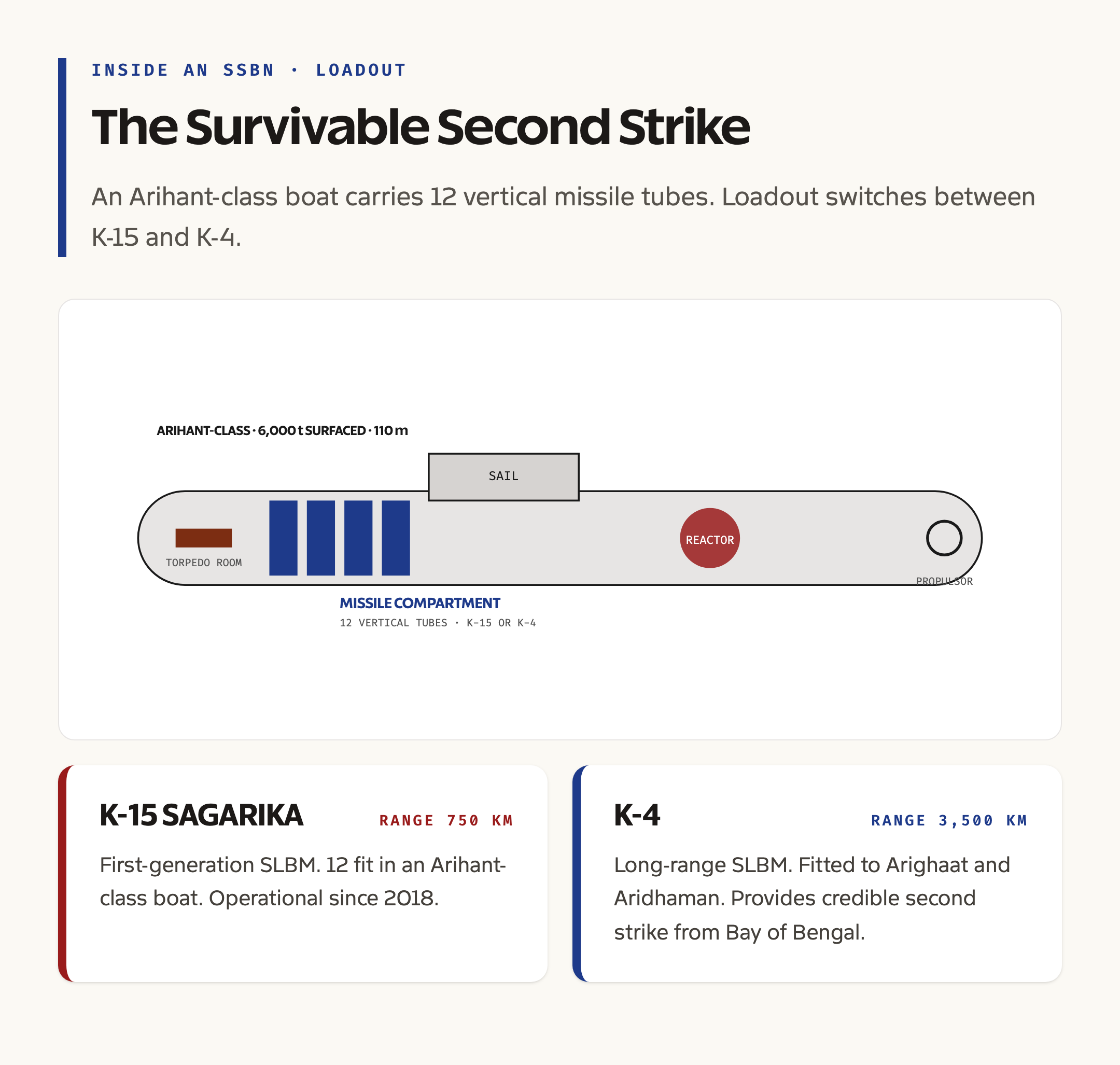
An SSBN carries SLBMs that can fly five thousand to twelve thousand kilometres and deliver multiple independently targetable nuclear warheads. India’s K-15 Sagarika has a range of about seven hundred and fifty kilometres and is the smaller, earlier weapon. The K-4 has a range close to thirty-five hundred kilometres and is the operational long-range missile fitted to the Arihant class. The future K-5 and K-6 are designed to extend that envelope further. Each missile carries a nuclear warhead, and a single SSBN can carry enough firepower to devastate a country.
Tactical sub-launched cruise missiles are increasingly carried on SSNs, and there is a separate category called SSGN that is purpose-built for cruise-missile carriage, but the strategic separation between SSN and SSBN remains the defining feature of nuclear submarine fleets. You can read more about how the broader submarine fleet of India fits with the rest of the Indian nuclear programme.
Stealth and Speed: A Different Kind of Quiet
Both classes are quieter than any conventional submarine, but the engineering priorities differ. An SSN’s propulsor is designed to allow high tactical speeds without cavitation, which is the formation of bubbles around a fast-spinning propeller that announces the boat’s presence over hundreds of nautical miles. The reactor coolant pumps and the steam plant are isolated on shock mounts to attenuate machinery noise.
An SSBN takes the same principles further. It is designed to cruise slowly, often at five to eight knots, in deep water for months. At those speeds the propulsor produces almost no noise. The reactor runs on natural circulation if the design allows it, eliminating the pumps that are usually the loudest part of a nuclear plant. Anechoic tiles on the hull absorb active sonar pings. The result is a boat that can be a few thousand metres from a search platform and remain undetected.
Detection works the other way around for the two classes too. An SSN is expected to put itself in proximity to enemy units to track them. An SSBN is expected to avoid every contact, including friendly ones, until the moment of launch.
Where India Stands
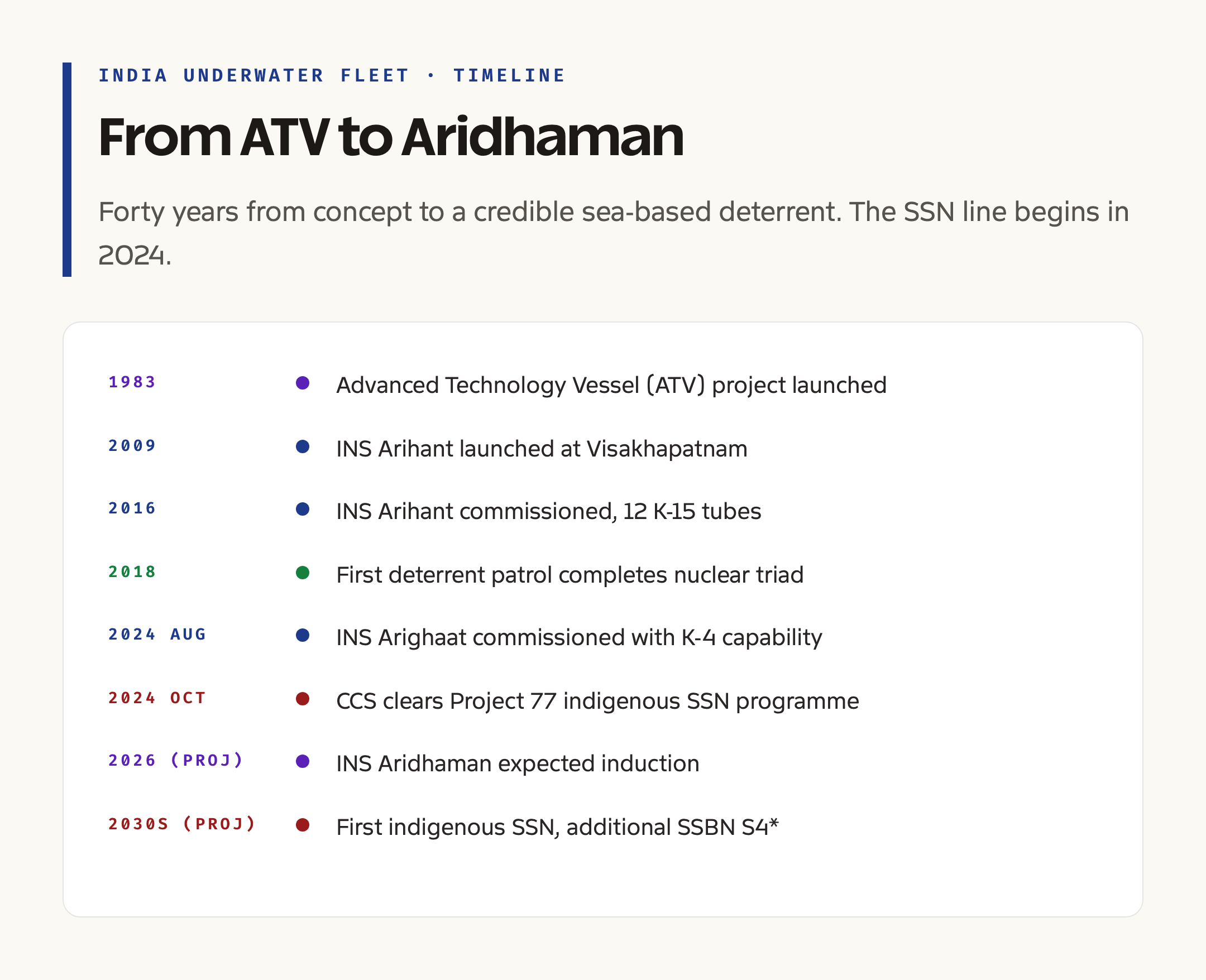
India’s Arihant-class is a programme that began as the Advanced Technology Vessel project in the early 1980s, accelerated after the 1998 Pokhran tests, and produced its first hull, INS Arihant, commissioned in August 2016. INS Arighaat followed in August 2024 with a slightly improved missile loadout. INS Aridhaman, the third boat, is larger and is expected to enter service in 2026 carrying eight K-4 missiles or twenty-four K-15 missiles. A fourth boat, sometimes referred to as S4 star, is under construction.
These are the strategic boats that complete the sea-based leg of the nuclear triad. They have given India, for the first time, a survivable second strike capability commensurate with the no-first-use posture announced after Pokhran-II. The 2018 maiden deterrent patrol of INS Arihant marked the moment the doctrine became operationally credible.
What India did not have, until very recently, was a single nuclear-powered attack submarine. The Indian Navy operated INS Chakra, a leased Russian Akula-II SSN, between 2012 and 2021, and was meant to lease a second boat. The 2024 Cabinet Committee on Security clearance of an indigenous Project 77 SSN programme, with a planned construction of two and an option for three more, finally puts India on a path to having its own attack submarines. The first hull is expected in the early 2030s.
Why the SSN Decision Matters
The absence of an indigenous SSN was a strategic gap. An attack submarine is the natural protector of an SSBN at sea. It is the platform that hunts the enemy’s nuclear hunters. It is the asset that can shadow a Chinese carrier group through the Strait of Malacca and report back without ever being detected. None of those tasks can be done effectively by a diesel-electric boat that has to come up for air every few days.
Project 77 is also a measure of industrial confidence. Building a reactor for the Arihant class taught India that it can produce a small naval power plant. Designing an SSN involves a different set of trade-offs around speed and quieting, but the engineering base is the same. The decision to invest tens of thousands of crores in two indigenous SSNs is a vote of confidence that the country’s shipyards, metallurgy, and reactor industry can sustain a second nuclear submarine line alongside the strategic boats.
There is a regional logic too. China’s submarine fleet is now the largest in the world by hull count, and its Yulin base on Hainan Island, where the Type 094 SSBNs and the Type 093 SSNs are based, projects directly into the Indian Ocean. India needs an SSN to deny that influence and to operate alongside coalition partners under the internal security and Indo-Pacific arrangements that have grown since 2018.
SSN vs SSBN: The One-Line Summary
If only one sentence is allowed in a UPSC answer, it is this. The SSN hunts; the SSBN hides. The first is the navy’s tactical sword that strikes when it has to. The second is the country’s strategic shield that succeeds simply by existing. Both run on reactors, both displace several thousand tonnes, and both are reserved for a small number of navies. They differ in size, weapons, role, and the kind of silence each is engineered for.
For India, the strategic boats are operational and growing in number, with INS Aridhaman expected next year. The hunters are still on the drawing board, with the 2024 SSN clearance promising the first indigenous boat in the early 2030s. The day both classes operate together will be the day the Indian Navy enters the first rank of nuclear submarine powers.
Frequently Asked Questions
What is the difference between SSN and SSBN?
An SSN is a nuclear-powered attack submarine designed to hunt enemy ships and submarines using torpedoes and cruise missiles. An SSBN is a nuclear-powered ballistic missile submarine designed to hide in deep water and provide a survivable nuclear second strike using submarine-launched ballistic missiles. Both are nuclear powered, but the SSN is tactical and the SSBN is strategic.
Does India have an SSN?
India does not currently operate an indigenous SSN. It leased the Russian Akula-class INS Chakra between 2012 and 2021. In October 2024, the Cabinet Committee on Security cleared an indigenous SSN programme called Project 77 for two boats, with a planned induction in the early 2030s.
How many SSBNs does India operate?
India operates two SSBNs as of 2026: INS Arihant, commissioned in 2016, and INS Arighaat, commissioned in August 2024. INS Aridhaman, the third and larger boat of the class, is undergoing trials and is expected to enter service in 2026. A fourth boat is under construction.
What missiles does INS Arihant carry?
INS Arihant carries the K-15 Sagarika SLBM with a range of about seven hundred and fifty kilometres. INS Arighaat and INS Aridhaman are designed to carry the longer-range K-4 with a range close to thirty-five hundred kilometres. The K-5 and K-6 are under development for future boats.
Why is an SSBN important for nuclear deterrence?
An SSBN provides the survivable second strike that anchors a credible nuclear deterrent. Land-based silos and aircraft can be targeted in a first strike, but a submarine on patrol cannot be located, so an adversary cannot rule out devastating retaliation. This is the sea-based leg of the nuclear triad and is considered the most stable of the three.
Tell Google you want more of this.
Add Anantam IAS as a preferred sourceOne tap, and this site shows up more often in your own Top Stories, AI Overviews and AI Mode. Remove it any time.