Promotion and Regulation of Online Gaming Act, 2025: E-Sports, Social Games and the Money-Game Ban
Online Gaming Act 2025 explained: NOGC regulator, the e-sports vs social games vs money games classification, MeitY framework, federal conflict over Entry 34 List II and the Article 19(1)(g) challenge.
The Promotion and Regulation of Online Gaming Act, 2025 is the first comprehensive statutory framework for the online gaming industry in India. Until it came into force, the legal terrain was a patchwork of state laws, the Public Gambling Act of 1867, the Information Technology Act of 2000, the IT Rules of 2021 with the 2023 online gaming amendment, and a thicket of Supreme Court rulings on the difference between a game of skill and a game of chance. The 2025 Act collapses most of that architecture into a single central law.
The political logic of the Act is simple. Online gaming, by its nature, crosses state boundaries through the internet. A user in Tamil Nadu plays a fantasy sports game hosted on a server in Bengaluru, with users in Maharashtra and operators incorporated in Singapore. Each state has tried to regulate the activity using its powers over “betting and gambling” under Entry 34 of the State List. Each state has run into the limits of territorial law in a borderless digital service. The Centre has stepped in with a uniform national framework, anchored in the Ministry of Electronics and Information Technology, and built around three categories of online games.
This guide walks through the structure of the Act, the new National Online Gaming Commission, the three-way classification of games, the federal and constitutional questions the Act has reopened, and the prelims and mains prep angles for the UPSC and state services examinations.
Quick Facts on the Online Gaming Act, 2025
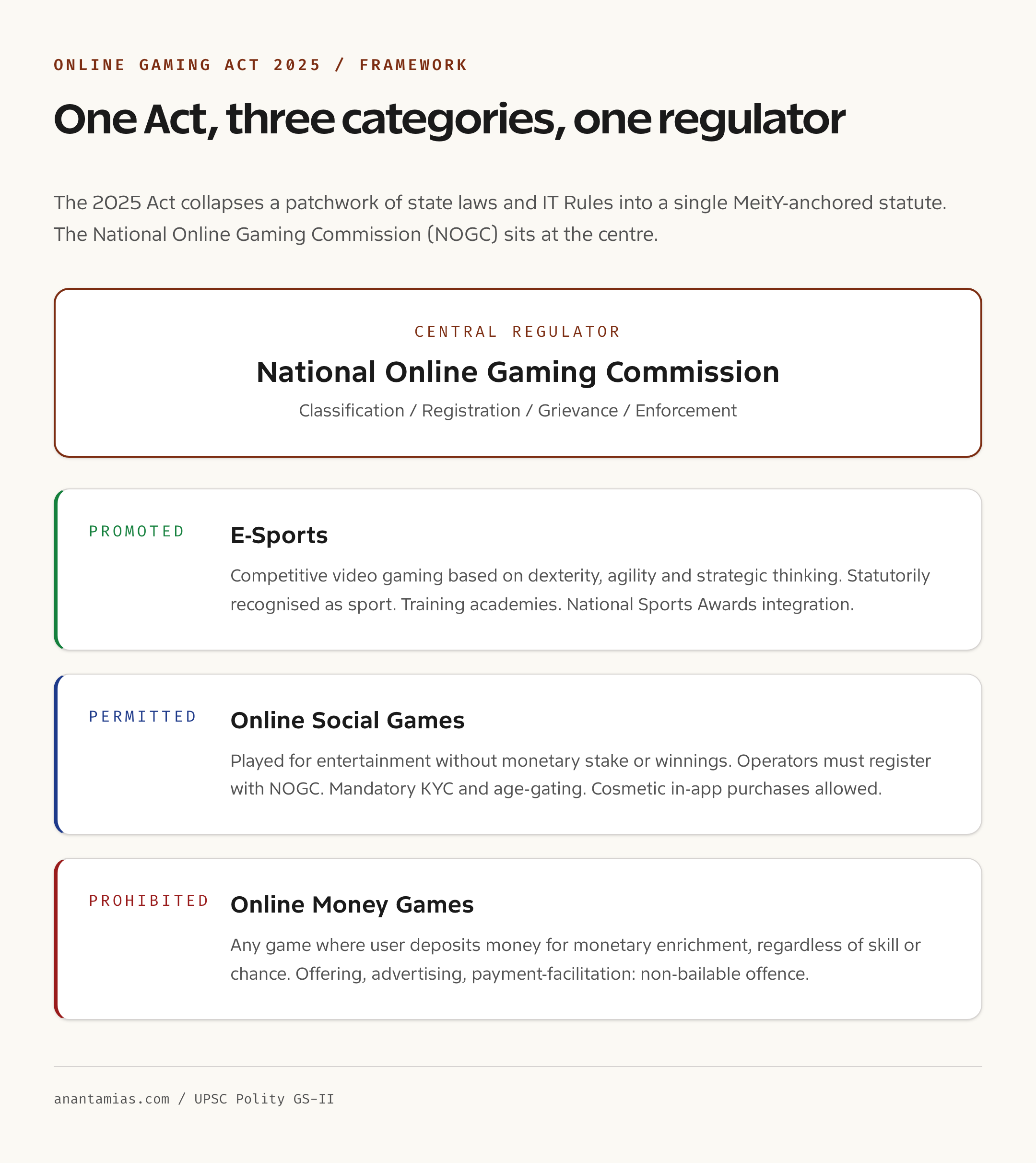
The Promotion and Regulation of Online Gaming Act, 2025 was enacted to create a unified central framework for online gaming. The nodal ministry is the Ministry of Electronics and Information Technology, MeitY. The Act sets up the National Online Gaming Commission, NOGC, as the central regulator. The Act classifies online games into three categories: e-sports, online social games, and online money games. Online money games are prohibited regardless of whether they involve skill or chance. The Act effectively reverses the older judicial distinction between a “game of skill” and a “game of chance” for monetary stake purposes. Offering, advertising or facilitating payments for online money games is a non-bailable offence under the Act. E-sports is statutorily recognised as a sport under the Act, separately from the Ministry of Youth Affairs and Sports framework. KYC and age-gating are mandated for all permissible online games.
What the 2025 Act Is
The Act is a comprehensive central enactment that regulates online gaming as a distinct activity, separate from the older state law regime on betting and gambling. It is a statute by Parliament, not a delegated subordinate legislation by MeitY. That difference matters, because earlier the IT Intermediary Guidelines and Digital Media Ethics Code Rules tried to regulate online real money games as an intermediary obligation. Industry pushback, court challenges, and the patchy effectiveness of self-regulatory bodies pushed the government towards a hard statute.
The Act applies to “online games” offered to users in India, regardless of where the operator is located. It captures domestic platforms, foreign platforms targeting Indian users, payment gateways processing transactions for online money games, and advertising platforms promoting them. The intent is to close the cross-border arbitrage that earlier let operators incorporate in offshore jurisdictions and continue serving Indian users.
Background and Historical Context
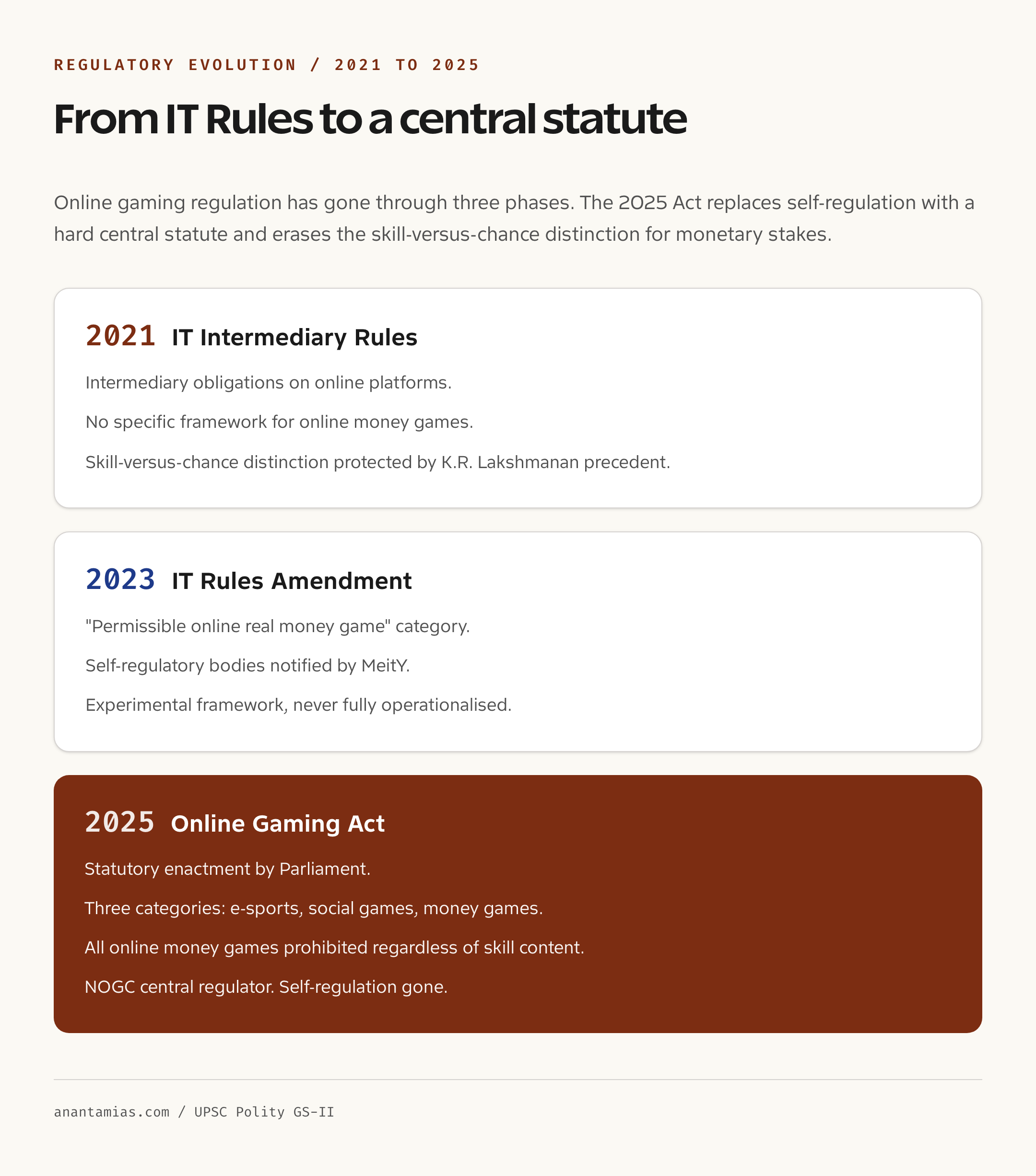
Online gaming regulation in India has gone through three distinct phases. The first phase, until 2018, was governed almost entirely by state laws. The Public Gambling Act, 1867 was the parent statute. Entry 34 of the State List in the Seventh Schedule placed “betting and gambling” in the legislative competence of state legislatures. States either tolerated, regulated, or banned online and offline gambling under that head. The Supreme Court’s K.R. Lakshmanan judgment of 1996 carved out an exception for “games of skill” such as horse racing, holding that they could not be banned under anti-gambling laws because the outcome depended substantially on player skill.
The second phase, from 2018 to 2023, saw rapid growth in fantasy sports, online poker, online rummy, and a wave of unicorn-scale online money game startups. State laws struggled to keep up. Tamil Nadu’s blanket ban on online gambling, Karnataka’s law on online gaming, and the Andhra Pradesh prohibitions were either struck down or read down by the respective High Courts on Article 19(1)(g) grounds and on the basis of the K.R. Lakshmanan distinction between skill and chance.
The third phase began with the 2023 amendment to the Information Technology (Intermediary Guidelines and Digital Media Ethics Code) Rules, 2021. The amendment created a category of “permissible online real money game” certified by self-regulatory bodies notified by MeitY. The framework was experimental and never fully operationalised. By late 2024, the government concluded that a self-regulatory body model could not deliver consistent oversight in a sector with billions of rupees of monthly transactions and high addiction risk. The 2025 Act is the result. For the wider digital regulation context, the IT Intermediary Guidelines and Digital Media Ethics Code amendment rules 2025 and the online content regulation framework for OTT and digital news are essential reading.
The Three Categories of Online Games
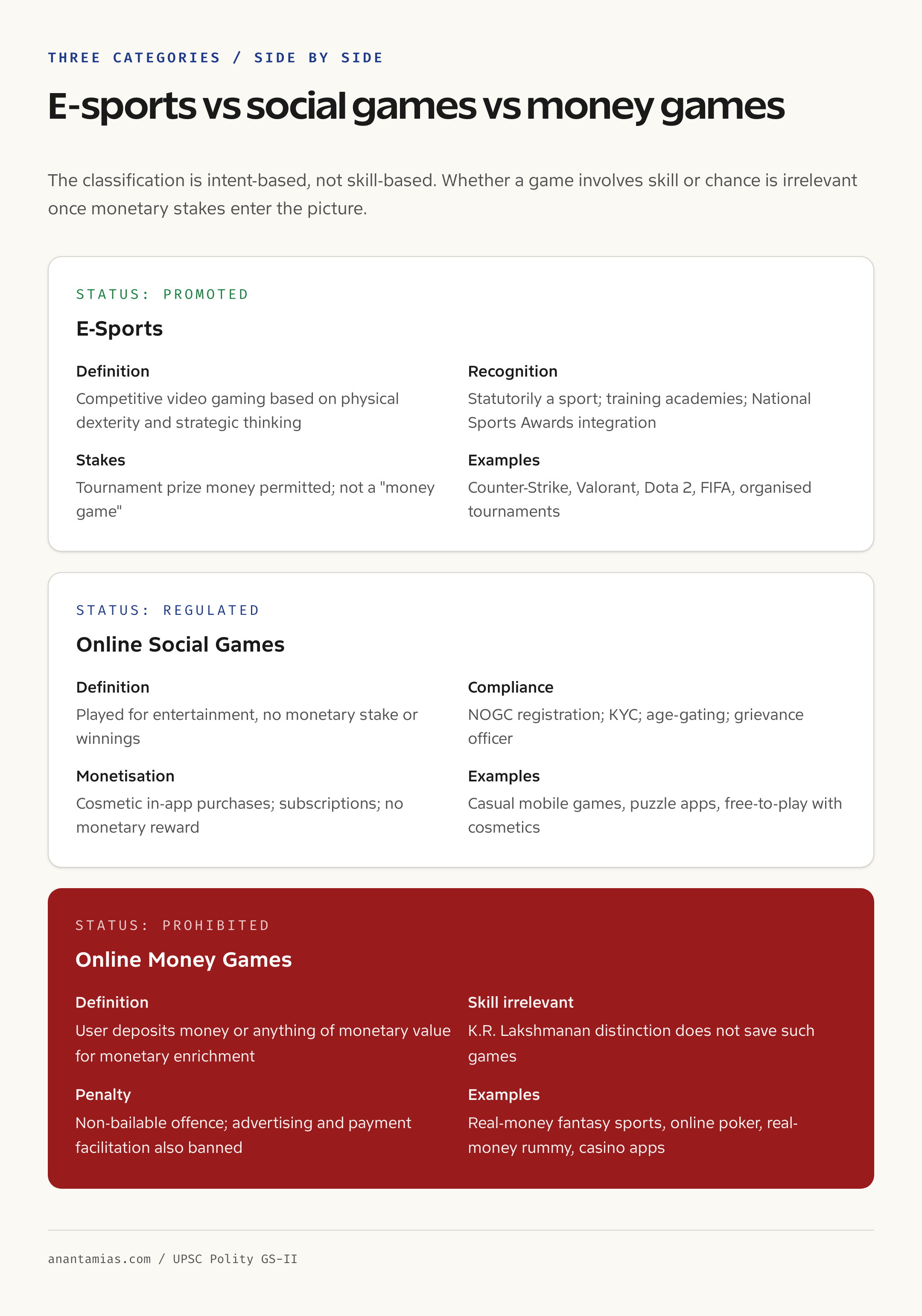
The Act builds its entire regulatory edifice on a three-way classification. Online money games are any games where a user deposits money or stakes anything of monetary value with the expectation of winning monetary enrichment, in cash or in kind. The classification is intent-based, not skill-based. Whether the game is poker, rummy, fantasy sports, or a strategy game, if a monetary stake is involved with the expectation of monetary reward, it is an online money game. The Act prohibits offering, advertising, sponsoring, or facilitating payments for online money games. Banks, payment service providers, and advertising platforms are explicitly required to block transactions and content related to such games.
Online social games are games played for entertainment or recreation without any monetary stake or winnings. The user pays nothing to participate, or pays a fixed entertainment fee that does not lead to monetary reward. These games are permitted, but operators must register with the NOGC, comply with age-gating, KYC for adults, and grievance redress norms. In-app purchases of cosmetic items or subscriptions are permitted as long as they do not function as monetary stakes.
E-sports is defined as competitive video gaming events whose outcomes depend on physical dexterity, mental agility and strategic thinking, and which are conducted in an organised competitive format. The Act recognises e-sports as a sport, separately from the Ministry of Youth Affairs and Sports framework, and provides for the establishment of training academies, the recognition of athletes, and the promotion of e-sports in the National Sports Awards architecture. The recognition tracks the 2023 Allocation of Business amendment that brought e-sports under the sports ministry.
Institutional Framework: The NOGC
The National Online Gaming Commission is the central regulator established under the Act. Its functions span four buckets. Classification is the first; the NOGC decides whether a particular game falls within the social, money, or e-sports category. Registration is the second; permissible online social games and e-sports platforms must register with the NOGC, share KYC and age-gating mechanisms, and comply with periodic audits. Grievance redress is the third; the NOGC operates a complaints framework for users, including escalation from platform-level grievance officers. Enforcement is the fourth; the NOGC can investigate, recommend prosecution, freeze assets, and direct payment service providers to block transactions.
The NOGC sits within the MeitY portfolio, with the Secretary, MeitY as the ex-officio chairperson in some interim arrangements. The board includes representatives from the Reserve Bank of India, the Department of Sports, child rights bodies, and independent experts. The composition tries to balance financial regulation, public health, sports policy and industry expertise.
Why It Matters: The Skill vs Chance Inversion
The single biggest legal change is the deliberate erasure of the older skill-versus-chance distinction for monetary stake purposes. From the Supreme Court’s State of Andhra Pradesh v. K. Satyanarayana case in 1968 through K.R. Lakshmanan in 1996, the doctrine had held that games whose outcome depended substantially on skill were not gambling, even if they involved monetary stakes. Fantasy sports, rummy, poker, bridge, and chess all enjoyed varying degrees of protection under this doctrine.
The 2025 Act treats the doctrine as outdated for online formats. Once monetary stakes are involved, the Act treats the game as an online money game, regardless of whether skill or chance dominates the outcome. The reasoning is twofold. First, online formats blur the skill-chance line through speed, multiple parallel games, algorithmic matching, and AI-assisted opponents. Second, the addiction and financial-distress externalities are present even in skill-based games when stakes are large and the playtime extends.
Detailed Analysis of Constitutional and Federal Conflict
The Act has reopened two constitutional debates. The federal debate centres on the Seventh Schedule. State governments argue that “betting and gambling” is squarely a state subject under Entry 34 of List II, and that the Centre cannot use the back door of Entry 31 (telegraphs and communications) of List I or Entry 42 (inter-state trade and commerce) of List I to regulate it. The Centre’s argument is that online gaming is not the same activity as offline betting; it operates over the internet and telecommunications infrastructure, crosses state boundaries, and falls within the Centre’s exclusive competence over communications and inter-state trade. The doctrine of pith and substance, and the more recent Supreme Court rulings on cross-cutting digital subjects, will likely decide the matter.
The fundamental rights debate centres on Article 19(1)(g), the right to practise any profession or to carry on any occupation, trade or business. Operators of skill-based online games, especially fantasy sports and poker platforms, have argued that the blanket ban on online money games regardless of skill violates the K.R. Lakshmanan principle and disproportionately restricts a constitutionally protected trade. The state’s defence rests on Article 19(6), which permits reasonable restrictions in the interests of the general public, and on the public health and addiction case for the ban. For the wider judicial reforms in India context, including how the courts have handled regulatory overreach challenges, the existing primer is useful.
A third sub-debate is the Article 14 challenge. Operators argue that the Act treats online and offline games differently for no compelling reason; offline rummy, poker and fantasy contests with monetary stakes continue under state law, while their online versions are banned. The classification, they argue, is not based on intelligible differentia. The state’s reply is that the online medium is materially different in scale, speed, addiction risk, and cross-border reach, and that the distinction is therefore reasonable.
Comparative Regulatory Models
Globally, online gaming is regulated through three broad models. The licensing model, used in the United Kingdom and Malta, treats online gaming as a legitimate licensed activity with strict consumer protection norms. The prohibition model, used in many US states and Singapore, bans online gambling outright while permitting limited e-sports and social gaming. The hybrid model, used in some European jurisdictions, distinguishes between “skill” and “chance” games, licensing the former and banning the latter.
The Indian 2025 Act sits closest to the prohibition model for monetary stake games and the licensing model for social and e-sports games. It is more restrictive than the older state-by-state Indian regime that protected skill-based games. It is also more permissive than the strictest prohibition models, because social games and e-sports are positively encouraged.
Challenges, Concerns and Implementation Risks
Implementation is the hard part. The first challenge is enforcement against offshore operators. Many online money game platforms are incorporated in jurisdictions outside India, and blocking their websites under Section 69A of the IT Act has proved imperfect; users use VPNs, mirror sites, and alternative payment channels. The second challenge is the legal vulnerability of the Act itself; constitutional challenges on federal and Article 19(1)(g) grounds are already pending before various High Courts and the Supreme Court. The third challenge is the loss of legitimate jobs and revenue; the online real money gaming industry employed tens of thousands of people and contributed significant GST revenue, all of which is now disrupted.
A fourth concern is regulatory capacity. The NOGC will need substantial technical, legal and forensic expertise to classify games, audit platforms, investigate cross-border transactions, and prosecute offenders. Building that capacity from scratch is non-trivial. A fifth concern is the displacement of users to even less regulated grey-market platforms, potentially worsening the addiction and consumer-protection problems that the Act seeks to solve.
Prelims Pointers
For the UPSC Prelims, the high-yield facts are: nodal ministry is MeitY; the central regulator is the National Online Gaming Commission, NOGC; the three categories are e-sports (promoted), online social games (registered), and online money games (prohibited); the Act effectively erases the skill-versus-chance distinction for monetary stake purposes; offering, advertising or facilitating payments for online money games is a non-bailable offence; KYC and age-gating are mandated for all permissible games; the relevant constitutional articles for the federal debate are Entry 34 List II and Entries 31 and 42 of List I; the Article 19(1)(g) challenge invokes the K.R. Lakshmanan precedent.
Mains Practice Questions
- “The Promotion and Regulation of Online Gaming Act, 2025 marks a deliberate departure from the judicial distinction between games of skill and games of chance.” Critically examine the legal and policy reasoning behind this departure. (15 marks, 250 words)
- Examine the federal questions raised by the 2025 Act with reference to Entry 34 of List II and Entries 31 and 42 of List I of the Seventh Schedule. (10 marks, 150 words)
- “Statutory recognition of e-sports under the 2025 Act is an opportunity, not just a regulatory move.” Discuss in the context of India’s sports policy and youth employment. (10 marks, 150 words)
Way Forward
The Act will succeed or fail on three implementation choices. First, the NOGC must build the technical and forensic capacity to actually enforce the law against cross-border operators, not just to issue notices. Second, the e-sports promotion architecture must be funded properly, with clear training academies, athlete recognition pathways, and integration with the National Sports Awards. Third, public health investment in addiction counselling and consumer awareness must accompany the prohibition; a ban without a parallel public health intervention will simply push users to riskier underground platforms. The constitutional challenges will work themselves out through the courts over the next two to three years, and a measured, well-implemented version of the Act has a better chance of surviving judicial scrutiny than an aggressive but under-resourced one.
Frequently Asked Questions
What does the Online Gaming Act, 2025 prohibit?
The Act prohibits online money games, defined as games where a user deposits money or anything of monetary value with the expectation of monetary enrichment in cash or in kind. The prohibition covers offering such games, advertising them, sponsoring them, and facilitating payments for them. Banks, payment service providers and advertising platforms are required to block transactions and content related to online money games.
What is the National Online Gaming Commission?
The National Online Gaming Commission, or NOGC, is the central regulator established under the 2025 Act. It classifies games into the three statutory categories, registers permissible platforms, handles user grievances, audits platform compliance with KYC and age-gating norms, and enforces the Act through investigation, prosecution recommendations and asset-freezing powers.
Are fantasy sports and online poker still legal in India?
No, when monetary stakes are involved. The 2025 Act classifies any online game with a monetary stake and an expectation of monetary enrichment as an online money game, regardless of whether skill or chance dominates the outcome. Fantasy sports and poker platforms that earlier operated under the K.R. Lakshmanan skill-game protection are now prohibited from offering money-stake versions of their games.
Is e-sports recognised as a sport under the Act?
Yes. The Act formally recognises e-sports as a sport, separately from the Ministry of Youth Affairs and Sports framework, and provides for training academies, athlete recognition, and promotion within the National Sports Awards architecture. The recognition complements the 2023 Allocation of Business amendment that brought e-sports under the sports ministry.
What is the difference between social games and money games under the Act?
Online social games are played for entertainment or recreation without any monetary stake or expectation of monetary reward. They are permitted, but operators must register with the NOGC and comply with KYC and age-gating norms. Online money games involve monetary stakes with an expectation of monetary enrichment and are prohibited under the Act, regardless of whether the outcome depends on skill or chance.
Why has the Act been challenged on federal grounds?
State governments argue that u0022betting and gamblingu0022 is exclusively in the State List under Entry 34 of List II of the Seventh Schedule, and that the Centre cannot use Entry 31 (communications) or Entry 42 (inter-state trade) of List I to regulate it. The Centre’s defence is that online gaming is materially different from offline betting; it operates across state boundaries through the internet and telecommunications infrastructure, falling within the Centre’s exclusive competence.
Does the Act violate Article 19(1)(g)?
Operators have argued that the blanket prohibition on online money games regardless of skill violates the right to carry on any profession, trade or business under Article 19(1)(g) and disregards the K.R. Lakshmanan precedent that protects skill-based games. The state’s defence rests on Article 19(6), which permits reasonable restrictions in the public interest, and on the public health and addiction case for the prohibition. The matter is pending before various courts.
What is the penalty for offering an online money game?
Offering, advertising, sponsoring, or facilitating payments for an online money game is a non-bailable offence under the Act, with substantial monetary penalties and imprisonment for repeat offenders. Banks and payment service providers that fail to block transactions can also face penalties under the Act.
How does the 2025 Act differ from the IT Rules, 2021 amendment of 2023?
The 2023 amendment to the IT Intermediary Guidelines created a category of u0022permissible online real money gameu0022 certified by self-regulatory bodies. The 2025 Act replaces that self-regulatory framework with a statutory ban on all online money games, supervised by the central NOGC. Self-regulation is gone; central statutory regulation is in.