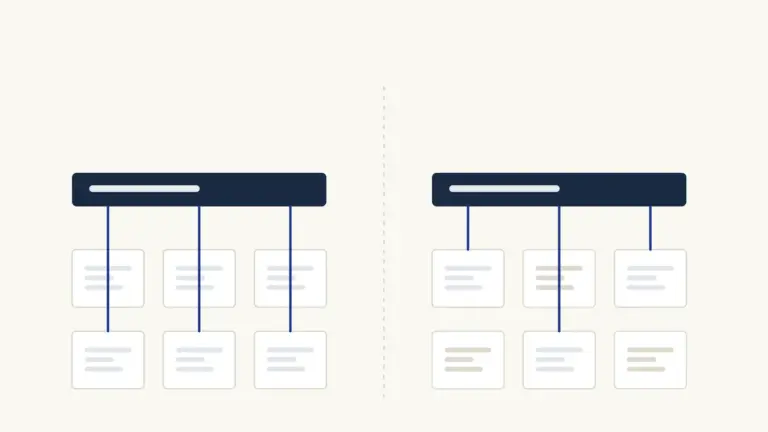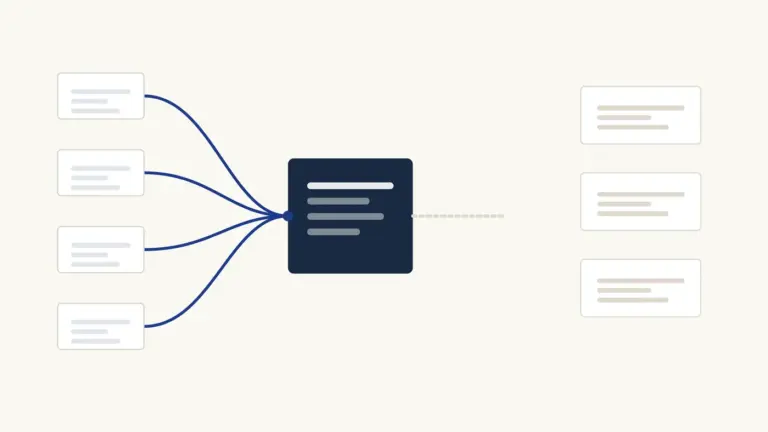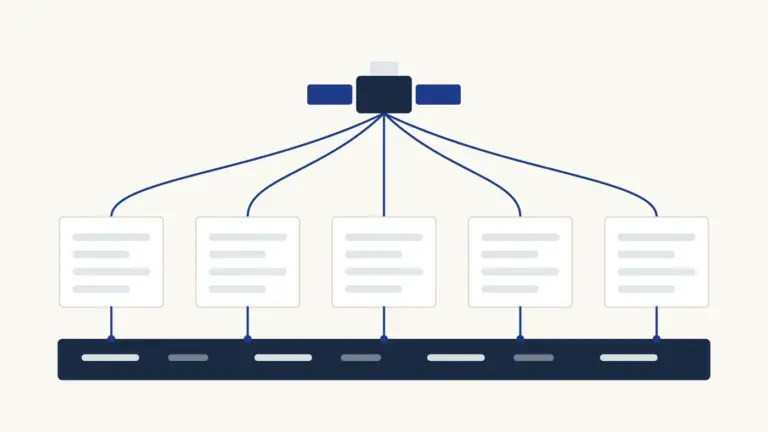
The Information Technology (Intermediary Guidelines and Digital Media Ethics Code) Rules 2021 are now the most contested instrument of Indian media regulation. They sit at the intersection of the IT Act 2000, the Cable Television Networks Act 1995, the Press Council Act 1978 and the Cinematograph Act 1952, creating a soft touch self regulatory architecture for OTT platforms and digital news publishers. The architecture has survived two rounds of court challenge, two amendments, the failed 2023 Fact Check Unit notification, and the migration of regulatory authority across the Ministry of Electronics and Information Technology and the Ministry of Information and Broadcasting.
This guide unpacks the three tier grievance mechanism, separates OTT self classification from CBFC pre censorship, traces the MeitY versus MIB jurisdictional split, and walks through the Cinematograph Amendment Act 2023 changes that interlock with the digital regime. It is built for UPSC GS Paper 2 candidates who need to distinguish four media regulators and one shifting digital regime in a single answer.
Quick Facts: Online Content Regulation
- Primary instrument: IT (Intermediary Guidelines and Digital Media Ethics Code) Rules 2021, framed under Section 87(2) of the IT Act 2000.
- Parent statute: Information Technology Act 2000.
- Dual ministry control: MeitY for social media intermediaries, MIB for OTT and digital news.
- OTT regime: self classification into five age categories, no CBFC certification.
- Three tier grievance mechanism: Tier 1 publisher level, Tier 2 industry self regulatory body, Tier 3 Inter-Departmental Committee under MIB.
- Cinematograph Amendment Act 2023: criminalises camcord piracy, makes CBFC certificates perpetually valid.
- Programme Code under Cable TV Act 1995 serves as the ethical benchmark for digital news.
What Is Online Content Regulation
Online content regulation in India is the rules architecture that governs three categories of internet content: social media intermediaries, over the top streaming platforms, and digital news publishers. Each category has different rules, different ministries and different enforcement triggers, but they all derive from the IT Act 2000 and were brought together by the IT Rules 2021.
The 2021 Rules are notable because they are subordinate legislation, not a parent statute. This makes them easier to amend but also more vulnerable to judicial review. The 2023 amendment added the Fact Check Unit clause, which the Bombay High Court struck down in 2024, illustrating the fragility of the soft touch architecture. The 2025 amendment cycle is currently in consultation. You can revisit the broader IT regime in our cyber security explainer.
Background and Historical Context
The 2021 Rules emerged from a four year gestation. The trigger was the 2018 Sabka Vishwas case, where the Supreme Court asked the government to regulate online intermediaries more rigorously. A draft set of Rules was floated in December 2018, withdrawn after pushback, and replaced by a fresh draft in 2020. The final 2021 Rules added the digital media ethics code, expanded the grievance mechanism to three tiers, and brought OTT platforms within the ambit for the first time.
The intellectual lineage runs back to the Press Council Act 1978 for print media, the Cable Television Networks Act 1995 for broadcast television, and the Cinematograph Act 1952 for theatrical films. Each statute was designed for one medium. Digital content does not respect these silos, and the 2021 Rules attempt to overlay a single grievance mechanism while preserving the underlying statutory regimes.
Key Provisions of the IT Rules 2021
Part II of the Rules governs intermediaries, including social media platforms. It imposes due diligence obligations, mandates a Grievance Officer, a Chief Compliance Officer, a Nodal Contact Person and a Resident Grievance Officer for significant social media intermediaries with over five million users.
Part III of the Rules is the Digital Media Ethics Code that applies to digital news publishers and OTT platforms. It mandates compliance with the Programme Code from the Cable TV Act 1995, the Norms of Journalistic Conduct of the Press Council of India, and the OTT specific Code of Ethics.
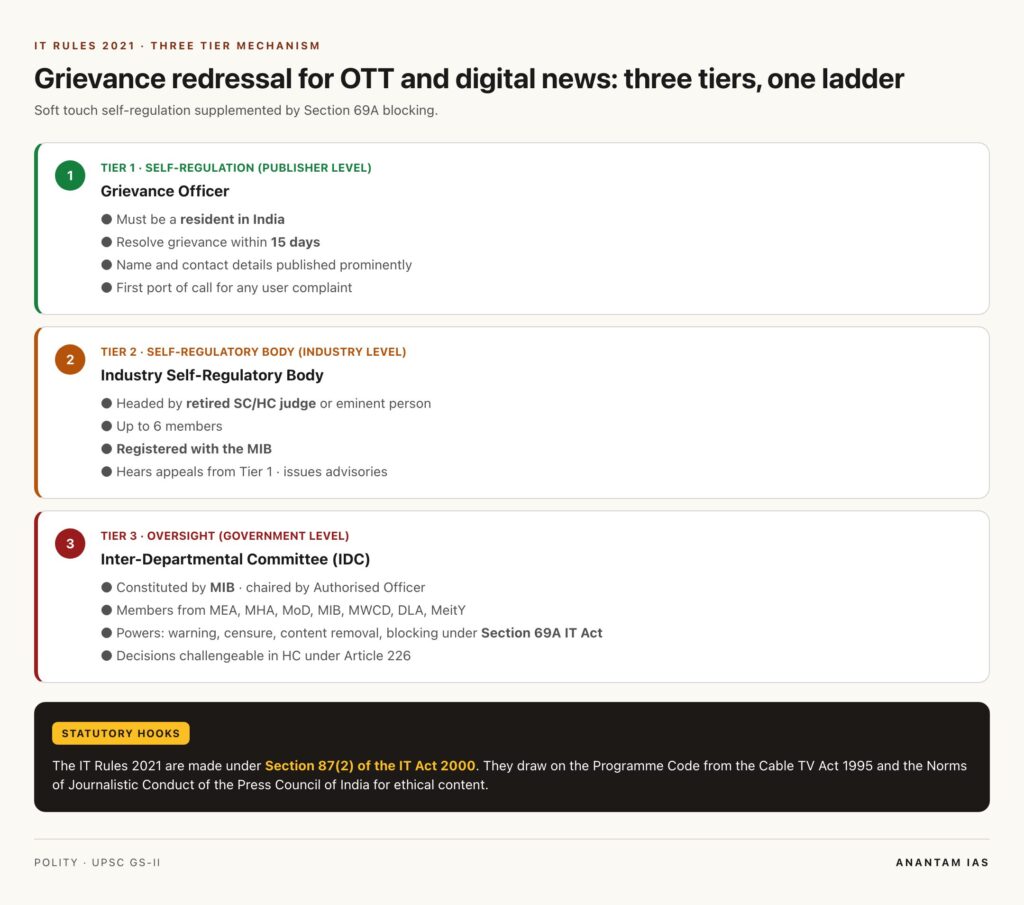
The three tier grievance mechanism runs as follows.
Tier 1 sits at the publisher level. The publisher must appoint a Grievance Officer who is a resident in India and must resolve a grievance within fifteen days. The decision is communicated to the complainant, who can appeal to Tier 2.
Tier 2 sits at the industry level. Each segment must form a self regulatory body, headed by a retired Supreme Court or High Court judge or an eminent person, with up to six members. The body must register with the MIB. It hears appeals from Tier 1 and can issue advisories or directions to publishers.
Tier 3 sits at the government level. The MIB constitutes an Inter-Departmental Committee, chaired by an Authorised Officer, with representatives from the Ministry of External Affairs, Ministry of Home Affairs, Ministry of Defence, MIB, Ministry of Women and Child Development, Department of Legal Affairs, and MeitY. The Committee can recommend warnings, censure, apology, deletion or modification of content, and blocking under Section 69A of the IT Act.
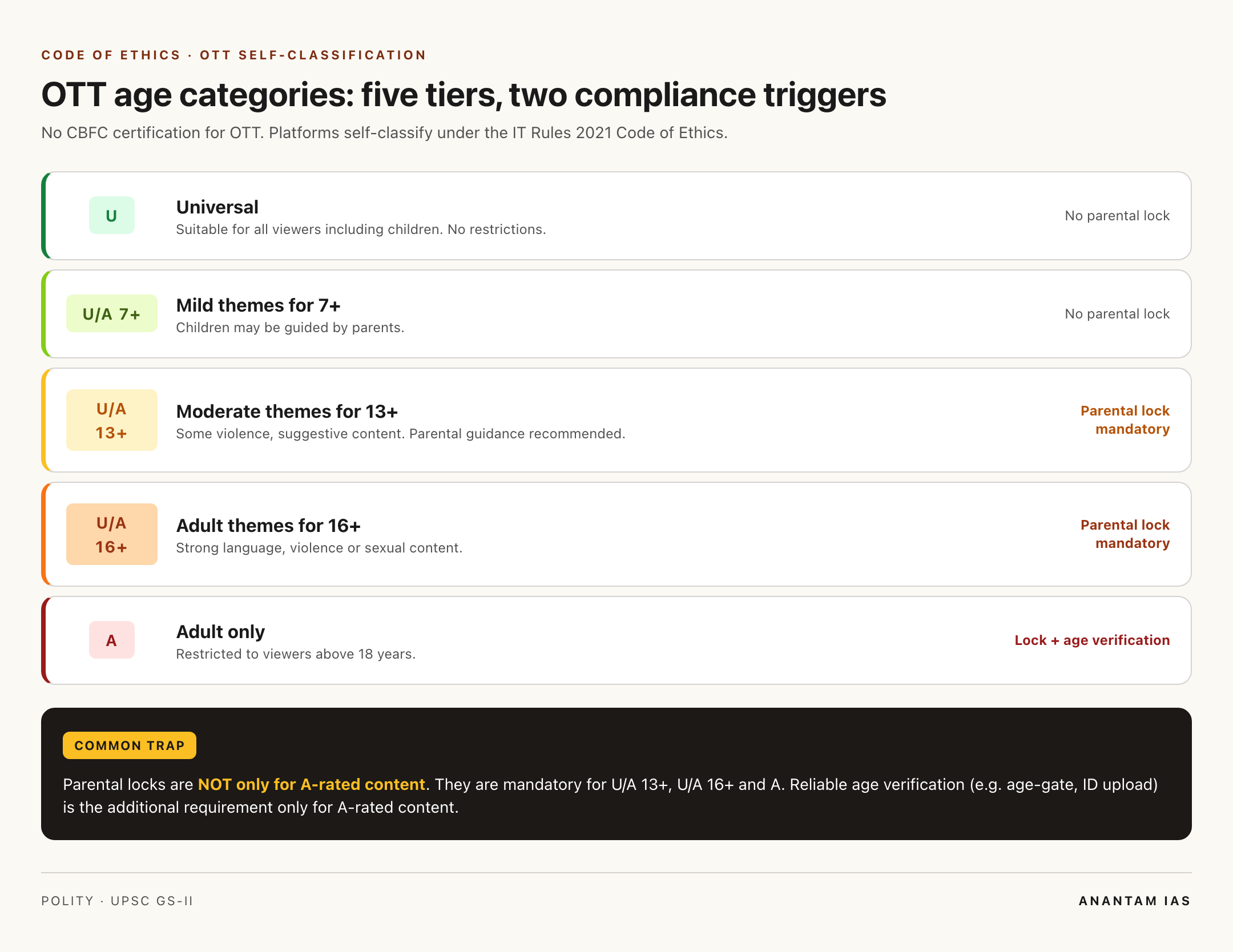
OTT self classification under the Code of Ethics requires platforms to classify content into five age categories: U for Universal, U/A 7+, U/A 13+, U/A 16+, and A for Adult. Parental locks are mandatory for U/A 13+ and above. Reliable age verification is mandatory for A rated content.
Why Online Content Regulation Matters
Three considerations explain why this is a high stakes regulatory area. The first is the scale of digital content consumption. India has over 800 million internet users, the largest OTT audience outside the United States, and a digital news ecosystem that has overtaken print in reach. Regulatory choices made for this market shape the experience of nearly every Indian household. The second is the constitutional balance between Article 19(1)(a) free speech and the reasonable restrictions in Article 19(2). Each tier of the 2021 Rules is a fresh test of where that line falls. The third is federalism. Online content does not respect state boundaries, but state law and order concerns do. The IT Rules sit firmly with the Union government, which strains the constitutional design when state grievances arise.
Detailed Analysis: The MeitY vs MIB Split
The 2021 Rules created a dual ministry architecture that reflects the institutional history of each medium. The Ministry of Electronics and Information Technology took the social media intermediaries because they are technology platforms. The Ministry of Information and Broadcasting took OTT and digital news because they are content publishers. The split is operationally clean but conceptually awkward, because a platform like YouTube is simultaneously an intermediary, an OTT service, and a host of digital news channels.
The 2023 amendment tried to reconcile this by giving MeitY the Fact Check Unit power to label government related content as misleading. The Bombay High Court struck this down in 2024 on the grounds that it gave the executive an unappealable power to declare content false, violating Article 14 and Article 19(1)(a). The Supreme Court is currently hearing the appeal.
The deeper question is whether dual ministry control creates regulatory arbitrage. A digital news publisher that distributes through a social media platform is in principle subject to both regimes. Industry has criticised the resulting compliance burden. Civil society has criticised the breadth of takedown powers under both regimes. The 2025 consultation is expected to address some of this overlap.
Comparative Framework: Four Media Regulators Compared
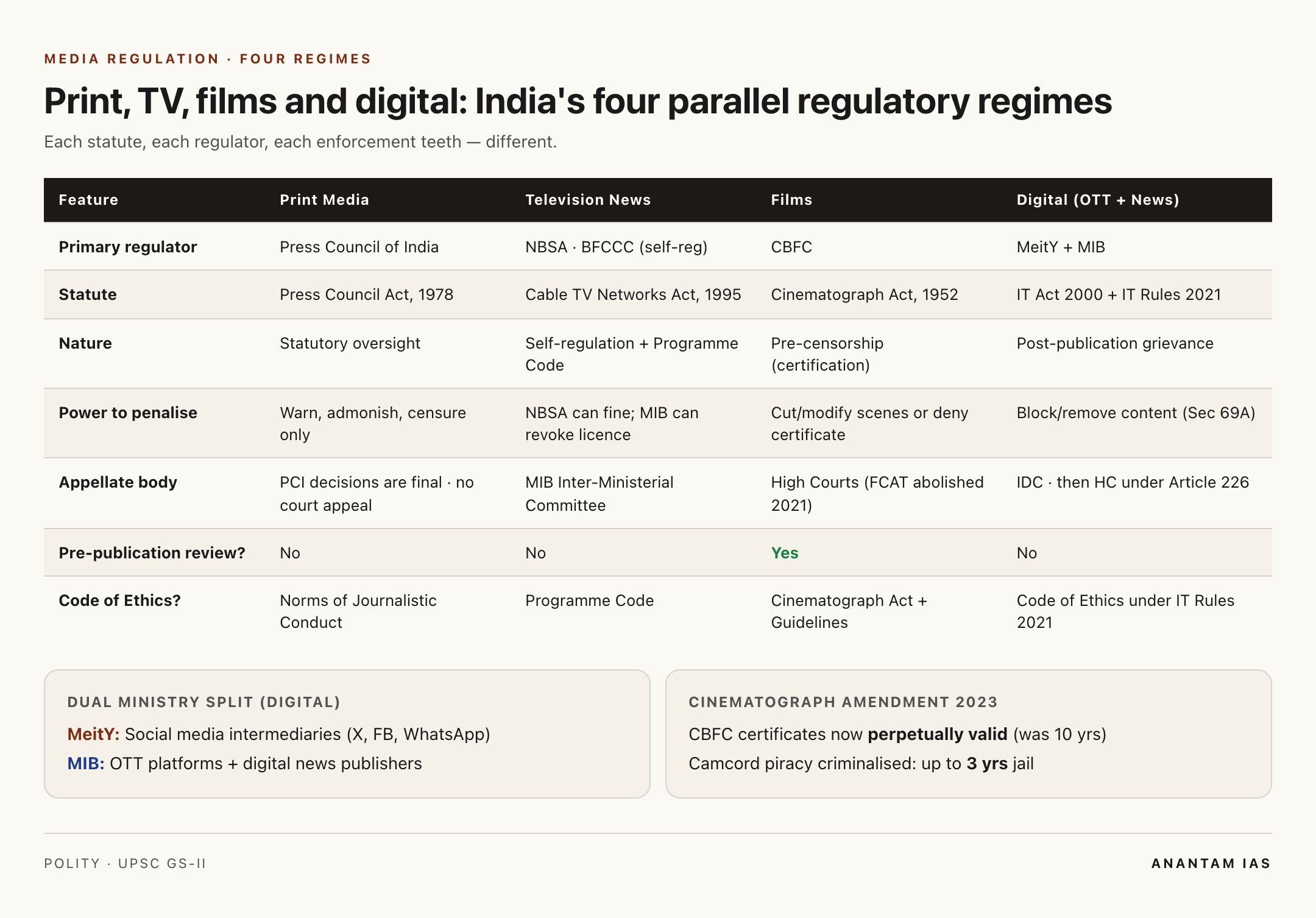
Indian media regulation is best understood as four parallel regimes, one per medium, with different statutes, regulators and enforcement teeth. We compare them in the same way as our freedom of speech and expression guide.
Print media is regulated by the Press Council of India under the Press Council Act 1978. The PCI is statutory but has no penalty power beyond admonition and censure. Its decisions cannot be appealed before a court of law, a position the Supreme Court reaffirmed in Reliance Petrochemicals vs Indian Express in 1989.
Television news is governed by self regulation through bodies like the News Broadcasting and Digital Standards Authority. The legal basis is the Cable Television Networks Act 1995, which contains the Programme Code. The MIB can revoke a licence, though it rarely does. Fines can be imposed by self regulatory bodies up to ₹100,000 per violation.
Films are regulated by the Central Board of Film Certification under the Cinematograph Act 1952. The CBFC operates a pre censorship regime, certifying films before theatrical release. The Cinematograph Amendment Act 2023 added perpetual validity for certificates and criminalised camcord piracy with up to three years imprisonment.
Digital media is governed by the IT Rules 2021, with a soft touch self regulation supplemented by Section 69A blocking. There is no pre censorship. Grievances are post publication, run through three tiers, and enforced ultimately through Section 69A blocking orders or content removal directions.
Challenges and Criticism
The IT Rules 2021 attract three persistent criticisms. The first is the constitutional bypass. Major regulatory powers have been granted through subordinate legislation rather than a parent statute, which Parliament has not formally debated. The 2024 Bombay High Court ruling on the Fact Check Unit is the strongest judicial signal that this approach has limits.
The second is the chilling effect. The thirty six hour takedown timeline under Rule 3(1)(d), combined with Section 79 safe harbour conditions, pushes platforms to remove content first and ask questions later. Smaller publishers and content creators face disproportionate burden, because they cannot afford lengthy legal challenges to wrongful takedowns.
The third is enforcement asymmetry. Foreign platforms with no Indian presence struggle to comply with the resident officer requirement. Platforms with Indian subsidiaries face the full brunt. The result is uneven competition that disadvantages domestic players, the opposite of the policy intent.
Prelims Pointers
- The IT Rules 2021 are framed under Section 87(2) of the IT Act 2000.
- MeitY regulates social media intermediaries; MIB regulates digital news and OTT.
- OTT content is not certified by the CBFC; it follows self classification.
- Five OTT age categories: U, U/A 7+, U/A 13+, U/A 16+, A.
- Parental locks are mandatory for U/A 13+ and above, not just A.
- The Tier 1 Grievance Officer must be a resident in India and resolve within 15 days.
- The Tier 2 self regulatory body must be headed by a retired SC or HC judge or an eminent person.
- The Tier 3 Inter-Departmental Committee is constituted by the MIB.
- The Cinematograph Amendment Act 2023 makes CBFC certificates perpetually valid and criminalises camcord piracy.
- FCAT was abolished in 2021, with appeals now going to High Courts.
Mains Practice Questions
- The IT Rules 2021 attempt to harmonise four parallel regulatory regimes for media in India. Critically examine the dual ministry architecture and its constitutional implications. (GS Paper 2, 250 words)
- The Bombay High Court struck down the Fact Check Unit clause of the 2023 IT Rules amendment. Discuss the constitutional reasoning and its implications for digital free speech. (GS Paper 2, 250 words)
- Compare the four media regulatory regimes for print, television, films and digital media in India. Suggest a unified framework that respects the unique character of each medium. (GS Paper 2, 250 words)
- OTT self classification is a soft touch alternative to CBFC pre censorship. Examine its strengths and weaknesses. (GS Paper 2, 150 words)
Way Forward
A coherent reform agenda would do four things. Parliament should pass a Digital India Act that consolidates the IT Act, the Rules and the relevant provisions of the Cinematograph Act, replacing the current patchwork with a single integrated statute. The Inter-Departmental Committee at Tier 3 should be reconstituted with at least one judicial member, addressing the Bombay High Court’s concern about executive overreach. The thirty six hour takedown timeline should be relaxed for content where fair dealing or free speech defences are arguable, with a longer evaluation window. And the dual ministry split should be merged under a single Digital Media Authority that has clear, parliamentary scrutinised mandates. None of these is a radical reform. They simply formalise what the 2021 Rules tried to achieve through subordinate legislation, with proper democratic anchoring.
Frequently Asked Questions
Are OTT platforms regulated under the Cinematograph Act?
No. OTT platforms are regulated under the IT Act 2000 through the IT Rules 2021. The Cinematograph Act 1952 applies to films released theatrically.
Do OTT platforms need CBFC certification?
No. OTT platforms self classify their content into five age categories under the Code of Ethics in the IT Rules 2021.
Who regulates digital news publishers?
The Ministry of Information and Broadcasting under the IT Rules 2021. The Programme Code from the Cable Television Networks Act 1995 and the Norms of Journalistic Conduct of the Press Council of India serve as ethical benchmarks.
What is the role of the Inter-Departmental Committee?
It is the Tier 3 oversight body, chaired by an Authorised Officer from the MIB, with representation from MEA, MHA, MoD, MIB, MWCD, Department of Legal Affairs and MeitY. It can recommend content removal, blocking under Section 69A, or warnings.
Can a Tier 3 decision be appealed?
Yes. A Tier 3 decision can be challenged in a High Court under Article 226 or before the Supreme Court under Article 32 if a fundamental rights violation is alleged.
What is the Programme Code?
It is the ethical content standard under the Cable Television Networks (Regulation) Act 1995, prohibiting offensive content, communal incitement, denigration of women, and similar concerns.
Are parental locks mandatory only for adult content?
No. Parental locks are mandatory for U/A 13+, U/A 16+ and A rated content. Age verification is additionally mandatory for A rated content.
What did the Cinematograph Amendment Act 2023 change?
It made CBFC certificates perpetually valid (previously valid for ten years), criminalised unauthorised camcord recording with up to three years imprisonment, and added new age based certificate categories aligned with OTT classification.
Was the 2023 Fact Check Unit constitutional?
The Bombay High Court ruled it unconstitutional in 2024, holding that giving the executive an unappealable power to declare content false violated Article 14 and Article 19(1)(a). The matter is on appeal in the Supreme Court.
Who must the Grievance Officer be?
A resident in India, appointed by the publisher or intermediary, who must resolve a grievance within fifteen days. The officer’s name and contact details must be published prominently.
Tell Google you want more of this.
Add Anantam IAS as a preferred sourceOne tap, and this site shows up more often in your own Top Stories, AI Overviews and AI Mode. Remove it any time.