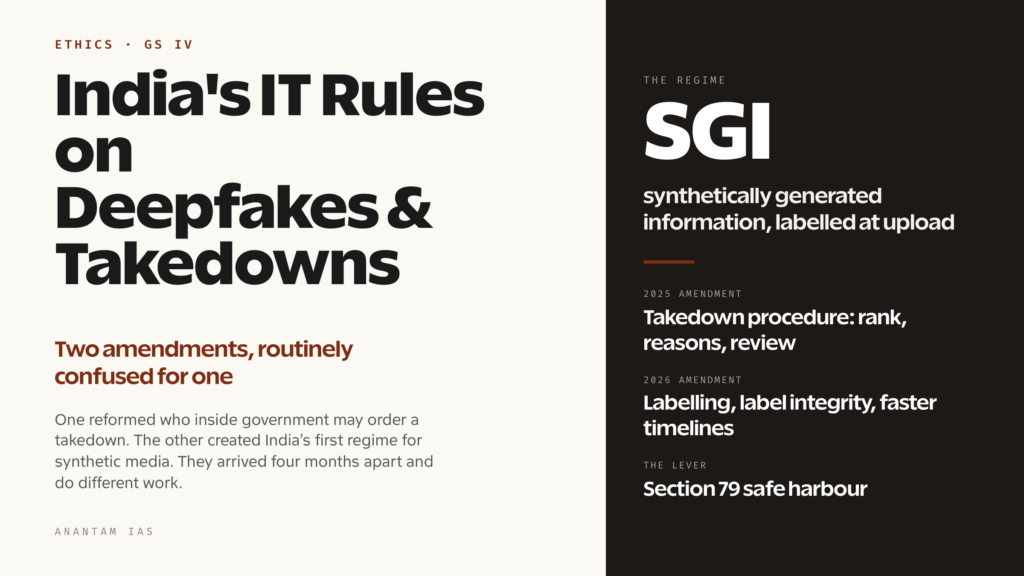
India amended its intermediary rules twice in quick succession, and the two amendments are constantly run together — including in a good deal of published commentary. They addressed different problems, arrived through different consultations, and impose different duties. Keeping them apart is the whole battle in understanding this area.
The first, notified in October 2025, reformed the procedure for ordering content takedowns: who inside government may issue one, what the order must say, and how it is reviewed. The second, notified in February 2026, created India’s first substantive regime for synthetically generated information — the legal term covering deepfakes — through mandatory labelling and compressed response timelines. Both sit on top of the parent Information Technology (Intermediary Guidelines and Digital Media Ethics Code) Rules, 2021, and both operate through the Section 79 safe harbour, which is the pressure point that makes any of it bite.
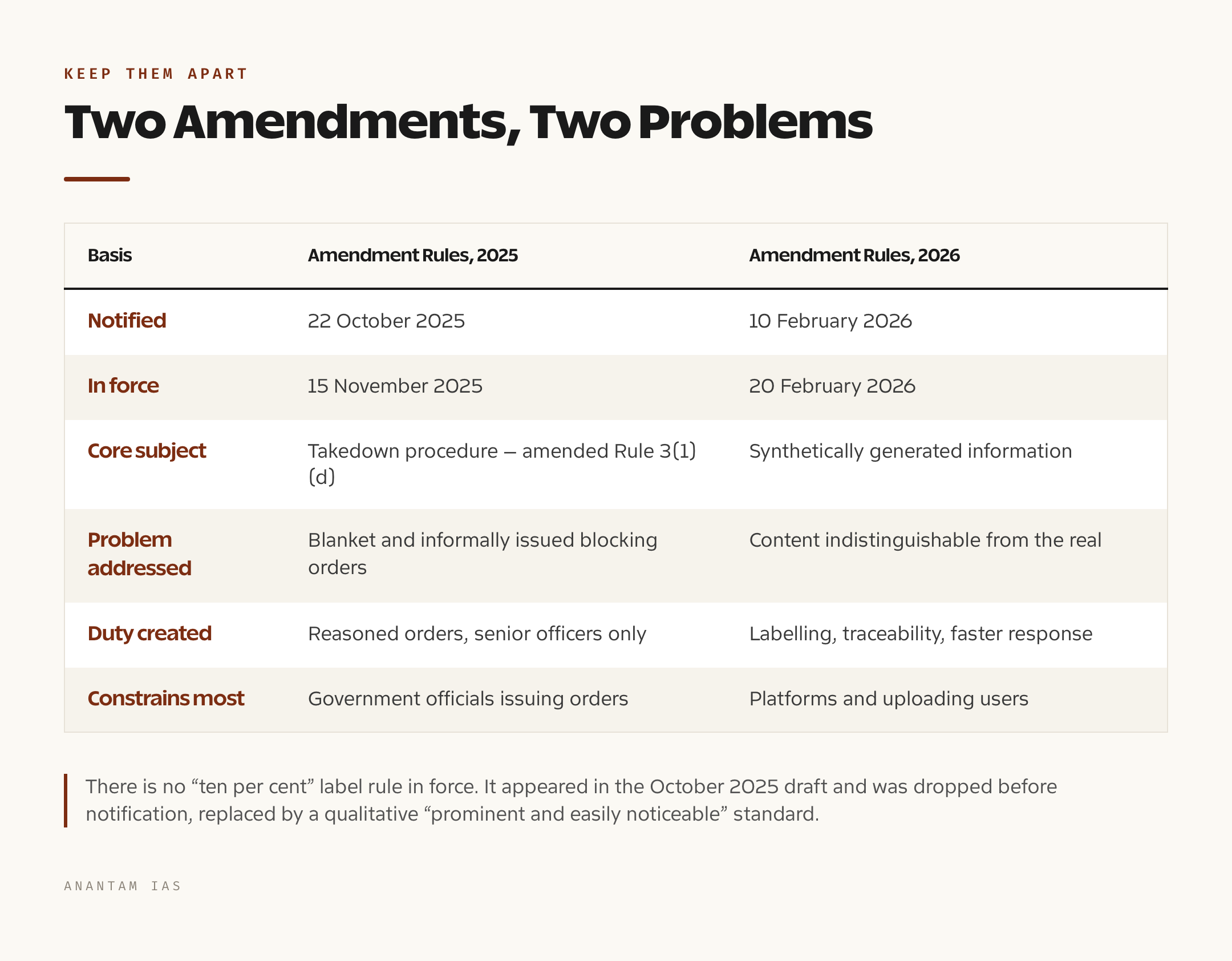
Two Amendments, Two Different Problems
| Amendment Rules, 2025 | Amendment Rules, 2026 | |
|---|---|---|
| Notified | 22 October 2025 | 10 February 2026 |
| In force | 15 November 2025 | 20 February 2026 |
| Core subject | Takedown procedure — the amended Rule 3(1)(d) | Synthetically generated information (SGI) |
| Problem addressed | Blanket and informally issued blocking orders | AI-generated content indistinguishable from the real |
| Principal duty created | Reasoned orders from senior officers only | Labelling, traceability and faster response |
| Who it constrains most | Government officials issuing orders | Platforms and uploading users |
The consultation histories differ too. The takedown reform followed sustained litigation and criticism over the Sahyog portal and informal blocking practice. The synthetic-media regime came out of a draft MeitY released for public comment in October 2025, which changed materially before notification — a point taken up below, because the change is the single most misreported fact in this area.
What the 2025 Amendment Changed: Who May Order a Takedown
Before this amendment, Rule 3(1)(d) let a broad range of officials notify intermediaries about unlawful content, and practice had drifted toward blanket account-level blocking and, in some instances, oral or informal instruction. The Supreme Court’s safeguards in Shreya Singhal v. Union of India — which read down the old Section 66A and constrained Section 79(3)(b) so that intermediaries act on a court order or an authorised government notification — were not being honoured in the manner of these communications.
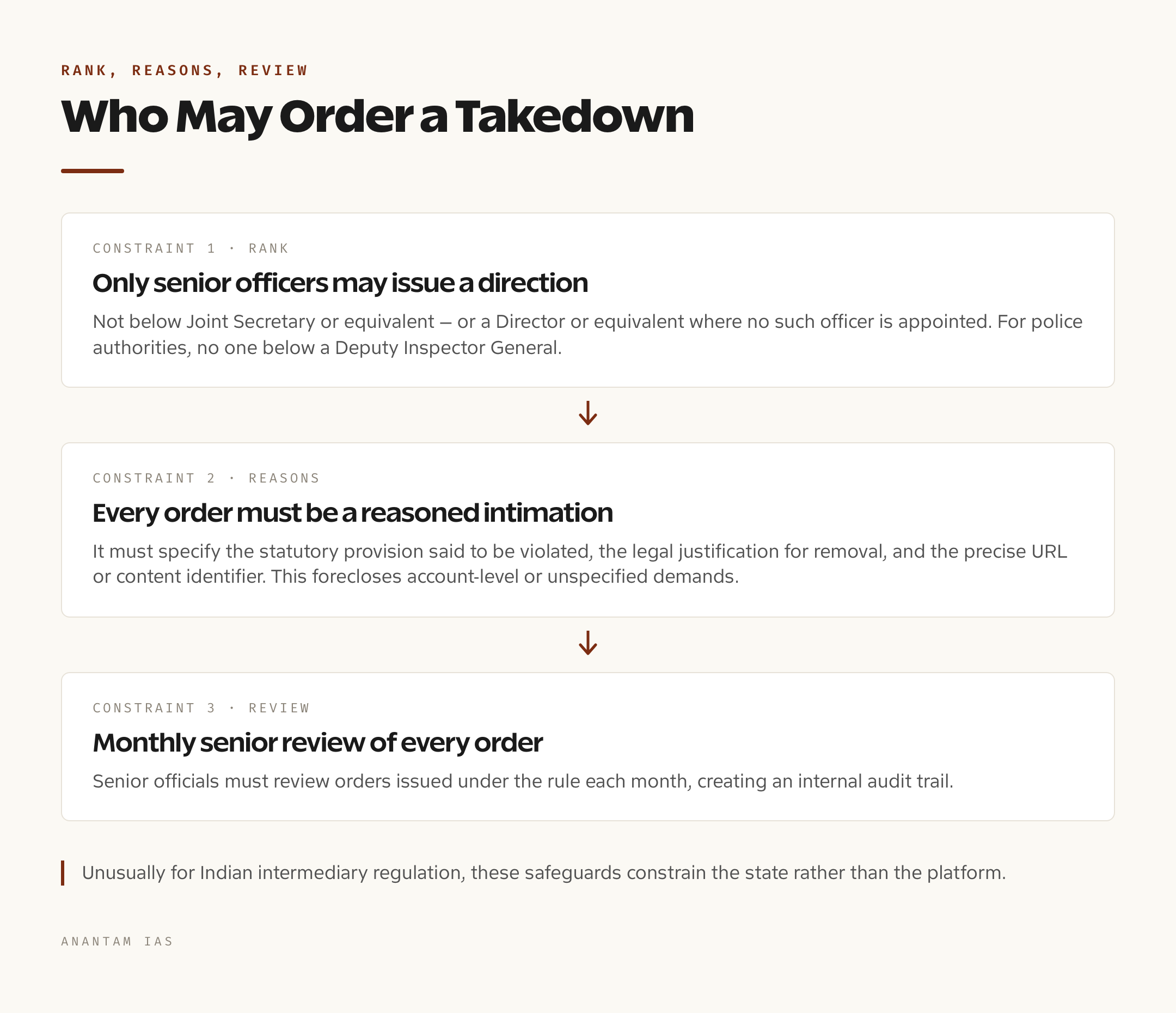
The amendment tightened three things.
Rank. A takedown direction may be issued only by an officer not below the rank of Joint Secretary or equivalent. Where no officer of that rank has been appointed, a Director or officer of equivalent rank may act. For police authorities, the power sits no lower than a Deputy Inspector General.
Reasons. Each order must specify the statutory provision said to be violated, the legal justification for removal, and the precise URL or content identifier targeted. This is the “reasoned intimation” requirement, and it forecloses the practice of demanding removal of an entire account or an unspecified body of content.
Review. Senior officials must conduct monthly reviews of orders issued under the rule, creating an internal audit trail.
Read together, these are procedural safeguards that constrain the state rather than the platform. That makes this amendment unusual in Indian intermediary regulation, most of which runs the other way.
What the 2026 Amendment Changed: Synthetic Media
The February 2026 amendment brought deepfakes inside the due-diligence framework for the first time, and it did so by defining the category rather than by naming the technology.
Synthetically generated information is defined as audio, visual or audio-visual material that is artificially generated and is likely to be perceived as indistinguishable from a natural person or a real-world event. Two features of that definition matter. It is effects-based — what matters is whether a viewer could tell, not which model produced it. And it is confined to audio and visual material, so purely textual fabrication falls outside it.
The duties that follow fall into three groups.
Disclosure at upload. Rule 3(3) requires that synthetically generated information be prominently disclosed and labelled. The obligation attaches when the content enters the platform, rather than only after a complaint.
Label integrity. Users are prohibited from removing or suppressing labels or the associated metadata. A label that can be stripped by whoever wants to deceive is not a safeguard, so the regime protects the marker as well as requiring it.
Compressed timelines. The amendment shortens takedown and grievance timelines, including a three-hour deadline for certain categories of harmful content. This is the provision industry has objected to most sharply.
The regime is disclosure-based rather than prohibitionist. Synthetic media is not banned; it is required to announce itself. That choice reflects a judgement that the harm lies in deception rather than in generation, and it keeps legitimate uses — satire, dubbing, accessibility, restoration, film work — lawful.
The Labelling Standard, and the Rule That Was Dropped
This is where published summaries most often go wrong, so it is worth stating precisely.
The draft circulated in October 2025 proposed a quantitative label: a visual label covering at least ten per cent of the display area, and for audio, a disclosure audible during at least the first ten per cent of the duration. That proposal attracted substantial criticism as arbitrary and unworkable across formats — a ten per cent overlay behaves very differently on a full-screen video and on a thumbnail.
The final notification dropped the percentage entirely. In its place is a qualitative standard: labels and disclosures must be prominent, easily noticeable, and adequately perceivable, without any prescribed proportion.
So there is no “ten per cent rule” in force. It was a draft proposal that did not survive consultation. The distinction is not pedantic — a qualitative standard shifts the compliance question from measurement to judgement, which makes it more adaptable across formats and less predictable to apply. Anyone relying on the earlier figure is describing a rule that never took effect.
Section 79 Safe Harbour: What Is Now at Stake
Neither amendment creates a standalone offence for a platform. Both work through Section 79 of the Information Technology Act, 2000, which grants intermediaries immunity from liability for third-party content provided they observe due diligence and act on valid notification.
That immunity is the foundation of the platform economy in India. Without it, every host would be exposed to liability for everything its users publish, which no service could carry. By writing the new obligations into the due-diligence code, the government makes compliance the price of immunity: fail to label, fail to honour a reasoned intimation, fail to meet the timeline, and the shield weakens.
This is a deliberately powerful lever, and it is also why the criticisms below matter. When the consequence of a wrong judgement is losing safe harbour, a rational platform resolves every doubt in favour of removal.
Constitutional and Legal Linkages
Article 19(1)(a) and proportionality. Restrictions on speech must fall within Article 19(2) and satisfy proportionality — a legitimate aim, a rational connection, the least restrictive means, and a fair balance. The 2025 amendment strengthens the proportionality position by requiring reasons and a senior signature. Compressed timelines pull the other way, because they reduce the room for the considered judgement proportionality assumes.
Article 21. Synthetic sexual imagery, fabricated speech and manipulated likeness engage dignity, autonomy and informational privacy, all read into Article 21. This is the strongest constitutional argument for the labelling regime.
Personality and publicity rights. Courts have been moving faster than the rules. On 9 July 2026, the Delhi High Court, through Justice Jyoti Singh, granted interim protection to a public figure against unauthorised commercial exploitation of name, image and likeness, restraining circulation of morphed and obscene AI-generated images and manipulated videos, and extending relief against online sellers of unauthorised merchandise. It continues a line of Delhi High Court rulings building a personality-rights remedy that operates independently of the IT Rules.
Federalism. Because officers of both the Union and the states may issue intimations within their respective domains, the regime distributes takedown power across governments, raising the prospect of inconsistent standards for identical content.
The Ethics Underneath the Rules
Strip away the drafting and three ethical judgements are embedded in this framework.
Consent over authenticity. By regulating material likely to be perceived as indistinguishable from a real person or event, the rules protect the subject rather than the truth as such. The wrong being addressed is using someone’s likeness or voice without their agreement — closer to a dignity claim than to a falsity claim.
Disclosure rather than prohibition. The framework assumes an informed viewer can be trusted to discount labelled content. That respects autonomy, and it is the same instinct now visible across Indian regulation of AI: label the synthetic, keep a human answerable. The judicial equivalent is the emerging requirement that AI-assisted filings be declared, discussed in professional ethics in the age of AI.
Speed against deliberation. A three-hour deadline embodies a choice about which error is worse. Removing lawful speech and leaving harmful content up are both failures, but they fall on different people. For a victim of synthetic sexual imagery, every hour of circulation is irreversible harm, and a slow process is no remedy. For a satirist wrongly taken down, an over-hasty process is the harm. The rules resolve the conflict in favour of the victim of the fastest-moving harm — a defensible choice, but a choice, not a technical parameter.
Whether platforms should hold this power at all is the deeper question, examined in algorithmic governance and algorithmic bias and in the ethics of deepfakes as a trust problem.
Criticisms and Open Questions
Operational feasibility. Many businesses regard a three-hour deadline as unachievable without continuous hybrid human-and-automated review, and warn that the practical consequence is erroneous removal at scale. Google and X have asked for tiered response times for lower-impact flags, arguing that proportionate regulation should distinguish severity rather than apply one clock to everything.
Overbreadth and chilling effect. The Internet Freedom Foundation has argued that the 2026 rules work against their own purpose, criticising opaque drafting and takedown triggers broad enough to catch protected expression. The mechanism is familiar: where the cost of under-removal is loss of safe harbour and the cost of over-removal is nothing, platforms over-remove.
Definitional fluidity. Providers of creative AI tools note that provenance standards remain vague and technically unsettled. Watermarking and metadata schemes are not yet interoperable, and metadata is routinely stripped by ordinary processing such as re-encoding or screenshotting — which can put a compliant user in breach through no act of their own.
The text gap. Because the definition covers audio and visual material, fabricated text presented as a real person’s statement sits outside the labelling regime, even though it is cheap to produce and easy to spread.
Enforcement asymmetry. Compliance is most easily enforced against large, identifiable platforms. Harm frequently originates in closed groups, small sites and offshore services where enforcement is hardest.
What Comes Next
Three developments are worth tracking.
A draft Second Amendment, published on 31 March 2026 for consultation, would extend publisher-like obligations to individual users who post news and current-affairs content above prescribed thresholds — requiring grievance-officer details, adherence to a code of ethics and takedown responsiveness. That would move the framework from regulating platforms to regulating people, which is a different constitutional question.
A standalone AI statute is under examination. Reporting on 22 July 2026 indicated MeitY is weighing a dedicated law rather than continuing to build on the Information Technology Act, 2000, with reported design questions covering limits on agentic autonomy, consent for synthetic use of a likeness or voice, allocation of model liability, and regulatory sandboxes. No draft Bill accompanied that reporting, so these are proposals under consideration, not settled law.
Judicial development continues to outpace the rules, particularly on personality rights, where courts are fashioning remedies faster than the executive is writing them.
FAQ
When did India’s deepfake labelling rules come into force? The Information Technology (Intermediary Guidelines and Digital Media Ethics Code) Amendment Rules, 2026 were notified on 10 February 2026 and came into force on 20 February 2026, giving platforms a ten-day compliance window.
Is there a “10 percent rule” for deepfake labels in India? No. A ten per cent requirement — a label covering at least a tenth of the visual display, or the first tenth of an audio duration — appeared in the October 2025 draft and was removed before notification. The rule in force requires labels to be prominent, easily noticeable and adequately perceivable, with no prescribed percentage.
What is synthetically generated information? Audio, visual or audio-visual material that is artificially generated and likely to be perceived as indistinguishable from a natural person or a real-world event. The test is whether a viewer could tell, not which tool was used.
Who can order content to be taken down? Since the 2025 amendment, only an officer not below the rank of Joint Secretary or equivalent — or a Director or equivalent where no such officer is appointed — and for police authorities, no one below a Deputy Inspector General. The order must cite the provision violated, give legal justification and identify the precise URL.
What is the three-hour rule? The 2026 amendment compressed takedown and grievance timelines, including a three-hour deadline for certain categories of harmful content. Industry has argued it is operationally unfeasible and invites erroneous removals; platforms have asked for tiered timelines based on severity.
Are deepfakes banned in India? No. The framework is disclosure-based rather than prohibitionist: synthetic media must be labelled and must not have its labels stripped. Separate criminal and civil law continues to apply to obscenity, defamation, fraud, impersonation and infringement of personality rights.
Does this affect Section 79 safe harbour? Yes, indirectly and powerfully. The new duties are written into the due-diligence code, so compliance becomes a condition of the immunity intermediaries rely on for third-party content.
Practice Questions
Prelims MCQs
- The Information Technology Amendment Rules, 2026 came into force on: (a) 22 October 2025 (b) 15 November 2025 (c) 10 February 2026 (d) 20 February 2026 — Answer: (d) They were notified on 10 February 2026 and came into force on 20 February 2026.
- Under the amended Rule 3(1)(d), a takedown direction from police authorities may be issued by an officer not below the rank of: (a) Sub-Inspector (b) Superintendent of Police (c) Deputy Inspector General (d) Director General of Police — Answer: (c) For police authorities the power sits no lower than a Deputy Inspector General.
- “Synthetically generated information” is defined with reference to: (a) the model architecture used (b) whether it is likely to be perceived as indistinguishable from a real person or event (c) the file format (d) the number of viewers reached — Answer: (b) The definition is effects-based rather than technology-based.
- The requirement that a label cover at least ten per cent of the visual display: (a) is in force since February 2026 (b) applies only to audio (c) appeared in a draft and was dropped before notification (d) applies only to political content — Answer: (c) The final notification replaced it with a qualitative “prominent and easily noticeable” standard.
- Both the 2025 and 2026 amendments operate principally through: (a) Article 21 (b) the Section 79 safe harbour and due-diligence code (c) the Competition Act (d) the Digital Personal Data Protection Act — Answer: (b) Obligations are written into due diligence, making compliance the price of intermediary immunity.
Mains Practice Questions
- Distinguish between the 2025 and 2026 amendments to India’s intermediary rules. Which of the two better satisfies the proportionality standard, and why? (15 marks, 250 words)
- “The framework regulates deception rather than generation.” Examine the disclosure-based approach to synthetic media, and assess whether it adequately protects dignity under Article 21. (15 marks, 250 words)
- A three-hour takedown deadline resolves a conflict between two kinds of error. Identify both, explain who bears each, and evaluate the choice the rules have made. (15 marks, 250 words)
- Discuss how conditioning safe harbour on compliance can produce systematic over-removal of lawful speech, and suggest safeguards. (10 marks, 150 words)
- Courts have moved faster than the executive on personality rights in the age of synthetic media. Discuss the implications of judicial pre-emption in a fast-moving technology domain. (10 marks, 150 words)
Tell Google you want more of this.
Add Anantam IAS as a preferred sourceOne tap, and this site shows up more often in your own Top Stories, AI Overviews and AI Mode. Remove it any time.