Traditional Values of Indian Society: UPSC Indian Society Guide
UPSC GS-I guide on traditional values of Indian society — tolerance, collectivism, religiosity, patriarchy, casteism — and how 2024-26 modernisation, gender shifts and digital culture are renegotiating them.
Indian society is anchored in a thick web of traditional values — tolerance, collectivism, respect for elders, religiosity, spiritualism, jointness of family, and patriarchy among them. These values have survived invasions, colonialism, Partition, the Green Revolution, liberalisation, and digitalisation because they are reproduced through three durable institutions: the family, caste, and religion. For UPSC GS-I (Indian Society) and the Essay paper, "traditional values" is not a nostalgia keyword — it is a structural lens for understanding why some social practices persist and others erode.
This guide unpacks what traditional values are, why they endured, how they are being renegotiated in 2024-26, and how candidates can deploy them in answers without lapsing into cultural cliché.
Defining Traditional Values
A value is a socially shared, normatively backed standard of what is desirable. Traditional values are values transmitted across generations through socialisation, often legitimised by religion, custom, or kinship rather than by formal law. They differ from modern values — individualism, gender equality, secular rationality, achievement-orientation — which derive legitimacy from constitutional rights and contractual relationships.
Sociological Frame
- Émile Durkheim: Values are part of the conscience collective — shared moral codes that integrate society. Tradition is the social glue of mechanical solidarity.
- Max Weber: Distinguished traditional, charismatic, and legal-rational authority. Indian traditional values draw heavily on traditional and charismatic authority.
- Talcott Parsons: Pattern variables — ascription vs. achievement, particularism vs. universalism, diffuseness vs. specificity — locate Indian society on the traditional pole on most dimensions, though that is changing.
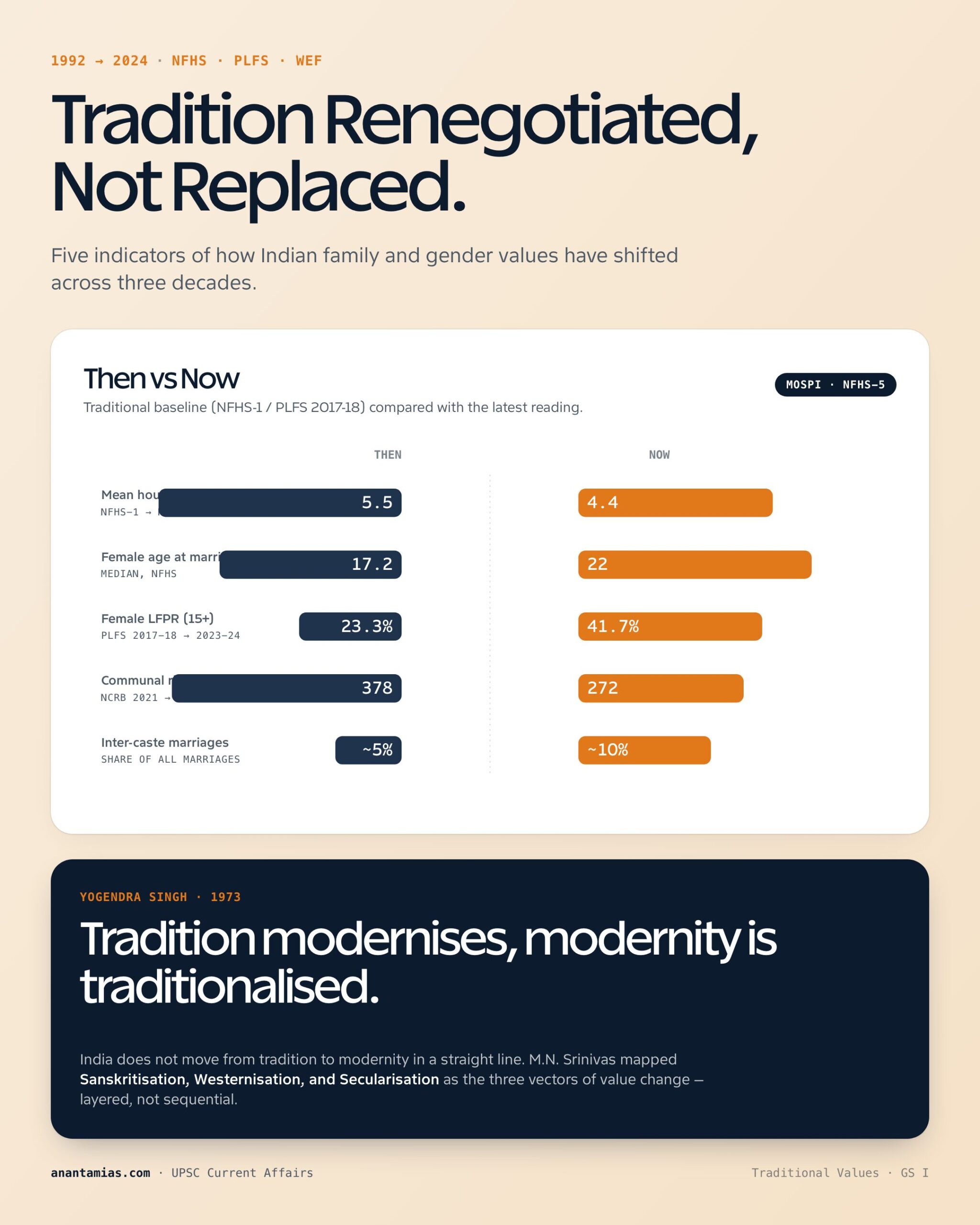
- Yogendra Singh (Modernisation of Indian Tradition, 1973): India does not move from tradition to modernity in a straight line; tradition modernises and modernity is traditionalised.
The Core Traditional Values of Indian Society
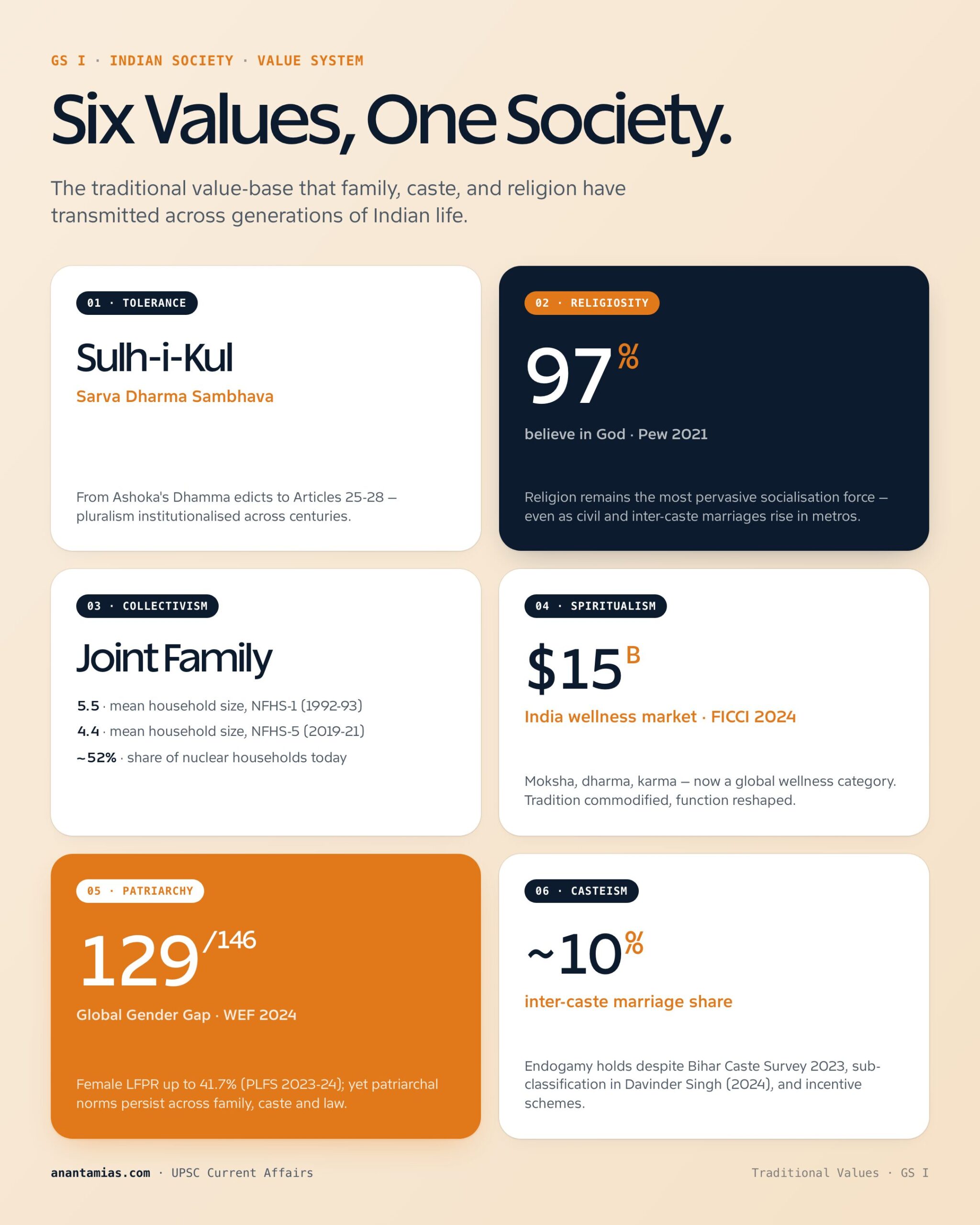
| Value | Core Idea | Institutional Carrier | 2024-26 Tension |
|---|---|---|---|
| Tolerance | Sulh-i-Kul, sarva dharma sambhava | Religion, polity | Hate speech, communalism |
| Collectivism | Community over individual | Joint family, caste, village | Nuclearisation, urban anonymity |
| Religiosity | Pervasive role of religion | Family rituals, festivals | Civil marriages, secular drift |
| Spiritualism | Moksha, dharma, karma | Ashramas, gurus, pilgrimages | Wellness commodification |
| Respect for elders | Gerontocracy | Joint family | Elderly abuse, isolation |
| Patriarchy | Male authority in family/public | Family, caste, law | Gender renegotiation |
| Casteism | Endogamy, hierarchy | Caste, jajmani, marriage | Class-caste interplay |
| Jointness of family | Multi-generational households | Patrilineal kinship | Nuclearisation |
Why Traditional Values Persisted
1. Tolerant Political Tradition
From Ashoka's Dhamma edicts (3rd century BCE) to Akbar's Sulh-i-Kul (peace with all) to Article 25-28 of the Constitution, Indian rulers and the Republic have institutionalised pluralism. Hinduism's syncretistic nature — absorbing Buddhist, Jain, Sufi, and folk elements — preserved religious value diversity.
2. Family as Socialisation Engine
The patrilineal joint family transmits patriarchy, gerontocracy, and gendered division of labour to each generation. Iravati Karve documented how kinship terminology and rituals reinforce these roles.
3. Jajmani System and Caste
The pre-modern village economy relied on functional interdependence between castes — Brahmin priest, Kshatriya patron, agricultural Jajmans, artisanal Kamins. This sustained casteism as ideology even as the underlying economy changed.
4. Agrarian Land Logic
India was traditionally agrarian; land was the central asset. Joint family ownership prevented fragmentation. The Hindu Succession Act amendments (2005) only formally equalised daughter's coparcenary rights — a clear legal break with patrilineal land tradition.
5. Religion-State Co-evolution
Indian secularism is principled distance, not strict separation (Rajeev Bhargava). The state can intervene to reform traditions (untouchability, sati, triple talaq, child marriage) — shaping values rather than abolishing them.
How Values Are Changing in 2024-26
Tolerance Under Stress
- World Press Freedom Index 2024: India 159/180.
- NCRB 2022: Communal/religious riots — 272 cases (down from 378 in 2021, but with severe spikes during major flashpoints).
- Hate speech monitoring by Centre for Study of Society and Secularism logged a sharp rise in mob lynching and targeted violence post-2014.
- The Supreme Court's Shaheen Abdulla v. Union of India (2022, 2023) directed states to suo motu register hate-speech FIRs.
Religiosity Renegotiated
- Pew Research (2021): 97% Indians believe in God; yet NFHS-5 (2019-21) shows rising civil marriages and inter-caste marriages in urban metros.
- Special Marriage Act, 1954 registrations have grown — though they remain a small share, the trend signals secular drift.
- Wellness/yoga industry estimated at ~$15 billion in India (FICCI 2024) — spiritualism commodified for global consumption.
Gender Renegotiation
- Female LFPR (15+) rose from 23.3% (PLFS 2017-18) to 41.7% (PLFS 2023-24).
- Hindu Succession Act 2005 amendment made daughters equal coparceners.
- Vishakha Guidelines (1997) → POSH Act (2013) institutionalised workplace anti-harassment norms.
- Marital rape debate before the Supreme Court (2024) and Triple Talaq criminalised (2019) — formal patriarchy is being challenged.
- Yet Global Gender Gap Index 2024 (WEF): India 129/146.
Collectivism vs. Individualism
- Mean household size fell from 5.5 (NFHS-1, 1992-93) to 4.4 (NFHS-5, 2019-21).
- Nuclear-household share is now ~52% (NFHS-5).
- Rising age at marriage — median female age at marriage 22 in NFHS-5, up from 17.2 in NFHS-1.
- Divorce rates remain low (<2% of marriages) but separation and "live apart together" are rising in metros.
Caste-Class Interplay
- Bihar Caste Survey 2023 showed OBCs 63% — reigniting national caste-census debate (now planned for Census 2027).
- State of Punjab v. Davinder Singh (2024 SC 7-judge bench) permitted sub-classification within SCs.
- Inter-caste marriage incentive schemes (e.g., Dr. Ambedkar Scheme for Social Integration, ₹2.5 lakh per couple) push class identity, but inter-caste marriage share is still ~10% (Lok Foundation–Oxford 2014–18 data).
Sociological Theorists on Indian Value Change
| Theorist | Concept | Application |
|---|---|---|
| M.N. Srinivas | Sanskritisation, Westernisation, Secularisation | Lower castes adopt upper-caste rituals; English-educated elite Westernises; state secularises law |
| Yogendra Singh | Modernisation of tradition | Layered change, not replacement |
| A.R. Desai | Marxist reading | Capitalist development reshapes value-base |
| Andre Beteille | Caste-class disjunction | Tanjore village showed values lag economic change |
| Dipankar Gupta | Mistaken Modernity | India has Westernisation without modernity in values |
| Triloki Nath Madan | Secularism debate | Indian secularism cannot ignore religion's vitality |
Constitutional and Legal Anchors
- Preamble: "Liberty of thought, expression, belief, faith and worship; equality of status and opportunity; fraternity assuring the dignity of the individual."
- Article 14, 15, 16, 17, 21: Equality, non-discrimination, abolition of untouchability, dignity.
- Article 44 (DPSP): Uniform Civil Code — operationalised by Uttarakhand UCC, 2024 (in force 2025).
- Article 51-A (Fundamental Duties): To value and preserve composite culture.
- Hindu Succession (Amendment) Act 2005: Equal coparcenary for daughters.
- POSH Act 2013, Triple Talaq Act 2019, Surrogacy Act 2021, ART Act 2021: Legal nudge to reshape values.
Government Initiatives that Reshape Values
- Beti Bachao Beti Padhao (2015, 2.0 in 2024) — gender values.
- Mission Shakti, Mission Vatsalya (2022) — women, child welfare.
- National Education Policy 2020 — emphasis on Indian Knowledge Systems alongside critical thinking and gender sensitivity.
- PM-JANMAN (2023) — value-sensitive welfare for PVTGs.
- Ek Bharat Shreshtha Bharat (2015) — cultural integration through linguistic-state pairing.
Data Snapshot (2024-26)
| Indicator | Value | Source |
|---|---|---|
| Female LFPR (15+) | 41.7% | PLFS 2023-24 |
| Mean household size | 4.4 | NFHS-5 |
| Median age at marriage (women) | 22 | NFHS-5 |
| Inter-caste marriage share | ~10% | Lok-Oxford |
| Crimes against women | 4,45,256 (2022) | NCRB |
| SC/ST atrocity cases | 57,582 (2022) | NCRB |
| Communal riot cases | 272 (2022) | NCRB |
| Global Gender Gap | 129/146 | WEF GGGR 2024 |
| Religious belief | 97% believe in God | Pew 2021 |
Challenges in the Value-Change Process
- Cultural lag (William Ogburn): Material culture (smartphones, IVF, gig work) outpaces non-material culture (family roles, gender norms).
- Selective modernisation: Society adopts technology but resists value change, producing tensions like honour killings, dowry violence, and queer marriage backlash.
- Polarisation: Tolerance value erodes faster than expected in mediatised public sphere.
- Generational divide: Digital-native youth values clash with gerontocratic family norms.
- Commodification of values: Yoga, spiritualism, traditional medicine sold as wellness packages emptied of social content.
Way Forward
- Strengthen constitutional values (Article 51-A) through curriculum (NEP 2020) — Indian Knowledge Systems alongside critical reasoning, gender sensitivity, and pluralism modules.
- Use principled distance secularism to reform traditions while protecting religious freedom; calibrate UCC implementation (Uttarakhand 2025 model) with consultative federalism rather than imposition.
- Ground gender, caste, and disability reform in lived experience through participatory planning (PESA 1996, MGNREGA, Mission Shakti SHGs, NRLM).
- Promote inter-cultural dialogue through institutions like Sangeet Natak Akademi, Sahitya Akademi, ICCR and NCERT revised curricula.
- Use digital public infrastructure (DigiLocker, Aadhaar-linked welfare, ONDC) to deliver value-aware services without flattening pluralism.
- Strengthen anti-discrimination architecture: SC/ST POA Act 1989, BNS 2023 hate-speech provisions, and a long-pending Anti-Racial Discrimination Act (Bezbaruah Committee 2014).
- Build gender-just workplaces through POSH compliance audits, crèche and 26-week maternity leave enforcement, and emerging menstrual leave frameworks (Bihar 1992, Kerala 2023, Sikkim 2023, Odisha 2024).
- Mainstream caregiver economy recognition through Time Use Surveys and care-work valuation in national accounts — addressing the patriarchal undervaluation of unpaid work.
- Invest in media literacy and counter-speech to reverse the corrosion of the tolerance value in the digital public sphere.
Mains Hook
"India does not modernise by abandoning tradition; it modernises by renegotiating it." Critically examine with reference to the changing value system of Indian society. (GS-I, 250 words, 15 marks)
Prelims Pointers
- Sanskritisation, Westernisation, Secularisation: M.N. Srinivas.
- Modernisation of Indian Tradition: Yogendra Singh, 1973.
- Pattern Variables: Talcott Parsons.
- Article 51-A: Composite culture duty (added by 42nd Amendment, 1976).
- Hindu Succession Amendment: 2005, daughters as coparceners.
- Triple Talaq Act: Muslim Women (Protection of Rights on Marriage) Act, 2019.
- Uttarakhand UCC: First state UCC operationalised (2025).
- Special Marriage Act: 1954 — civil marriage route.
- NFHS-5 mean household size: 4.4.
- Female LFPR: 41.7% (PLFS 2023-24).
Traditional values in India are neither dying nor static — they are shifting in form while persisting in function. The UPSC answer sweet spot is to demonstrate this dynamism with theory + data + recent law/judgment rather than romanticising the past or dismissing tradition as backward.