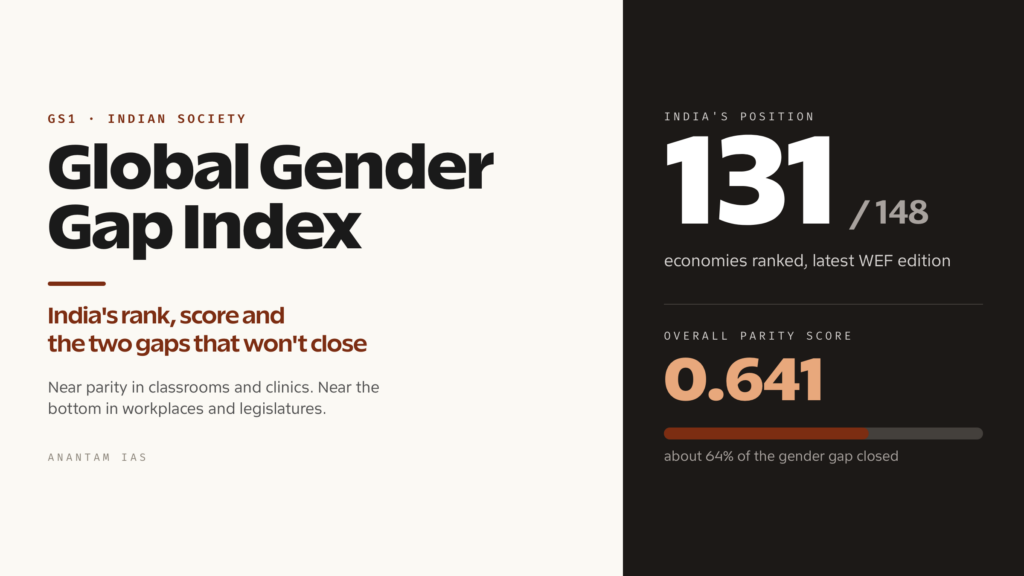
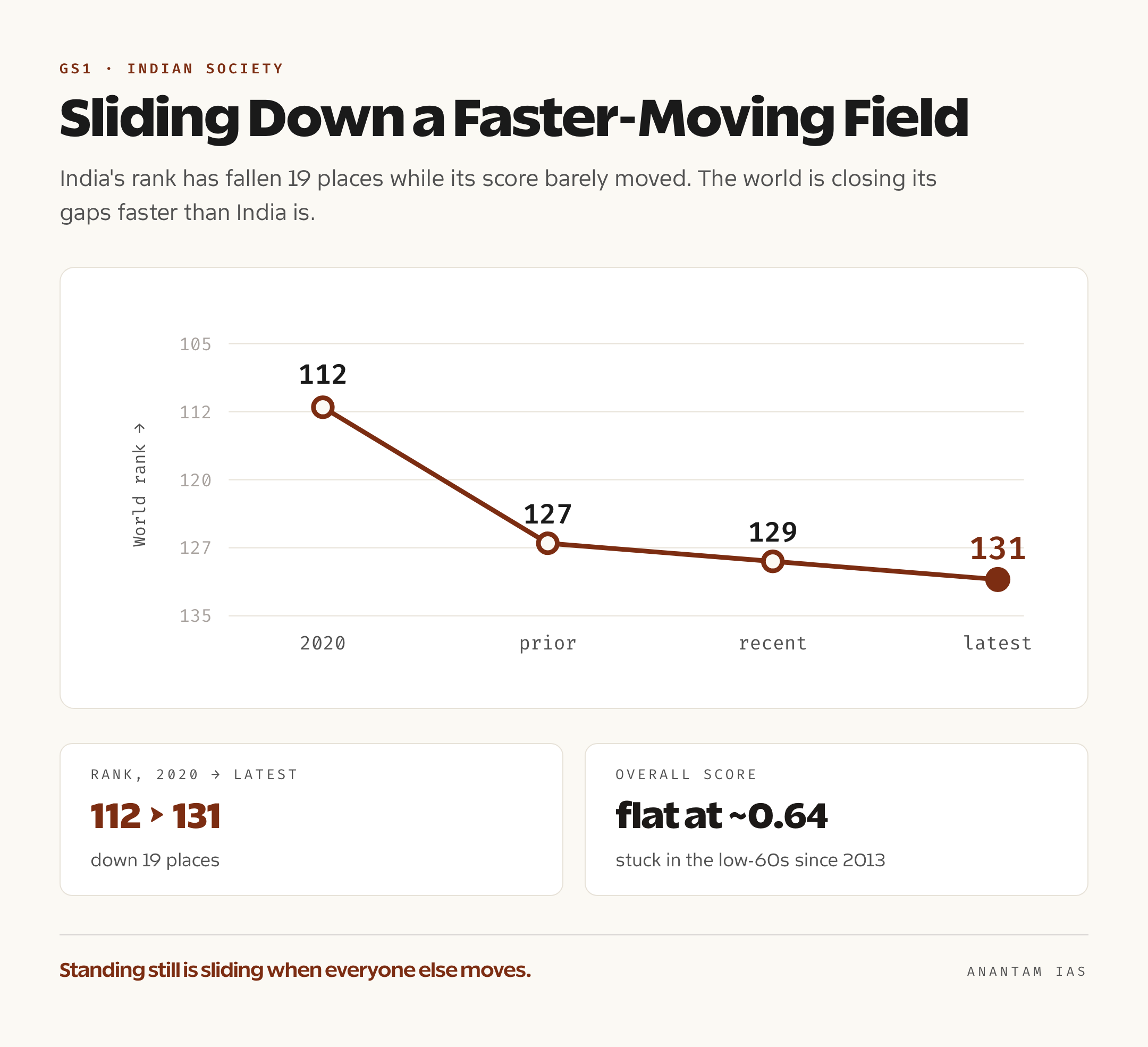
India ranks 131st out of 148 countries on the World Economic Forum’s Global Gender Gap Index — the latest reading, two places lower than the year before, and a long way from where a fast-growing economy thinks it should sit. The headline number is easy to mock and easy to misread, so it pays to be precise about what it actually says. India has closed about 64% of its gender gap. The remaining third is not spread evenly. It is concentrated almost entirely in two places: who earns and who rules.
That is the real story the index tells, and it survives every change of year and edition. India’s girls now reach school and its women now reach hospitals at rates close to parity with men. But Indian women still work for pay far less than Indian men do, and they hold a shrinking sliver of political power. A country can grow at 7% a year and still rank near the bottom of this list, because growth and gender parity are not the same thing. This explainer walks through what the index measures, where India actually stands, why it ranks where it does, how it differs from the better-known Gender Inequality Index, and what would genuinely move the number.
What the Index Actually Measures
The Global Gender Gap Index has been published by the World Economic Forum every year since 2006. The single most important thing to understand about it is the word gap. It does not measure how well women are doing in absolute terms — it measures the distance between women and men within the same country. So a poor country where men and women are equally poor can score higher than a rich country where men race ahead of women. The index rewards parity, not prosperity.
The score runs on a scale from 0 to 1, where 1 means men and women are exactly equal on the things measured and 0 means total disparity. That headline number is the simple average of four sub-indices, each measuring the gap in a different slice of life:
- Economic Participation and Opportunity — the gap in labour force participation, wages for similar work, estimated earned income, and the share of women in senior, managerial and technical roles.
- Educational Attainment — the gap in literacy and in enrolment across primary, secondary and tertiary education.
- Health and Survival — the sex ratio at birth (a proxy for sex-selective abortion) and the gap in healthy life expectancy.
- Political Empowerment — the gap in seats held in parliament, in ministerial positions, and in years with a woman as head of state over the past half-century.
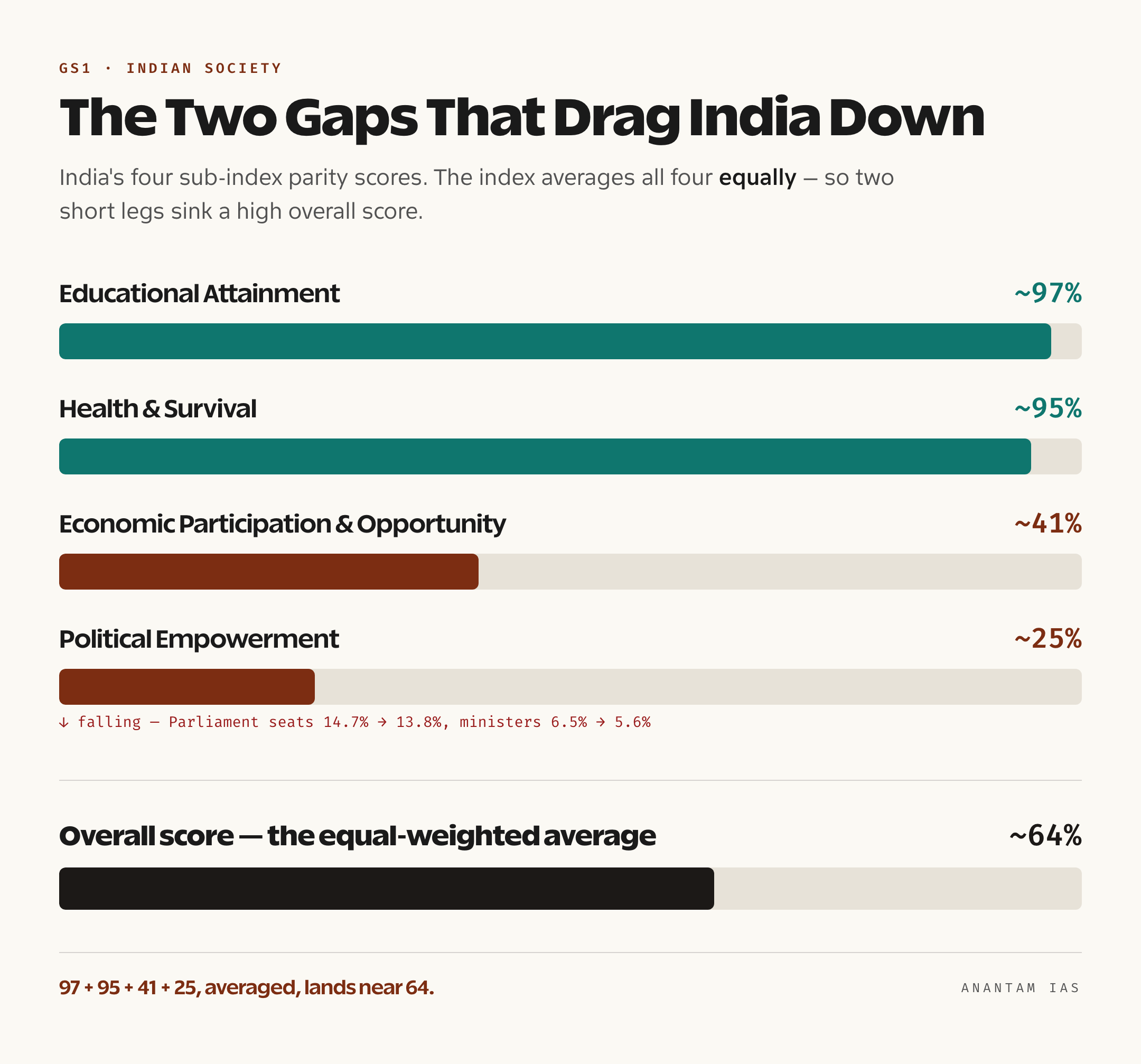
Two design choices matter for reading India’s score. First, the index caps several measures at parity — once a country closes a gap, doing better for women doesn’t earn extra credit, because the goal is equality, not female advantage. Second, the sub-indices are weighted equally in the final average, so a near-perfect education score and a near-empty political score pull in opposite directions with equal force. That is exactly what happens to India.
Where India Stands Now
India sits 131st of the 148 economies ranked in the latest edition, with an overall score of about 0.641 — roughly 64% of its gender gap closed. The number itself has barely moved in over a decade; since 2013 India’s score has hovered in the low-to-mid 60s, which is why the country keeps slipping in rank even when its own score nudges up. Others are simply closing their gaps faster.
The four sub-indices explain the whole picture, and they pull violently apart. On Educational Attainment, India scores about 97% — near parity, helped by rising female literacy and tertiary enrolment. On Health and Survival, India scores around 95%, dragged down almost entirely by a skewed sex ratio at birth that still reflects son preference, even as life expectancy parity is strong. So far, so close to equal.
Then the floor drops away. On Economic Participation and Opportunity, India scores only about 41% — one of the weakest readings in the world. And on Political Empowerment, India scores in the mid-20s and has been falling: women’s share of seats in Parliament slipped from 14.7% to 13.8% between the last two editions, and the share of women in ministerial roles dropped from 6.5% to 5.6%. Average those four together — 97, 95, 41, 25 — and you land near 64. The two weak legs are doing all the damage.
The regional comparison stings, because it kills the easy excuse that this is just South Asia being South Asia. Bangladesh, far poorer than India per head, ranks 24th in the world — its strong record of women in top political office lifts its political score dramatically. Bhutan (119th), Nepal (125th) and Sri Lanka (130th) all rank above India. Only Pakistan, last at 148th, ranks below. India is not held back by its region; it is an outlier within it.
Why India Ranks Where It Does
So why are the two weak legs so weak? Start with work, because that single sub-index does most of the damage. India’s female labour force participation has actually risen sharply on paper — the Periodic Labour Force Survey reports it climbing from 23.3% in 2017-18 to 41.7% in 2023-24. That sounds like good news, and partly it is. But economists like Shamika Ravi have shown that most of the recent jump comes from rural women, often in unpaid family farm work counted under “self-employment,” not from women entering salaried jobs. So the headcount rises while the income gap barely closes. The index captures both — and the estimated earned income measure still sits near 30%, meaning Indian women earn, on average, less than a third of what men do.
Underneath that sit a few stubborn structural facts. Care work is the biggest one. Indian women spend several times as many hours as men on unpaid cooking, cleaning and caregiving — among the widest such gaps measured anywhere — which quietly forces educated women out of paid work after marriage or childbirth. Add a persistent wage gap for similar work, thin representation in senior corporate and technical roles, and patchy safety in public spaces and on the commute despite the POSH Act on workplace harassment, and you get the familiar U-shaped curve: Indian women are most likely to work when they are very poor and have no choice, drop out as household incomes rise, and return only at the top of the education ladder.
The political picture is starker and more recent. India has had women as Prime Minister and President, which props up the “years as head of state” component. But day to day, women hold under 14% of Lok Sabha seats and a similar share in most state assemblies — and that figure has been drifting down, not up, which is why India’s political sub-index actively lost ground in the latest edition. The Women’s Reservation Act of 2023 (the Nari Shakti Vandan Adhiniyam) promises to reserve a third of Lok Sabha and assembly seats for women, but it is tied to a future census and delimitation, so it has not yet changed a single seat. Until it does, the political number stays stuck.
How It Differs From the Gender Inequality Index
Students routinely confuse the WEF’s Global Gender Gap Index with the UNDP’s Gender Inequality Index (GII), and examiners love the distinction — so it’s worth getting right. They give very different verdicts on India. On the GII, India ranks 102nd of 193 countries in the latest Human Development Report, up from 108th earlier. On the Global Gender Gap Index, India ranks 131st of 148. Same country, same year, two very different positions. The gap is not an error; it comes from what each index chooses to measure.
The Global Gender Gap Index measures relative gaps between women and men and nothing else. It deliberately ignores a country’s overall level of development — it doesn’t care whether the maternal mortality rate is high or low, only whether women and men are treated equally on its four chosen dimensions. The GII, by contrast, blends gaps with levels: it uses maternal mortality and adolescent birth rates (absolute health outcomes, not gaps), plus parliamentary seats, secondary education and labour participation. Because India’s maternal and adolescent health numbers have improved in absolute terms, the GII reading looks better than the gap-only reading.
There’s also a difference in spirit. The Gender Gap Index caps every measure at parity, so a country can never score points for women out-earning or out-voting men — its only target is equality. The GII has no such cap and reads more like a composite of disadvantage. So the practical rule for an answer is simple: the Global Gender Gap Index tells you how equally a society treats its women; the GII tells you how badly gender inequality drags down a country’s human development. They are complements, not rivals — and quoting both, with the rank difference explained, is what separates a strong answer from a rote one.
What Would Move India Up — and the Index’s Limits
Because India’s score is lopsided, the path up is unusually clear: education and health are near the ceiling, so the only way to raise the average is to close the economic and political gaps. That means the focus has to be narrow. Get more women into paid, counted, dignified work — through accessible childcare and creches, safe public transport, flexible and formal-sector jobs, and a serious attack on the unpaid care burden through public services. Build a leadership pipeline with mentoring and board-diversity norms so women rise into the senior and technical roles the economic sub-index weighs heavily. And operationalise the Women’s Reservation Act quickly, because the political sub-index simply cannot improve while women’s share of seats keeps falling.
But a good analyst also names the index’s limits, and there are real ones. First, the relative-gap design means India can look worse than a poorer country where men and women are equally badly off — the index says nothing about whether women’s absolute lives are improving, only whether the gap to men is narrowing. Second, the political sub-index leans heavily on parliamentary seats and a 50-year head-of-state window, which can swing a country’s rank dramatically on a single election; Bangladesh’s high rank rests largely on this. Third, the economic measures rely on modelled estimates of earned income and on survey data that struggle to capture India’s vast informal and unpaid economy, so the numbers carry genuine uncertainty. None of this makes the index worthless. It makes it one lens — best read alongside the GII, NFHS health data and the PLFS — rather than a verdict.
The honest takeaway is the one the lead promised. India has nearly solved the gap in getting girls to school and women to clinics. It has barely touched the gap in getting women paid work and political power. The index is blunt and imperfect, but on this it is not wrong: economic growth has not bought gender parity, and it never will on its own. That has to be built — job by job, seat by seat.
For Your Mains Answer
This topic maps cleanly onto GS Paper 1 (issues relating to women, social empowerment), GS Paper 2 (welfare schemes, important international reports and indices, role of women’s organisations), and GS Paper 3 (inclusive growth and the demographic dividend). It is also a reliable Essay anchor on women, development or the gap between growth and equity. Treat the index as a diagnostic — a way to argue precisely about which gender gap India must close, not as a number to memorise.
How to Build the Answer
Open with the asymmetry, not the rank. State that India is near parity on education and health but near the bottom on economic participation and political empowerment, and that the equal-weighted average is why the overall rank looks so poor. Then explain the why (care burden, informal-sector work, falling parliamentary share), distinguish the index from the GII, and close with a targeted way forward aimed only at the two weak legs. That structure — asymmetry, causes, comparison, targeted reform — beats a generic “problems and solutions” template every time.
Common Mistakes to Avoid
Don’t confuse the Global Gender Gap Index (WEF, ranks gaps) with the Gender Inequality Index (UNDP, blends gaps and levels) — mixing the two ranks is a classic error. Don’t say India is “improving” simply because female LFPR rose; flag that much of the rise is unpaid rural family work. Don’t list every government scheme without tying it to a specific sub-index. And don’t treat the rank as a moral scorecard — explain that it measures gaps, not absolute welfare.
A Compact Answer Spine
Index measures gaps, not levels (four equal-weighted sub-indices) → India near parity on education (~97%) and health (~95%) → far behind on economic participation (~41%) and political empowerment (~mid-20s, falling) → causes: unpaid care burden, informal work, low and declining seat share → differs from UNDP’s GII, which mixes gaps with absolute health → fix the two weak legs: paid work, childcare, leadership pipeline, operationalise the Women’s Reservation Act.
Diagram or Flowchart Idea
Draw four horizontal bars of unequal length for the sub-indices — two almost full (education, health), two short (economic, political) — under a single averaged “overall score” bar sitting at about 64%. The visual instantly shows why a high average is impossible while two legs lag, and it earns marks fast.
A Balanced-Conclusion Line
A line that lands: “India has closed the gap in classrooms and clinics; it has yet to close it in workplaces and legislatures — and no rate of GDP growth will close it automatically.” It states the asymmetry, credits real progress, and points at the unfinished work without sloganeering.
How to Use Data Without Cramming
You need only a handful of anchors: rank 131 of 148; overall score ~64%; education ~97% and health ~95% versus economic ~41% and political ~mid-20s; female LFPR up to 41.7% (PLFS 2023-24) but largely unpaid; women under 14% of Lok Sabha; GII rank 102 of 193 for contrast. Six or seven numbers, each tied to an argument, read as mastery — a wall of statistics reads as panic.
FAQ
What is India’s rank on the Global Gender Gap Index? India ranks 131st out of 148 countries in the latest WEF Global Gender Gap Report, with an overall score of about 0.641 — roughly 64% of its gender gap closed. That is two places lower than the previous edition, mainly because of a falling political-empowerment score, even though India’s absolute score has been broadly flat for over a decade.
Why does India rank so low despite near-parity in education and health? Because the index averages four sub-indices equally. India scores about 97% on Educational Attainment and 95% on Health and Survival, but only about 41% on Economic Participation and in the mid-20s on Political Empowerment. The two weak legs — low paid-work participation for women and a small, shrinking share of women in Parliament — drag the overall average down to around 64%.
How is the Global Gender Gap Index different from the Gender Inequality Index? The WEF’s Global Gender Gap Index measures only the gap between women and men, ignoring a country’s development level, and caps every measure at parity. The UNDP’s Gender Inequality Index blends gaps with absolute outcomes like maternal mortality and adolescent birth rates. That’s why India ranks 131 of 148 on the gap index but 102 of 193 on the GII in the same year — the indices ask different questions.
What would improve India’s Global Gender Gap ranking? Since education and health are near the ceiling, the only lever is closing the economic and political gaps. That means moving women into paid, counted work through childcare, safe transport and formal jobs; easing the unpaid care burden; building a female leadership pipeline; and operationalising the Women’s Reservation Act of 2023, which is currently tied to a future census and delimitation and has not yet changed any seats.
Practice Questions
Prelims MCQs
- The Global Gender Gap Index is published by which organisation?
(a) UNDP
(b) World Economic Forum
(c) UN Women
(d) World Bank
Answer: (b) — The WEF has published the index annually since 2006; the UNDP publishes the separate Gender Inequality Index. - The Global Gender Gap Index is the average of how many equally weighted sub-indices?
(a) Two
(b) Three
(c) Four
(d) Five
Answer: (c) — Economic Participation, Educational Attainment, Health and Survival, and Political Empowerment are weighted equally. - On which two sub-indices does India lag the most?
(a) Educational Attainment and Health
(b) Economic Participation and Political Empowerment
(c) Health and Political Empowerment
(d) Education and Economic Participation
Answer: (b) — India is near parity on education (~97%) and health (~95%) but scores only ~41% on economic participation and the mid-20s on political empowerment. - Which of the following best distinguishes the WEF Global Gender Gap Index from the UNDP Gender Inequality Index?
(a) Both measure absolute outcomes
(b) The Gender Gap Index measures only gaps and caps measures at parity, while the GII blends gaps with absolute outcomes like maternal mortality
(c) The GII measures only gaps
(d) Both cap every measure at parity
Answer: (b) — The gap index rewards parity, not prosperity; the GII mixes relative gaps with absolute health and development levels. - The Women’s Reservation Act, 2023 (Nari Shakti Vandan Adhiniyam) proposes to reserve what share of Lok Sabha and assembly seats for women?
(a) One-fourth
(b) One-third
(c) Half
(d) One-tenth
Answer: (b) — It promises to reserve a third of seats, but is tied to a future census and delimitation and has not yet changed any seat.
Mains Practice Questions
- “Economic growth does not automatically buy gender parity.” Critically examine this statement in light of India’s performance on the Global Gender Gap Index. (15 marks, 250 words)
- India ranks near parity on education and health but near the bottom on economic participation and political empowerment on the Global Gender Gap Index. Analyse the structural causes of this asymmetry and suggest targeted reforms. (15 marks, 250 words)
- Distinguish between the WEF Global Gender Gap Index and the UNDP Gender Inequality Index. Why does India rank very differently on the two in the same year? (10 marks, 150 words)
- India’s female labour force participation has risen on paper, yet the gender gap in earned income has barely closed. Discuss the reasons, with reference to unpaid care work and the informal economy. (15 marks, 250 words)
- Composite international indices are useful diagnostics but imperfect verdicts. Evaluate the limitations of the Global Gender Gap Index and how it should be read alongside other data sources. (15 marks, 250 words)
Tell Google you want more of this.
Add Anantam IAS as a preferred sourceOne tap, and this site shows up more often in your own Top Stories, AI Overviews and AI Mode. Remove it any time.