UPSC Prelims 2026: Face Authentication and Answer Key Reform
UPSC Prelims 2026 brought face authentication, provisional answer keys and 2,072 venues into focus. Use the latest facts for Prelims and Mains revision.
Introduction
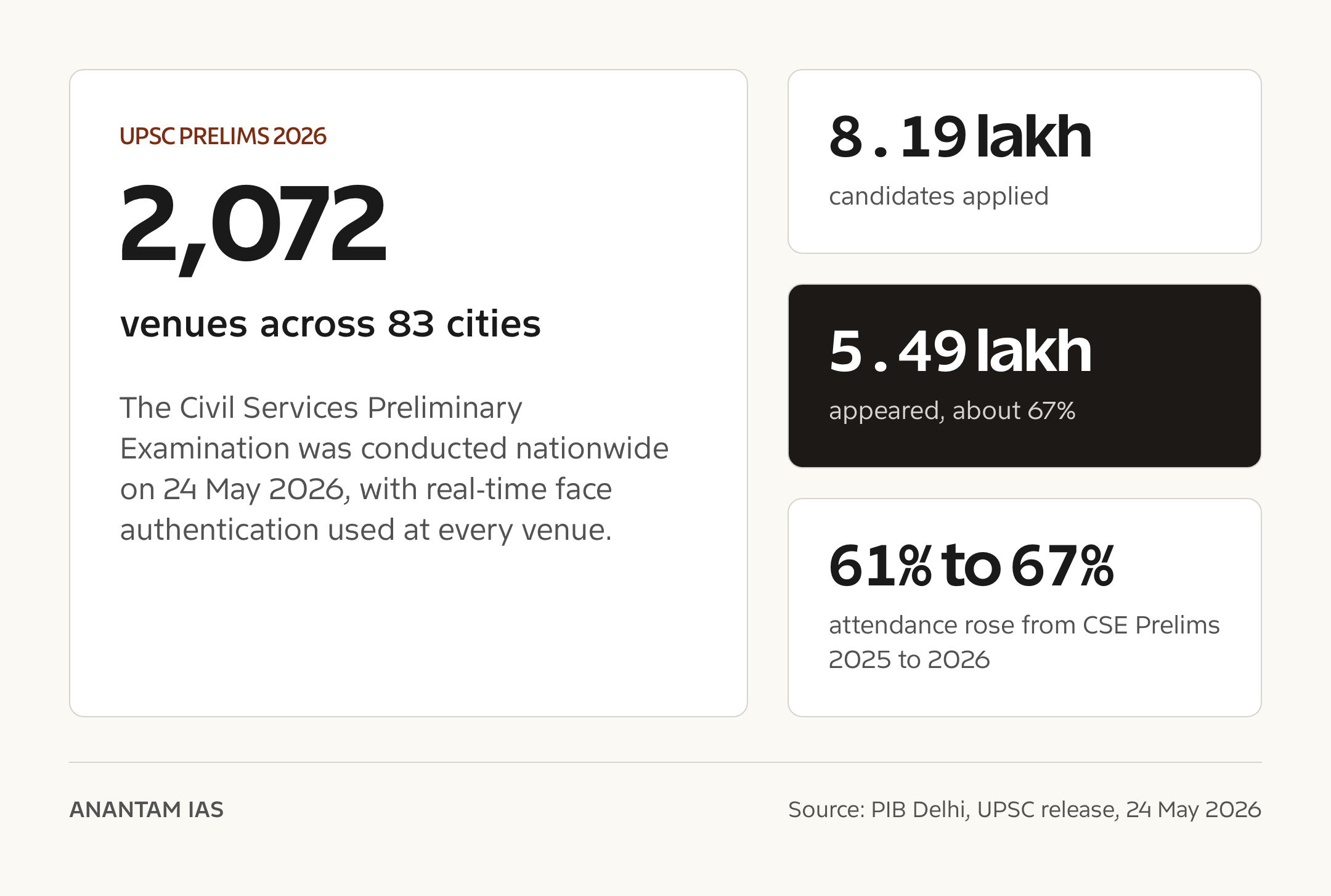
UPSC Prelims 2026 was not just another screening test. On 24 May 2026, the Union Public Service Commission conducted the Civil Services (Preliminary) Examination, 2026, including the Indian Forest Service (Preliminary) Examination, across 2,072 venues in 83 cities. The bigger story is that the Commission combined scale with three governance reforms: real-time face authentication at every venue, early release of a provisional answer key, and a structured representation window through the QPRep portal.
The numbers are unusually useful for UPSC aspirants. As per provisional data released through PIB Delhi, 8,19,732 candidates applied and nearly 5.49 lakh candidates appeared, giving an attendance rate of about 67%. In 2025, nearly 9.5 lakh candidates had applied and about 5.8 lakh appeared, an attendance rate of around 61%. That makes UPSC Prelims 2026 a good case study in administrative capacity, exam integrity, digital public infrastructure, accessibility, and transparency. For Prelims, it gives exact facts. For Mains, it gives a live example of how a public institution tries to protect credibility in a high-stakes examination.

Quick Facts at a Glance
| Indicator | Latest Data | Source |
|---|---|---|
| Exam conducted | Civil Services (Preliminary) Examination, 2026 and Indian Forest Service (Preliminary) Examination, 2026 | PIB Delhi, 24 May 2026 |
| Date of examination | 24 May 2026 | PIB Delhi |
| Venues and cities | 2,072 venues across 83 examination centres or cities | PIB Delhi |
| Total applicants | 8,19,732 candidates applied | PIB Delhi |
| Attendance | Nearly 5.49 lakh appeared, about 67% | PIB Delhi |
| 2025 comparison | Nearly 9.5 lakh applied and about 5.8 lakh appeared, around 61% | PIB Delhi |
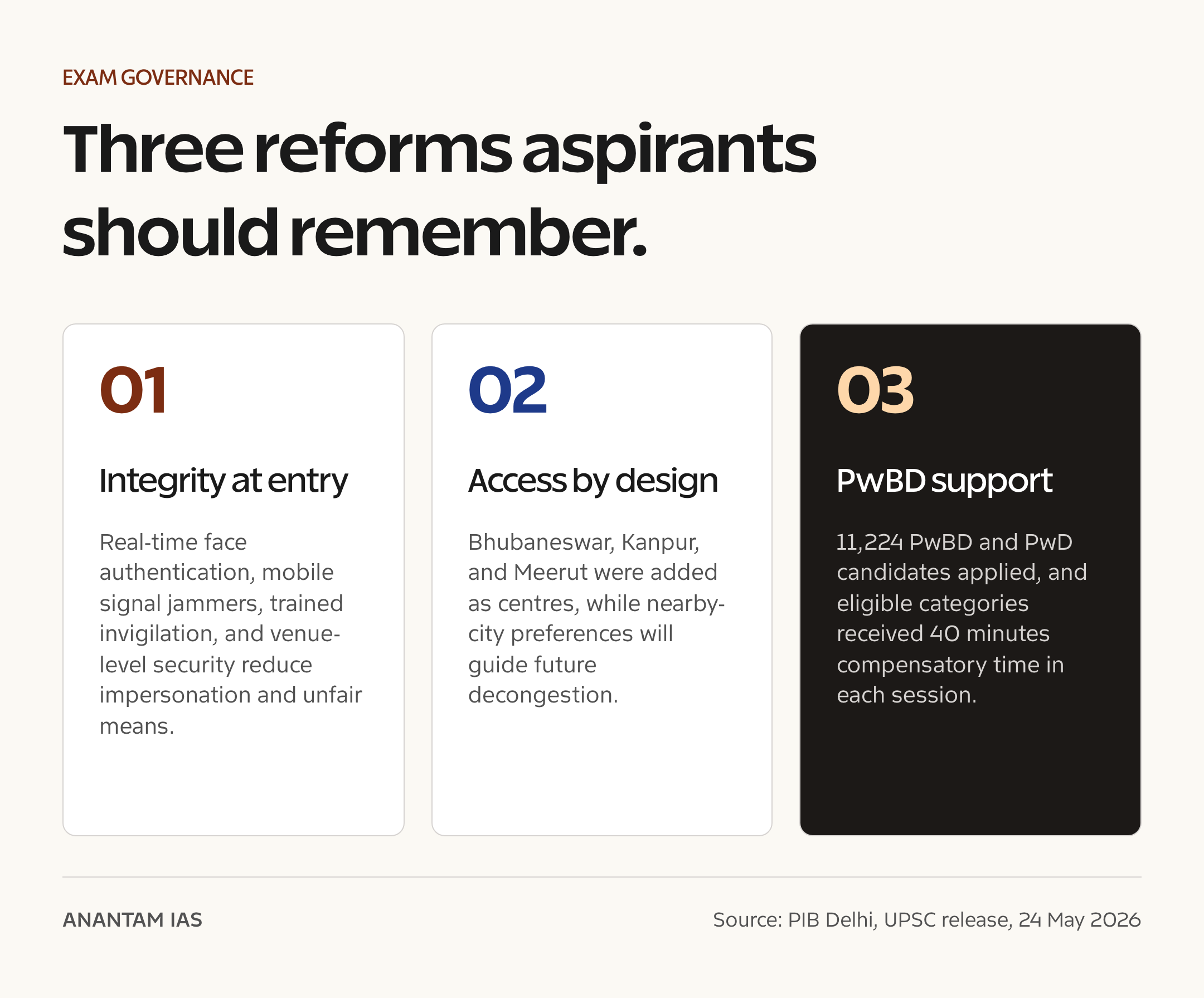
| New integrity measure | Real-time face authentication introduced for the first time at all 2,072 venues | PIB Delhi |
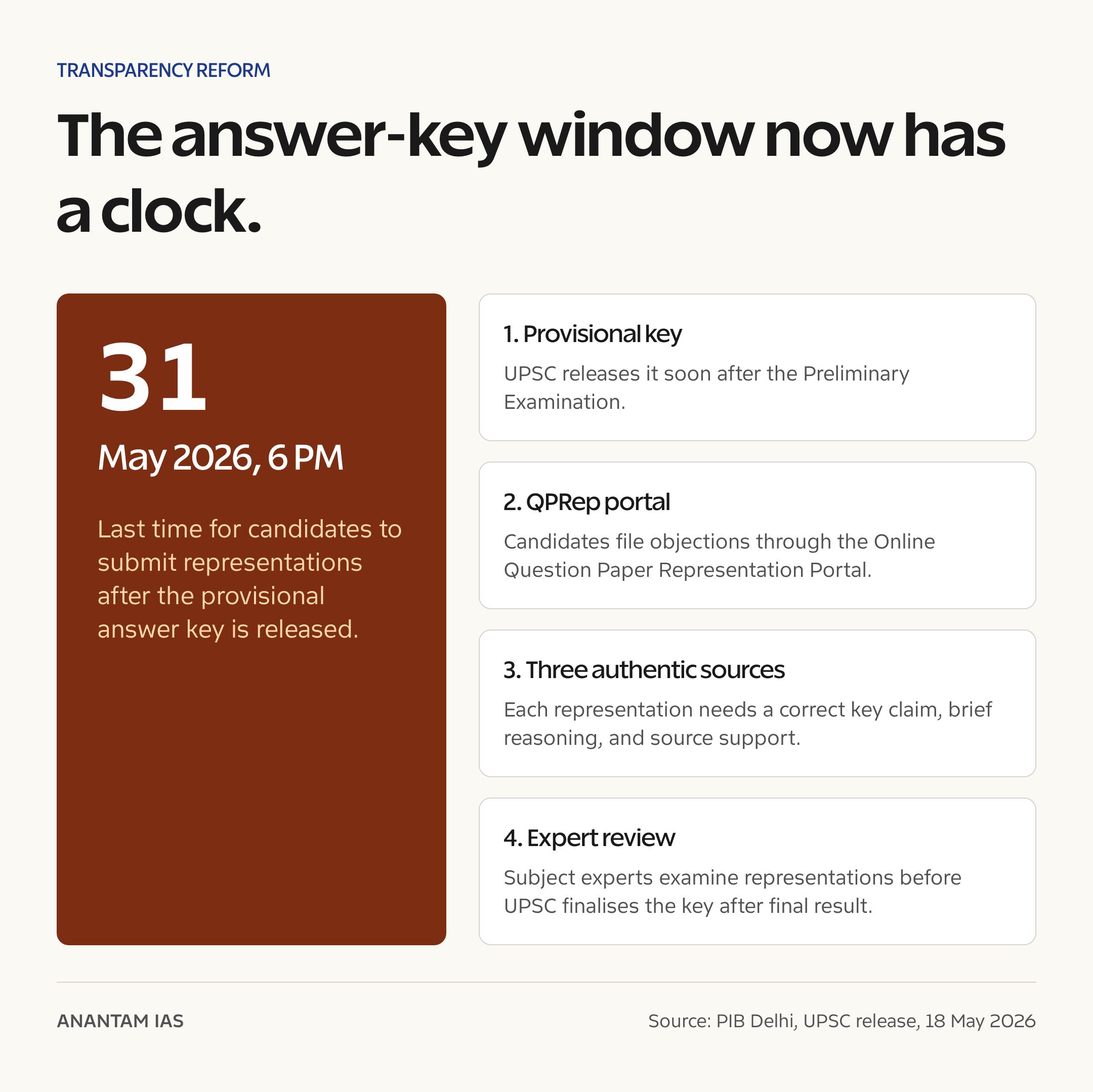
| Answer key reform | Provisional answer key to be released soon after the exam, with representations accepted till 31 May 2026, 6 PM | PIB Delhi, 18 May 2026 |
| PwBD and PwD applicants | 11,224 candidates belonged to PwBD or PwD categories | PIB Delhi |
Background and Historical Context
The Civil Services Examination is the central recruitment pipeline for the IAS, IPS, IFS and several Group A and Group B services. The Preliminary Examination is the first filter. UPSC’s own examination FAQ describes it as a screening test, with marks not counted for the final order of merit. That point is easy to forget because the Prelims season carries enormous emotional pressure. But institutionally, the purpose of Prelims is narrow: reduce a very large applicant pool to a smaller group eligible for the Main Examination.
That is exactly why the 2026 conduct note matters. A screening test at this scale has to solve four problems at once. It must verify that the right candidate is sitting in the right seat. It must prevent unfair means without making honest candidates feel trapped in a hostile environment. It must run across summer conditions, crowded cities, smaller centres and accessibility requirements. And it must give candidates a credible way to challenge the answer key without waiting until the entire examination cycle is over.
For years, aspirants complained that official answer keys came too late to help them make informed decisions in the same cycle. Coaching keys came within hours, but they disagreed on difficult questions. Candidates often spent weeks in an anxious fog: should they start Mains preparation, move to the next attempt, or wait for the official result? UPSC’s 2026 decision to release a provisional answer key soon after the examination is a response to that long-standing demand. It does not remove uncertainty, but it moves part of the uncertainty into a formal, evidence-backed process.
This reform also sits in a wider exam-governance context. India has seen repeated debates around paper leaks, impersonation, digital cheating and public examination credibility. The National Testing Agency itself has become a recurring UPSC topic because exam bodies are no longer seen as clerical agencies. They are public institutions whose design choices affect trust, access and fairness. UPSC Prelims 2026 gives aspirants a fresh example of that shift.
Key Features of UPSC Prelims 2026
UPSC Prelims 2026 can be remembered through four features: scale, identity verification, transparency in the answer-key process, and accessibility. Each feature has a Prelims fact and a Mains angle. That is the sweet spot for current affairs.
Scale and Attendance
The exam was held at 2,072 venues in 83 cities. Delhi had the highest application load with 70,885 candidates across 144 venues, followed by Hyderabad with 44,209 candidates at 100 venues and Patna with 39,147 candidates across 79 venues. At the other end, Kargil had only 98 candidates at one venue, Port Blair had 270 candidates at one venue, and Leh had 308 candidates across two venues. That variation tells you something important: a national examination is not one logistical problem. It is hundreds of local logistical problems solved on the same day.
Real-Time Face Authentication
UPSC introduced real-time face authentication for the first time in the Civil Services Preliminary Examination. The system was developed indigenously through the National e-Governance Division of MeitY, with support from the National Informatics Centre. PIB records that it worked across all 2,072 venues and described the exercise as possibly the largest real-time face-authentication exercise conducted by UPSC. For aspirants, the fact to remember is simple: this was not a pilot in one city. It was a nationwide deployment.
Provisional Answer Key and QPRep
UPSC also announced that it would release the provisional answer key soon after the examination. Candidates can submit representations through the Online Question Paper Representation Portal, or QPRep, available at upsconline.nic.in. The representation window remains open till 31 May 2026, 6 PM. The candidate has to indicate the correct key according to their understanding, provide a brief explanation, and support it with documents from three authentic sources. The final answer key will still be released only after the final result of Civil Services Examination 2026, which keeps continuity with the older practice while adding an early correction window.
Accessibility and Candidate Support
The 2026 conduct note records 11,224 PwBD and PwD candidates among total applicants. PwBD candidates in the categories of blindness, locomotor disability with both arms affected, and cerebral palsy received compensatory time of 20 minutes per hour, which means 40 minutes in each two-hour session. Candidates with other disabilities, including those with less than 40% disability but difficulty in writing, were also eligible for compensatory time subject to a medical certificate. This connects directly with an earlier Anantam IAS current-affairs note on UPSC centre-of-choice safeguards for PwBD candidates.
Significance for UPSC and General Knowledge
- GS Paper II, governance: UPSC Prelims 2026 shows how administrative institutions protect fairness, accountability and public trust in recruitment.
- GS Paper II, social justice: PwBD compensatory time and accessibility arrangements connect exam governance with the Rights of Persons with Disabilities Act framework.
- GS Paper III, science and technology: Real-time face authentication is a live example of digital technology entering public administration.
- GS Paper IV, ethics: The issue raises questions of fairness, transparency, impersonation, institutional integrity and candidate dignity.
- Prelims: Exact numbers such as 2,072 venues, 83 cities, 8,19,732 applicants and 31 May 2026 representation deadline are testable facts.
- Essay: The topic can support essays on technology and trust, exams and merit, or the balance between surveillance and fairness.
- Interview: Aspirants may be asked whether biometric or face-authentication systems improve credibility or create new privacy concerns.
Detailed Analysis: Exam Integrity Meets Candidate Rights
The most useful way to read UPSC Prelims 2026 is not as a technology story. It is an institutional-trust story. Face authentication, mobile signal jammers, answer-key representations and accessibility support are different tools, but they are all trying to solve the same problem: how does a public examination remain credible when the stakes are high enough to create pressure for fraud, litigation, anxiety and misinformation?
The case for face authentication is obvious. Impersonation attacks the moral core of a merit-based exam. If the person who appears is not the person who applied, every honest candidate is cheated. In a pool of more than eight lakh applicants, manual identity checks alone are slow and uneven. Real-time face authentication gives UPSC a more standardised identity-verification layer. It also creates a deterrent. A candidate considering impersonation now has to account not only for document checks and invigilator scrutiny, but also for a digital comparison at the venue.
But technology in governance never comes free. It shifts the problem. The new question is not only whether the system catches impersonation, but whether it works reliably across skin tones, lighting conditions, rural and urban centres, internet constraints, and candidates whose appearance may differ from the photograph uploaded months earlier. PIB says the 2026 system worked across all venues and recorded 100% success. That is the official operational claim. For Mains, a better answer should still add the long-term safeguards: clear consent architecture where required, data minimisation, retention limits, audit trails, grievance redressal and human override for false mismatch cases.
The provisional answer key reform is just as important. Earlier, candidates relied heavily on unofficial coaching keys. That created two problems. First, coaching institutes often disagreed on difficult questions, especially in environment, science and polity where wording can change the answer. Second, candidates had no early official process to place evidence before UPSC. The QPRep portal changes that posture. Candidates now have a defined window and a burden of proof: identify the disputed answer, explain the claim, and support it with three authentic sources.
The reform also changes candidate behaviour. A serious aspirant can no longer stop at “my coaching key says option C.” That may be good enough for a Telegram discussion, but it is weak evidence before a subject expert. If UPSC asks for three authentic sources, the aspirant has to think like a researcher. Where does the fact actually come from? Is it in an Act, a government report, an official map, a textbook, a standard international publication, or a primary scientific source? This is not separate from preparation. It is preparation, only in compressed form.
There is also a psychological benefit. The old answer-key practice produced a long waiting period in which the most serious candidates often lost momentum. If a candidate scored around the expected cut-off, every disputed question became a source of daily anxiety. An early provisional answer key does not end that anxiety, but it gives it a channel. Candidates can estimate their position with more confidence, file evidence-backed objections where they genuinely have a case, and then return to Mains preparation without treating every coaching discussion as official truth.
| Reform | Governance Problem | Exam-Oriented Insight |
|---|---|---|
| Real-time face authentication | Impersonation and identity fraud | Technology can improve integrity, but it needs privacy safeguards and human review. |
| Mobile signal jammers | Digital cheating and unfair communication | Security measures must be proportionate and venue-wide. |
| Provisional answer key | Long delay in official answer-key transparency | Early disclosure improves accountability but does not replace expert finalisation. |
| QPRep portal | Unstructured objections and informal grievance channels | Evidence-backed representation turns candidate grievance into a reviewable record. |
| New centres at Bhubaneswar, Kanpur and Meerut | Overcrowding and travel burden | Access to examination infrastructure is part of equality of opportunity. |
| PwBD compensatory time | Disability-linked disadvantage in writing speed or access | Formal equality is not enough; exam design must create fair conditions. |
There is a practical lesson here for aspirants too. If you file a representation, do not treat it like a social-media argument. UPSC has asked for authentic sources. That means official textbooks, standard government publications, recognised reports, statutory text, court judgments, or primary institutional documents where possible. A vague claim that “many teachers said so” will not carry the same weight as a precise source trail. This is also why preparing for Prelims through primary material matters. In 2026, the difference between a strong and weak objection may be the difference between a source and an opinion.
Access is the quieter part of the story, but I would not ignore it. UPSC added Bhubaneswar, Kanpur and Meerut as new examination centres to decongest existing centres. It also introduced a dropdown option for candidates to indicate preferred nearby cities. That data will work like a demand survey for future exam-centre planning. This is a small design change with large administrative value. Instead of guessing where pressure is building, UPSC can use candidate preference data to identify feasible new centres.
The PwBD provisions also matter because they convert an abstract principle into operational time. Twenty minutes per hour is not a slogan. It is a measurable accommodation that changes how a candidate experiences a two-hour paper. An institution that ignores disability support may still claim equal rules, but it does not create equal opportunity. That is a clean GS II point.
How UPSC Prelims 2026 Changes Candidate Strategy
For candidates, UPSC Prelims 2026 changes the post-exam routine. Earlier, the usual pattern was mechanical: compare answers with three or four coaching keys, calculate a range, look at expected cut-offs, panic for a week, then start Mains preparation half-heartedly. I have watched enough aspirants lose precious June days to this loop. It feels like analysis, but most of it is emotional noise.
The QPRep window forces a cleaner process. First, separate questions into three buckets: clearly correct, clearly wrong, and genuinely disputed. Second, for disputed questions, identify whether the dispute is factual, conceptual or language-based. A factual dispute needs an authoritative source. A conceptual dispute needs a standard text or official explanation. A language dispute needs close reading of the question stem. Third, file only those representations where the evidence is strong enough to survive expert review. Throwing twenty weak objections at the portal may feel satisfying for five minutes, but it does not build credibility.
This also means aspirants should keep better source habits during preparation. If you make notes from Lakshmikant, NCERTs, Economic Survey, Budget, government reports, PIB releases, IPCC reports or official Acts, keep the source name and page reference. It sounds boring until you need to support an answer-key objection in 48 hours. Then the student with clean source notes has an advantage over the student with a folder full of screenshots.
The face-authentication reform changes exam-day strategy in a different way. Candidates should treat identity verification as part of the exam environment, not as an interruption. Reach early. Carry the required documents exactly as instructed. Do not experiment with appearance so drastically that the live check becomes avoidably difficult. And if there is a mismatch or delay, stay calm and insist on the official fallback process. The real test still begins when the paper lands on the desk, but the administrative layer around the paper has become more serious.
There is a Mains lesson hidden here. Good governance is often less glamorous than policy announcements. It is the small design work of making systems predictable: a deadline that everyone can see, a portal where representations are filed, a record that experts can review, a compensatory-time rule that invigilators understand, and a centre-allocation system that reduces unnecessary travel. UPSC Prelims 2026 gives you language for that kind of answer.
Digital Governance Angle
UPSC Prelims 2026 is also a neat example of the Indian state’s digital-governance turn. The same public system that uses Aadhaar-linked services, DigiLocker, UPI, e-courts, digital land records and online grievance portals is now using identity technology inside the examination hall. That does not automatically make the reform good or bad. It means aspirants should evaluate it using the standard governance tests: legality, necessity, proportionality, accountability, transparency and grievance redressal.
Legality asks whether the institution has authority to collect and process the data. Necessity asks whether a less intrusive tool could solve the problem. Proportionality asks whether the public benefit, preventing impersonation in a national exam, is strong enough to justify the intrusion. Accountability asks who is answerable if the system fails. Transparency asks whether candidates know what is being collected and how long it will be retained. Grievance redressal asks whether a genuine candidate can challenge a mistake without losing the exam attempt. These six words can carry an entire GS II or GS III answer.
That is why this topic should be read alongside wider current affairs on data and security. Anantam IAS has already covered NCRB crime statistics and the rise of cybercrime, which shows why digital systems need security by design. The exam hall is not a bank, a court or a police database, but the trust problem is similar. Once public institutions depend on digital identity, the quality of the database, the audit mechanism and the human fallback become part of public law.
There is also an inclusion angle. Technology can make a system cleaner for most candidates while making it harder for a small group if edge cases are ignored. A candidate with a disability, a changed appearance, a poor photograph, or a centre with weak lighting should not be punished for system design. Good digital governance anticipates such cases before the exam day. That is the difference between using technology as a tool and using it as a shield against accountability.
Comparative Perspective
UPSC is not alone in using technology to protect exam credibility. Across India, recruitment and admission bodies have moved toward camera surveillance, biometric checks, encrypted question-paper handling, computer-based testing, and candidate grievance portals. The difference with UPSC Prelims 2026 is the scale and the sensitivity. Civil services recruitment is not a private entrance test. It is a constitutional-administrative gateway into the higher bureaucracy. That gives every design choice a public-law character.
| Institution or Exam System | Integrity Tool | Public Policy Lesson |
|---|---|---|
| UPSC Prelims 2026 | Real-time face authentication, jammers, QPRep representations | High-stakes public exams need identity verification and transparent answer-key review. |
| National Testing Agency exams | Computer-based testing, centre allocation, surveillance and post-exam review | Centralised testing bodies must balance standardisation with public trust. |
| State public service commissions | Biometric checks, stricter venue controls and litigation-driven reforms | Exam credibility often becomes a federal governance issue after paper leak controversies. |
| Digital courts and AI tools | E-filing, virtual hearings and algorithmic assistance debates | Technology improves access only when accountability keeps pace with adoption. |
The wider lesson is similar to the debate around courts in India and AI tools. Technology can make institutions faster and cleaner, but it cannot substitute for institutional judgment. A face-authentication system can verify identity. It cannot decide what fairness means if the system fails for a genuine candidate. A provisional answer key can invite objections. It cannot by itself guarantee that all disputed questions are resolved beyond criticism. The human process behind the technology still matters.
Challenges and Criticisms
The first challenge is privacy. Real-time face authentication processes biometric or face-template data. Even if the system worked well on exam day, UPSC and its technology partners should be judged over the full data life cycle: collection, storage, access, retention, deletion and audit. The Digital Personal Data Protection Act, 2023 gives India a statutory privacy framework, but public examination systems will still need clear operational rules. Aspirants should not have to choose between exam integrity and basic data dignity.
The second challenge is error handling. Any authentication system can produce false mismatches. A candidate may have changed appearance. Lighting may be poor. Camera quality may vary. The official statement reports successful deployment across all venues, which is reassuring. But a mature system still needs a visible fallback process: who verifies a mismatch, how quickly, with what documentation, and how the candidate’s exam time is protected. This is where administrative design matters more than the tool itself.
The third challenge is answer-key evidence quality. Asking candidates to support objections with three authentic sources is sensible because it filters casual objections. But it may also privilege candidates with better access to libraries, paid resources, expert guidance and language confidence. UPSC should make the representation format as plain and accessible as possible. A transparent process should not become a lawyerly maze.
The fourth challenge is exam-centre equity. Adding Bhubaneswar, Kanpur and Meerut helps, but centre distribution will always lag demand unless UPSC uses candidate data continuously. Aspirants from smaller towns often pay the hidden cost of national exams through travel, lodging, unfamiliar cities and weather exposure. The nearby-city preference dropdown is a good start because it converts scattered inconvenience into data that can guide future planning.
The fifth challenge is communication. UPSC has improved candidate support in recent months, including steps discussed in Anantam IAS’s note on extended call-centre operations. That matters because digital reform without candidate support can become another source of confusion. If a candidate does not understand how to file a representation, what counts as an authentic source, or what to do when a face-authentication check fails, the reform’s benefit shrinks. Public institutions need not only good rules, but also plain instructions.
A fair criticism is that UPSC has announced the key reform, but the quality of implementation will decide its real value. Will the provisional key come early enough for candidates to use it? Will the portal remain stable near the deadline? Will expert review be transparent enough to inspire confidence? Will UPSC publish broad reasons when major objections are accepted or rejected? These are the questions to track after 31 May 2026. The reform deserves credit, but the audit is not over on announcement day.
Prelims Pointers
- UPSC Prelims 2026 date: 24 May 2026.
- Exams covered: Civil Services (Preliminary) Examination, 2026 and Indian Forest Service (Preliminary) Examination, 2026.
- Total venues: 2,072.
- Total cities or centres: 83.
- Total applicants: 8,19,732 candidates.
- Total appeared: nearly 5.49 lakh candidates.
- Attendance rate: around 67% in 2026, compared with around 61% in 2025.
- Highest application centre: Delhi, with 70,885 candidates across 144 venues.
- Next crowded centres: Hyderabad, 44,209 candidates at 100 venues; Patna, 39,147 candidates across 79 venues.
- Least application centre: Kargil, 98 candidates across one venue.
- New centres added: Bhubaneswar, Kanpur and Meerut.
- Technology introduced: real-time face authentication at exam venues for the first time.
- Technology partners mentioned: National e-Governance Division and National Informatics Centre.
- Answer-key portal: Online Question Paper Representation Portal, or QPRep.
- Representation deadline: 31 May 2026, 6 PM.
- Representation requirement: correct key as per candidate, brief description and supporting documents from three authentic sources.
- PwBD and PwD applicants: 11,224.
- Compensatory time: 20 minutes per hour, or 40 minutes in each two-hour session, for eligible categories.
- Prelims status: screening test only; marks do not count toward final merit.
Mains Practice Questions
- “UPSC Prelims 2026 shows that exam integrity is now as much a governance question as an administrative one.” Discuss with reference to real-time face authentication and answer-key transparency. (250 words, GS Paper II)
- Technology can reduce impersonation in public examinations, but it can also create new privacy and exclusion risks. Examine in the context of real-time face authentication in UPSC Prelims 2026. (250 words, GS Paper III)
- Early release of provisional answer keys can improve candidate confidence in high-stakes public examinations. Critically evaluate the benefits and limits of UPSC’s QPRep-based representation system. (150 words, GS Paper II)
- Access to examination centres is a part of equality of opportunity. Discuss using UPSC’s addition of Bhubaneswar, Kanpur and Meerut as new centres in 2026. (150 words, GS Paper II)
- Formal equality in examinations is not enough for candidates with disabilities. Explain with reference to compensatory time and PwBD support in public recruitment exams. (250 words, GS Paper II)
- Public examination bodies need both technological safeguards and human accountability. Analyse this statement using examples from UPSC, NTA and state recruitment systems. (250 words, GS Paper II)
- How can public institutions use candidate data without compromising trust? Discuss in relation to exam-centre planning, authentication systems and grievance portals. (150 words, GS Paper IV)
- “A transparent answer key is not merely a candidate convenience; it is an accountability mechanism.” Comment. (150 words, GS Paper II)
Conclusion
UPSC Prelims 2026 will be remembered for more than the paper difficulty or the expected cut-off chatter. The official data shows a public examination operating at enormous scale: 2,072 venues, 83 cities, more than eight lakh applicants, and nearly five and a half lakh candidates actually sitting for the test. But the lasting current-affairs value lies in the reforms wrapped around the exam.
Real-time face authentication tells us that exam integrity is moving into the domain of digital public infrastructure. The provisional answer key tells us that candidate-facing transparency can be built into the process earlier than before. The QPRep portal tells us that grievance redressal works best when it is structured around evidence, deadlines and expert review. The PwBD provisions remind us that fairness is not only about catching fraud. It is also about giving every genuine candidate a fair shot.
For aspirants, the lesson is direct. Do not reduce this topic to a fact sheet. Use the numbers in Prelims, but use the story in Mains. UPSC Prelims 2026 is a compact case study in the modern Indian state: more digital, more data-driven, more security-conscious, but still dependent on trust, clarity and procedural fairness.
Frequently Asked Questions
What is UPSC Prelims 2026?
UPSC Prelims 2026 refers to the Civil Services (Preliminary) Examination, 2026, conducted on 24 May 2026 along with the Indian Forest Service Preliminary Examination. It is the first stage of the Civil Services Examination and works as a screening test for the Main Examination.
How many candidates appeared in UPSC Prelims 2026?
Nearly 5.49 lakh candidates appeared in UPSC Prelims 2026 out of 8,19,732 applicants, as per provisional data released by PIB Delhi. The attendance rate was around 67%, higher than the 2025 attendance rate of around 61%.
What was new in UPSC Prelims 2026?
The biggest new feature was real-time face authentication at all 2,072 venues. UPSC also moved toward early release of a provisional answer key and gave candidates a formal representation window through the QPRep portal till 31 May 2026, 6 PM.
What is QPRep portal?
QPRep means Online Question Paper Representation Portal. It is the platform through which candidates can submit objections to the provisional answer key. For UPSC Prelims 2026, candidates must provide their preferred answer, a brief explanation, and documents from three authentic sources.
When is the answer key objection deadline?
For UPSC Prelims 2026, the provisional answer key representation deadline is 31 May 2026 at 6 PM. UPSC will examine representations through subject experts before finalising the answer key. The final answer key will be released after the final result.
Why is face authentication important?
Face authentication matters because it helps prevent impersonation in high-stakes exams. In UPSC Prelims 2026, the system was used across all 2,072 venues for the first time. The Mains angle is the balance between exam integrity, privacy, error handling and candidate rights.
Which new centres were added?
UPSC added Bhubaneswar, Kanpur and Meerut as new examination centres in 2026 to reduce crowding. The Commission also introduced a nearby-city preference dropdown so candidate data can help identify future locations for additional exam centres.
Why does this matter for UPSC Mains?
UPSC Prelims 2026 matters for Mains because it links governance, technology, transparency and inclusion. Aspirants can use it in answers on digital public infrastructure, public recruitment integrity, disability accommodation, administrative reform and institutional accountability.