The Indian Forest Service (IFoS) is one of the three All India Services constituted under Article 312 of the Indian Constitution, alongside the Indian Administrative Service (IAS) and the Indian Police Service (IPS). Often confused with the Indian Foreign Service (IFS), the IFoS is India’s premier civil service for the management of forests, wildlife, and the environment. For UPSC aspirants, understanding the IFoS is relevant both as a career option and as a governance topic in the examination.
Constitutional and Legal Basis
Article 312 — All India Services
- Article 312 empowers the Rajya Sabha to create new All India Services by a resolution supported by not less than two-thirds of the members present and voting.
- The IFoS was constituted in 1966 under the All India Services Act, 1951, based on the recommendation of the National Forest Policy of 1952 and the need for a specialised cadre for forest management.
- Before 1966, forest management was handled by the Imperial Forest Service (established 1867 during British rule) and subsequently by state-level forest services.
The Three All India Services
| Service | Abbreviation | Constituted | Recruiting Body |
|---|---|---|---|
| Indian Administrative Service | IAS | 1950 (successor to ICS) | UPSC (Civil Services Exam) |
| Indian Police Service | IPS | 1948 | UPSC (Civil Services Exam) |
| Indian Forest Service | IFoS | 1966 | UPSC (IFoS Exam — separate) |
Important: The IFoS has its own separate examination conducted by UPSC. It is not recruited through the Civil Services Examination (which recruits IAS, IPS, IFS-Foreign, and other Group A services).
The UPSC IFoS Examination
Exam Structure
The IFoS examination is conducted annually by the Union Public Service Commission (UPSC):
Stage 1: Preliminary Examination (Common with Civil Services)
- The Prelims paper is shared with the Civil Services Preliminary Examination.
- Candidates must indicate their preference for IFoS when filling the application form.
- Two papers: General Studies Paper I (objective) and CSAT Paper II (qualifying).
- CSAT is qualifying only (minimum 33% required).
Stage 2: Main Examination (Separate for IFoS)
- This is where the IFoS exam diverges from the Civil Services Main Exam.
- Consists of 6 papers:
| Paper | Subject | Marks |
|---|---|---|
| Paper I | General English | 300 |
| Paper II | General Knowledge | 300 |
| Paper III | Optional Subject I — Paper 1 | 200 |
| Paper IV | Optional Subject I — Paper 2 | 200 |
| Paper V | Optional Subject II — Paper 1 | 200 |
| Paper VI | Optional Subject II — Paper 2 | 200 |
| Total | 1400 |
- Candidates choose two optional subjects from a list that includes science-based subjects such as Botany, Zoology, Agriculture, Forestry, Chemistry, Physics, Geology, Mathematics, Statistics, and others.
Stage 3: Personality Test (Interview)
- Conducted by UPSC; carries 300 marks.
- Assesses the candidate's suitability for a career in forest management.
Total marks: 1400 (Mains) + 300 (Interview) = 1700 marks.
Eligibility
- Age: 21 to 32 years (relaxation for reserved categories as per government norms).
- Education: Bachelor's degree in Science (with at least one of the subjects: Animal Husbandry & Veterinary Science, Botany, Chemistry, Geology, Mathematics, Physics, Statistics, Zoology) or a Bachelor's degree in Agriculture or Forestry or Engineering from a recognised university.
- Attempts: General — 6; OBC — 9; SC/ST — unlimited (up to age limit).
Training — IGNFA Dehradun
Selected candidates undergo training at the Indira Gandhi National Forest Academy (IGNFA) in Dehradun, Uttarakhand:
- IGNFA is the premier training institution for IFoS officers.
- The training period is approximately 2 years (including foundation course at the Lal Bahadur Shastri National Academy of Administration, Mussoorie).
- Training covers:
- Forestry science — silviculture, forest ecology, wildlife management, forest mensuration.
- Law and policy — Indian Forest Act 1927, Wildlife Protection Act 1972, Forest Conservation Act 1980, Environment Protection Act 1986.
- Field training — extensive outdoor training in forests across India.
- Administration — financial management, human resources, project planning.
- Physical fitness — rigorous physical training including trekking and survival skills.
Role and Functions of IFoS Officers
IFoS officers hold key positions in forest and environmental governance:
Key Responsibilities
- Forest management — Conservation, regeneration, and sustainable utilisation of forest resources.
- Wildlife protection — Management of national parks, wildlife sanctuaries, tiger reserves, and biosphere reserves.
- Environmental governance — Implementation of environmental laws and policies; forest clearance processes.
- Tribal welfare — Managing the relationship between forest-dependent communities and conservation objectives; implementation of the Forest Rights Act, 2006.
- Climate change mitigation — Afforestation programmes; REDD+ (Reducing Emissions from Deforestation and Forest Degradation); carbon sequestration projects.
- Revenue management — Timber and non-timber forest produce management; minor forest produce.
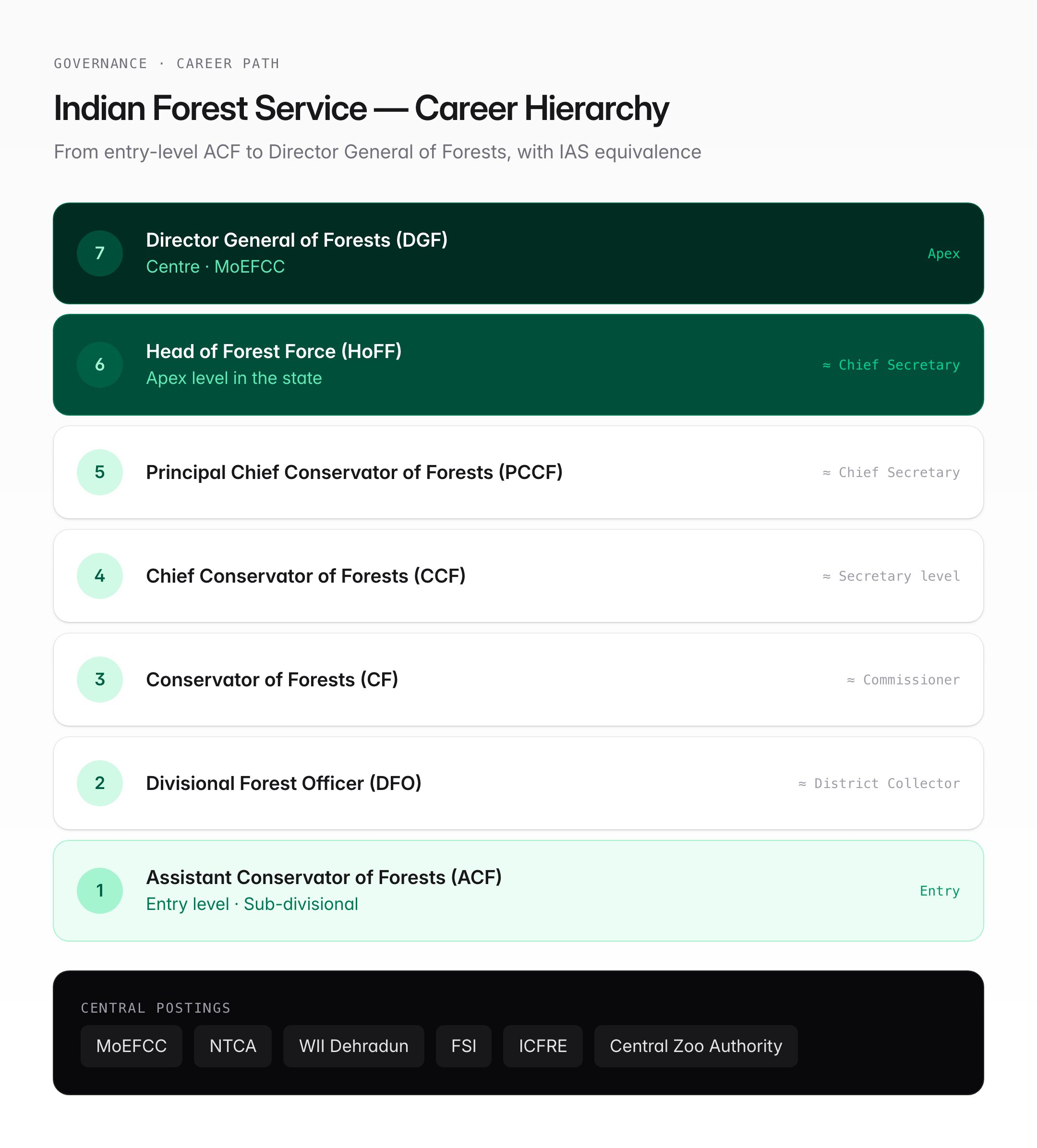
Career Hierarchy
| Designation | Equivalent IAS Rank |
|---|---|
| Assistant Conservator of Forests (ACF) | Entry level (Sub-Divisional level) |
| Divisional Forest Officer (DFO) | District Collector equivalent |
| Conservator of Forests (CF) | Commissioner level |
| Chief Conservator of Forests (CCF) | Secretary level |
| Principal Chief Conservator of Forests (PCCF) | Chief Secretary equivalent |
| Head of Forest Force (HoFF) | Apex level in the state |
| Director General of Forests (DGF) | At the Centre (MoEFCC) |
Central Postings
IFoS officers also serve in central government roles:
- Ministry of Environment, Forest and Climate Change (MoEFCC)
- National Tiger Conservation Authority (NTCA)
- Wildlife Institute of India (WII), Dehradun
- Forest Survey of India (FSI), Dehradun
- Indian Council of Forestry Research and Education (ICFRE)
- Central Zoo Authority
Cadre Allocation
- Like IAS and IPS, IFoS officers are allocated to state cadres or joint cadres.
- Cadre allocation is based on a roster system that balances officers' preferences with the needs of the states.
- The officer serves primarily in their allocated state but can be deputed to the Centre or other organisations.
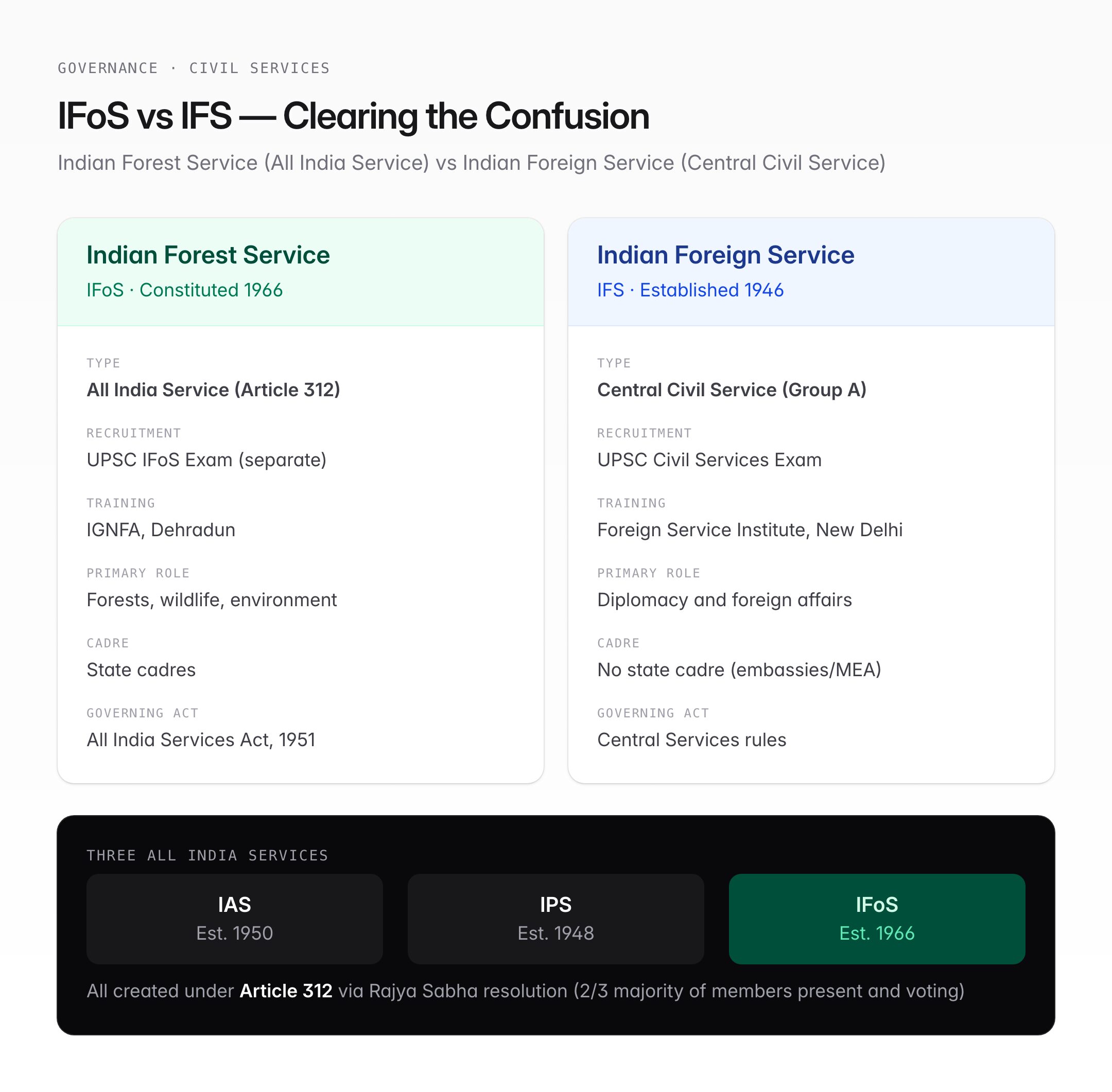
IFoS vs IFS (Indian Foreign Service) — Clearing the Confusion
| Feature | Indian Forest Service (IFoS) | Indian Foreign Service (IFS) |
|---|---|---|
| Full form | Indian Forest Service | Indian Foreign Service |
| Abbreviation | IFoS (to distinguish from IFS) | IFS |
| Type | All India Service (Article 312) | Central Civil Service (Group A) |
| Recruitment | UPSC IFoS Examination (separate) | UPSC Civil Services Examination |
| Training academy | IGNFA, Dehradun | Foreign Service Institute, New Delhi |
| Primary role | Forest/wildlife/environment management | Diplomacy and foreign affairs |
| Cadre | State cadres | No state cadre (posted in embassies/MEA) |
| Governing Act | All India Services Act, 1951 | IFS rules under Central Services |
Key point for UPSC: The IFoS is an All India Service (like IAS and IPS), whereas the IFS (Foreign Service) is a Central Civil Service. This distinction matters because All India Services serve under both the Centre and the States.
UPSC Relevance
GS Paper II — Governance: Civil services; statutory and regulatory bodies; government policies for environment.
GS Paper III — Environment: Conservation; forest policy; biodiversity.
Prelims key facts:
- The IFoS was constituted in 1966 under the All India Services Act, 1951.
- It is one of the three All India Services (IAS, IPS, IFoS) under Article 312.
- IFoS has a separate UPSC examination — candidates share only the Prelims with Civil Services.
- Training is at the IGNFA (Indira Gandhi National Forest Academy), Dehradun.
- The IFoS is an All India Service; the IFS (Foreign Service) is a Central Civil Service — they are different.
- Article 312 requires a Rajya Sabha resolution (two-thirds majority of members present and voting) to create a new All India Service.
- The Director General of Forests is the senior-most IFoS position at the Centre, under MoEFCC.
- IFoS officers manage national parks, tiger reserves, wildlife sanctuaries, and implement laws like the Wildlife Protection Act 1972 and Forest Conservation Act 1980.
Tell Google you want more of this.
Add Anantam IAS as a preferred sourceOne tap, and this site shows up more often in your own Top Stories, AI Overviews and AI Mode. Remove it any time.