PM Vishwakarma Yojana: Scheme Benefits, Eligibility and Trades Covered
PM Vishwakarma Yojana supports 18 traditional artisans with training, toolkits, credit and marketing. Explore benefits, eligibility and UPSC insights.
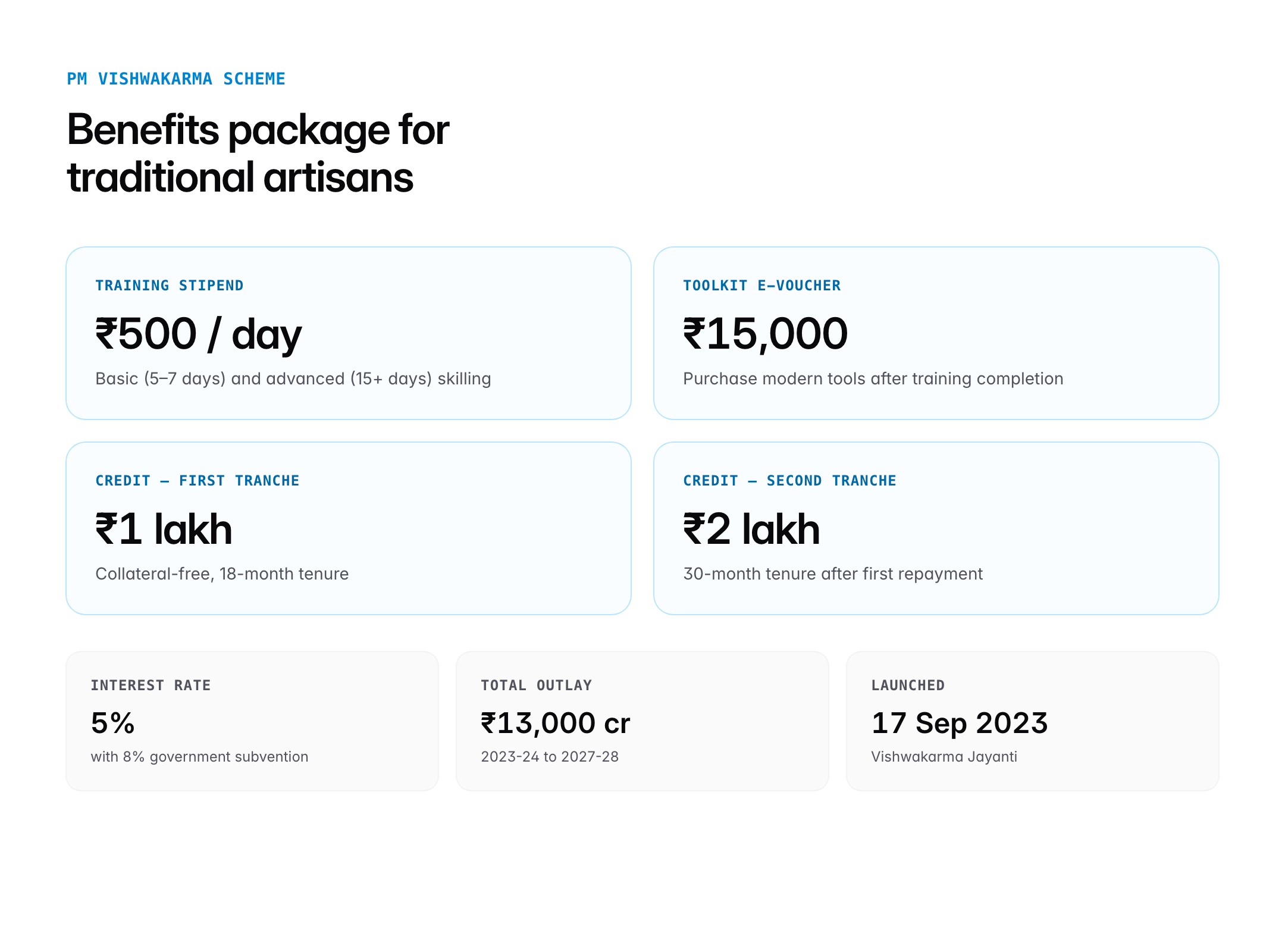
The Vishwakarma Yojana, officially the PM Vishwakarma Scheme, is a central sector scheme launched to support traditional artisans and craftspeople working with their hands and simple tools. Announced by Prime Minister Narendra Modi in his Independence Day speech on 15 August 2023 and formally launched on 17 September 2023 (Vishwakarma Jayanti), the scheme recognises 18 traditional trades, covering workers such as carpenters, blacksmiths, goldsmiths, potters, cobblers, tailors, boat-makers and masons. With a total outlay of around Rs. 13,000 crore for the period 2023-24 to 2027-28, it is one of the largest convergence schemes aimed at India's vast artisan economy.
Origin and Rationale
India's artisan and craft sector employs crores of workers, often working in family-based units using traditional skills transmitted across generations. However, they face structural disadvantages: lack of formal credit, outdated tools, weak branding, limited digital access, and shrinking demand due to industrialisation. The PM Vishwakarma Yojana seeks to integrate these workers into modern value chains without eroding their traditional identity.
The scheme is implemented by the Ministry of Micro, Small and Medium Enterprises (MoMSME) along with the Ministry of Skill Development & Entrepreneurship (MSDE) and the Department of Financial Services (DFS).
Coverage: 18 Traditional Trades
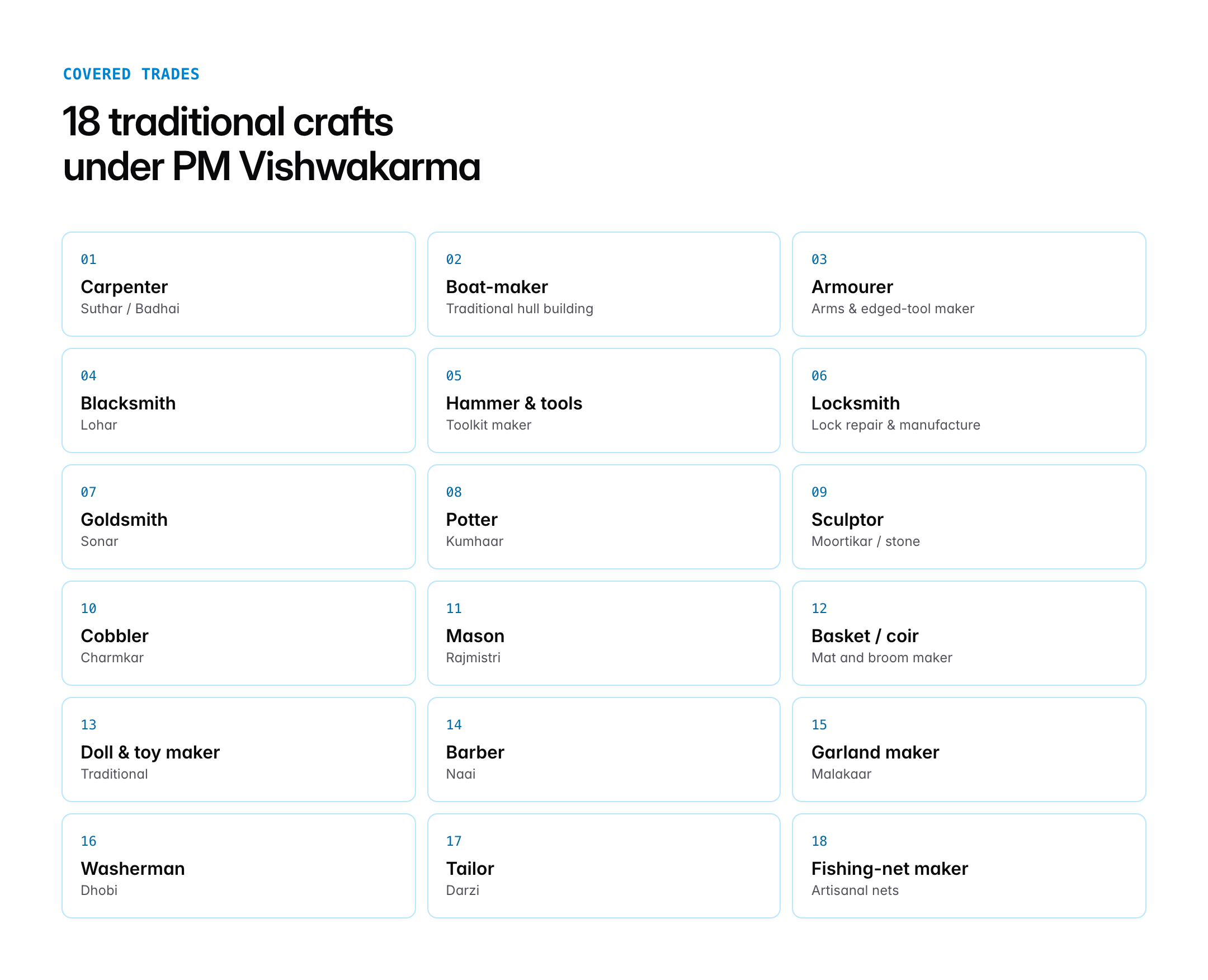
The scheme identifies 18 family-based trades for coverage. These include:
- Carpenter (Suthar/Badhai)
- Boat-maker
- Armourer
- Blacksmith (Lohar)
- Hammer and toolkit maker
- Locksmith
- Goldsmith (Sonar)
- Potter (Kumhaar)
- Sculptor (Moortikar, stone carver), stone breaker
- Cobbler / Footwear artisan (Charmkar)
- Mason (Rajmistri)
- Basket / mat / broom maker / coir weaver
- Doll and toy maker (traditional)
- Barber (Naai)
- Garland maker (Malakaar)
- Washerman (Dhobi)
- Tailor (Darzi)
- Fishing net maker
Key Benefits
The scheme provides an end-to-end package rather than a one-time transfer. Benefits flow in a sequenced way.
| Benefit | Detail |
|---|---|
| Recognition | PM Vishwakarma Certificate and ID card |
| Skill training | Basic (5-7 days) and Advanced (15+ days) |
| Stipend | Rs. 500 per day during training |
| Toolkit incentive | Rs. 15,000 e-voucher for modern tools |
| Credit (first tranche) | Up to Rs. 1 lakh, collateral-free, 18 months tenure |
| Credit (second tranche) | Up to Rs. 2 lakh, 30 months tenure |
| Interest rate | Concessional 5 per cent (with 8 per cent government subvention) |
| Digital transactions | Incentive of Re 1 per digital transaction (capped) |
| Marketing support | Branding, e-commerce onboarding, GeM, exports |
Eligibility Criteria
The scheme is tightly targeted at self-employed artisans operating in the unorganised sector.
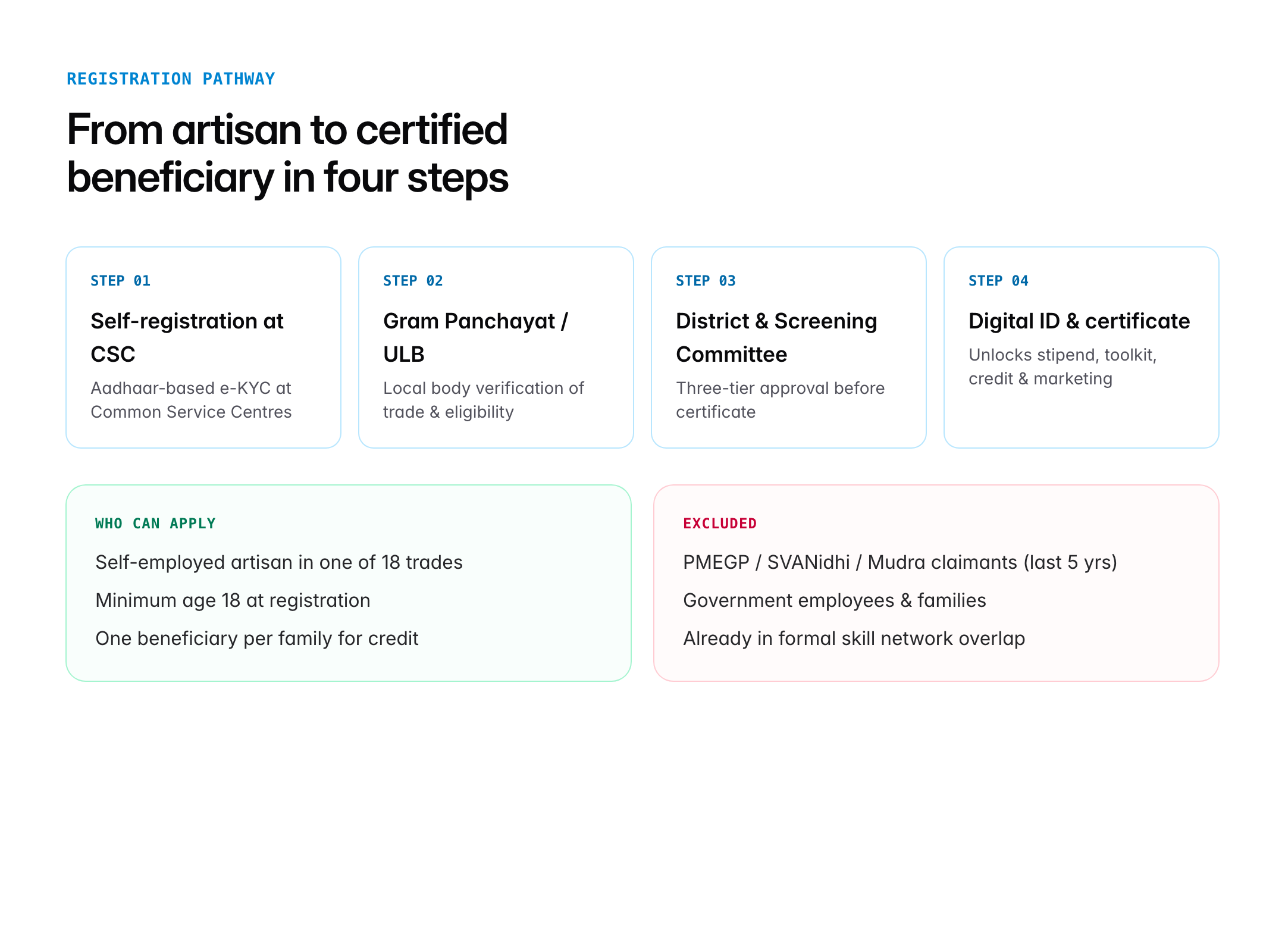
Who can apply:
- An artisan or craftsperson working in any of the 18 listed trades
- Minimum age 18 years at the time of registration
- Engaged in the trade on a self-employment basis, on the date of registration
- Family-based (only one member per family can avail credit support)
Who is excluded:
- Beneficiaries of similar credit-based central or state schemes such as PMEGP, PM SVANidhi, or Mudra in the past five years (with some exceptions)
- Government employees and their family members
- Persons covered through the formal skilling network under other central schemes (with overlap constraints)
Registration pathway
- Self-registration at Common Service Centres (CSCs) using Aadhaar-based e-KYC
- Three-tier verification: Gram Panchayat / ULB → District Implementation Committee → Screening Committee
- Digital ID card and certificate issued on approval
Implementation Architecture
PM Vishwakarma runs on a whole-of-government platform.
- MoMSME: Nodal ministry
- MSDE: Skill training delivery through accredited institutes and master trainers
- DFS / Public Sector Banks, RRBs, Cooperative Banks, SFBs, NBFCs: Credit delivery
- MeitY / CSCs: Last-mile registration
- State governments: District committees and verification
- National Committee for Marketing oversees marketing support and exports.
Significance and Impact
Livelihood security: Provides artisans with formal identity, credit access and market linkages, reducing their dependence on informal moneylenders.
Skill upgrading: Bridges the gap between inherited craft knowledge and modern tools, safety practices and design.
Inclusive growth: Traditional trades are disproportionately practised by OBCs, SCs, STs and women, making the scheme an instrument of social inclusion.
Cultural preservation: Many of the 18 trades are custodians of intangible cultural heritage.
Supporting Atmanirbhar Bharat: Encourages local production, niche exports (e.g., handmade crafts, Geographic Indication products), and reduces import dependence in small-value manufacturing.
Convergence with Other Schemes
- PMEGP: Margin money support for larger enterprises graduating from Vishwakarma.
- ONDC and GeM: Digital marketplaces for artisans.
- Mudra Yojana: Larger credit after artisans mature into MSMEs.
- Skill India Mission: Complementary certification under NSQF.
- One District One Product (ODOP): Market branding of craft clusters.
Challenges in Implementation
- Awareness gaps in remote and tribal areas
- Verification bottlenecks at Gram Panchayat and ULB level
- Weak digital literacy among older artisans
- Limited female participation in some trades
- Credit disbursement pace and risk-aversion of banks
- Overlap with state-level artisan schemes
UPSC Relevance
Prelims focus
- Launch date (17 September 2023), nodal ministry (MoMSME)
- Number of trades (18), stipend (Rs. 500/day), toolkit voucher (Rs. 15,000)
- Credit tranches and subsidised interest rate
- Difference between PM Vishwakarma and Mudra/PMEGP/SVANidhi
Mains GS-II angle
- Welfare schemes for vulnerable sections
- Issues relating to development and management of the social sector
Mains GS-III angle
- Inclusive growth and employment
- Promotion of MSMEs, traditional crafts and GI products
Sample PYQ-style question
"The PM Vishwakarma Scheme attempts to formalise the traditional artisan economy of India. Examine its design features and discuss the challenges in achieving its objectives." (GS-II/III, 15 marks)