Western Hoolock Gibbons in India: Ape of the Northeast and the Hoollongapar Story
The Western Hoolock Gibbon is the only ape that lives in India, swinging through the canopy of the Northeast. Here is its ecology, why a single canopy gap can doom a family, the Hoollongapar railway and oil-drilling battles, and what conservation must do next.
There is exactly one ape in all of India, and most Indians have never seen it. It doesn’t live in the forests of the south or the central tiger reserves. It lives in the far Northeast, high in the wet evergreen canopy, and it announces itself not by sight but by sound — a loud, whooping, two-voiced song that a mated pair throws across the treetops at dawn to say, plainly, this patch is ours. That animal is the Western Hoolock Gibbon, and the surprising thing is not that it sings. It is that we keep cutting the very thing it cannot live without: an unbroken roof of branches.
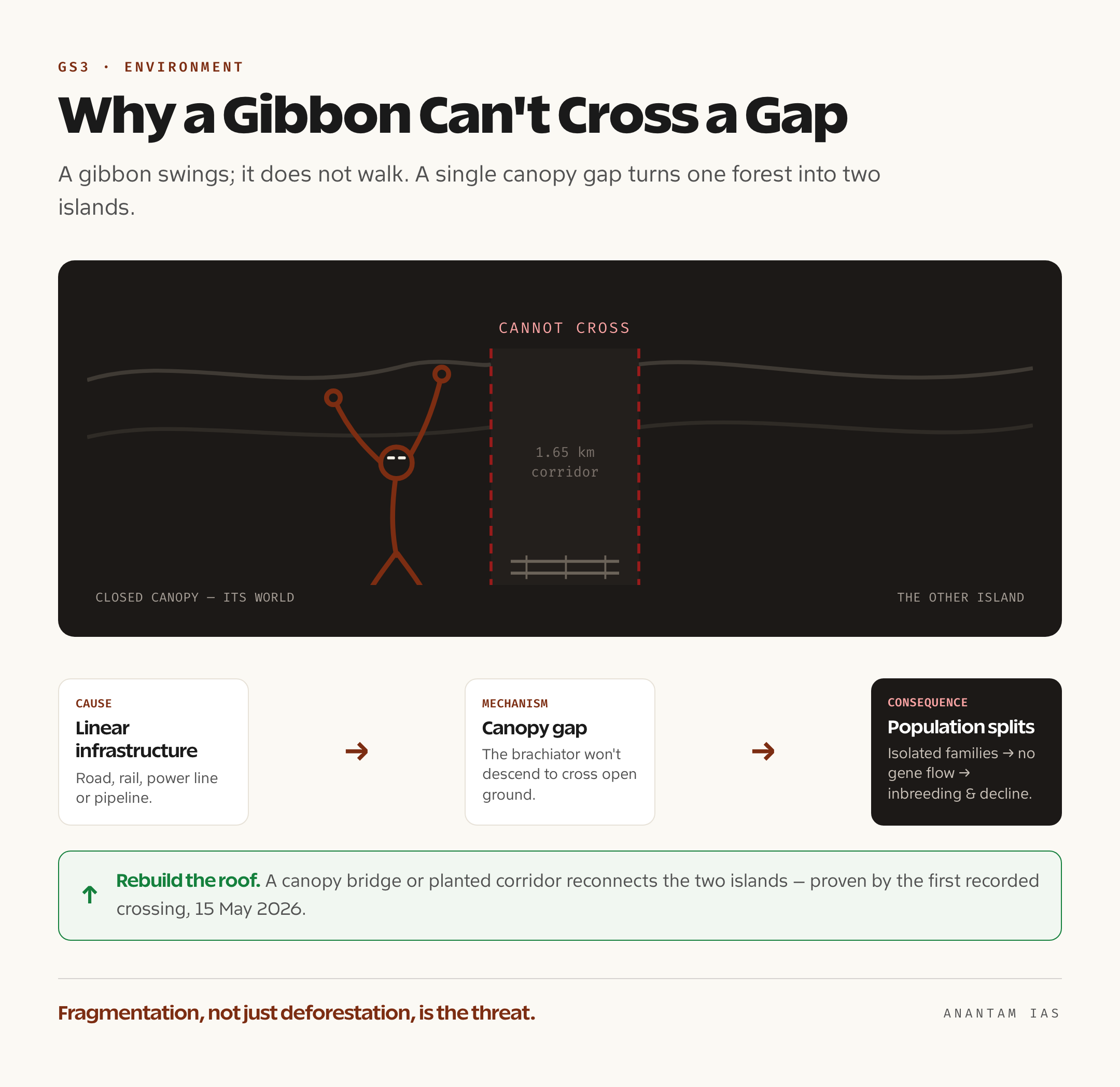
Because here is the trap at the centre of this animal’s story. A gibbon doesn’t walk the forest floor like a gorilla or a chimpanzee. It swings, arm over arm, through the high canopy, and it will not come down to cross a gap. So when a road, a railway line or a power line slices a clearing through its forest, the gibbon on one side and the gibbon on the other are, for all practical purposes, on different islands. They stop meeting. They stop breeding. The forest looks intact from a satellite, and the population quietly collapses anyway. That single fact — that a treetop animal is undone by a line on the ground — is why India’s only ape matters far beyond the Northeast, and why a tiny sanctuary in Assam keeps ending up in the news.
What the Western Hoolock Gibbon Is
Let’s name it precisely before we get attached to it. The Western Hoolock Gibbon (Hoolock hoolock) belongs to the family Hylobatidae — the gibbons, or “lesser apes.” That word “lesser” is misleading; it only means smaller, not lower. Gibbons are true apes, more closely related to us than any monkey, and they share the ape signature: no tail, a broad chest, and the ability to hold the body upright. The great apes (orangutans, gorillas, chimpanzees, bonobos and humans) make up the other ape family, the Hominidae. India has two hoolock species — the Western and the Eastern Hoolock (Hoolock leuconedys) — and the Western occupies almost the entire Indian range, with the Eastern restricted to a sliver of eastern Arunachal Pradesh.
A common exam trap is the ape-versus-monkey question, so settle it once. Apes have no tail, broader chests and a more upright posture; monkeys typically have tails, narrower chests and a four-legged gait. The hoolock is unambiguously an ape. It’s slender and light — an adult weighs only about six to nine kilograms — with arms dramatically longer than its legs. The most striking field mark is the white eyebrows: both sexes carry two bright white brow streaks above the eyes, which is how the animal got its older name, the “white-browed gibbon.” There’s also a clean colour split between the sexes, what biologists call sexual dichromatism. Males are black; females are a coppery buff-brown. Infants are born pale and darken as they grow, and only the males stay black for life.
The other thing to know is how they live, because it shapes everything that follows. Hoolocks are monogamous. A breeding pair holds a territory with their dependent young, usually a family group of around three to four animals, and they defend it with that famous duet — a structured, escalating “song” the pair performs together, often joined by the older offspring, that can carry for a kilometre through the forest. They feed mostly on ripe fruit, especially figs, with leaves, flowers, shoots and the occasional insect, and in eating fruit high in the canopy they scatter seeds across the forest — making them quiet but genuine gardeners of the ecosystem they depend on.
Where It Lives and How It Moves
The Western Hoolock Gibbon’s world is a specific corner of South Asia. In India it’s confined to the Northeast, in the broadleaf evergreen and semi-evergreen forests south of the Brahmaputra River and west of the Dibang River — which means Assam, Arunachal Pradesh (west of the Dibang), Nagaland, Manipur, Mizoram, Tripura and the Garo Hills of Meghalaya. Beyond India it ranges into Bangladesh and into Myanmar as far as the Chindwin River, the natural boundary that separates it from its eastern cousin. It is not found anywhere in peninsular, central or western India. So when you read “India’s only ape,” read also “an animal hemmed into one biogeographic pocket” — which is part of why it’s so fragile.
Now the locomotion, because it explains the whole conservation problem. The hoolock moves by brachiation — swinging hand over hand beneath the branches, using only the arms, the body hanging below like a pendulum. The anatomy is purpose-built for it: arms far longer than legs, a ball-and-socket wrist that lets the hand rotate freely, and long hook-like fingers that grab a branch without a true grip. A gibbon in full flow can clear three to four metres in a single swing and travel through tall forest faster than a person can run beneath it. It is, by common agreement, the most accomplished brachiator of all the primates.
Three consequences fall straight out of that body plan, and you should hold all three together. First, habitat dependence: brachiation needs a continuous, closed canopy of interlocking branches. A break — even a narrow one — is a wall the gibbon won’t cross, because it won’t descend to the ground where leopards, dogs and traffic wait. Second, the diet and the lightness go together: a six-to-nine-kilogram fruit-eater hanging in the treetops is nothing like a heavy, ground-walking gorilla, and any statement to the contrary is simply wrong. Third, slow reproduction: a female produces a single infant roughly every two to three years, so a population that loses adults or stops mixing cannot bounce back quickly. Put those together and you get an animal exquisitely adapted to one thing — an unbroken forest roof — and almost defenceless the moment that roof is cut.
Why It Is in Trouble
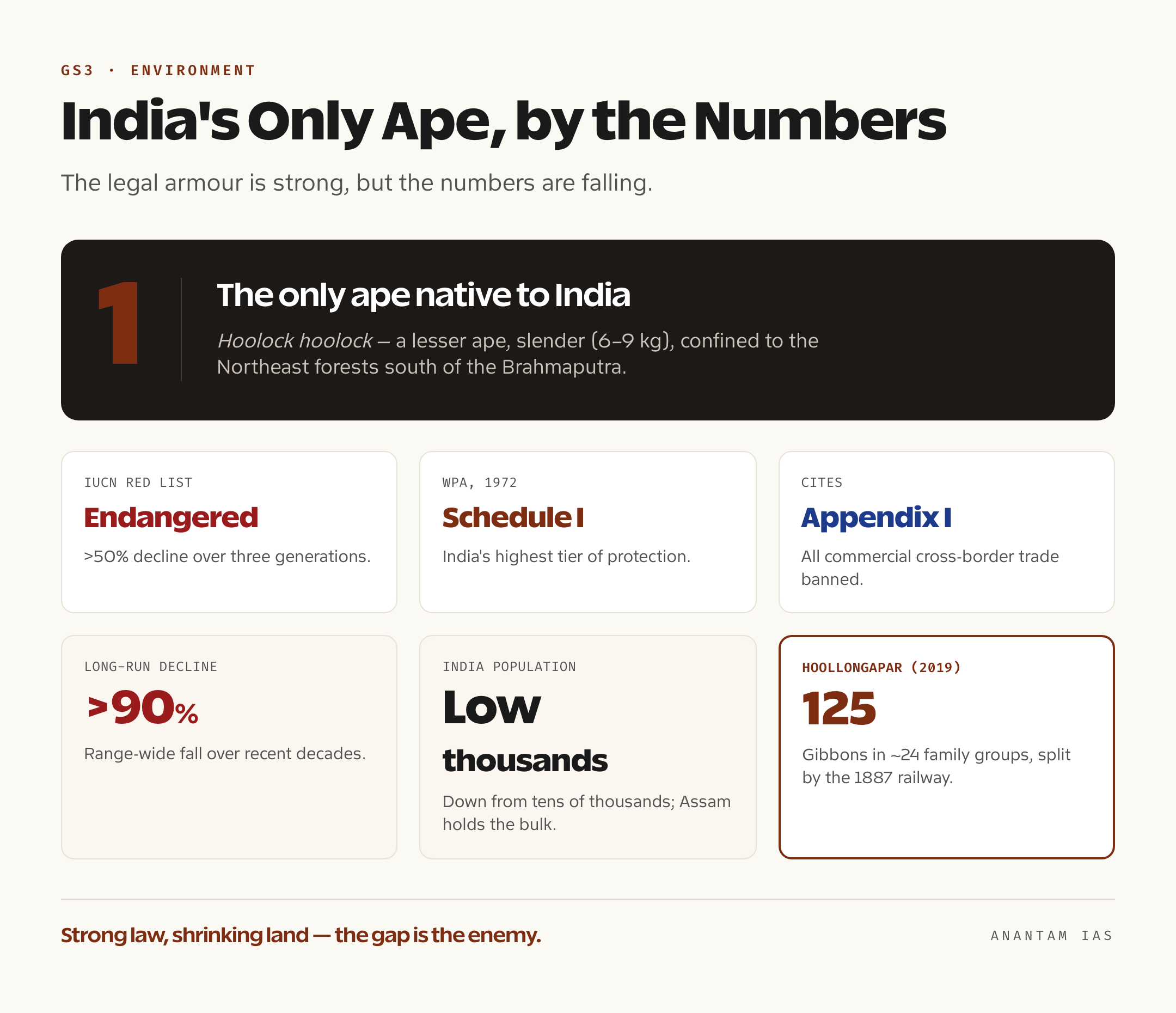
Start with the legal picture, because on paper this animal is well protected. The Western Hoolock Gibbon is listed as Endangered on the IUCN Red List, with the IUCN noting a population decline of more than 50 per cent across three generations driven by habitat loss. It sits on Schedule I of India’s Wild Life (Protection) Act, 1972 — the strongest tier of protection the country offers, which bans hunting outright and carries the heaviest penalties. And it’s on Appendix I of CITES, the international convention, meaning all commercial cross-border trade is prohibited. The Eastern Hoolock, with its smaller range, is listed as Vulnerable. On legal armour, India has done the right things.
And yet the numbers keep sliding, which tells you the problem isn’t the law — it’s the land. Hard counts are difficult for a canopy animal, and estimates vary, but the long-run trajectory is brutal. Researchers reckon hoolock gibbon numbers across their whole range fell from well over 100,000 a few decades ago — Assam alone may have held something like 80,000 in the early 1970s — to a small fraction of that today, a decline many scientists put at more than 90 per cent. India’s surviving population is now counted in the low thousands rather than the tens of thousands, and Assam still holds the bulk of it. Whatever the exact figure, every credible source agrees on the direction: down.
The driver, overwhelmingly, is habitat loss and fragmentation, and here the gibbon’s biology turns ordinary development into an extinction risk. Roads, railway tracks, oil and gas pipelines, transmission lines and the steady spread of tea gardens and settlements all do the same thing — they punch gaps in the canopy. For most animals a gap is an inconvenience. For a gibbon that refuses to cross open ground, a gap is a sealed border. Populations get carved into ever-smaller fragments, each too small to stay genetically healthy, and inbreeding sets in. Layer on the older pressures — shifting (jhum) cultivation where the cycle has shortened so the canopy never recovers, hunting for meat and the cruel infant pet trade in which the mother is shot to take the baby, electrocution on power lines strung across clearings, and climate stress that disrupts the fruiting of the figs they live on — and you have a species being squeezed from several directions at once, all of which begin with a broken canopy.
The Hoollongapar Flashpoint
Nowhere shows this more sharply than the Hoollongapar Gibbon Wildlife Sanctuary in Assam’s Jorhat district — the only protected area in India named after a primate, renamed in 2004 for the towering hollong tree (Dipterocarpus macrocarpus), Assam’s state tree, that dominates its canopy. It’s small, only about 21 square kilometres of semi-evergreen forest, but it’s the most studied gibbon habitat in the country and one of the most primate-rich sites in mainland India, holding seven primate species in all — the hoolock plus the Bengal slow loris, stump-tailed macaque, northern pig-tailed macaque, eastern Assamese macaque, rhesus macaque and capped langur. A 2019 Wildlife Institute of India census put the sanctuary’s gibbons at about 125 individuals living in roughly two dozen family groups.
The problem that has defined Hoollongapar for over a century runs right through its core: a railway line laid in 1887. A 1.65-kilometre stretch of the Mariani-Dibrugarh broad-gauge route cuts the sanctuary into two halves, and because the gibbons won’t cross the open track, the families on either side have been reproductively isolated for generations — a textbook case of how a single line on the ground can fracture an arboreal population. The pressure rose again when the National Board for Wildlife cleared the line’s electrification in October 2024 and a doubling of the track was proposed; conservationists argued the line should have been rerouted out of the sanctuary altogether rather than upgraded through it. And on a separate front, in December 2024 the NBWL’s Standing Committee approved exploratory oil-and-gas drilling by Cairn Oil & Gas on a 4.5-hectare site about 13 kilometres away inside the sanctuary’s eco-sensitive zone, raising fears over noise, groundwater and elephant corridors even with conditions that bar extraction within the zone itself. Hoollongapar has become the place where India argues out, in miniature, the development-versus-canopy trade-off.
But Hoollongapar is also where a remedy was tested — and, remarkably, worked. Because gibbons won’t descend to cross the track, the obvious fix is to give them a bridge in the air. Between February and March 2025, researchers from the Wildlife Institute of India, working with the Assam Forest Department and the Northeast Frontier Railway, strung artificial canopy rope bridges with safety nets across the rail corridor, designed for natural creepers to grow over them in time. For more than a year nothing used them. Then, on 15 May 2026, a male Western Hoolock Gibbon was filmed brachiating across one of these bridges — a clip shared by the Union Environment Minister and described as possibly the first documented case anywhere in the world of a gibbon crossing a canopy bridge built over a railway line. One crossing doesn’t reconnect a population. But it proves the principle: if you rebuild the roof, the ape will use it.
How to Save India’s Only Ape
The way forward writes itself once you accept the core diagnosis: the gibbon’s enemy is the gap, so conservation is the work of keeping the canopy whole and rejoining it where it’s broken. That means the small-scale, almost low-tech interventions that Hoollongapar has just validated — canopy bridges over every linear barrier, planted corridors of fast-growing native trees to knit fragmented forest patches back together, and insulating or rerouting the power lines that electrocute animals at clearings. Where new infrastructure is unavoidable, the lesson of the 2024 railway and drilling clearances is that the cheapest time to protect a gibbon is at the design stage: route the line around the forest, not through it, and treat canopy continuity as a hard constraint rather than an afterthought.
The bigger structure is also falling into place, and it’s worth knowing for an answer. The Centre’s broader Project Primate push has expanded central support for hoolock and other primate conservation, while long-standing field players — the Wildlife Institute of India on science and population surveys, and the Assam-based NGO Aaranyak on rescue, rehabilitation and community work — supply the on-ground capacity. CAMPA funds (the Compensatory Afforestation Fund) can pay for corridor restoration, and the IUCN Primate Specialist Group provides technical guidance. The honest verdict, though, is that none of this works without the people of the Northeast: gibbons live in landscapes shared with jhum cultivators, tea estates and growing towns, and conservation that ignores those livelihoods won’t hold. The realistic goal isn’t a fortress sanctuary but a connected, lived-in landscape where a gibbon can swing from one forest fragment to the next without ever touching the ground — and where the communities alongside it have a reason to keep the canopy closed.
For Your Mains Answer
This topic is a clean fit for GS Paper 3 — conservation, biodiversity and the development-versus-environment trade-off — and it works beautifully as a concrete example in any answer on habitat fragmentation, environmental clearances, or the cost of linear infrastructure (roads, rail, power, pipelines) to wildlife. Its strength as an example is the tight causal chain: a treetop animal, a refusal to cross gaps, a single railway line, a fragmented population. Examiners reward a candidate who can show that mechanism rather than list disconnected facts about an endangered species.
How to Build the Answer
Open with the hook that does the work — India’s only ape, an animal that swings and won’t come down — and then immediately convert it into the central idea: a canopy specialist is destroyed by canopy gaps, so fragmentation, not just deforestation, is the real threat. Move outward in widening circles: what the gibbon is and how brachiation works, the threats that all reduce to broken canopy, Hoollongapar as the live case study (railway, electrification, oil drilling, and the canopy-bridge crossing of May 2026), and finally the way forward built around reconnection. That object-to-system arc fits almost any single-species conservation question.
Common Mistakes to Avoid
Don’t call the gibbon a monkey or describe it as heavy and ground-dwelling — it’s a lesser ape, slender, and arboreal. Don’t quote a single hard population number as gospel; note the wide range and the clear downward trend instead. Don’t treat the railway or the oil project as cartoon villains — frame them as genuine development-versus-ecology trade-offs, which reads as balance. And don’t stop at “ban infrastructure”; the sophisticated point is mitigation and design (canopy bridges, rerouting, corridors), which the 2026 crossing shows can actually work.
A Compact Answer Spine
India’s only ape (Western Hoolock Gibbon, Hoolock hoolock, lesser ape) → moves by brachiation, so it needs a continuous closed canopy and won’t cross gaps → range confined to Northeast India south of the Brahmaputra → IUCN Endangered, WPA Schedule I, CITES Appendix I, population falling (>90% long-run decline) → core threat is fragmentation from roads, rail, power lines, tea and pipelines, plus hunting and the pet trade → Hoollongapar case study (1887 railway, 2024 electrification and oil-drilling clearances, May 2026 canopy-bridge crossing) → way forward: canopy bridges, corridors, rerouting at the design stage, Project Primate, community-led landscape conservation.
Diagram or Flowchart Idea
Draw a simple cause-and-effect chain: “Linear infrastructure (road / rail / power line) → canopy gap → brachiating gibbon won’t cross → population split into islands → no gene flow → inbreeding and local decline.” Then add one upward arrow off the “canopy gap” box labelled “canopy bridge / corridor → reconnection.” A clean causal diagram like this proves you understand the mechanism, not just the headline, and earns marks fast.
A Balanced-Conclusion Line
End on the trade-off, not a slogan: the challenge in the Northeast isn’t to choose railways and energy over the gibbon, or the gibbon over development — it’s to design infrastructure that keeps the canopy connected, so that India’s only ape and the people who share its forests can both keep moving.
How to Use Data Without Cramming
Pick three anchors and stop: the gibbon’s range-wide decline of more than 90 per cent over recent decades; Hoollongapar’s roughly 125 gibbons split by an 1887 railway line; and the first recorded canopy-bridge crossing on 15 May 2026. Three precise, well-placed facts beat a paragraph of memorised statistics, and the 2026 date signals that your preparation is current.
FAQ
Why is the Western Hoolock Gibbon called India’s only ape? Because it’s the single ape species native to India. Apes are tailless primates more closely related to humans than monkeys are, split into great apes (orangutans, gorillas, chimpanzees, bonobos, humans) and lesser apes (gibbons). India’s only wild apes are the two hoolock gibbons, and the Western Hoolock occupies almost the entire Indian range, in the forests of the Northeast.
What is brachiation, and why does it make the gibbon so vulnerable? Brachiation is movement through the forest by swinging from branch to branch using only the arms, with the body hanging below. It needs a continuous, closed canopy, and a gibbon won’t descend to cross open ground. So any gap — a road, a railway line, a power-line clearing — becomes a barrier it won’t cross, splitting one population into isolated fragments. That’s why habitat fragmentation, not just outright deforestation, is the gibbon’s greatest threat.
Why does Hoollongapar Gibbon Sanctuary keep making news? This Assam sanctuary, the only protected area in India named after a primate, has a railway line running through its core since 1887 that splits its roughly 125 gibbons in two. Recent flashpoints include the 2024 clearance to electrify and double the railway, a 2024 approval for exploratory oil-and-gas drilling in its eco-sensitive zone, and — on the positive side — the first recorded gibbon crossing of an artificial canopy bridge over the railway in May 2026.
What conservation status does the Western Hoolock Gibbon hold? It is Endangered on the IUCN Red List, listed under Schedule I of India’s Wild Life (Protection) Act, 1972 (the highest level of protection), and on Appendix I of CITES, which bans international commercial trade. Its sister species, the Eastern Hoolock Gibbon, is listed as Vulnerable.
Practice Questions
Prelims MCQs
- With reference to the Western Hoolock Gibbon, which one of the following statements is correct?
(a) It is a species of Old World monkey found across peninsular India
(b) It is the only ape native to India, found in the forests of the Northeast
(c) It is a great ape closely related to the orangutan and found in the Western Ghats
(d) It is a nocturnal loris restricted to the Andaman Islands
Answer: (b) The Western Hoolock Gibbon (Hoolock hoolock) is a lesser ape and the only ape native to India, confined to Northeast forests south of the Brahmaputra. - Consider the following about the Western Hoolock Gibbon:
1. It is listed as Endangered on the IUCN Red List.
2. It is protected under Schedule I of the Wild Life (Protection) Act, 1972.
3. It is placed on Appendix I of CITES.
Which of the statements are correct?
(a) 1 and 2 only
(b) 2 and 3 only
(c) 1 and 3 only
(d) 1, 2 and 3
Answer: (d) The species is IUCN Endangered, on Schedule I of the WPA (the highest protection), and on CITES Appendix I, which bars international commercial trade. - The term “brachiation,” associated with the hoolock gibbon, refers to:
(a) producing loud territorial songs at dawn
(b) swinging through the forest canopy using only the arms
(c) building nests on the forest floor
(d) migrating seasonally between forests
Answer: (b) Brachiation is arm-over-arm locomotion through the canopy; it requires a continuous closed canopy, which is why gibbons cannot cross open gaps. - The Hoollongapar Gibbon Wildlife Sanctuary is located in which state, and what is notable about it?
(a) Manipur; it is a floating sanctuary on a lake
(b) Assam; it is the only protected area in India named after a primate
(c) Meghalaya; it is India’s largest tiger reserve
(d) Arunachal Pradesh; it is a marine sanctuary
Answer: (b) Hoollongapar, in Assam’s Jorhat district, is the only protected area in India named after a primate and is bisected by a railway line. - Which one of the following is the primary reason habitat fragmentation is so damaging to the Western Hoolock Gibbon?
(a) The gibbon migrates long distances each year and needs open corridors
(b) The gibbon refuses to descend to the ground, so canopy gaps isolate populations
(c) The gibbon requires saltwater wetlands that fragmentation drains
(d) The gibbon nests only in caves that infrastructure destroys
Answer: (b) As a canopy brachiator that won’t cross open ground, the gibbon is split into reproductively isolated islands whenever a gap breaks the canopy.
Mains Practice Questions
- “India’s only ape is undone not by deforestation alone but by fragmentation.” Examine how the biology of the Western Hoolock Gibbon turns ordinary linear infrastructure into an extinction risk, and suggest mitigation measures. (15 marks, 250 words)
- The Hoollongapar Gibbon Wildlife Sanctuary has become a microcosm of India’s development-versus-conservation debate. Critically analyse with reference to the railway line, recent infrastructure clearances and canopy-bridge interventions. (15 marks, 250 words)
- Discuss the ecological role of the Western Hoolock Gibbon and the legal framework that protects it in India. (10 marks, 150 words)
- “Strong legal protection has not halted the decline of the Western Hoolock Gibbon.” Evaluate this statement and explain why landscape-level, community-inclusive conservation is necessary. (15 marks, 250 words)
- Linear infrastructure projects in biodiversity-rich regions impose hidden ecological costs that environmental clearances often underestimate. Examine this using the Hoollongapar Gibbon Sanctuary as a case study. (10 marks, 150 words)