Introduction
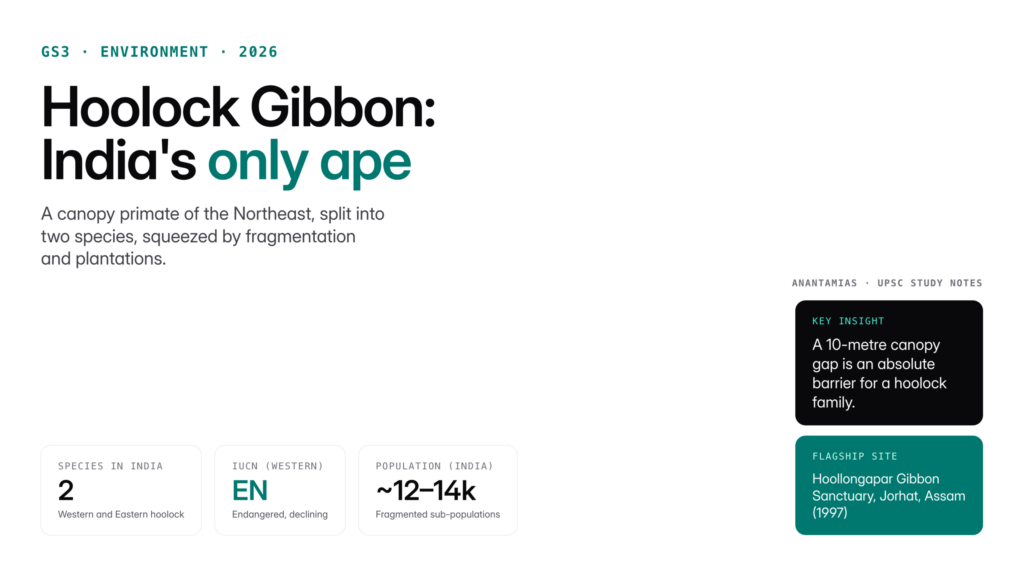
Deep in the rainforest canopies of Assam, Arunachal Pradesh, Nagaland and Meghalaya, an unmistakable duet echoes at dawn. A male and female sing in synchrony, carrying for more than a kilometre through the mist. This is the call of the hoolock gibbon, India’s only ape and one of the most charismatic primates of South and Southeast Asia. For the UPSC aspirant, the hoolock gibbon is more than a species fact. It is a living case study in habitat fragmentation, ecological keystones, cross-border conservation and the tension between infrastructure and biodiversity.
The hoolock gibbon sits at the intersection of multiple UPSC themes. It appears in Environment and Ecology for its IUCN Red List status, in Geography for the Northeast Himalayan biodiversity hotspot, and in Governance for the protected area network that shelters it. Questions have been asked in Prelims on the state bird and state animal context, while Mains essays on biodiversity loss, forest fragmentation, and sustainable development all benefit from a concrete example like this. Understanding the hoolock gibbon is a compact way to understand the ecological stakes of the entire Eastern Himalaya.
Quick Facts at a Glance
| Attribute | Detail |
|---|---|
| Common name | Hoolock gibbon |
| Scientific genus | Hoolock |
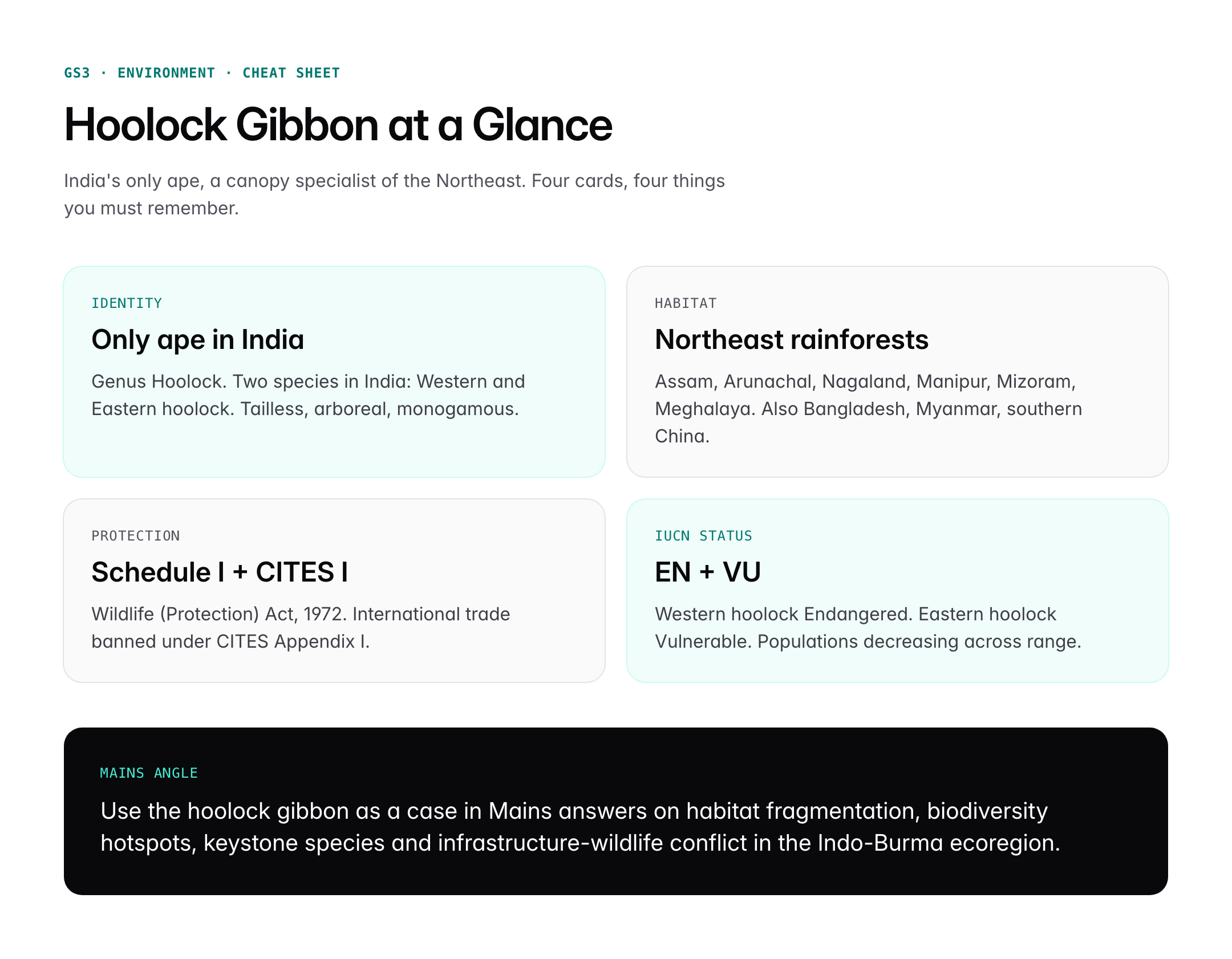
| Species in India | Western hoolock gibbon, Eastern hoolock gibbon |
| Distribution | Northeast India, Bangladesh, Myanmar, southern China |
| IUCN status (Western) | Endangered |
| IUCN status (Eastern) | Vulnerable |
| Indian legal status | Schedule I, Wildlife (Protection) Act, 1972 |
| Flagship sanctuary | Hoollongapar Gibbon Sanctuary, Assam |
| Diet | Frugivorous, with leaves, flowers, insects |
| Social structure | Monogamous family groups of 2 to 6 |
Background and Historical Context
The hoolock gibbon was long clubbed with the Southeast Asian gibbons under the genus Bunopithecus and then Hylobates. Genetic work in the early 2000s elevated hoolocks to their own genus, Hoolock. For many decades Indian taxonomists recognised only one species, the western hoolock gibbon. In 2005 the eastern hoolock gibbon was formally described as a separate species based on pelage and cranial differences, giving India two of the world’s then 19 gibbon species.
Historically, hoolock populations stretched in a near-continuous band from the Brahmaputra valley eastward into the hills of present-day Myanmar and Yunnan. British forestry records from the nineteenth century describe gibbons as common residents of the tall evergreen forests of Upper Assam. Shifting cultivation, tea plantations and the great Assam earthquakes of 1897 and 1950 steadily fragmented that canopy. By the time systematic primate surveys were attempted in the 1970s and 1980s, populations had already contracted to isolated forest patches separated by agricultural and plantation landscapes.
The Hoollongapar Gibbon Sanctuary in Assam’s Jorhat district, notified in 1997, became the first Indian protected area named after a primate. A railway line that bisects the sanctuary has become a national symbol of habitat fragmentation, and the debate around building a canopy bridge over it has featured prominently in conservation commentary. The eastern hoolock, confined largely to parts of eastern Arunachal Pradesh, remains the least studied of India’s apes.
Key Features
Taxonomic Distinctions
The western hoolock gibbon (Hoolock hoolock) is found west of the Chindwin river in Myanmar, which extends into India across Assam, Nagaland, Manipur, Mizoram, Meghalaya and parts of Arunachal Pradesh. The eastern hoolock gibbon (Hoolock leuconedys) occurs east of the Chindwin and enters India only in small pockets of eastern Arunachal Pradesh. A third species, the Skywalker hoolock gibbon (Hoolock tianxing), was described from China and Myanmar in 2017 and may marginally occur in India, though its Indian presence is still under study.
Physical Appearance
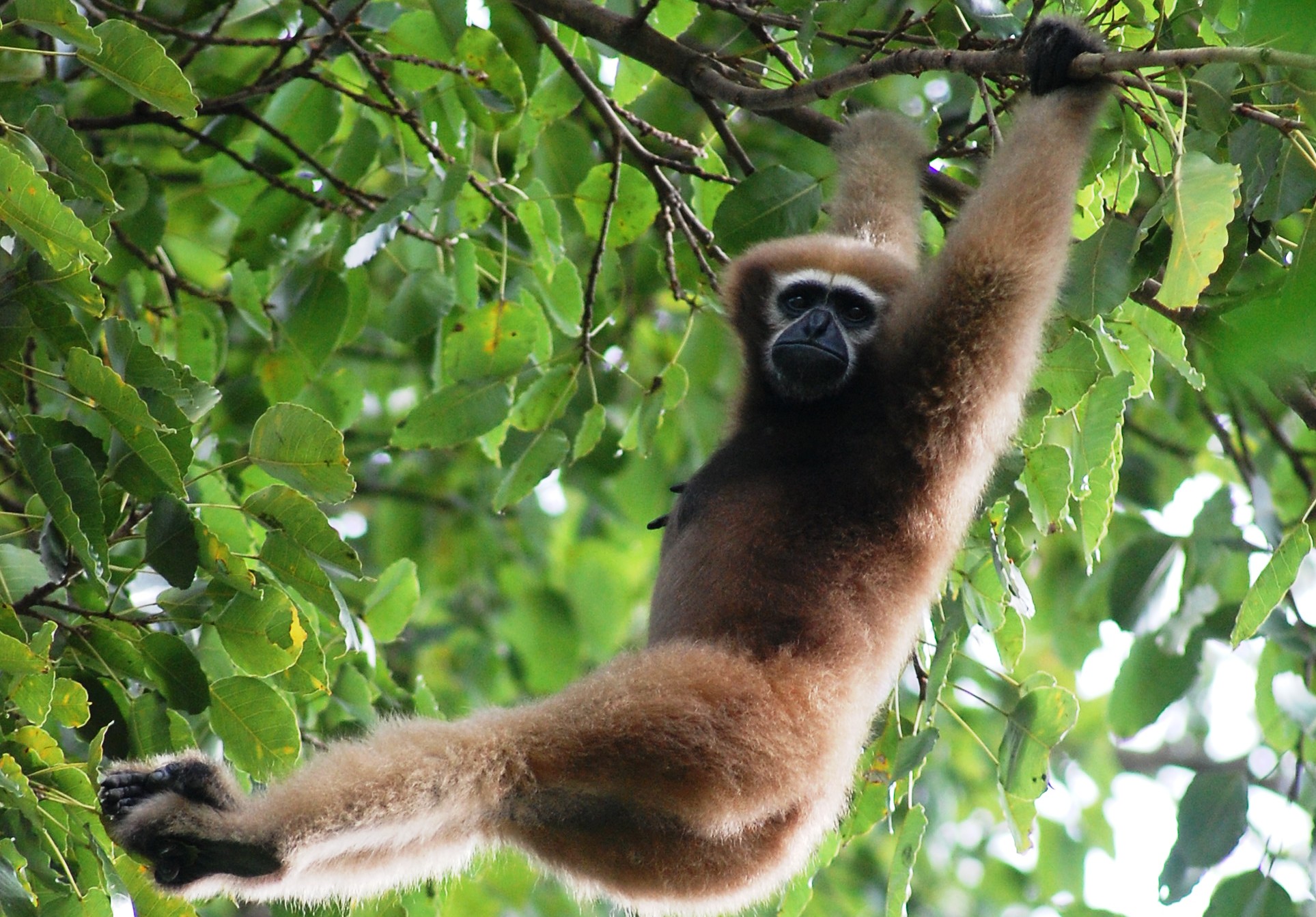
Hoolocks are small apes weighing 6 to 9 kilograms with no tail and very long arms that allow brachiation, a swinging mode of locomotion through the canopy. Males are uniformly black with prominent white brow streaks. Females are a contrasting buff-brown with darker cheek patches. This strong sexual dichromatism is a reliable field mark and is especially useful in survey work. Infants are born pale and darken over the first year before females lighten again at maturity.
Behaviour and Ecology
Hoolocks are strictly diurnal and arboreal. They rarely descend to the ground, which makes canopy continuity vital for survival. Groups are small and monogamous, usually an adult pair with one to three offspring of different ages. Each family defends a home range of 15 to 30 hectares through loud morning duets. Diet is dominated by ripe fruit, especially figs, supplemented by young leaves, flowers, and occasional insects. By dispersing seeds across hundreds of metres every day, gibbons function as keystone seed dispersers for canopy tree species.
Distribution in India
Within India the stronghold is Assam, which hosts the largest contiguous populations. Significant groups survive in the Mehao Wildlife Sanctuary and Namdapha National Park in Arunachal Pradesh, in Dampa Tiger Reserve in Mizoram, and in community forests of Nagaland and Meghalaya. Rough estimates place the total Indian hoolock population at around 12,000 to 14,000 individuals, though fragmentation means the largest single sub-population rarely exceeds a few hundred animals.
Significance for UPSC and General Knowledge
- Only ape found in India and South Asia, making it a standard Prelims identification item
- Flagship of the Indo-Burma biodiversity hotspot and the Eastern Himalaya Endemic Bird Area
- Keystone seed disperser for tropical evergreen forest regeneration in the Northeast
- Anchor species for habitat corridor planning and canopy bridge engineering
- Test case for reconciling linear infrastructure projects with forest connectivity
- Living link in discussions on Wildlife (Protection) Act Schedule I, IUCN Red List, and CITES Appendix I
Detailed Analysis — Conservation Status and Threats
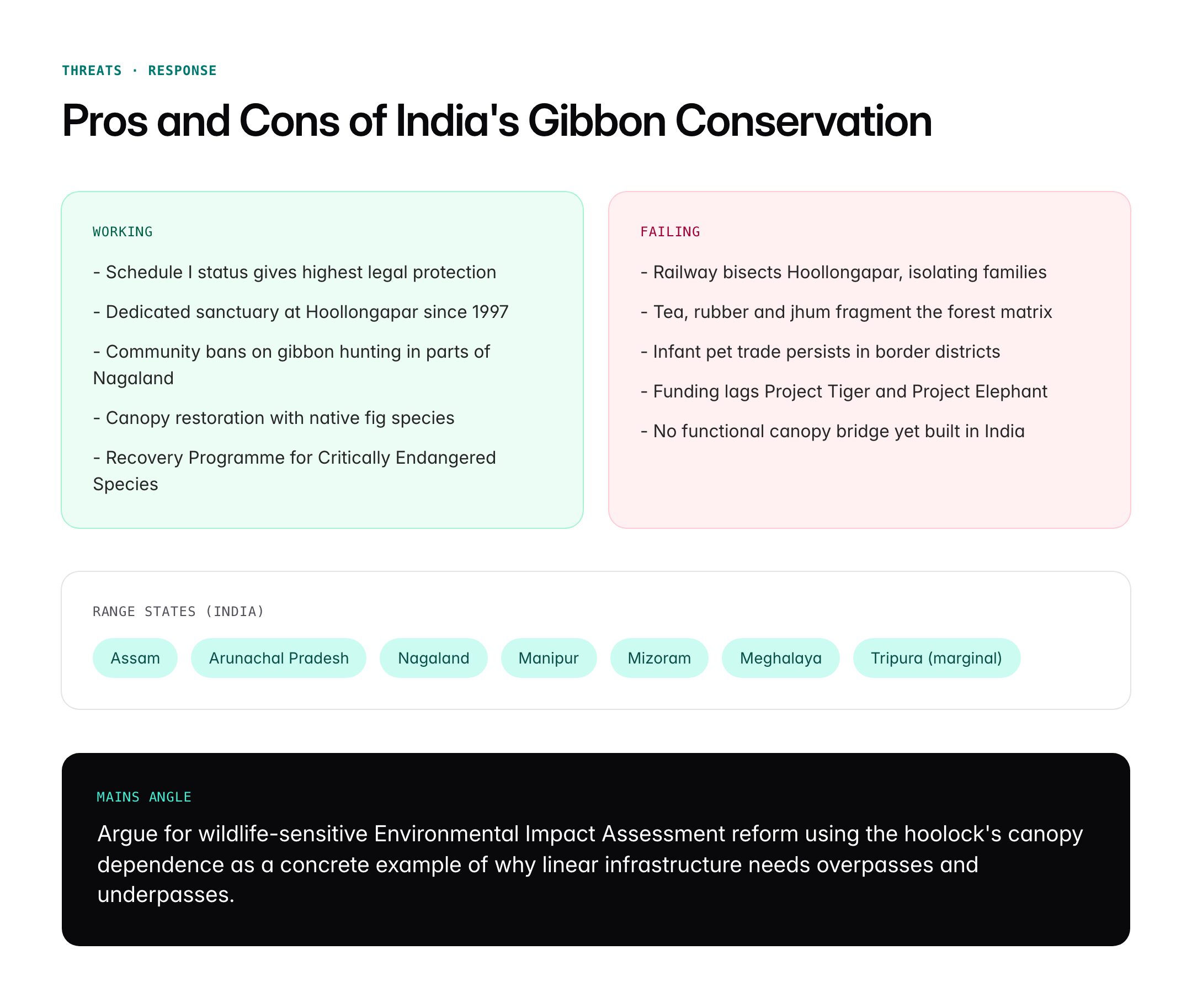
The western hoolock gibbon is listed as Endangered on the IUCN Red List, with population trends classified as decreasing. The eastern hoolock gibbon is listed as Vulnerable, though Indian populations are so small and fragmented that their outlook is arguably worse. Both species are on Schedule I of the Wildlife (Protection) Act, 1972, which gives them the highest domestic legal protection, and on Appendix I of CITES, which prohibits international commercial trade.
Habitat loss is the headline threat. The tropical evergreen and semi-evergreen forests of the Northeast have been converted to tea gardens, rubber plantations, jhum cultivation plots and infrastructure corridors. Hoolocks do not cross open ground, so a 10 metre gap in the canopy can be an absolute barrier. The Hoollongapar Gibbon Sanctuary is bisected by both a railway line and a disused oil pipeline corridor, isolating families on either side. A proposed canopy bridge and an underpass extension have been discussed for years as technical solutions.
Hunting pressure has historically been significant in parts of Nagaland, Mizoram and Arunachal Pradesh. The Indian Wildlife Institute, working with community elders, has reported meaningful declines in gibbon hunting where traditional leaders adopt bans. The illegal pet trade, especially of infants after mothers are killed, continues in border districts. Climate change adds a slower but compounding stress by altering fruiting phenology and favouring drier forest types that hoolocks avoid.
Conservation responses include the Hoollongapar Gibbon Conservation Reserve proposal, community conservancy models in Nagaland’s Khonoma Nature Conservation and Tragopan Sanctuary, and a national Recovery Programme for Critically Endangered Species managed by the Ministry of Environment, Forest and Climate Change. The Wildlife Trust of India and local NGOs run canopy restoration projects that plant native fig species to rebuild degraded corridors.
Comparative Perspective
Placing the hoolock gibbon next to other Asian apes helps an aspirant remember the taxonomic landscape and the relative conservation crisis.
| Species | Genus | Range | IUCN status | Approximate population |
|---|---|---|---|---|
| Western hoolock gibbon | Hoolock | NE India, Bangladesh, Myanmar | Endangered | Under 5,000 mature |
| Eastern hoolock gibbon | Hoolock | E Arunachal, Myanmar, China | Vulnerable | Few thousand |
| Skywalker hoolock gibbon | Hoolock | Myanmar, China | Endangered | Under 150 in China |
| Bornean orangutan | Pongo | Borneo | Critically Endangered | About 100,000 |
| Western lowland gorilla | Gorilla | Central Africa | Critically Endangered | Under 100,000 |
The comparison shows that while hoolocks are more numerous than some great apes, they are the only ape in a country of 1.4 billion people, which creates unusually strong land-use pressure per individual gibbon.
Challenges and Criticisms
Gibbon conservation in India is often criticised as underfunded compared to the tiger or the Asian elephant. Primate conservation receives a fraction of Project Tiger budgets, despite the fact that protecting hoolock habitat automatically protects large blocks of Northeast evergreen forest. Critics of the current approach also point out that sanctuaries alone are insufficient. Because hoolocks live in small family territories, a single well-managed sanctuary of 20 square kilometres can host only a few dozen families, far below the population size needed for long-term genetic viability.
There is also a debate on whether infrastructure mitigation actually works. The proposed canopy bridge at Hoollongapar has been delayed by technical and inter-agency disagreements between the forest department, the railways and the road authorities. Some scientists argue that translocation and population reinforcement may be needed to rescue the most isolated groups before bridges are ready. Others caution that moving territorial, monogamous apes is ethically and biologically risky. The policy question for UPSC Mains is how to balance precautionary protection with urgent intervention for the smallest sub-populations.
Prelims Pointers
- Hoolock gibbon is the only ape found in India
- Genus Hoolock contains three recognised species as of 2017
- Western hoolock gibbon is classified as Endangered on IUCN Red List
- Eastern hoolock gibbon is classified as Vulnerable on IUCN Red List
- Both species are listed in Schedule I of the Wildlife (Protection) Act, 1972
- Both species are on CITES Appendix I
- Hoollongapar Gibbon Sanctuary is located in Jorhat district, Assam
- The sanctuary was notified in 1997 and is India’s first named after a primate
- Hoolocks are arboreal and almost never descend to the ground
- Male hoolocks are black with white brows, females are buff-brown
- Hoolocks are monogamous and live in small family groups
- The Indo-Burma biodiversity hotspot is the hoolock’s core range
Mains Practice Questions
- The hoolock gibbon has been described as an indicator species for the health of Northeast India’s forests. Critically examine the role of keystone and indicator species in biodiversity conservation policy.
- Define keystone and indicator species with textbook examples
- Use hoolock gibbon to illustrate cascading ecosystem effects
- Assess how Indian forest governance can operationalise indicator-species data
- Habitat fragmentation caused by linear infrastructure has emerged as a central conservation concern. Discuss with reference to the hoolock gibbon and suggest a policy framework for wildlife-friendly infrastructure.
- Explain fragmentation with the Hoollongapar railway line case
- Review existing mitigation such as canopy bridges and underpasses
- Propose a structured Environmental Impact Assessment reform
Conclusion
The hoolock gibbon is small, quiet for most of the day and confined to a narrow band of rainforest that most Indians will never visit. Yet its fate tracks the fate of the entire Northeast’s biological wealth. When canopy closes, gibbons return. When forests are cut, they vanish first. That makes them a precise, honest barometer of conservation effort in the region.
For the UPSC aspirant, the hoolock offers a compact storyline: a unique Indian ape, split into two species, squeezed by plantations and railways, protected by law but limited by fragmentation, and ultimately dependent on how seriously the country treats its Northeast forests. Remembering the name, status and sanctuary is the starting point. Using the hoolock as a case in Mains answers on biodiversity, forest governance and sustainable infrastructure is what turns a fact into a mark.
Frequently Asked Questions
What is the hoolock gibbon?
The hoolock gibbon is India’s only ape, a small, tailless, arboreal primate of the genus Hoolock. It lives in the tropical evergreen forests of the Northeast and parts of Bangladesh, Myanmar and southern China. India hosts two species, the western hoolock gibbon and the eastern hoolock gibbon, both protected under Schedule I of the Wildlife (Protection) Act, 1972.
Why is the hoolock gibbon important for UPSC?
The hoolock gibbon recurs across Prelims and Mains. Prelims asks about India’s only ape, IUCN status, and the Hoollongapar sanctuary. Mains uses it as a case study for biodiversity hotspots, habitat fragmentation by linear infrastructure, and Northeast forest governance. It anchors answers on keystone species, Schedule I protection and the Indo-Burma hotspot.
How is the hoolock gibbon related to the Indo-Burma biodiversity hotspot?
The Indo-Burma hotspot stretches across Northeast India, Myanmar and adjoining regions, and is the core range of all three Hoolock species. Gibbons are canopy-dependent seed dispersers, so their presence indicates healthy tall evergreen forest, the defining vegetation of the hotspot. Conservation of hoolocks automatically protects large blocks of this globally significant ecoregion.
How many hoolock gibbons are left in India?
Rough field estimates place India’s total hoolock gibbon population at around 12,000 to 14,000 individuals, with Assam holding the largest share. Because forests are fragmented, no single sub-population exceeds a few hundred animals, which raises long-term genetic viability concerns despite the overall number.
Where is the Hoollongapar Gibbon Sanctuary?
Hoollongapar Gibbon Sanctuary lies in Assam’s Jorhat district. Notified in 1997, it was the first Indian protected area named after a primate. It is famous for its dense hoolock population and for a railway line that bisects the forest, isolating groups and driving national debate on canopy bridges for wildlife.
What are the main threats to the hoolock gibbon?
Habitat loss from tea and rubber plantations, jhum cultivation and infrastructure is the primary threat. Canopy breaks isolate family groups because gibbons rarely come to the ground. Hunting and the infant pet trade remain issues in some Northeast districts. Climate change further alters fruiting cycles on which gibbons depend.
How do male and female hoolock gibbons differ?
The species shows strong sexual dichromatism. Adult males are black with distinctive white brow streaks, while adult females are buff-brown with darker cheek patches. This contrast allows field researchers to identify sex and approximate age from a distance, a useful trait for population surveys in dense forest.
What is the IUCN status of the hoolock gibbon?
The western hoolock gibbon is classified as Endangered on the IUCN Red List, and the eastern hoolock gibbon as Vulnerable. Both are listed on CITES Appendix I, banning commercial international trade. Within India both species receive the highest domestic protection under Schedule I of the Wildlife (Protection) Act, 1972.
Tell Google you want more of this.
Add Anantam IAS as a preferred sourceOne tap, and this site shows up more often in your own Top Stories, AI Overviews and AI Mode. Remove it any time.