50 Years of the National Emergency (1975-2025): Lessons, Reforms and the 44th Amendment
Fifty years after the 1975 Emergency, this guide explains Article 352, the 44th Amendment safeguards, Articles 358 and 359, the Habeas Corpus case, and what UPSC aspirants must know.
The night of June 25, 1975 stands as the most contested moment in the history of Indian democracy. President Fakhruddin Ali Ahmed signed the proclamation of National Emergency on the advice of Prime Minister Indira Gandhi, citing “internal disturbance” as the constitutional ground. Over the next 21 months, civil liberties stood suspended, opposition leaders went to jail under the Maintenance of Internal Security Act, the press worked under censorship, and Parliament passed amendments that pushed the Constitution to the edge of authoritarian rule. June 25, 2025 marked 50 years since that proclamation.
The Emergency is not a closed chapter. It shapes the constitutional architecture that governs us today. The 44th Constitutional Amendment of 1978, passed by the Janata government after Indira Gandhi’s electoral defeat, rewrote large parts of the emergency framework so that no future government could replicate what happened in 1975. The Supreme Court’s basic structure jurisprudence, refined in Minerva Mills v. Union of India in 1980, took its current shape against the backdrop of the Emergency excesses. And the answer to almost every UPSC question on emergency provisions begins by separating the pre-1978 position from the post-1978 position.
This guide walks through the constitutional provisions, the political timeline, the 44th Amendment safeguards, the comparison between Articles 358 and 359, the leading judicial decisions, and the prelims and mains pointers that an aspirant should carry into the examination hall.
Quick Facts on the National Emergency
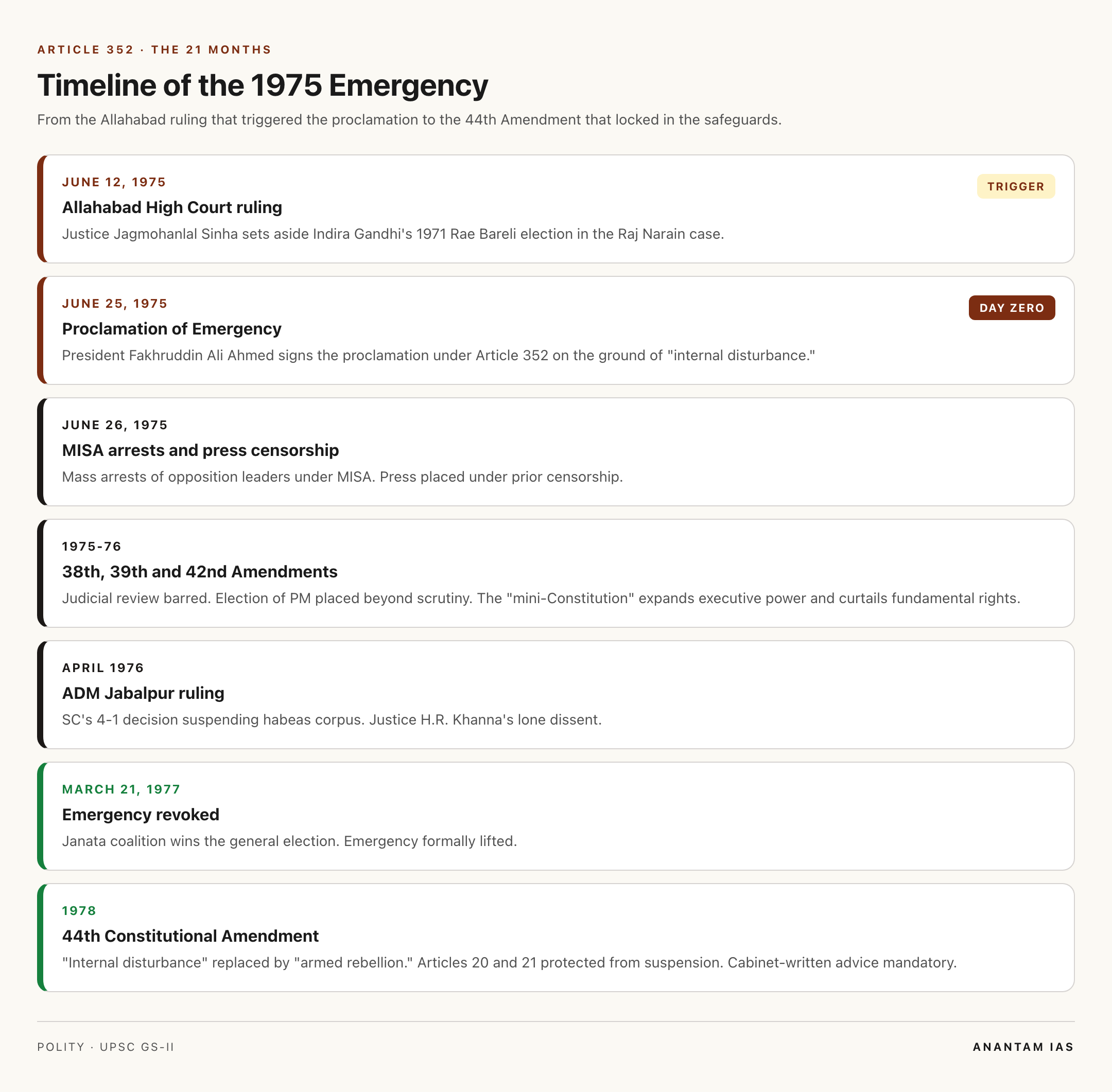
The first National Emergency under Article 352 was proclaimed on June 25, 1975 and revoked on March 21, 1977. The constitutional ground cited was “internal disturbance,” which has since been replaced by “armed rebellion” through the 44th Amendment of 1978. The Lok Sabha was extended twice during the Emergency, the longest such extension in Indian history. Three National Emergencies have been proclaimed in independent India: 1962 (Indo-China war), 1971 (Indo-Pak war and Bangladesh crisis), and 1975 (internal disturbance). The 44th Amendment Act, 1978 protects Articles 20 and 21 from suspension during any Emergency. The Supreme Court’s ruling in ADM Jabalpur v. Shivkant Shukla, popularly called the Habeas Corpus case, was overruled in 2017 in the Justice K.S. Puttaswamy decision on privacy.
What the 1975 Emergency Was
A National Emergency under Article 352 is a constitutional mechanism that allows the Union government to assume sweeping executive, legislative and financial powers when the security of India is threatened. It is one of three emergency provisions in the Indian Constitution, alongside President’s Rule under Article 356 and Financial Emergency under Article 360. The 1975 Emergency was the only proclamation issued on the ground of internal disturbance, a phrase the 44th Amendment subsequently replaced because of its vagueness.
Background and Historical Context
The trigger sat in a courtroom in Allahabad. On June 12, 1975, Justice Jagmohanlal Sinha of the Allahabad High Court declared Indira Gandhi’s 1971 election from Rae Bareli void on grounds of electoral malpractice in the Raj Narain case. The verdict disqualified her from holding elected office for six years. The Supreme Court granted a conditional stay on June 24. By the night of June 25, the Cabinet was bypassed and a proclamation of internal-disturbance Emergency was placed before the President for signature.
The political setting amplified the legal trigger. Jayaprakash Narayan‘s “Total Revolution” movement had built a country-wide opposition mobilisation, the Bihar movement and the Gujarat Navnirman Andolan had already toppled state governments, and the railway strike of 1974 had stretched the Centre’s administrative capacity. The proclamation suspended ordinary politics. Mass arrests of opposition leaders began in the early hours of June 26 under MISA, the press came under prior censorship, and Parliament soon began passing constitutional amendments that placed presidential and prime-ministerial actions beyond judicial review.
The 38th Amendment barred judicial review of the Emergency proclamation. The 39th Amendment placed the elections of the President, Vice-President, Prime Minister and Speaker beyond judicial scrutiny. The 42nd Amendment of 1976, often called the “mini-Constitution,” made sweeping changes that elevated Directive Principles over Fundamental Rights, extended Parliament’s term, restricted judicial review, and inserted “Socialist,” “Secular” and “Integrity” into the Preamble. Indira Gandhi called fresh elections in early 1977. The Janata coalition, led by Morarji Desai, won decisively. The 44th Amendment, passed in 1978, was the legal answer to the Emergency.
Constitutional Provisions of Article 352
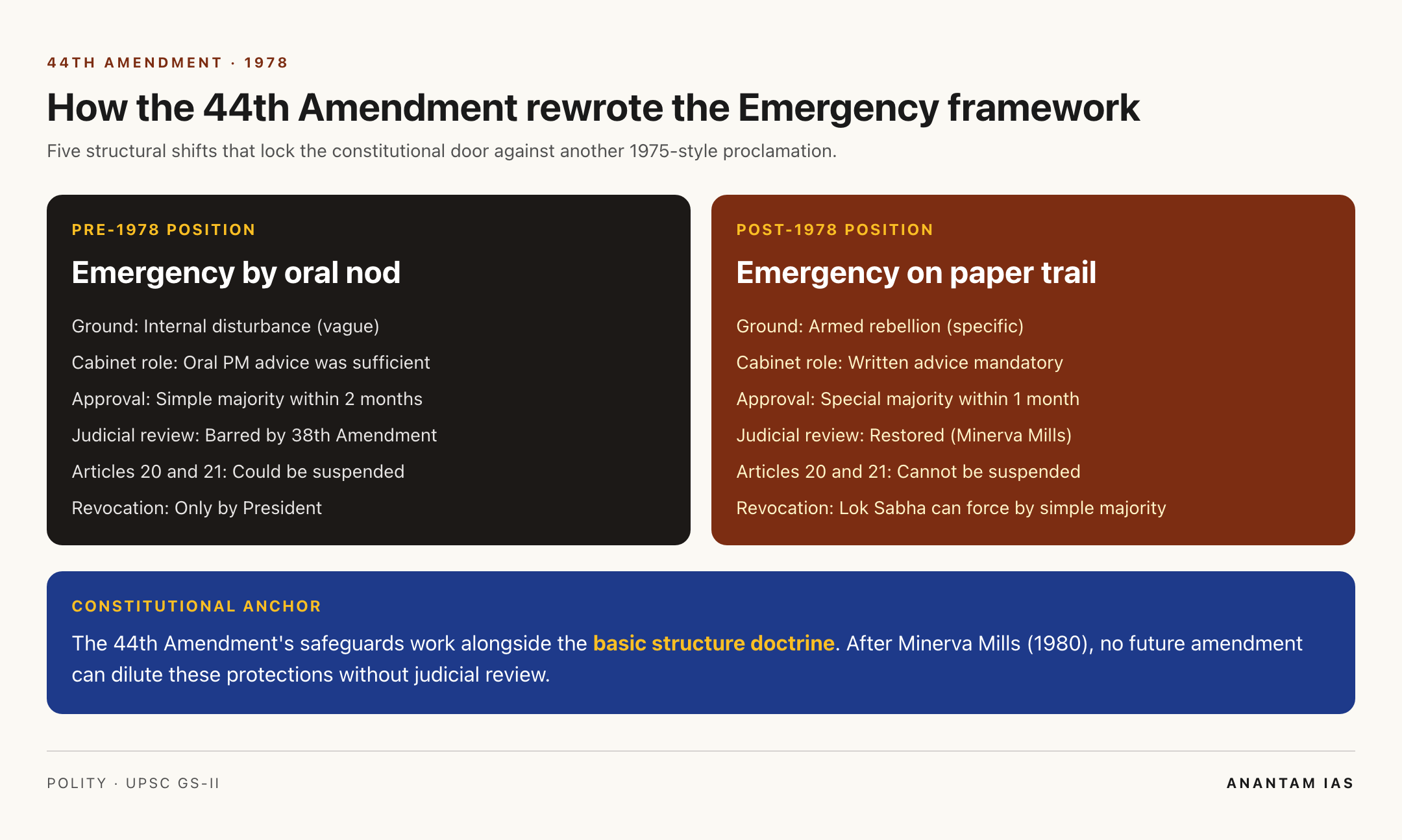
Article 352 sits in Part XVIII of the Constitution. The President can proclaim a National Emergency when the security of India or any part of it is threatened by war, external aggression or armed rebellion. This last ground replaced the older expression “internal disturbance” by way of the 44th Amendment, because “internal disturbance” was vague enough to capture political protest and opposition mobilisation. After 1978, only an armed challenge to the state itself qualifies.
The procedure now reads as follows. The President can proclaim only on the written advice of the Cabinet, not on oral advice from the Prime Minister alone. The proclamation must be approved by both Houses of Parliament within one month, instead of the older two-month window, and that approval must come by a special majority, defined as a majority of total membership and two-thirds of members present and voting. Once approved, the proclamation continues for six months at a time and requires fresh parliamentary approval at every renewal. The Lok Sabha can force revocation by passing a resolution of disapproval by simple majority, and the Centre is required to bring the matter before the House if at least one-tenth of Lok Sabha members ask for it.
For more on the constitutional framework, see our explainer on the Constitution of India and the 42nd Amendment of the Indian Constitution which represented the high point of executive overreach during the Emergency.
Effects of a National Emergency
A National Emergency reshapes the federal structure, the legislative scheme and the rights regime simultaneously. On the executive side, the Centre becomes empowered to give directions to states on any matter, even on subjects in the State List. State governments are not dismissed, unlike under President’s Rule, but their executive functions become subordinate to central direction. Federalism shifts from a “cooperative” pattern to what scholars often call a “unitary” pattern for the duration of the Emergency. Our federalism explainer goes deeper into the standard pattern.
On the legislative side, Parliament acquires the power to legislate on any subject in the State List for as long as the Emergency operates. Such laws remain valid for six months after the Emergency is revoked unless extended. The Lok Sabha’s term can be extended by Parliament for one year at a time during an Emergency, and during the 1975 Emergency this power was used twice, stretching the Fifth Lok Sabha well beyond its original term. The financial implications are also significant. The President can modify constitutional revenue-sharing arrangements between the Union and the states under Article 354 for the duration of the Emergency.
The 44th Amendment and Its Safeguards
The 44th Amendment Act, 1978 stands as one of the most consequential post-Independence amendments because it deliberately reduces the executive’s room for abuse. It replaced “internal disturbance” with “armed rebellion” so that political mobilisation alone cannot trigger an Emergency. It mandated written Cabinet advice, ensuring that no single individual including the Prime Minister could push a proclamation through. It compressed the parliamentary approval window from two months to one and raised the approval threshold to a special majority. It put the proclamation back under judicial review, reversing the 38th Amendment’s protective shell. And, most importantly, it placed Articles 20 and 21 beyond suspension under any Emergency.
The amendment also restored balance to the rights framework. It clarified that Article 358 only kicks in when the Emergency is declared on the ground of war or external aggression, not armed rebellion. And it required any Article 359 order to identify the specific rights whose enforcement is being suspended, rather than allowing a blanket suspension. For a fuller treatment, the 44th Amendment of the Indian Constitution explainer covers the detailed clauses.
Articles 358 and 359: How Rights Are Affected
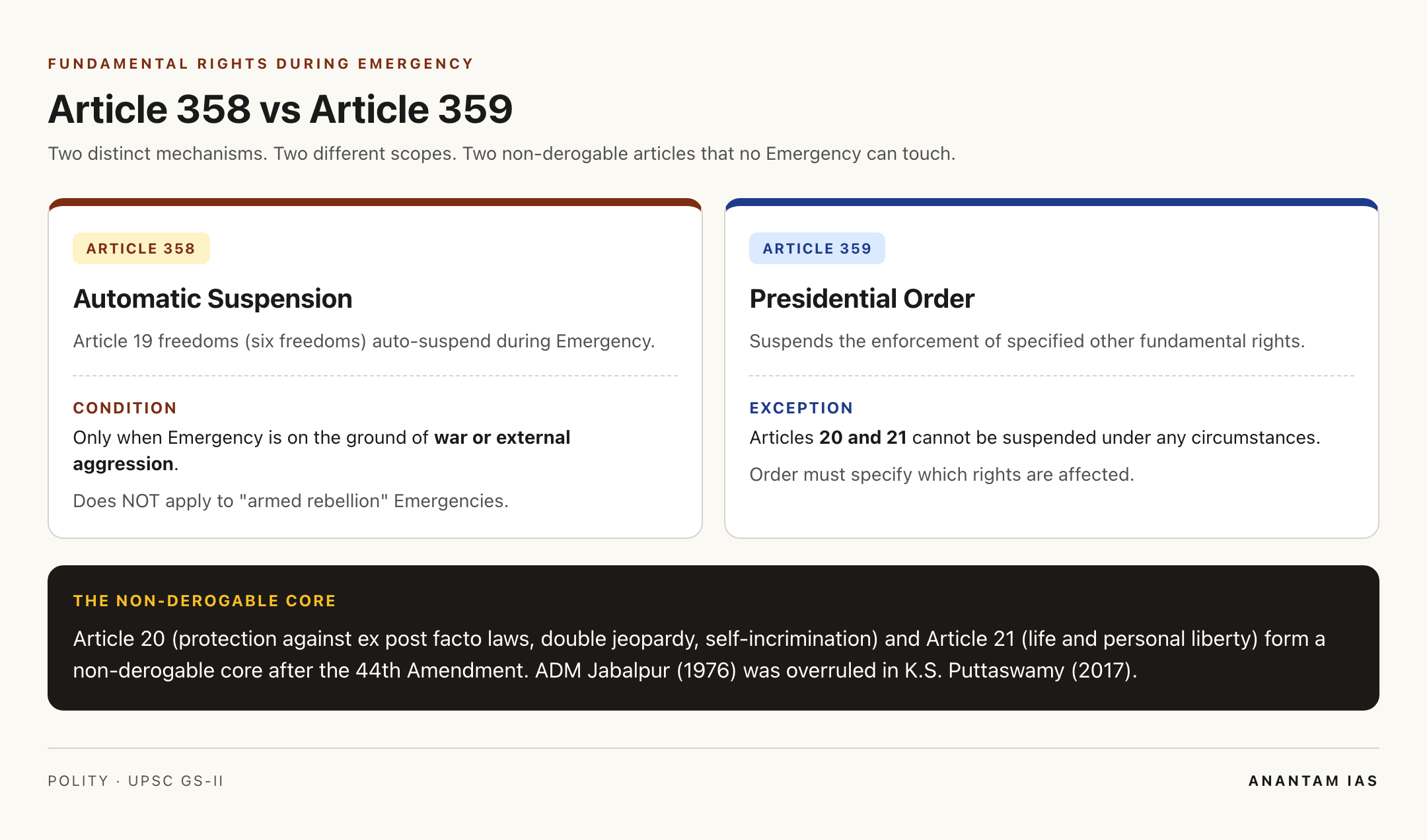
The 1975 Emergency saw a near-total suspension of fundamental rights, and the post-1978 framework has tightened how this can happen. Article 358 deals with the automatic suspension of Article 19 freedoms. The crucial post-1978 limitation is that this automatic suspension applies only when an Emergency is declared on the ground of war or external aggression, not on the ground of armed rebellion. So a future internal-rebellion Emergency cannot wipe out the Article 19 freedoms automatically. Our explainer on Article 19 covers the underlying freedoms that this article protects.
Article 359 operates differently. It allows the President to issue an order suspending the enforcement of other fundamental rights, but it does not suspend the rights themselves. After the 44th Amendment, the President cannot suspend the enforcement of Article 20, which protects against retrospective punishment, double jeopardy and self-incrimination, or Article 21, which protects life and personal liberty. These two articles now form a non-derogable core of the rights regime, comparable to the non-derogable rights identified in the International Covenant on Civil and Political Rights.
The Habeas Corpus Case and Its Reversal
ADM Jabalpur v. Shivkant Shukla, decided in April 1976, became the most criticised ruling in the Supreme Court’s history. By a 4-1 majority, the Court held that during a Presidential order suspending enforcement of fundamental rights under Article 359, no person had locus to move any High Court for a writ of habeas corpus, even if life and liberty were at stake. Justice H.R. Khanna’s lone dissent, in which he argued that the right to life and liberty existed independently of the Constitution, cost him the Chief Justiceship. He was superseded by Justice M.H. Beg in 1977, but his dissent eventually became the orthodox position.
The Justice K.S. Puttaswamy v. Union of India ruling of 2017, recognising privacy as a fundamental right under Article 21, formally overruled ADM Jabalpur. The nine-judge bench held that the majority view in ADM Jabalpur was “seriously flawed” and “deserved to be buried.” The 44th Amendment had already taken care of the legal hole by ensuring that Articles 20 and 21 cannot be suspended, but the formal overruling closed the doctrinal door.
Comparative Approach: Three Emergencies
The 1962 Emergency was proclaimed on the ground of external aggression after the Chinese attack on October 26, 1962. It remained in force until 1968, well past the active phase of the war, but did not lead to internal political controversy. The 1971 Emergency was proclaimed in December 1971 on the ground of external aggression during the Indo-Pak war, and the proclamation was not revoked even after the war ended in December 1971. It was the 1971 proclamation that remained in force when the 1975 internal-disturbance Emergency was added on top of it, creating a “concurrent” emergency situation.
The 1975 Emergency stands apart for three reasons. It was the only emergency declared on the ground of internal disturbance. It was the only emergency that suspended the political process, with the Lok Sabha extended twice, opposition leaders jailed and elections postponed. And it was the only emergency that triggered a comprehensive constitutional rewrite once it ended, in the form of the 44th Amendment.
Challenges and Continuing Debates
Three challenges remain even with the 44th Amendment safeguards. First, the boundary between “armed rebellion” and ordinary internal disturbance is not bright-line, and any future government could plausibly argue an armed rebellion in border regions or in a Maoist-insurgency district to justify a National Emergency. Second, the political checks depend on Lok Sabha numbers. A government with a special majority in both Houses could in principle approve a future Emergency without effective opposition resistance. Third, the safeguards apply to Article 352. President’s Rule under Article 356 and the Armed Forces Special Powers Act framework operate on different and arguably weaker rights protections.
Prelims Pointers
The first National Emergency on internal-disturbance grounds was proclaimed on June 25, 1975. The 44th Amendment Act, 1978 replaced “internal disturbance” with “armed rebellion” in Article 352. Written Cabinet advice is mandatory after 1978. Approval requires special majority within one month. The Lok Sabha can force revocation by simple majority. Articles 20 and 21 cannot be suspended under any Emergency post-1978. Article 358 applies only when Emergency is declared on the grounds of war or external aggression, not armed rebellion. Article 359 cannot suspend enforcement of Articles 20 and 21. ADM Jabalpur, 1976 was overruled in K.S. Puttaswamy, 2017. The 38th, 39th and 42nd Amendments expanded executive power during the Emergency. The 44th Amendment of 1978 reversed most of those changes. Our fundamental rights and articles explainer maps these relationships in detail.
Mains Practice Questions
- The 44th Amendment of 1978 represents a deliberate constitutional response to the excesses of the 1975 Emergency. Discuss the principal safeguards introduced and assess whether they are sufficient to prevent a recurrence. (GS Paper 2, 250 words)
- Examine the Supreme Court’s ruling in ADM Jabalpur v. Shivkant Shukla and analyse how the basic structure jurisprudence and the 44th Amendment together corrected the constitutional gap it exposed. (GS Paper 2, 250 words)
- Compare the three National Emergencies declared in independent India and bring out their differential impact on civil liberties and federalism. (GS Paper 2, 150 words)
- Article 358 and Article 359 affect the fundamental rights regime in different ways. Explain. (GS Paper 2, 150 words)
Way Forward
The strongest safeguard against an Emergency-like episode lies less in constitutional text and more in institutional culture. A Cabinet that insists on collective decision-making, a Parliament with a substantive opposition, an independent press, a self-aware judiciary willing to read fundamental rights expansively, and a civil society alert to administrative overreach together do more to prevent abuse than any clause. The 44th Amendment supplies the legal scaffolding. The political ecosystem has to keep the scaffolding load-bearing.
For students, the lesson of the 1975 Emergency is that constitutional rights, federal balance and judicial independence are not self-executing. They require continuous institutional vigilance, of the kind that built up between 1977 and 1980 and that the Supreme Court’s basic structure doctrine line of cases formalised in Minerva Mills.
Frequently Asked Questions
When was the 1975 National Emergency proclaimed and revoked?
The proclamation was issued on June 25, 1975, by President Fakhruddin Ali Ahmed on the advice of Prime Minister Indira Gandhi, citing internal disturbance as the constitutional ground. The Emergency was formally revoked on March 21, 1977, after the Janata coalition’s victory in the general election. It lasted approximately 21 months and remains the only emergency declared on the ground of internal disturbance.
What did the 44th Amendment of 1978 change about Article 352?
The 44th Amendment replaced the ground u0022internal disturbanceu0022 with u0022armed rebellion,u0022 made written Cabinet advice mandatory before the President can proclaim an Emergency, reduced the parliamentary approval window from two months to one month, raised the approval threshold to a special majority, and gave the Lok Sabha the power to force revocation by simple majority. It also placed the proclamation back within judicial review and protected Articles 20 and 21 from suspension.
What is the difference between Article 358 and Article 359?
Article 358 deals with automatic suspension of Article 19 freedoms during an Emergency declared on the ground of war or external aggression. Article 359 allows the President to issue an order suspending the enforcement of other fundamental rights, but only those listed in the order. After the 44th Amendment, Article 358 cannot operate when the Emergency is on the ground of armed rebellion, and Article 359 cannot suspend the enforcement of Articles 20 and 21 under any circumstances.
Why is the ADM Jabalpur case considered important?
ADM Jabalpur v. Shivkant Shukla, decided in 1976, held by a 4-1 majority that habeas corpus petitions were not maintainable during a Presidential order under Article 359, even when life and liberty were at stake. The dissenting opinion of Justice H.R. Khanna became the moral and intellectual standard. The case was formally overruled in K.S. Puttaswamy v. Union of India, 2017, which recognised privacy as a fundamental right.
Can the President declare a National Emergency on the basis of oral advice from the Prime Minister?
No. After the 44th Amendment, the Constitution requires written advice from the Cabinet. This was a direct response to the 1975 Emergency, where the proclamation was issued without proper Cabinet consultation. The change makes it harder for any single individual to push a proclamation through and creates a documentary record of collective responsibility.
How many National Emergencies have been declared in India?
Three. The first was in 1962 on the ground of external aggression during the Sino-Indian war and lasted until 1968. The second was in 1971 on the ground of external aggression during the Indo-Pak war. The third was in 1975 on the ground of internal disturbance and was revoked in 1977. The 1962 and 1971 Emergencies are widely accepted as legitimate responses to external threats, while the 1975 Emergency remains constitutionally and politically controversial.
What is the role of the Lok Sabha in revoking an Emergency?
After the 44th Amendment, the Lok Sabha can force revocation by passing a resolution of disapproval by simple majority. If at least one-tenth of the members of the Lok Sabha give written notice to the Speaker, or to the President if the House is not in session, a special sitting must be held within fourteen days to consider the resolution. This is a substantial check that did not exist before 1978.
Can fundamental rights be suspended during a National Emergency today?
Some can, but Articles 20 and 21 cannot be suspended under any circumstances. Article 19 freedoms are automatically suspended under Article 358, but only when the Emergency is on the ground of war or external aggression. Other fundamental rights can be suspended under Article 359 only by a Presidential order that specifies which rights, and only for the duration of the Emergency. Even during such suspension, the right itself continues to exist; only its enforcement before courts is paused.
What is the connection between the Emergency and the basic structure doctrine?
The basic structure doctrine was articulated in Kesavananda Bharati v. State of Kerala in 1973, before the Emergency. But its real-world bite came after the Emergency. The 42nd Amendment, passed during the Emergency, attempted to insulate constitutional amendments from judicial review. In Minerva Mills v. Union of India in 1980, the Supreme Court struck down the relevant clauses of the 42nd Amendment by relying on the basic structure doctrine. The Emergency thus became the political backdrop against which the doctrine acquired its working force.
Has there been any National Emergency under Article 352 since 1977?
No. India has not seen a National Emergency under Article 352 since the 1975-77 episode. Several states have come under President’s Rule under Article 356 since then, but that is a different constitutional mechanism. The 44th Amendment safeguards, the political memory of 1975, and the strengthened basic structure jurisprudence have together raised the threshold for any future Article 352 proclamation considerably.