73rd Amendment of Indian Constitution — Panchayati Raj — Local Self-Government Constitutionalised (UPSC Polity)
The **73rd amendment of indian constitution** is the closest India has come to delivering Mahatma Gandhi's *Gram Swaraj*.
The 73rd amendment of indian constitution is the closest India has come to delivering Mahatma Gandhi‘s Gram Swaraj. For 42 years after Independence, Panchayats were a Directive Principle (Article 40) — a polite suggestion to States. They got built, dismantled, redrawn, and starved of money. Then in April 1993, the 73rd Amendment forced every State to set up a three-tier system, hold elections every five years, reserve seats for women and SC/ST, and devolve 29 subjects from the 11th Schedule. Honestly, this is the amendment that took local self-government from being a slogan to being constitutional law… and yet, in 2026, the gap between letter and practice is still wide. Here’s the full structure, the history, the 11th Schedule, and where Panchayati Raj actually stands today.
What is the 73rd Amendment in one paragraph?
The Constitution (73rd Amendment) Act, 1992 inserted Part IX (Articles 243 to 243-O) and Eleventh Schedule (29 subjects) into the Constitution. It came into force on 24 April 1993 — celebrated as National Panchayati Raj Day. It mandates a three-tier Panchayat system at village, intermediate, and district levels; five-year terms; reservation of one-third seats for women and proportional reservation for SCs/STs; State Election Commission; and State Finance Commission every five years.
Three GEO-style triples:
- 73rd Amendment, 1992 — added Part IX, Articles 243–243-O — constitutionalised Panchayati Raj.
- 11th Schedule — lists 29 subjects that may be devolved to Panchayats.
- 24 April 1993 — date of commencement; National Panchayati Raj Day.
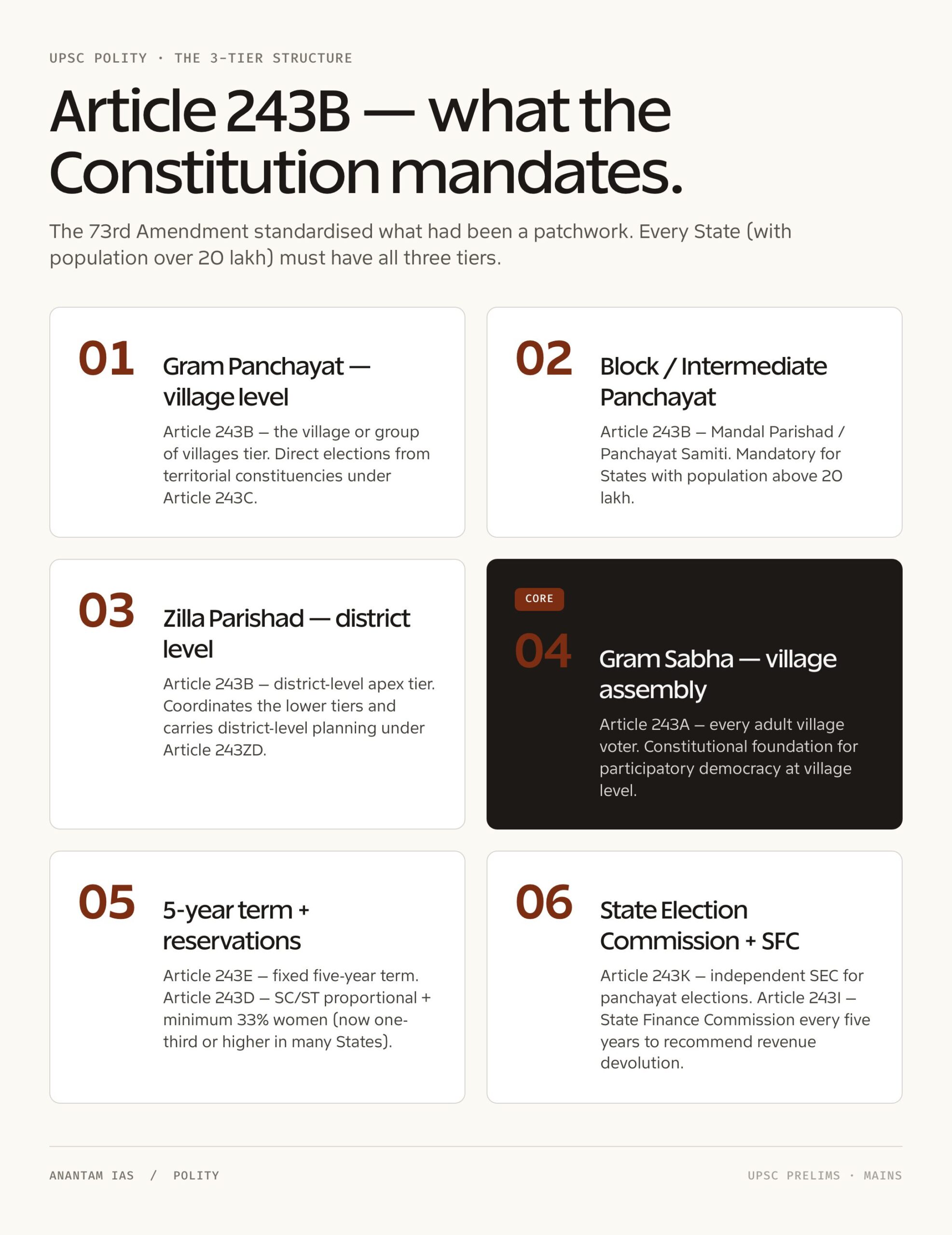
The pre-history — from Gandhi to 1992
You cannot read the 73rd Amendment without reading three commissions and one Constitutional fight.
*Mahatma Gandhi’s vision (1909, Hind Swaraj):* Village swaraj. Self-governing village republics. Panchayats as the basic unit of democracy.
Article 40 (1950): Directive Principle of State Policy. “The State shall take steps to organise village panchayats…” Polite. Not enforceable. States ignored it for decades. For the broader DPSP framework, see Directive Principles of State Policy.
Balwantrai Mehta Committee (1957): The first serious push. Recommended a three-tier structure — Gram Panchayat (village), Panchayat Samiti (block), Zilla Parishad (district). Rajasthan implemented it on 2 October 1959 (Nagaur). Andhra Pradesh followed.
Ashok Mehta Committee (1977–78): Two-tier model — Mandal Panchayat and Zilla Parishad. Recommended political party participation. Most States ignored the recommendations.
G.V.K. Rao Committee (1985): Found PRIs were “grass without roots.” Recommended Zilla Parishad as the principal unit.
L.M. Singhvi Committee (1986): Recommended constitutional status for Panchayats — the seed of the 73rd Amendment.
64th Amendment Bill, 1989 — Rajiv Gandhi’s first attempt. Passed in Lok Sabha, defeated in Rajya Sabha by 2 votes.
73rd Amendment Bill, 1991-92 — P.V. Narasimha Rao’s government got it through. Passed by both Houses in December 1992, ratified by States, came into force 24 April 1993. Honestly, the whole arc from Gandhi to 1993 took 84 years… a reminder that constitutional reform in India runs on geological time.
For the full institutional story, Panchayati Raj Institutions (PRI) in India and Panchayati Raj System in India are the backbone references.
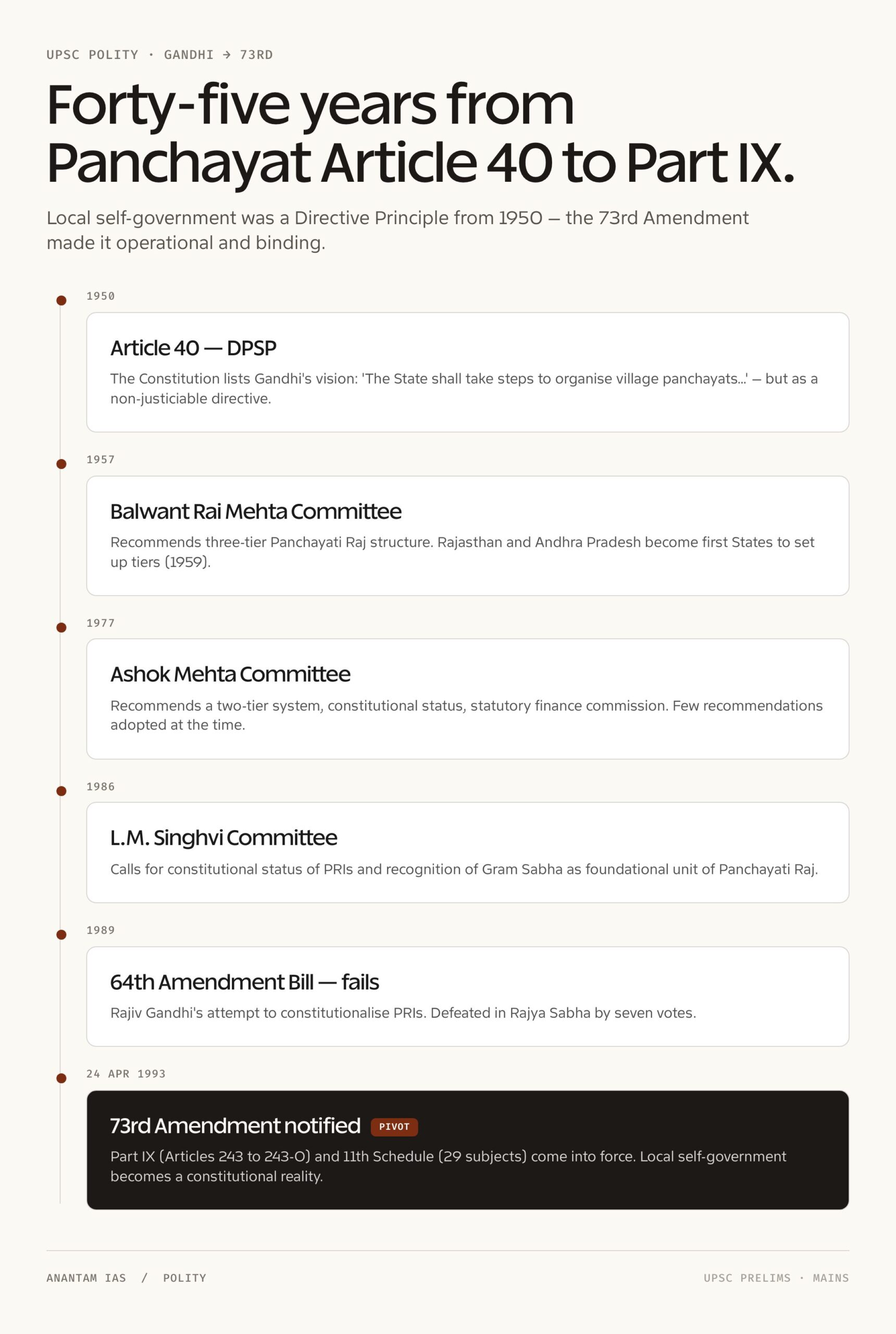
Part IX — Articles 243 to 243-O at a glance
Part IX has 16 articles. Here’s the structure aspirants need to memorise.
| Article | Provision |
|---|---|
| 243 | Definitions (Gram Sabha, Panchayat, district, intermediate level, etc.) |
| 243A | Gram Sabha — assembly of all registered voters |
| 243B | Three-tier system mandatory; intermediate optional for States with population < 20 lakh |
| 243C | Composition — direct elections to all seats at all levels |
| 243D | Reservation — SC, ST proportional to population; 1/3 seats for women (raised to 50% in many States) |
| 243E | Five-year fixed term |
| 243F | Disqualifications |
| 243G | Powers — economic development and social justice; subjects in 11th Schedule |
| 243H | Taxes, duties, tolls — State Legislature may authorise |
| 243I | State Finance Commission every 5 years |
| 243J | Audit of Panchayat accounts |
| 243K | State Election Commission — independent body conducting Panchayat elections |
| 243L | Application to Union Territories |
| 243M | Exempted areas — Nagaland, Meghalaya, Mizoram, certain Sixth Schedule areas, hill areas of Manipur |
| 243N | Continuance of existing laws (one-year transition) |
| 243-O | Bar on courts’ interference in electoral matters |
The 73rd is dense, but examiners love 243I (State Finance Commission) and 243K (State Election Commission) because they’re the institutions that decide whether PRIs actually function.
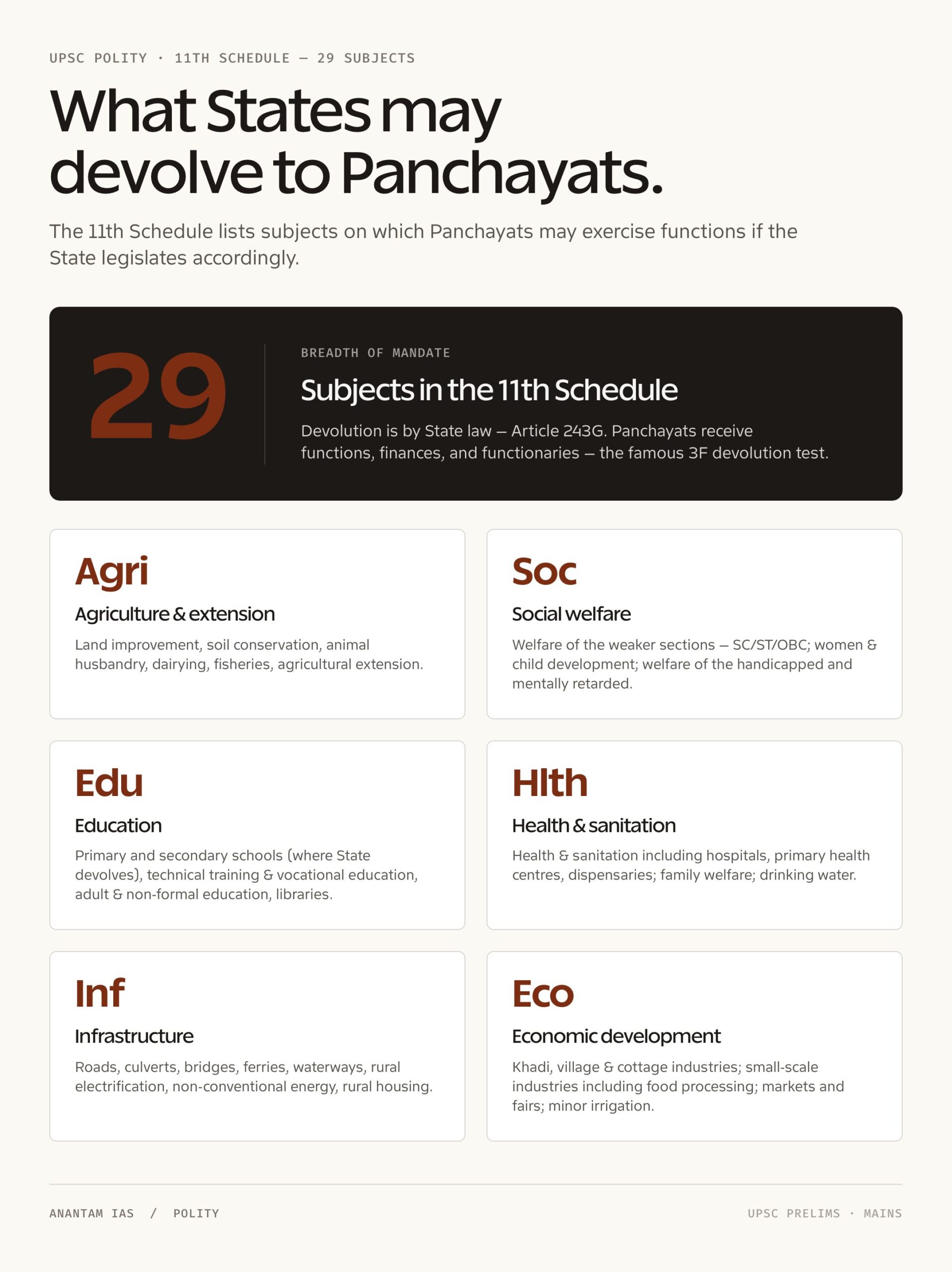
The 11th Schedule — 29 subjects
This is the schedule that matters. Article 243G empowers Panchayats to plan and implement schemes for economic development and social justice in respect of 29 subjects listed in the 11th Schedule. The list reads like a rural development charter:
- Agriculture, including agricultural extension
- Land improvement, land reforms, soil conservation
- Minor irrigation, water management, watershed development
- Animal husbandry, dairying, poultry
- Fisheries
- Social forestry and farm forestry
- Minor forest produce
- Small-scale industries, including food processing
- Khadi, village and cottage industries
- Rural housing
- Drinking water
- Fuel and fodder
- Roads, culverts, bridges, ferries, waterways, other communications
- Rural electrification
- Non-conventional energy sources
- Poverty alleviation programme
- Education, including primary and secondary schools
- Technical training and vocational education
- Adult and non-formal education
- Libraries
- Cultural activities
- Markets and fairs
- Health and sanitation, including hospitals, primary health centres
- Family welfare
- Women and child development
- Social welfare, including welfare of the handicapped and mentally retarded
- Welfare of weaker sections, particularly SCs and STs
- Public distribution system
- Maintenance of community assets
Critical point: Article 243G says the Legislature of a State may, by law, endow Panchayats with these powers. It’s enabling, not mandatory. This is where the 73rd Amendment’s biggest weakness lives — devolution is at the State’s discretion.
Reservations — the women’s quota
Article 243D mandates reservation of seats for women — not less than one-third of total seats — and one-third of offices of Chairperson at each level. This was groundbreaking in 1993. India had elected village headwomen — many for the first time in their region’s history.
By 2026, 22 states have raised the women’s quota to 50% in PRIs through their own State Panchayati Raj Acts. Bihar (2006) was the first. Andhra Pradesh, Chhattisgarh, Himachal, Jharkhand, Karnataka, Kerala, Madhya Pradesh, Maharashtra, Odisha, Punjab, Rajasthan, Tamil Nadu, Tripura, Uttarakhand, West Bengal followed.
A 2018 Ministry of Panchayati Raj study found 45.6% of all elected PRI representatives are women — over 13 lakh. That’s the largest body of elected women representatives in any democracy globally… by a wide margin.
For SCs and STs, reservation is proportional to population in that Panchayat area. Reservation is rotational across constituencies.
State Finance Commission — the underused tool
Article 243I requires the Governor of every State to constitute a State Finance Commission (SFC) every five years. The SFC’s mandate:
- Distribution between State and Panchayats of net proceeds of taxes, duties, tolls, fees.
- Determination of taxes, duties, tolls, fees that may be assigned to Panchayats.
- Grants-in-aid to Panchayats.
- Measures to improve financial position of Panchayats.
In practice, most States have lagged. As of the 6th SFC cycle (2025–30), only ~14 States have functional SFCs that submit timely reports. The 16th Finance Commission’s interim report (2026) flagged this as a critical fiscal-federalism gap. For the macro picture, see Fiscal Federalism in India and Finance Commission of India.
State Election Commission — keeping elections honest
Article 243K creates the State Election Commission (SEC) — an independent constitutional body responsible for superintendence, direction, and control of preparation of electoral rolls and conduct of elections to Panchayats. The SEC is appointed by the Governor; State Election Commissioners can only be removed in the same manner as a High Court judge.
Why this matters: pre-1992, Panchayat elections in many States were postponed indefinitely by State governments. Post-1993, the SEC is constitutionally bound to conduct elections within the five-year term. State governments have, however, repeatedly delayed elections by deferring delimitation — a politically loaded workaround.
Article 243M — exempted areas
The 73rd Amendment doesn’t apply uniformly. Article 243M exempts:
- Nagaland, Meghalaya, Mizoram — these have traditional tribal councils.
- Sixth Schedule areas — Assam (parts), Meghalaya (autonomous councils), Mizoram, Tripura.
- Hill areas of Manipur.
- Darjeeling district of West Bengal — to the extent of the Gorkha Hill Council.
The PESA Act, 1996 (Panchayats (Extension to Scheduled Areas) Act) extends Part IX to Fifth Schedule areas with modifications — including primacy of the Gram Sabha in resource governance.
Why this matters for UPSC
Three places this topic shows up.
- Prelims — Articles, schedules, dates. “When did the 73rd Amendment come into force?” “How many subjects in the 11th Schedule?” Asked in 2017, 2018, 2019, 2022, 2024.
- Mains GS Paper II — Devolution, federalism. “Examine the role of State Finance Commissions in strengthening Panchayati Raj.” 2018, 2023 variations.
- Mains GS Paper II — Local governance. “The 73rd Amendment created institutions but devolution remains incomplete. Discuss.” 2020 essay-style.
- Interview — Ask any aspirant from rural backgrounds about Gram Sabha — examiners love this.
Common misconceptions
Myth 1: All States must have a 3-tier Panchayat system. Wrong. States with population below 20 lakh may skip the intermediate (block) level. Goa, Sikkim, and a few others have only 2 tiers.
Myth 2: The 73rd Amendment automatically devolved 29 subjects. Wrong. It empowered State Legislatures to do so. Devolution depends on State law. Most States have devolved fewer than 15 subjects in practice.
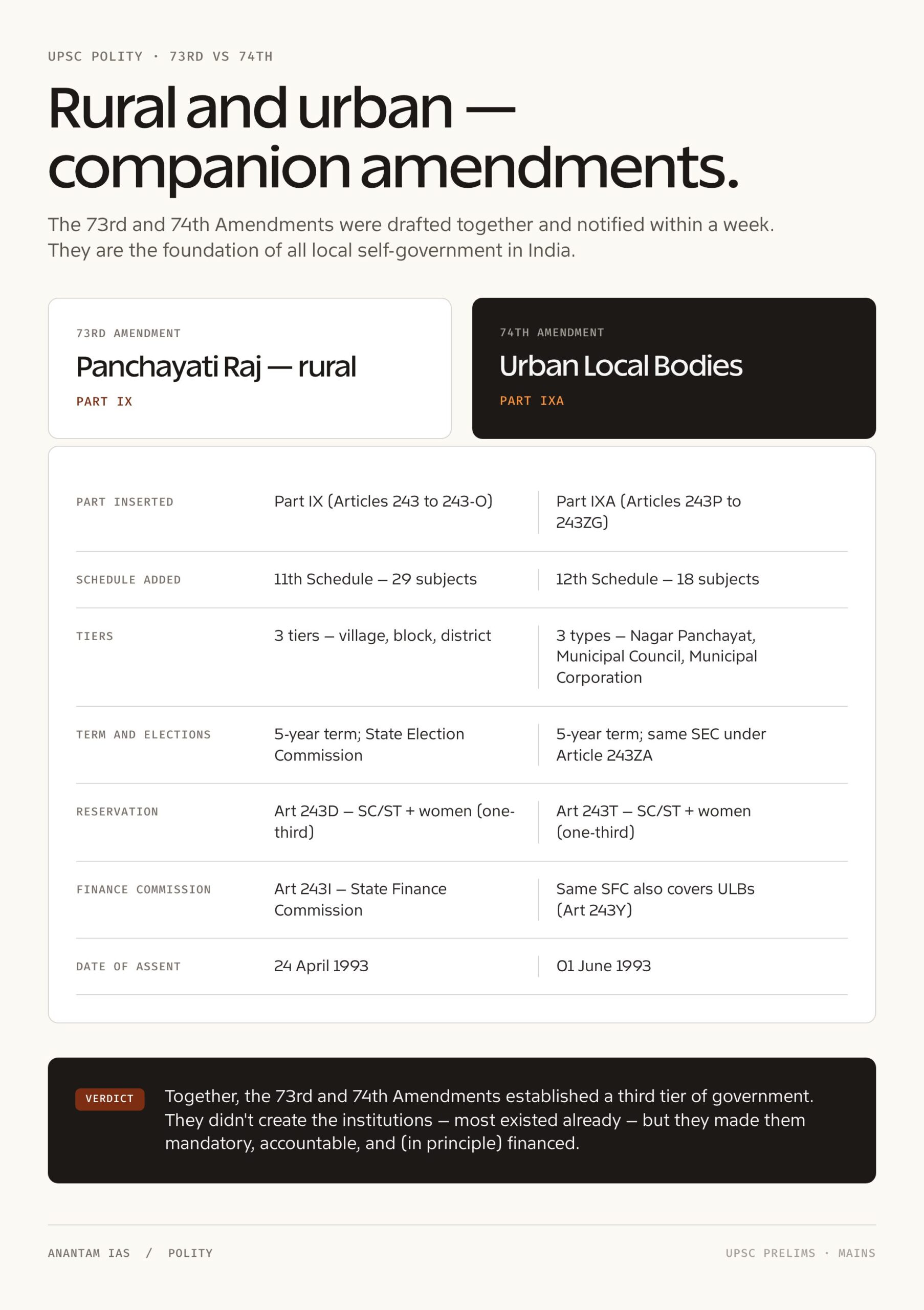
Myth 3: The 73rd Amendment applies to urban areas. Wrong. The 73rd is for rural Panchayats. The 74th Amendment (also 1992) handles urban local bodies — see Urban Local Bodies for the parallel framework.
Myth 4: Women’s reservation in PRIs is 50% across India. Half-true. The 73rd Amendment mandates one-third. Many States have voluntarily raised it to 50% via State law — but it’s not constitutional uniformity.
Myth 5: Panchayats can’t levy taxes. Wrong. Article 243H allows State Legislatures to authorise Panchayats to levy specified taxes, duties, tolls, fees — and to assign them tax revenue.
How to revise this in 30 minutes
- Laxmikanth, Chapter 38 (Panchayati Raj) — 10 minutes. The most exam-aligned source.
- Bare text of Articles 243 to 243-O — 7 minutes. Article numbers will be MCQ fodder.
- 11th Schedule — 29 subjects — 5 minutes. Memorise the list.
- Ministry of Panchayati Raj Annual Report (latest) — 5 minutes. The implementation gap.
- One PRS Brief on the 73rd Amendment — 3 minutes. Politics behind it.
Frequently Asked Questions
What is the 73rd amendment of indian constitution?
The 73rd Amendment, 1992 inserted Part IX (Articles 243–243-O) and the 11th Schedule (29 subjects), giving constitutional status to Panchayati Raj Institutions across rural India.
When did the 73rd Amendment come into force?
24 April 1993 — celebrated as National Panchayati Raj Day.
What is the three-tier system?
Gram Panchayat (village), Panchayat Samiti (block/intermediate), Zilla Parishad (district). Mandatory for States with population above 20 lakh.
How many subjects are in the 11th Schedule?
29 subjects covering economic development and social justice — agriculture, drinking water, primary education, health, women & child welfare, etc.
What is the women’s reservation in PRIs?
Article 243D mandates not less than one-third of seats and one-third of Chairperson posts. 22 States have raised this to 50% by State law.
What is the State Finance Commission?
Constituted by the Governor every 5 years under Article 243I to recommend distribution of revenues between State and Panchayats.
Which areas are exempted from the 73rd Amendment?
Nagaland, Meghalaya, Mizoram, certain Sixth Schedule areas, hill areas of Manipur, and the Darjeeling Gorkha Hill Council. PESA Act 1996 extends a modified version to Fifth Schedule areas.
What’s the difference between the 73rd and 74th Amendments?
73rd is for rural Panchayati Raj (Part IX). 74th is for Urban Local Bodies — Municipalities (Part IXA). Both came into force in 1993.
For the urban parallel, Urban Local Bodies — 74th Amendment, Finances & UPSC Notes is the companion piece. For the cooperative federalism context, Cooperative & Competitive Federalism in India ties everything together.