Air Pollution in India — UPSC Environment Notes
UPSC guide to air pollution in India: sources, AQI, NCAP, Delhi smog, stubble burning, BS-VI, CAQM, health impacts, mitigation measures, WHO thresholds.
Air pollution kills more Indians each year than tobacco, alcohol, and road accidents combined. The State of Global Air 2024 report attributes over 2 million premature deaths in India annually to air pollution, and 39 of the world's 50 most polluted cities are Indian. Delhi's winter smog is only the most visible face of a nationwide crisis driven by transport, industry, biomass burning, construction, and agricultural residue burning. For UPSC, this is a perennial GS-III topic with many sub-themes.
Sources of air pollution
| Sector | Major pollutants |
|---|---|
| Transportation | CO, NOx, NMVOCs, PM; road dust |
| Industry (iron, steel, cement, sugar, paper, aluminium, copper, fertiliser) | SPM, SOx, NOx, CO2 |
| Power plants (thermal) | SO2, TSP, NOx, mercury |
| Agriculture | NH3, N2O, CH4 (enteric fermentation), stubble PM |
| Waste management / biomass burning | PM, dioxins, CH4 |
| Household (kerosene, wood, dung cakes) | CO, PM, black carbon |
| Construction & demolition | PM10, silica dust |
Delhi-NCR — a meteorology-sensitive basin
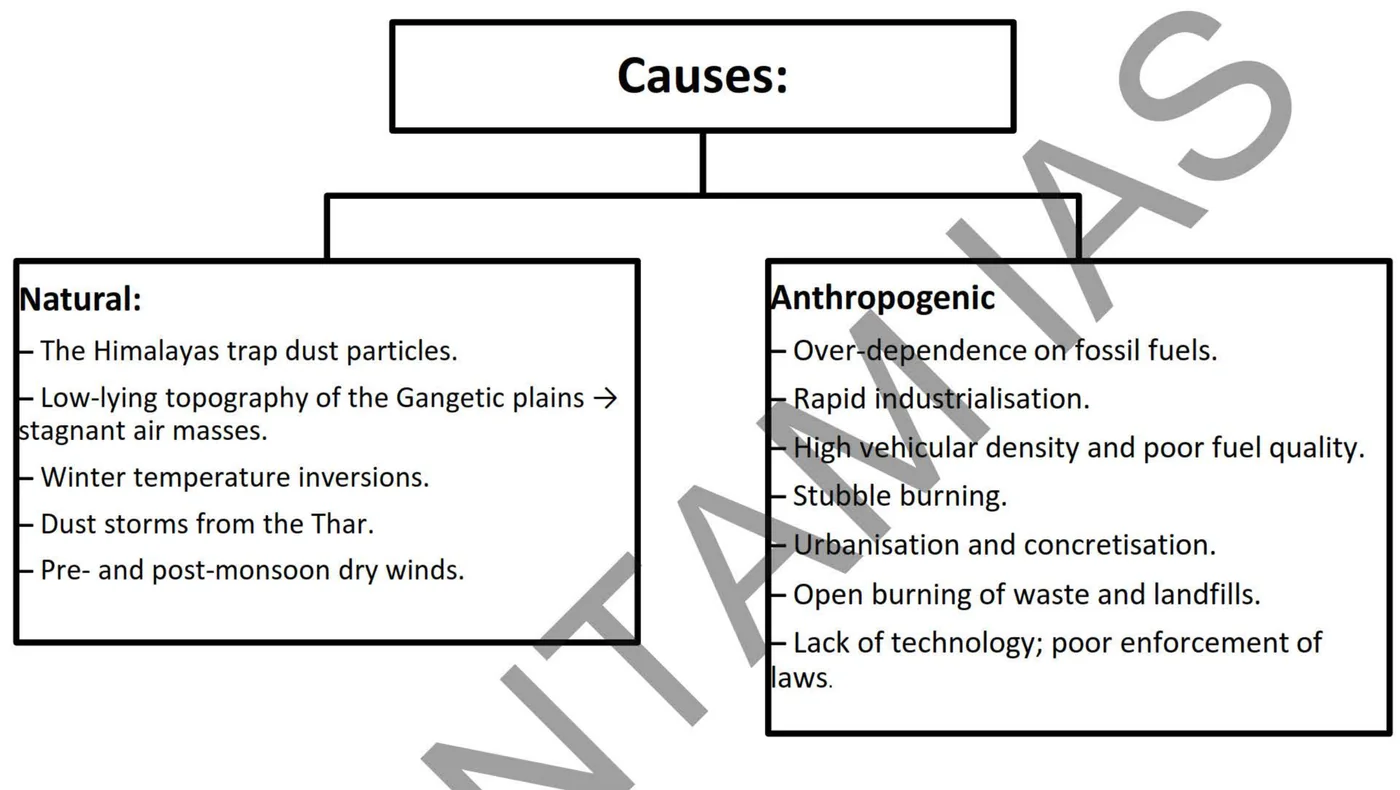
- Reduced wind speeds in winter trap pollutants.
- Temperature inversion stops vertical dispersion.
- Farm fires in Punjab-Haryana (late October-November) add to a high baseline.
- Geographical bowl of the NCR compounds stagnation.
Key pollutants — quick reference
| Pollutant | Primary source | Health effect |
|---|---|---|
| PM2.5 | Combustion, vehicles, biomass | Cardiovascular, respiratory, cancer |
| PM10 | Dust, construction | Respiratory irritation |
| NO2 | Vehicles, power plants | Asthma, lung function |
| SO2 | Coal combustion | Respiratory, acid rain |
| O3 (tropospheric ozone) | VOCs + NOx + sunlight | Lung damage, crop loss |
| CO | Incomplete combustion | Reduced oxygen uptake |
| Benzene, Pb, NH3 | Fuels, industry, agri | Various chronic impacts |
Impacts
- Health — CSE estimates India's life expectancy is 2.6 years shorter because of air pollution; AQLI (Chicago) puts it closer to 5 years for polluted basins.
- Economy — USD 150+ billion/year (~5% of GDP) in disease, premature death, welfare loss.
- Climate — black carbon is a short-lived climate forcer; NOx and ozone alter radiative balance.
- Crops — ozone and PM reduce wheat and rice yields.
- Wildlife — alters plant physiology and breeding behaviours.
Key initiatives
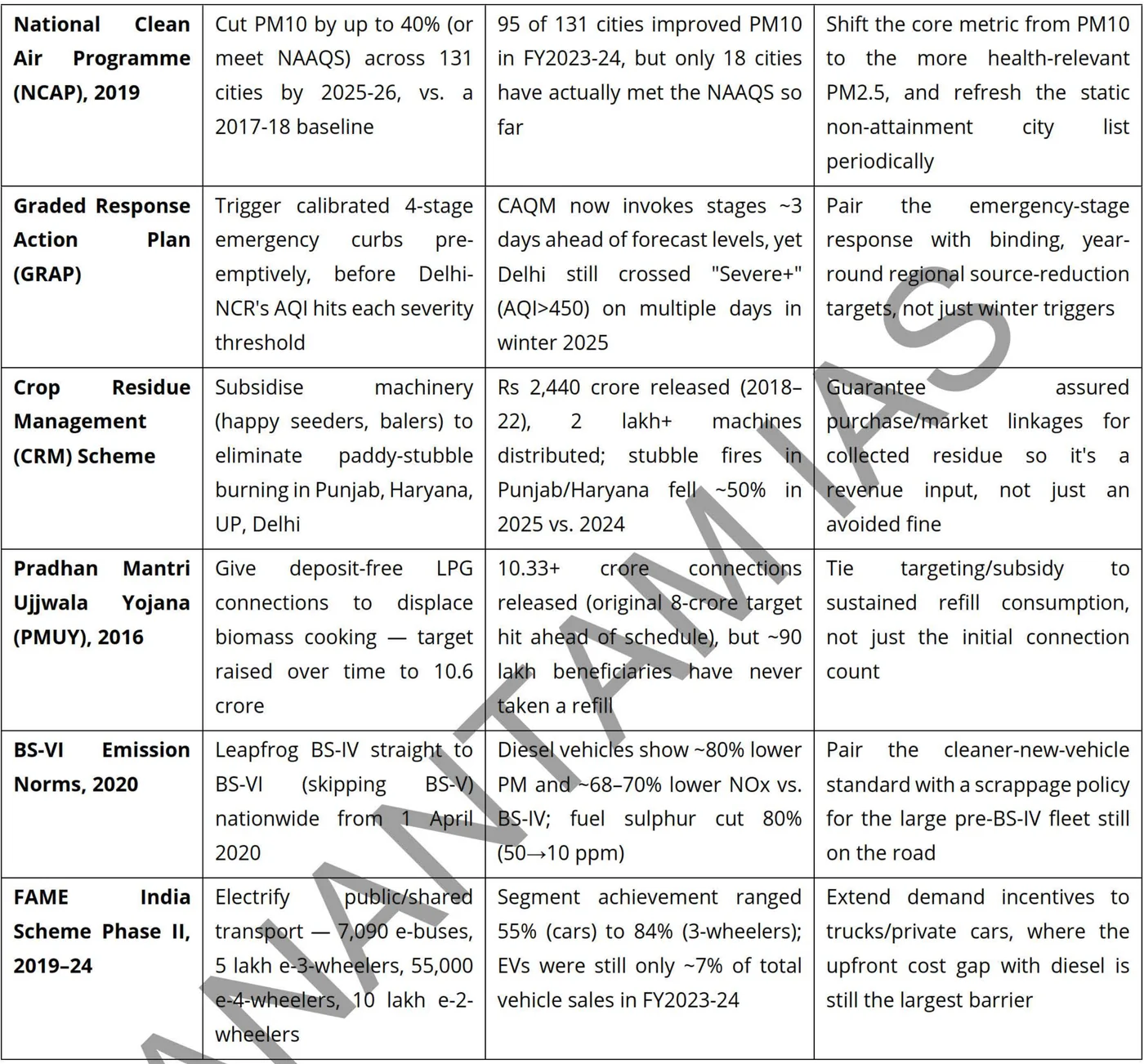
National Clean Air Programme (NCAP), 2019
- MoEFCC-led national programme.
- Original target: 20-30% reduction in PM2.5 and PM10 by 2024 (base 2017); revised to 40% reduction by 2025-26.
- Covers 131 non-attainment cities (up from 102).
- XV Finance Commission allocated Rs 4,400+ crore for 42 million-plus cities; Rs 2,217 crore for 82 other cities over 5 years.
- Prana portal for monitoring action plans.
Commission for Air Quality Management (CAQM), 2021
- Statutory body covering NCR and adjoining areas.
- Replaced the ad hoc EPCA.
- Directions are binding across Delhi, Haryana, Punjab, Rajasthan, UP-NCR.
Graded Response Action Plan (GRAP)
Four-stage emergency response:
| Stage | AQI | Action examples |
|---|---|---|
| I | Poor (201-300) | Ban on garbage burning |
| II | Very Poor (301-400) | Parking fee hike, DG sets off |
| III | Severe (401-450) | Construction ban |
| IV | Severe+ (>450) | Truck entry ban, school closures |
Fuel and vehicle standards
- BS-VI from 1 April 2020 — skipped BS-V entirely.
- Pet-coke and furnace oil ban in NCR (2017).
- Ethanol blending — E20 target advanced to 2025-26.
Clean cooking fuel
- Pradhan Mantri Ujjwala Yojana (PMUY) — over 10 crore LPG connections to below-poverty-line households (2016 onward).
Industrial controls
- 24×7 online emission monitoring in 17 heavily polluting industries.
- National Air Quality Index (NAQI) — launched 2014; 6 categories from Good to Severe.
- National Ambient Air Quality Standards (NAAQS) — last revised 2009; WHO's 2021 guidelines are tighter (India under review).
Specific Delhi measures
- Odd-even scheme (2016, 2017, 2019).
- Smog towers at Connaught Place and Anand Vihar.
- Anti-smog guns on construction sites.
- Dust mitigation plans mandatory for sites >500 sq m.
Stubble (paddy residue) burning
Why it happens
- Combine harvesters leave tall stalks that must be cleared fast.
- Punjab Preservation of Subsoil Water Act, 2009 (and Haryana's equivalent) delayed paddy sowing to conserve groundwater — but shrank the window to clear fields for wheat.
- High silica content in paddy straw makes it unfit for fodder.
- Cheapest option remains setting fire.
Solutions
- Pusa Bio-Decomposer (IARI) — in-situ residue decomposition.
- Happy Seeder, Super Straw Management System (SMS), Surface Seeder — mechanical alternatives.
- Ex-situ use — biomass pellets, cardboard, bio-ethanol, power co-firing with coal.
- Cash incentives to non-burning farmers (proposed).
Indoor air pollution
Often overlooked but a major killer, especially among women and children in rural India:
- ~500 million Indians still use solid fuels (firewood, dung, crop residue) for cooking.
- Global Burden of Disease estimates indoor air pollution kills ~0.8 million Indians annually.
- Ujjwala Yojana and AGNI scheme aim to transition these households to LPG/clean fuels.
Latest developments (2024-26)
Updated context: figures evolve; check MoEFCC and CPCB annual updates.
- NCAP revised target (2023) — 40% PM reduction by 2025-26.
- CAQM tightening measures — 2024 winter saw GRAP Stage IV invoked multiple times.
- Stubble burning — 2024 saw fewer Punjab fire counts but Haryana numbers remained high; debate around Air Quality Commission/Lok Sabha Committee report ongoing.
- BS-VI second stage (RDE) — real-driving emissions phase operational.
- Sovereign Green Bonds proceeds partly channelled to NCAP projects.
- CPCB AQI upgrade — expansion of real-time monitoring network from ~300 to ~1,500 stations targeted by 2026.
- COP29 — methane commitments from agriculture and waste sectors.
UPSC relevance
GS-III mapping
Directly covers "pollution" under conservation and environmental degradation.
Prelims bullets
- NAAQS parameters: 12 pollutants (PM10, PM2.5, SO2, NO2, CO, O3, NH3, benzene, Pb, BaP, As, Ni).
- NCAP launched in January 2019.
- CAQM Act, 2021 replaced EPCA.
- GRAP has 4 stages.
- BS-VI rolled out on 1 April 2020.
- India AQI — 6 categories; scale 0-500.
- SAFAR — System of Air Quality and Weather Forecasting (by IITM, Pune).
Mains angles
- “Delhi’s winter air pollution is the outcome of agricultural policy, urban planning, and meteorology. Critically examine.”
- "Evaluate the achievements and limitations of the National Clean Air Programme."
- "Discuss the governance architecture for air quality management in the NCR."
Essay hooks
- The right to clean air as a constitutional right (Article 21).
- Cooperative federalism in air pollution — an unfinished project.
- Health as the silent victim of development.
Quick revision
| Concept | Value |
|---|---|
| NCAP launch | 2019 |
| NCAP revised target | 40% PM reduction by 2025-26 |
| NCAP non-attainment cities | 131 |
| BS-VI introduction | 1 April 2020 |
| CAQM formation | 2021 (Act) |
| Smog towers | Connaught Place, Anand Vihar |
| Ujjwala connections | ~10 crore |
| WHO PM2.5 guideline | 5 µg/m³ annual mean |
| NAAQS PM2.5 | 40 µg/m³ annual |
For UPSC, the consistent narrative is: India has one of the world's most extensive air quality regulatory architectures on paper — NCAP, CAQM, BS-VI, GRAP — yet the gap between norms and outcomes remains wide. Closing it requires cooperative federalism, agricultural diversification, urban design, and political will.