Air pollution kills more Indians each year than tobacco, alcohol, and road accidents combined. The State of Global Air 2024 report attributes over 2 million premature deaths in India annually to air pollution, and 39 of the world's 50 most polluted cities are Indian. Delhi's winter smog is only the most visible face of a nationwide crisis driven by transport, industry, biomass burning, construction, and agricultural residue burning. For UPSC, this is a perennial GS-III topic with many sub-themes.
Sources of air pollution
| Sector | Major pollutants |
|---|---|
| Transportation | CO, NOx, NMVOCs, PM; road dust |
| Industry (iron, steel, cement, sugar, paper, aluminium, copper, fertiliser) | SPM, SOx, NOx, CO2 |
| Power plants (thermal) | SO2, TSP, NOx, mercury |
| Agriculture | NH3, N2O, CH4 (enteric fermentation), stubble PM |
| Waste management / biomass burning | PM, dioxins, CH4 |
| Household (kerosene, wood, dung cakes) | CO, PM, black carbon |
| Construction & demolition | PM10, silica dust |
Delhi-NCR — a meteorology-sensitive basin
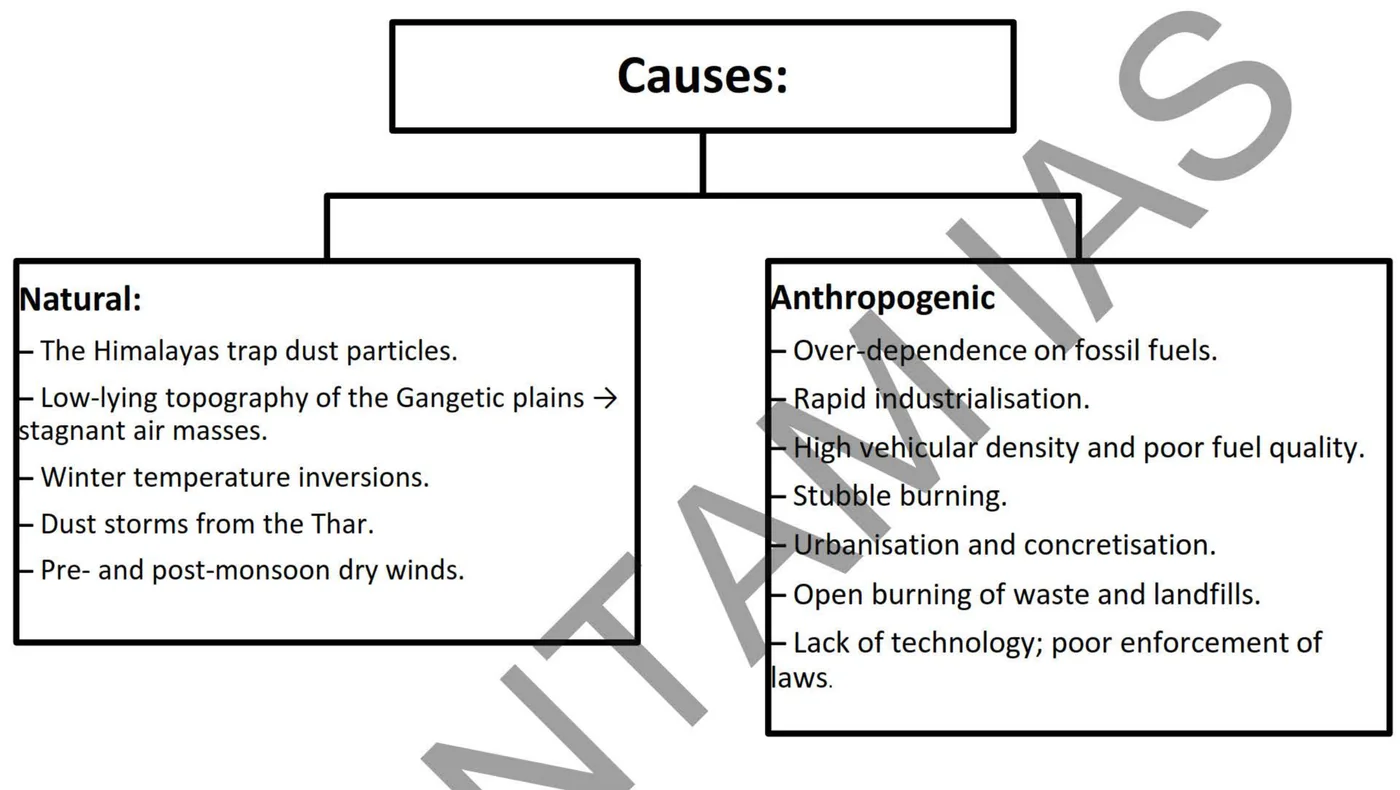
- Reduced wind speeds in winter trap pollutants.
- Temperature inversion stops vertical dispersion.
- Farm fires in Punjab-Haryana (late October-November) add to a high baseline.
- Geographical bowl of the NCR compounds stagnation.
Key pollutants — quick reference
| Pollutant | Primary source | Health effect |
|---|---|---|
| PM2.5 | Combustion, vehicles, biomass | Cardiovascular, respiratory, cancer |
| PM10 | Dust, construction | Respiratory irritation |
| NO2 | Vehicles, power plants | Asthma, lung function |
| SO2 | Coal combustion | Respiratory, acid rain |
| O3 (tropospheric ozone) | VOCs + NOx + sunlight | Lung damage, crop loss |
| CO | Incomplete combustion | Reduced oxygen uptake |
| Benzene, Pb, NH3 | Fuels, industry, agri | Various chronic impacts |
Impacts
- Health — CSE estimates India's life expectancy is 2.6 years shorter because of air pollution; AQLI (Chicago) puts it closer to 5 years for polluted basins.
- Economy — USD 150+ billion/year (~5% of GDP) in disease, premature death, welfare loss.
- Climate — black carbon is a short-lived climate forcer; NOx and ozone alter radiative balance.
- Crops — ozone and PM reduce wheat and rice yields.
- Wildlife — alters plant physiology and breeding behaviours.
Key initiatives
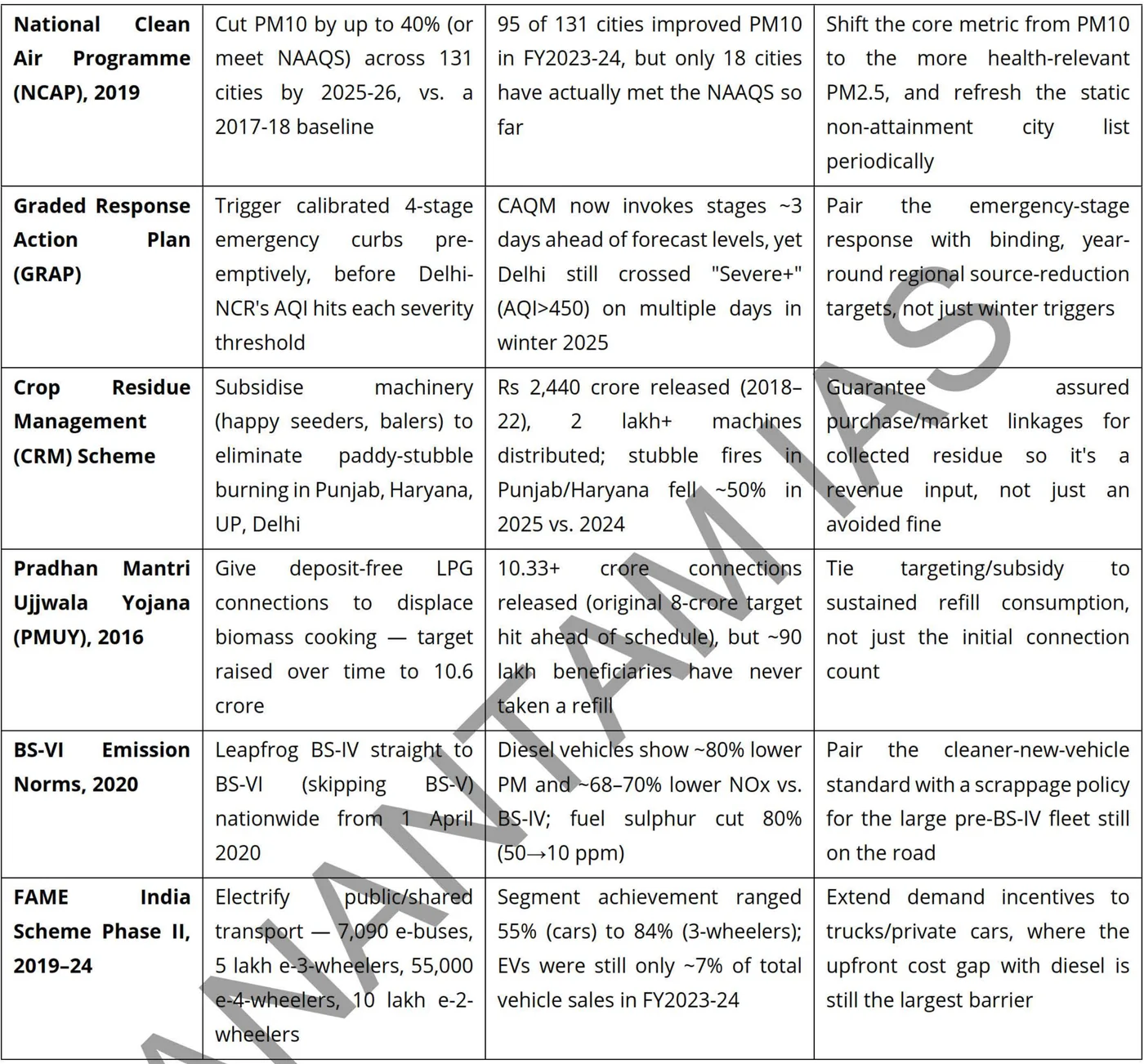
National Clean Air Programme (NCAP), 2019
- MoEFCC-led national programme.
- Original target: 20-30% reduction in PM2.5 and PM10 by 2024 (base 2017); revised to 40% reduction by 2025-26.
- Covers 131 non-attainment cities (up from 102).
- XV Finance Commission allocated Rs 4,400+ crore for 42 million-plus cities; Rs 2,217 crore for 82 other cities over 5 years.
- Prana portal for monitoring action plans.
Commission for Air Quality Management (CAQM), 2021
- Statutory body covering NCR and adjoining areas.
- Replaced the ad hoc EPCA.
- Directions are binding across Delhi, Haryana, Punjab, Rajasthan, UP-NCR.
Graded Response Action Plan (GRAP)
Four-stage emergency response:
| Stage | AQI | Action examples |
|---|---|---|
| I | Poor (201-300) | Ban on garbage burning |
| II | Very Poor (301-400) | Parking fee hike, DG sets off |
| III | Severe (401-450) | Construction ban |
| IV | Severe+ (>450) | Truck entry ban, school closures |
Fuel and vehicle standards
- BS-VI from 1 April 2020 — skipped BS-V entirely.
- Pet-coke and furnace oil ban in NCR (2017).
- Ethanol blending — E20 target advanced to 2025-26.
Clean cooking fuel
- Pradhan Mantri Ujjwala Yojana (PMUY) — over 10 crore LPG connections to below-poverty-line households (2016 onward).
Industrial controls
- 24×7 online emission monitoring in 17 heavily polluting industries.
- National Air Quality Index (NAQI) — launched 2014; 6 categories from Good to Severe.
- National Ambient Air Quality Standards (NAAQS) — last revised 2009; WHO's 2021 guidelines are tighter (India under review).
Specific Delhi measures
- Odd-even scheme (2016, 2017, 2019).
- Smog towers at Connaught Place and Anand Vihar.
- Anti-smog guns on construction sites.
- Dust mitigation plans mandatory for sites >500 sq m.
Stubble (paddy residue) burning
Why it happens
- Combine harvesters leave tall stalks that must be cleared fast.
- Punjab Preservation of Subsoil Water Act, 2009 (and Haryana's equivalent) delayed paddy sowing to conserve groundwater — but shrank the window to clear fields for wheat.
- High silica content in paddy straw makes it unfit for fodder.
- Cheapest option remains setting fire.
Solutions
- Pusa Bio-Decomposer (IARI) — in-situ residue decomposition.
- Happy Seeder, Super Straw Management System (SMS), Surface Seeder — mechanical alternatives.
- Ex-situ use — biomass pellets, cardboard, bio-ethanol, power co-firing with coal.
- Cash incentives to non-burning farmers (proposed).
Indoor air pollution
Often overlooked but a major killer, especially among women and children in rural India:
- ~500 million Indians still use solid fuels (firewood, dung, crop residue) for cooking.
- Global Burden of Disease estimates indoor air pollution kills ~0.8 million Indians annually.
- Ujjwala Yojana and AGNI scheme aim to transition these households to LPG/clean fuels.
Latest developments (2024-26)
Updated context: figures evolve; check MoEFCC and CPCB annual updates.
- NCAP revised target (2023) — 40% PM reduction by 2025-26.
- CAQM tightening measures — 2024 winter saw GRAP Stage IV invoked multiple times.
- Stubble burning — 2024 saw fewer Punjab fire counts but Haryana numbers remained high; debate around Air Quality Commission/Lok Sabha Committee report ongoing.
- BS-VI second stage (RDE) — real-driving emissions phase operational.
- Sovereign Green Bonds proceeds partly channelled to NCAP projects.
- CPCB AQI upgrade — expansion of real-time monitoring network from ~300 to ~1,500 stations targeted by 2026.
- COP29 — methane commitments from agriculture and waste sectors.
UPSC relevance
GS-III mapping
Directly covers "pollution" under conservation and environmental degradation.
Prelims bullets
- NAAQS parameters: 12 pollutants (PM10, PM2.5, SO2, NO2, CO, O3, NH3, benzene, Pb, BaP, As, Ni).
- NCAP launched in January 2019.
- CAQM Act, 2021 replaced EPCA.
- GRAP has 4 stages.
- BS-VI rolled out on 1 April 2020.
- India AQI — 6 categories; scale 0-500.
- SAFAR — System of Air Quality and Weather Forecasting (by IITM, Pune).
Mains angles
- “Delhi’s winter air pollution is the outcome of agricultural policy, urban planning, and meteorology. Critically examine.”
- "Evaluate the achievements and limitations of the National Clean Air Programme."
- "Discuss the governance architecture for air quality management in the NCR."
Essay hooks
- The right to clean air as a constitutional right (Article 21).
- Cooperative federalism in air pollution — an unfinished project.
- Health as the silent victim of development.
Quick revision
| Concept | Value |
|---|---|
| NCAP launch | 2019 |
| NCAP revised target | 40% PM reduction by 2025-26 |
| NCAP non-attainment cities | 131 |
| BS-VI introduction | 1 April 2020 |
| CAQM formation | 2021 (Act) |
| Smog towers | Connaught Place, Anand Vihar |
| Ujjwala connections | ~10 crore |
| WHO PM2.5 guideline | 5 µg/m³ annual mean |
| NAAQS PM2.5 | 40 µg/m³ annual |
For UPSC, the consistent narrative is: India has one of the world's most extensive air quality regulatory architectures on paper — NCAP, CAQM, BS-VI, GRAP — yet the gap between norms and outcomes remains wide. Closing it requires cooperative federalism, agricultural diversification, urban design, and political will.
Tell Google you want more of this.
Add Anantam IAS as a preferred sourceOne tap, and this site shows up more often in your own Top Stories, AI Overviews and AI Mode. Remove it any time.