Ashoka the Great (268 to 232 BCE): Kalinga, Dhamma and the Edicts
Ashoka the Great ruled the Mauryan Empire from 268 to 232 BCE, fought the Kalinga War in 261 BCE, converted to Buddhism, and left 33 sets of edicts inscribed in rock, pillar and cave across the subcontinent. UPSC notes on his reign, Dhamma policy, and missions abroad.
Ashoka the Great was the third and most famous emperor of the Mauryan Empire, reigning from 268 to 232 BCE. He brought the empire to its greatest territorial extent, fought the brutal Kalinga War in 261 BCE, converted to Buddhism in remorse, replaced the policy of military expansion with the policy of Dhamma, and left behind a body of 33 sets of rock, pillar and cave inscriptions in Brahmi, Kharosthi, Greek and Aramaic that constitute the earliest deciphered written records of Indian history. He is the only Indian king before modern times whose own words survive in his own voice.
This article walks through the life and reign of Ashoka the Great in detail, with a focus on the Kalinga War, the Dhamma policy, the edicts, the Buddhist missions abroad, and the administrative legacy. He is one of the most heavily examined figures in UPSC Prelims and Mains under Ancient History, Indian Polity and Indian Art and Culture, and is the centrepiece of the larger story of the Mauryan Empire founded by his grandfather Chandragupta Maurya.
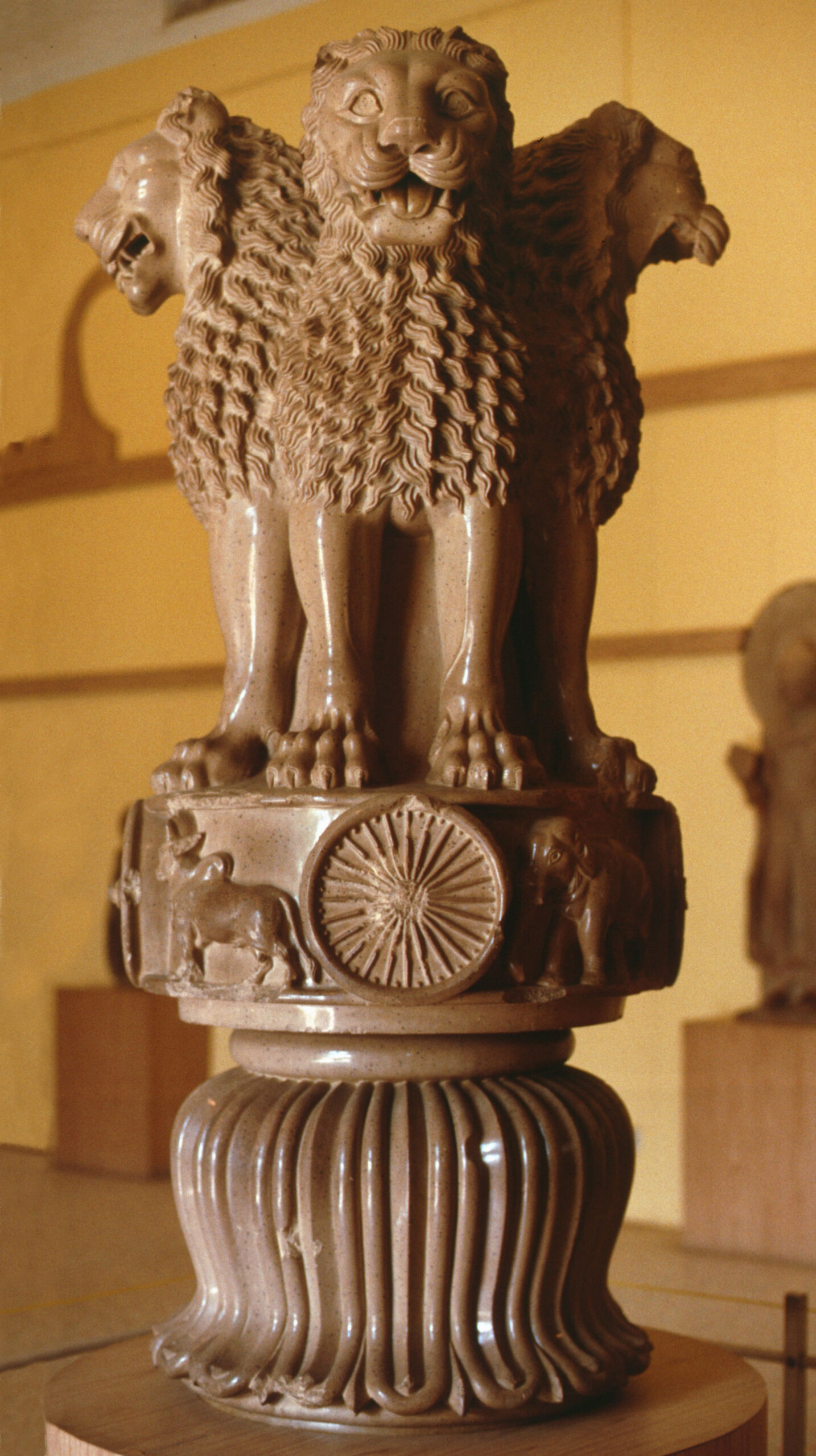
Ashoka the Great matters in 2026 because the symbols of the modern Republic of India are his. The Lion Capital at Sarnath is the State Emblem. The Dharma Chakra on the national flag is his Wheel of Dhamma. The motto Satyameva Jayate is a citation of the Mundaka Upanishad set in his epigraphic tradition. The Brahmi script of his edicts is the ancestor of every modern Indian writing system except Urdu.
Quick Facts About Ashoka the Great
- Reign: 268 to 232 BCE (consecrated 268 BCE after a 4-year succession struggle)
- Father: Bindusara, second Mauryan emperor
- Grandfather: Chandragupta Maurya, founder of the empire
- Capital: Pataliputra (modern Patna, Bihar)
- Titles in his own edicts: Devanampiya (“Beloved of the Gods”), Piyadasi (“He who looks on with affection”), Devanampiya Piyadasi
- Kalinga War: 261 BCE, against the kingdom of Kalinga in modern Odisha
- Edicts: 14 Major Rock Edicts, several Minor Rock Edicts, 7 Pillar Edicts, Minor Pillar Edicts, Cave Inscriptions
- Scripts: Brahmi (most), Kharosthi (north-west), Greek and Aramaic (Kandahar bilingual edicts)
- Deciphered by: James Prinsep in 1837, working on the Sankissa, Delhi and Allahabad pillars
- Children: Mahinda and Sanghamitra (sent on Buddhist mission to Sri Lanka), Kunala (mentioned in tradition)
Early Life and Accession of Ashoka
Ashoka the Great was the son of Bindusara and one of his queens, named Subhadrangi or Dharma in different sources. He was not the eldest son and not the official heir. According to the Sri Lankan Buddhist chronicle Mahavamsa and the Sanskrit text Ashokavadana, Ashoka fought a four-year succession war against his brothers after Bindusara’s death in 273 BCE, and emerged as sole ruler in 269 or 268 BCE. Tradition records that he killed 99 brothers, although this is almost certainly literary exaggeration. He was formally consecrated in 268 BCE.
Before his accession Ashoka served as viceroy at two of the four provincial capitals of the Mauryan Empire. He was first sent to Ujjain in central India as the head of the Avantirashtra province. He suppressed a revolt at Takshashila in the north-west and is later said to have been sent there as viceroy. At Ujjain he married Devi, daughter of a merchant of Vidisha, with whom he had Mahinda and Sanghamitra, his two children who would later carry Buddhism to Sri Lanka.
The pre-conversion phase of his reign was, by tradition, violent. The Ashokavadana paints him as Chandashoka, “the cruel Ashoka,” who built a torture chamber at Pataliputra. Modern historians treat this as Buddhist hagiography composed centuries later to dramatise his subsequent transformation. What is certain is that the first eight years of his reign were spent consolidating power, and that he was personally responsible for the campaign in Kalinga.
The Kalinga War, 261 BCE
The Kalinga War of 261 BCE is the single defining event in Ashoka’s reign and a turning point in the moral history of Indian kingship. Kalinga was a wealthy, independent kingdom on the eastern coast of the subcontinent, in present-day Odisha and northern Andhra Pradesh, with strong maritime trade and a tradition of self-rule. It had stayed outside the Mauryan Empire even at the height of Chandragupta’s expansion. Ashoka invaded it in his eighth regnal year, 261 BCE.
We have Ashoka’s own account of the carnage in the 13th Major Rock Edict, inscribed at Shahbazgarhi, Mansehra, Kalsi, Girnar, Sopara, Yerragudi and Erragudi. He records: “One hundred and fifty thousand persons were carried away captive, one hundred thousand were slain, and many times that number died.” He further records: “After the Kalingas had been conquered, the Beloved of the Gods came to feel a strong inclination towards the Dhamma, a love for the Dhamma, and for instruction in the Dhamma. Now the Beloved of the Gods regrets the conquest of the Kalingas. For the conquest of an unconquered country involves the slaughter of innocent men, their death, or their captivity. The Beloved of the Gods is grieved by this.”
This is the only inscription in the ancient world in which a victorious king publicly repents of his victory. It changed the trajectory of Ashoka’s reign. He renounced military conquest (digvijaya by danda) and embraced the conquest by Dhamma (dhamma vijaya). He converted to Buddhism, possibly under the guidance of the Buddhist monk Upagupta, and began the policy of moral propaganda and public works for which he is remembered.
The Kalinga Edicts
Two separate rock edicts (the Kalinga Edicts, or the Separate Rock Edicts) were inscribed at Dhauli and Jaugada in Odisha, addressed specifically to the Mahamatras of the conquered province. They lay out a new ethical code of governance: “All men are my children; just as I desire for my own children that they should obtain welfare and happiness in this world and the next, the same do I desire for all men.”
Dhamma: Ashoka’s Moral Policy
Ashoka’s Dhamma is not Buddhism in the narrow sectarian sense. It is a public moral code, designed to be acceptable across the religious diversity of the Mauryan Empire, including Buddhists, Jains, Ajivikas, Brahmins and the followers of various local cults. The 12th Major Rock Edict explicitly enjoins toleration of all sects, on the grounds that the “growth of the essentials” of all religions is in the public interest.
Dhamma in practice meant: non-violence (ahimsa) towards humans and animals, respect for elders, kind treatment of slaves and servants, truthfulness, generosity, restraint in speech, observance of religious festivals, and care for travellers, the sick, and prisoners. The 1st Major Rock Edict prohibits the slaughter of animals for royal feasts. The 5th Major Rock Edict creates a new class of officers, the Dhamma Mahamatras, to spread the policy.
Public works followed. Ashoka built rest houses (dharamshalas) for travellers, planted shade trees and mango groves along major roads, dug wells, and provided medical care for humans and animals. The 2nd Major Rock Edict says he set up “two kinds of medical treatment” (chikitsa), one for humans and one for animals.
Distinction from Buddhism
Ashoka’s personal Buddhism is recorded in the Bhabru (or Calcutta-Bairat) Minor Rock Edict, addressed to the Sangha, in which he expresses his faith in the Triratna (Buddha, Dhamma, Sangha) and recommends seven specific Buddhist texts for monks and lay-people. He went on pilgrimage to Lumbini (recorded in the Rummindei Pillar Edict) and to other Buddhist sites. He convened the Third Buddhist Council at Pataliputra in 250 BCE under the monk Moggaliputta Tissa, which standardised the Theravada canon.
But his public edicts almost never name the Buddha by name in a way that would exclude other traditions. The Dhamma he proclaimed publicly was a broad ethical Buddhism rather than a sectarian programme.
Edicts of Ashoka
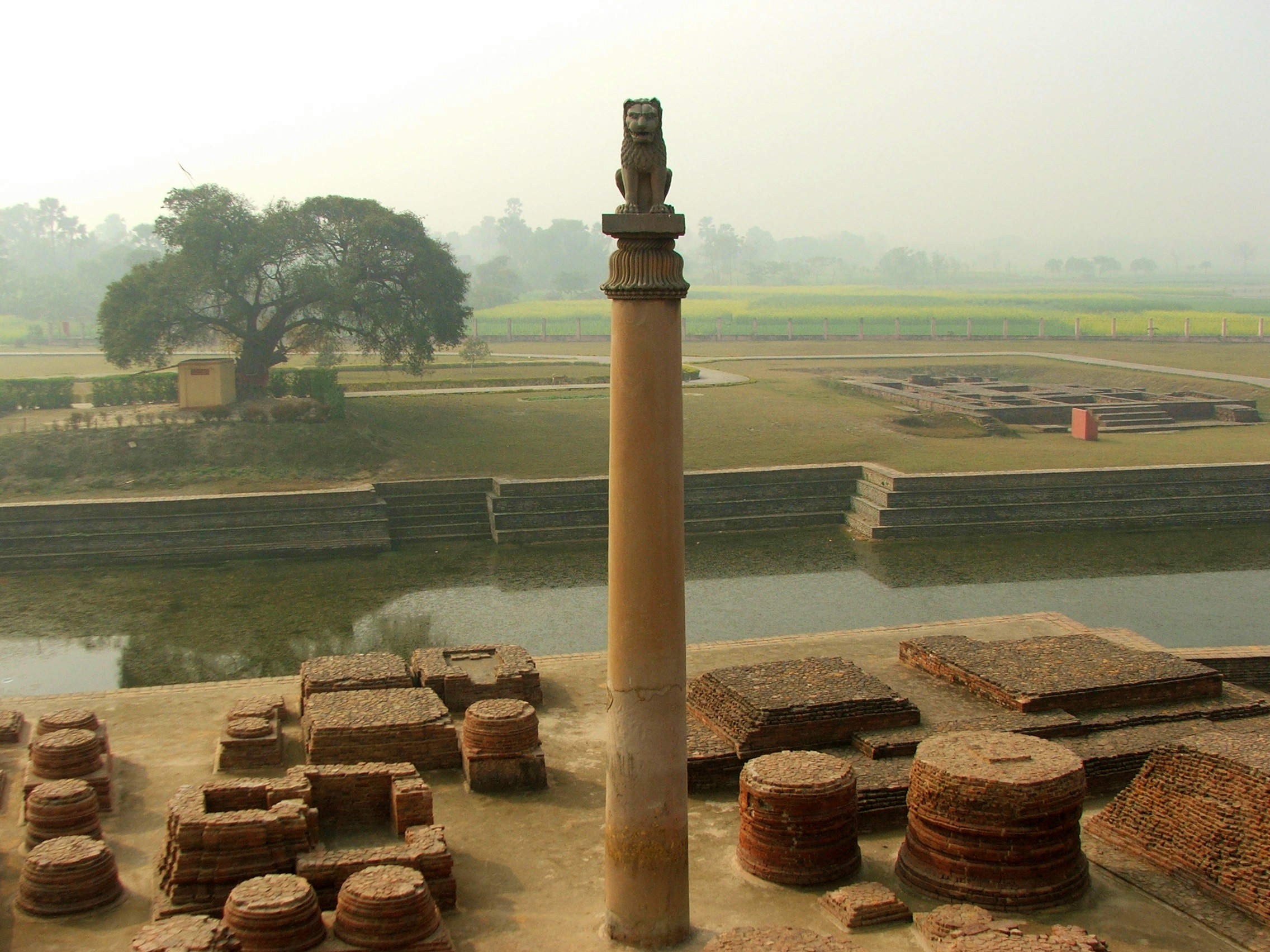
The edicts are Ashoka’s most distinctive contribution. They are the earliest deciphered written records of Indian history, the earliest examples of stone epigraphy on the subcontinent, and the primary source for his reign. They fall into four main groups:
14 Major Rock Edicts: Inscribed on boulders at the geographic edges of the empire, including Shahbazgarhi and Mansehra (Pakistan, in Kharosthi), Kalsi (Uttarakhand), Girnar (Gujarat), Sopara (Maharashtra), Dhauli and Jaugada (Odisha), Yerragudi and Erragudi (Andhra Pradesh), and Kandahar (Afghanistan, in Greek and Aramaic).
Minor Rock Edicts: Earlier and shorter, found at Brahmagiri, Maski, Gavimath, Palkigundu, Sasaram, Rupnath, Bairat, Bhabru, Yerragudi and Kandahar. The Maski and Gujarra edicts uniquely name “Devanampiya Ashoka,” confirming his identity.
7 Pillar Edicts: Inscribed on six polished sandstone pillars, dated to the 26th and 27th regnal years of Ashoka. The principal sites are Delhi-Topra (now in Delhi), Delhi-Meerut (now in Delhi), Allahabad, Lauriya-Araraj, Lauriya-Nandangarh, and Rampurva. They form the most complete summary of Dhamma policy.
Minor Pillar Edicts and Cave Inscriptions: Including the Rummindei Pillar at Lumbini, the Nigali Sagar Pillar near Kapilavastu, the Schism Edict at Sarnath, Allahabad and Sanchi, and the Barabar Hill cave inscriptions donating caves to the Ajivikas.
James Prinsep and the Brahmi Decipherment
The edicts had been visible for centuries but unread. The Brahmi script in which most were written had been forgotten by the medieval period. The breakthrough came in 1837 when James Prinsep, secretary of the Asiatic Society of Bengal, decoded Brahmi by working on the Sanchi inscriptions and matching repeated short donative formulas. With Brahmi deciphered, the entire corpus of Ashokan inscriptions became readable, and the historical Ashoka emerged from the legendary Ashoka of the Buddhist texts.
Buddhist Missions Abroad
After the Third Buddhist Council at Pataliputra in 250 BCE, Ashoka sent Buddhist missions to nine regions, according to the Mahavamsa. The most famous and the only one historically confirmed by independent evidence is the mission to Sri Lanka, led by his son Mahinda and joined later by his daughter Sanghamitra (who carried a sapling of the Bodhi tree). The Sri Lankan king Devanampiya Tissa converted to Buddhism, and Sri Lanka has remained a Theravada Buddhist country ever since.
Other missions were sent to Suvarnabhumi (Myanmar/Thailand region), to Maharashtra, Gandhara, Kashmira, Mahishamandala (Mysore area), the Yavana country (Hellenistic world), Vanavasi (north Kanara), and Aparantaka (western coast). The 13th Major Rock Edict names five Hellenistic kings to whom Ashoka claims to have sent Dhamma envoys: Antiochus II of Syria, Ptolemy II of Egypt, Magas of Cyrene, Antigonus Gonatas of Macedonia, and Alexander of Epirus. This is the only Indian inscription naming contemporary Mediterranean rulers, and it allows historians to date Ashoka’s reign with precision.
Mauryan Art Under Ashoka
The Lion Capital at Sarnath, raised by Ashoka around 250 BCE to mark the site of the Buddha’s First Sermon, is the most famous Mauryan sculpture. Four lions stand back to back on an abacus bearing four animals (elephant, bull, horse, lion) and four chakras, the whole capital crowned by a great Dharma Chakra (now lost) and set on an inverted lotus bell. The Republic of India adopted it as the State Emblem in 1950, and the abacus chakra became the chakra at the centre of the national flag.
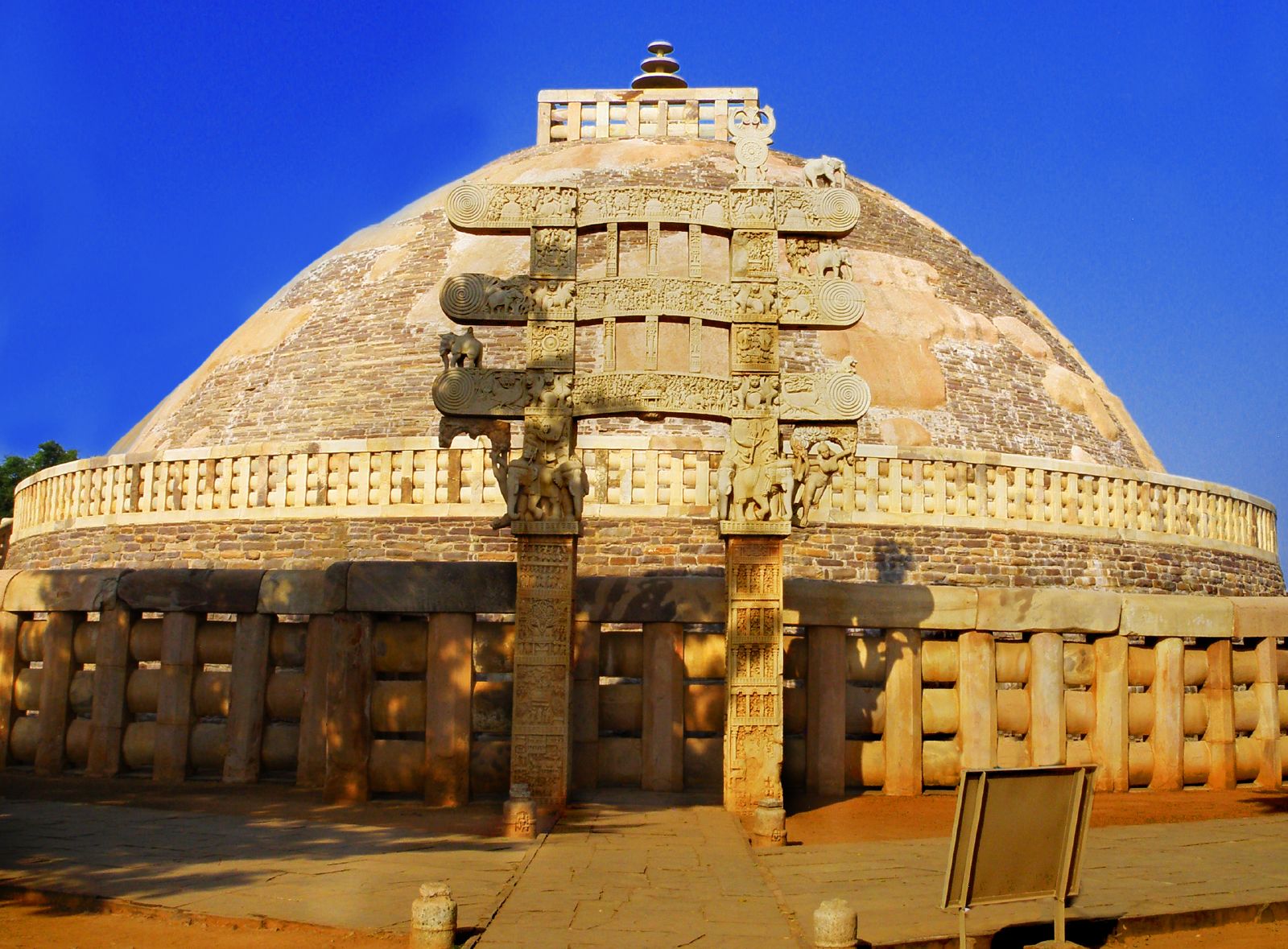
Other monumental works include the single-animal capitals at Vaishali, Sankissa, Rampurva, Lauriya-Nandangarh and Lauriya-Araraj; the polished caves at Barabar Hills near Gaya, the earliest rock-cut sanctuaries in India, donated to the Ajivikas; and the original brick core of the Great Stupa at Sanchi. The defining technical feature of Mauryan court art is the distinctive mirror polish on Chunar sandstone, which has survived 2,250 years on the surviving pillars.
Administrative Legacy
Ashoka’s administration largely continued the framework of his predecessors, with one major addition: the Dhamma Mahamatras, officers tasked with the propagation of Dhamma and the welfare of subjects. They were sent into the provinces and were authorised to visit prisons, deal with welfare cases, ensure fair treatment of religious minorities, and report violations of Dhamma directly to the king.
The empire was still organised around four to five provinces (Pataliputra at the centre, Taxila in the north-west, Ujjain in the west, Suvarnagiri in the south, and Tosali for the conquered Kalinga) under princes (Kumaras), with district officers (Pradeshikas) and village officers (Gramikas) below them. The standing army, the espionage corps and the road system inherited from Chandragupta’s time continued.
The defining administrative innovation, however, was the use of the epigraphic medium itself. By cutting his official policy into rock and pillar across the entire empire, Ashoka made the policy public, durable, and resistant to local distortion. It is the first known propaganda by inscription on a continental scale.
For related ancient and medieval Indian history reading, see Mauryan Empire, Chandragupta Maurya, Kautilya, and the later south Indian state of Rajaraja Chola I.
Frequently Asked Questions
Who was Ashoka the Great?
Ashoka the Great was the third emperor of the Mauryan Empire, reigning from 268 to 232 BCE. He was the grandson of Chandragupta Maurya and the son of Bindusara. He fought the Kalinga War in 261 BCE, converted to Buddhism in remorse, adopted the policy of Dhamma, and left 33 sets of edicts inscribed across the subcontinent in Brahmi, Kharosthi, Greek and Aramaic.
What was the Kalinga War?
The Kalinga War was fought by Ashoka in 261 BCE against the kingdom of Kalinga in modern Odisha. According to his own 13th Major Rock Edict, 100,000 people were killed, 150,000 deported and many more died of starvation and disease. The war caused Ashoka deep remorse, and he renounced military conquest, converted to Buddhism, and replaced bherighosha (the drum of war) with dhammaghosha (the proclamation of Dhamma).
What is Ashoka’s Dhamma policy?
Ashoka’s Dhamma was a public moral code, not a sectarian Buddhism. It enjoined non-violence (ahimsa) towards humans and animals, respect for elders, kind treatment of slaves, truthfulness, generosity, religious tolerance, and care for travellers, the sick and prisoners. It was promoted by a new class of officers called Dhamma Mahamatras and propagated through rock and pillar edicts across the empire.
How many edicts did Ashoka leave?
Ashoka left 33 distinct sets of inscriptions, including 14 Major Rock Edicts, several Minor Rock Edicts, 7 Pillar Edicts, Minor Pillar Edicts (including the Rummindei pillar at Lumbini and the Schism Edict), and Cave Inscriptions in the Barabar Hills. They are inscribed in Brahmi (most), Kharosthi (north-west), and Greek and Aramaic (Kandahar). They were deciphered by James Prinsep in 1837.
Why is the Lion Capital of Ashoka important?
The Lion Capital of Ashoka was raised at Sarnath, near Varanasi, around 250 BCE to mark the site of the Buddha’s First Sermon. It shows four lions standing back to back on an abacus carved with four animals and four chakras, on an inverted lotus bell. The Republic of India adopted it as the State Emblem in 1950, and the chakra became the central feature of the national flag.
Where did Ashoka send Buddhist missions?
After the Third Buddhist Council at Pataliputra in 250 BCE, Ashoka sent Buddhist missions to nine regions according to the Mahavamsa. The most important and historically confirmed is the mission to Sri Lanka, led by his son Mahinda and his daughter Sanghamitra. Other missions went to Myanmar and Thailand (Suvarnabhumi), Maharashtra, Gandhara, Kashmir, Mysore, the Hellenistic Yavana world, and the western coast.
Who deciphered Ashoka’s inscriptions?
The Brahmi script of Ashoka’s inscriptions was deciphered by James Prinsep, secretary of the Asiatic Society of Bengal, in 1837. He worked on the short repeated donative inscriptions at Sanchi to identify the Brahmi alphabet, and then read the longer pillar and rock edicts. Prinsep’s decipherment was the foundation of all modern study of Indian antiquity.
What is Ashoka’s lasting legacy?
Ashoka the Great’s lasting legacy includes the national symbols of the Republic of India (the Lion Capital, the Dharma Chakra and the Brahmi-derived scripts), the spread of Buddhism beyond India through state missions, the model of a king who renounces conquest by force in favour of moral influence, and the world’s first continental-scale programme of epigraphic communication of state policy.