Asian Elephant (Elephas maximus): Biology, Conservation, and India’s National Heritage Animal
A complete UPSC GS-III guide to the Asian elephant, India's National Heritage Animal. Covers biology, social structure, conservation status under WPA Schedule I and CITES Appendix I, range, and the comparison with the African elephant.
The Asian elephant, scientifically Elephas maximus, is the largest land animal in Asia and the cultural, ecological, and political emblem of Indian wildlife. India hosts roughly sixty percent of the global Asian elephant population, a remarkable concentration for any large mammal in the modern world, and the country has accordingly built one of the most layered legal and institutional protections seen anywhere. The Asian elephant was declared India’s National Heritage Animal in 2010, sits on Schedule I of the Wildlife Protection Act, and is on Appendix I of CITES, the strictest international trade prohibition available.
For a UPSC aspirant, the Asian elephant is more than a species. It is a keystone, an umbrella, and an indicator. Its corridors define the ecological geography of the country in ways that political boundaries do not. Its matriarchal social structure and long gestation make it one of the most well-studied large mammals in the world. And its conflicts with human settlements, infrastructure, and agriculture place it at the centre of every serious conversation about biodiversity conservation in India.
Quick Facts on the Asian Elephant
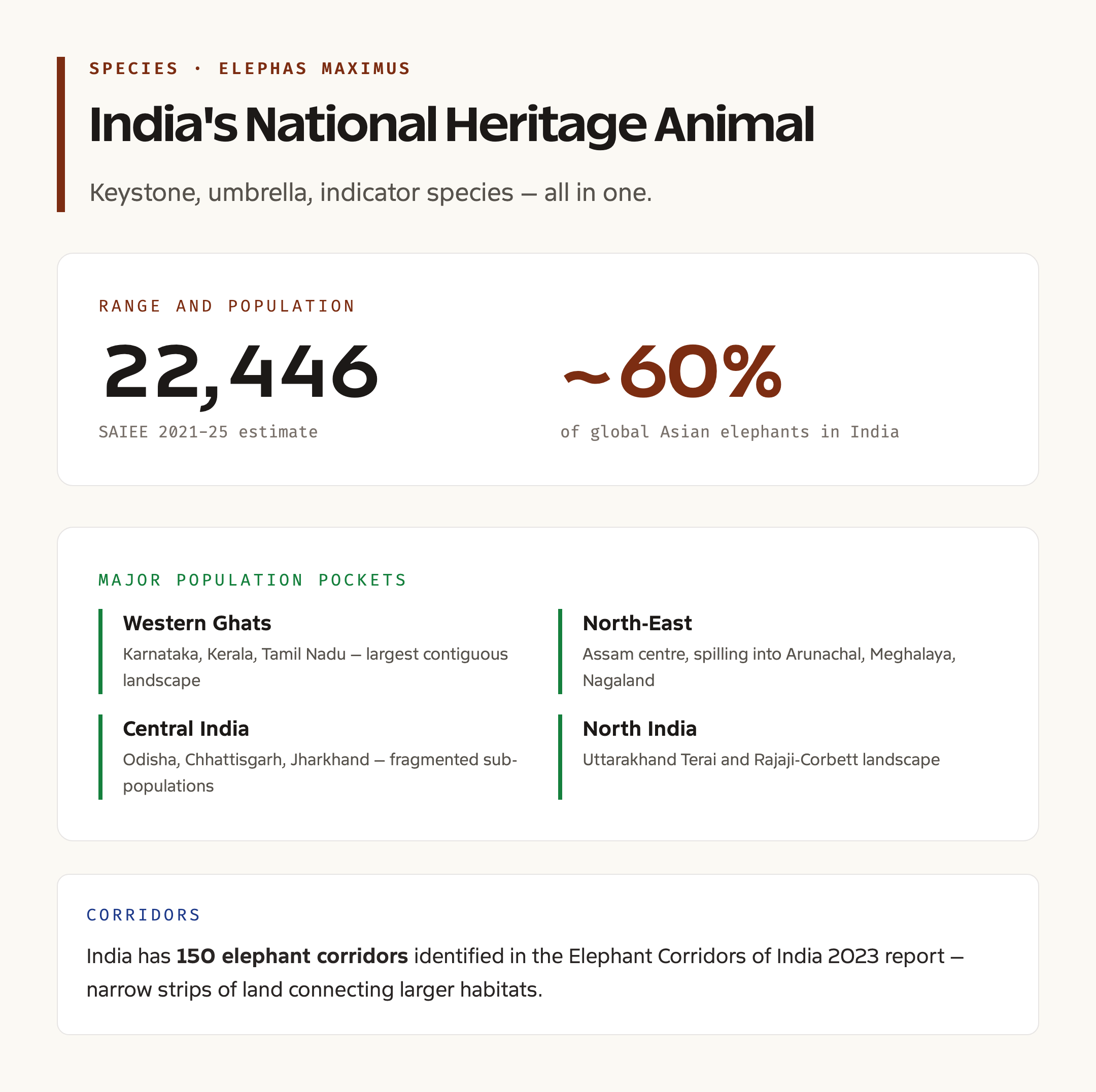
The Asian elephant is one of three living elephant species, the other two being the African Savanna Elephant and the African Forest Elephant. Adults reach a maximum height of around 3.5 metres at the shoulder, somewhat smaller than the African Savanna Elephant. Females have a gestation period of 18 to 22 months, the longest of any mammal. The species lives in matriarchal herds led by the oldest female, while adult males are typically solitary. India hosts roughly 60 percent of the global wild population, with major sub-populations in Karnataka, Assam, Kerala, Tamil Nadu, and the Northeast.
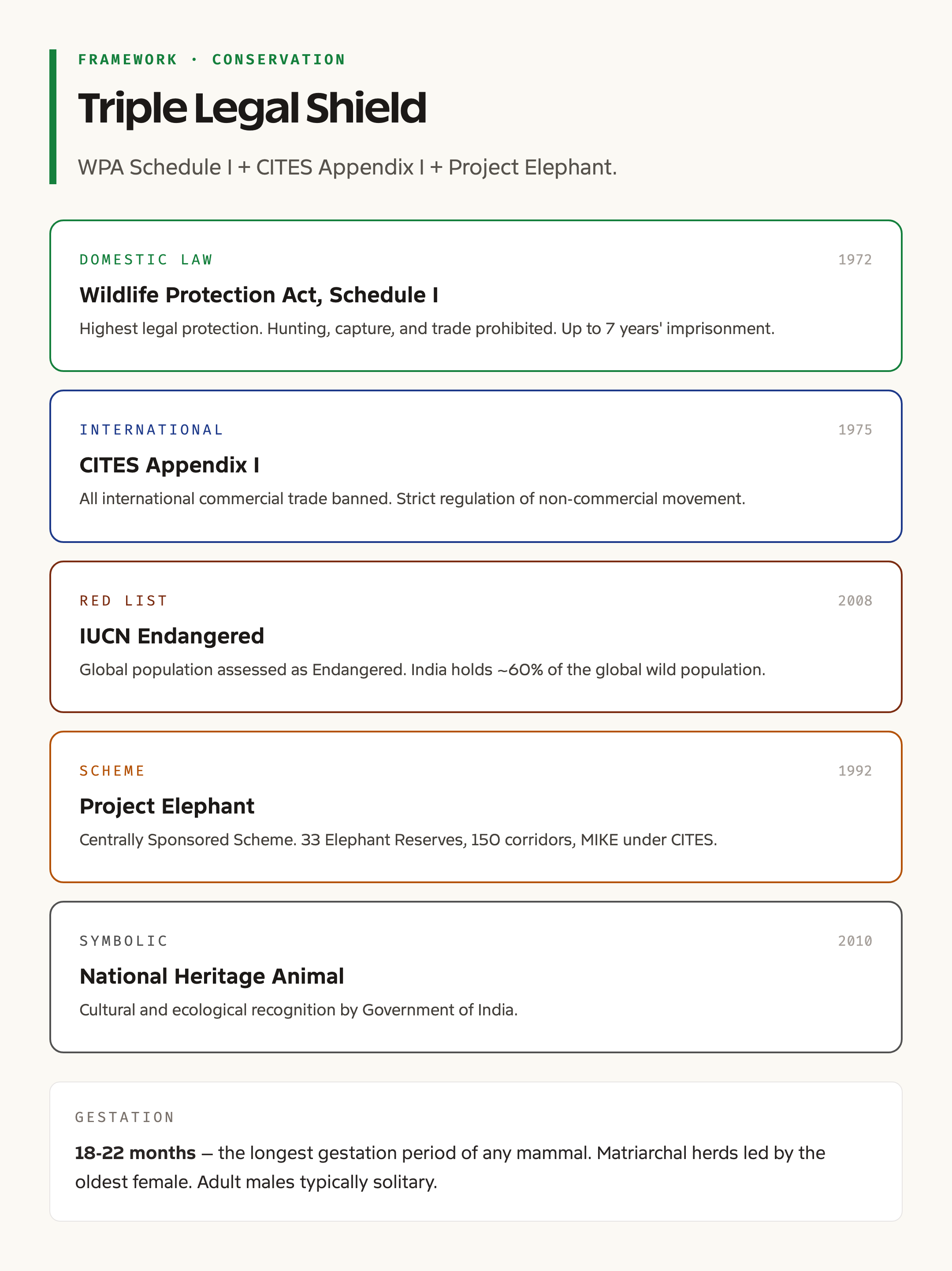
Conservation status reads like a complete legal kit. The IUCN Red List classifies the species as Endangered. Schedule I of the Wildlife Protection Act, 1972 gives it the highest possible protection in India. CITES Appendix I bans all international commercial trade. The 2010 declaration as National Heritage Animal sealed the species’ symbolic importance.
What the Asian Elephant Is
Background and Historical Context
Elephants have been part of Indian civilisation for at least four thousand years. Indus Valley seals depict them, the Mahabharata and Ramayana feature them, and Ashokan edicts use them as symbols of royal authority. The first evidence of capture and training of wild elephants appears in the late Vedic period, and by the Mauryan empire war elephants formed a key arm of the Indian military, a role they retained well into the Mughal period.
In the colonial era, the elephant was both protected and exploited. Forest Departments captured elephants for timber haulage, and the Madras Elephants Preservation Act of 1873, one of the earliest wildlife laws in the country, was passed largely to ensure a steady supply of working elephants. After independence, the species shifted from a working animal to a conservation icon. The 1972 Wildlife Protection Act placed the elephant on Schedule I. Project Elephant followed in 1992 as a Centrally Sponsored Scheme, modelled on the success of Project Tiger. The 2010 declaration as National Heritage Animal completed the symbolic elevation.
The release of the Synchronous All India Elephant Estimation 2021-25 put the wild population at 22,446, with confidence intervals tight enough to act as a baseline for the next decade. Read this against the broader picture of wildlife protection in India and the legal architecture of environmental laws to see the layered framework now in place.
Key Provisions of Asian Elephant Conservation
The Asian elephant’s protection in India sits on three legal pillars. The first is the Wildlife Protection Act of 1972, which on Schedule I prohibits hunting, capture, and trade in any form, with penalties of up to seven years’ imprisonment. The second is CITES, the Convention on International Trade in Endangered Species, which on Appendix I bans all international commercial trade and tightly regulates non-commercial movement of live elephants and elephant products such as ivory. The third is Project Elephant, the operational scheme that funds elephant reserves, corridor protection, anti-depredation measures, and community engagement.
The country has notified 33 Elephant Reserves covering more than 80,000 square kilometres of habitat. Unlike Tiger Reserves, Elephant Reserves do not have an independent statutory backing equivalent to the National Tiger Conservation Authority, and this is a recurring policy gap that the Elephant Task Force has flagged repeatedly. The MIKE programme, established under CITES in 2003, monitors illegal killing across ten Indian sites and feeds data into a global poaching database.
Why the Asian Elephant Matters
The Asian elephant matters first as a keystone species. By eating large amounts of vegetation, dispersing seeds across vast distances, creating water holes, and trampling forest pathways, elephants shape the structure and species composition of the forests they inhabit. Loss of elephants in a landscape leads to measurable shifts in tree species composition over decades. The species also matters as an umbrella species: protecting elephant habitat at landscape scale automatically protects hundreds of co-occurring species that would never receive dedicated conservation attention on their own.
It matters second as an indicator. Elephants need large, contiguous, well-watered habitat. Where they thrive, the forest is functioning. Where they decline, something is wrong. The collapse of elephant populations in central India over the last fifty years tracked the fragmentation of dry deciduous forest by mining, plantations, and linear infrastructure. The robust population in the Western Ghats reflects the relative integrity of that landscape.
It matters third as a cultural and political signal. The 2010 National Heritage Animal declaration was followed by tighter protection of corridors, the Elephant Task Force report, and the recent Synchronous All India Elephant Estimation. Each step reaffirmed that India’s commitment to elephant conservation is a sustained policy choice rather than a one-time gesture.
Detailed Analysis: Biology and Social Structure
The Asian elephant lives in tightly knit matriarchal herds, typically of eight to twelve individuals, although temporary aggregations can be much larger. The oldest female leads the herd and her decisions shape feeding routes, water access, and response to threats. Adult males leave the natal herd at around fourteen years of age and lead solitary or small bachelor-group lives, joining herds briefly during musth, the periodic state of heightened reproductive activity marked by elevated testosterone, temporal gland secretion, and aggressive behaviour.
Reproduction is slow. Females reach sexual maturity at around twelve to fourteen years and produce a single calf after a gestation of 18 to 22 months. The inter-calving interval averages four to five years. A female may have five or six calves over a sixty-year reproductive lifespan. This slow reproductive rate makes the species especially vulnerable to demographic shocks. A herd that loses its matriarch through poaching or accident often fragments and may take years to restabilise.
Communication is sophisticated. Elephants use a combination of low-frequency infrasonic calls, often below the threshold of human hearing, that can travel several kilometres through the ground. They also use seismic signals through the feet, allowing distant herds to coordinate movement during dry seasons. Their cognitive abilities, including self-recognition in mirrors and tool use, place them among the most intelligent non-human species on the planet.
Comparative Look: Asian vs African Elephant
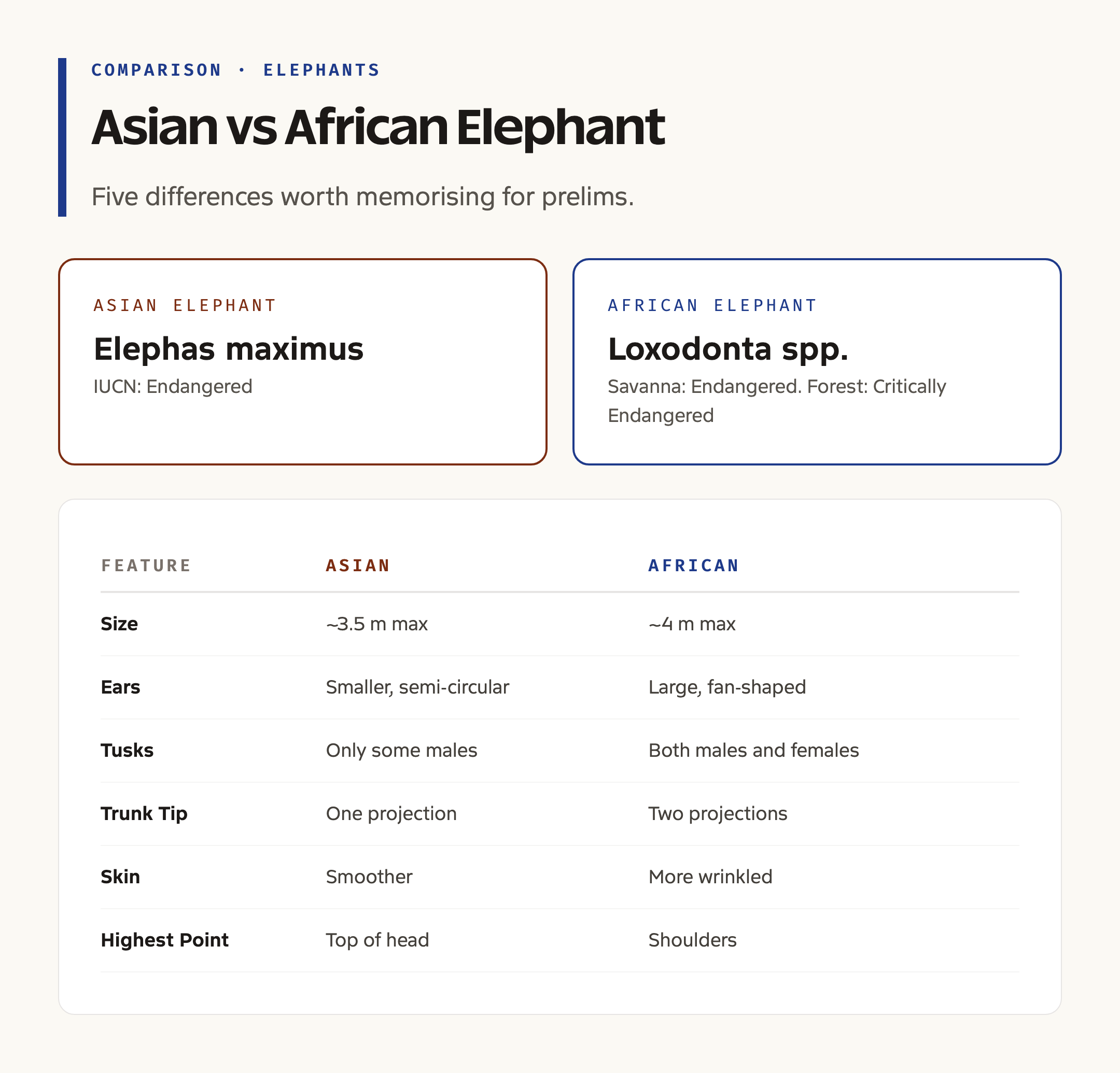
| Feature | Asian Elephant | African Elephant |
|---|---|---|
| Size | Smaller, max around 3.5 m tall | Larger, max around 4 m tall |
| Ears | Smaller, semi-circular | Large, fan-shaped, like the African continent |
| Tusks | Only some males have tusks | Both males and females have tusks |
| Trunk Tip | One finger-like projection | Two finger-like projections |
| Skin | Smoother | More wrinkled |
| Highest Body Point | Top of the head | Shoulders |
| IUCN Status | Endangered | Savanna: Endangered. Forest: Critically Endangered |
The most useful exam fact is the trunk tip: one projection for Asian, two for African. The next is the ear shape, since the larger fan-shaped ear of the African elephant is shaped like the African continent itself. Note that the African elephant is now treated by IUCN as two distinct species, the African Savanna Elephant which is Endangered and the African Forest Elephant which is Critically Endangered.
Challenges Facing the Asian Elephant in India
The first challenge is corridor loss. India has 150 identified elephant corridors, many of them narrow and increasingly fragmented by highways, railways, plantations, and mining leases. The 2023 amendment to the Forest Conservation Act exempted certain strategic projects within 100 kilometres of international borders, which overlaps with elephant range in the Northeast.
The second challenge is human-elephant conflict. Around 500 people and 100 elephants die every year in India in conflict incidents. The losses are concentrated in fringe villages of West Bengal, Odisha, Jharkhand, Assam, and the Western Ghats. Crop raiding, especially of paddy, sugarcane, and bananas, is the immediate trigger. Underneath lies habitat loss, denial of corridor access, and the collapse of traditional buffer zones.
The third challenge is captive elephants. India has around 2,500 captive elephants, half of them privately owned. Conditions vary widely and welfare concerns are acute. The Supreme Court has issued multiple directions on the welfare of captive elephants, and the Ministry has tightened registration and transfer rules, but enforcement is uneven. The fourth is poaching for ivory, which has declined in India but remains a regional risk through trans-boundary networks.
Prelims Pointers
The Asian elephant, Elephas maximus, was declared India’s National Heritage Animal in 2010. It is on Schedule I of the Wildlife Protection Act, 1972, on Appendix I of CITES, and listed as Endangered on the IUCN Red List. India hosts approximately 60 percent of the global wild population. The Synchronous All India Elephant Estimation 2021-25 puts the population at 22,446.
The gestation period is 18 to 22 months, the longest among mammals. The species lives in matriarchal herds led by the oldest female, while adult males are typically solitary. Communication uses low-frequency infrasonic calls. Project Elephant was launched as a Centrally Sponsored Scheme in 1992. India has 33 Elephant Reserves and 150 identified corridors.
Mains Questions on the Asian Elephant
Discuss the ecological and cultural significance of the Asian elephant in India and evaluate the institutional framework for its conservation. Critically examine the challenges of human-elephant conflict in India and suggest a way forward. Compare and contrast the conservation regimes for tigers and elephants in India.
A complete answer would distinguish the keystone and umbrella roles of the species, would link conflict to corridor loss and infrastructure pressure, and would acknowledge that Project Elephant lacks the statutory backing that Project Tiger acquired through the 2006 amendment to the Wildlife Protection Act creating the National Tiger Conservation Authority.
Way Forward
The route forward involves four reforms. The first is statutory backing for Elephant Reserves equivalent to that for Tiger Reserves, with a National Elephant Conservation Authority empowered to clear or block linear infrastructure through corridors. The second is mandatory underpasses and overpasses on all new highways and railways through identified corridors, with retrofitting of existing alignments where possible.
The third is a national framework for fast-track ex-gratia and crop insurance for fringe villages, recognising that conflict cannot be ended but can be made financially survivable for the poorest farmers. The fourth is the integration of SAIEE data into a national elephant database that tracks individual movements, enabling early warning of corridor breakdowns.
Frequently Asked Questions
What is the scientific name of the Asian elephant?
Elephas maximus. It is one of three living elephant species, the other two being the African Savanna Elephant, Loxodonta africana, and the African Forest Elephant, Loxodonta cyclotis.
Why is the Asian elephant called India’s National Heritage Animal?
The Government of India declared the Asian elephant the National Heritage Animal in 2010 to recognise its cultural, ecological, and economic importance. The declaration followed recommendations from the Elephant Task Force and was intended to focus public attention on conservation.
What is the conservation status of the Asian elephant?
It is Endangered on the IUCN Red List, on Schedule I of the Wildlife Protection Act, 1972, and on Appendix I of CITES, which bans all international commercial trade.
How is the Asian elephant different from the African elephant?
The Asian elephant is smaller, has smaller semi-circular ears, only some males have tusks, and the trunk has one finger-like projection at the tip. The African elephant is larger, has fan-shaped ears, both males and females have tusks, and the trunk has two finger-like projections.
What is the gestation period of the Asian elephant?
Eighteen to twenty-two months. This is the longest gestation period of any mammal.
Why is the Asian elephant called a keystone species?
A keystone species shapes the structure of its ecosystem out of proportion to its numbers. Elephants disperse seeds across vast distances, create water holes, maintain forest clearings, and shape vegetation through browsing. Loss of elephants leads to measurable shifts in tree species composition.
What is the role of the matriarch in elephant society?
The matriarch is typically the oldest female in the herd. She leads decisions on feeding routes, water access, response to threats, and movement during dry seasons. Her experience and memory are central to the herd’s survival.
What is musth?
Musth is a periodic state of heightened reproductive activity in adult male elephants, characterised by elevated testosterone, secretions from the temporal glands on the side of the face, and increased aggression. Bull elephants in musth are unpredictable and dangerous to approach.
What is Project Elephant?
Project Elephant is a Centrally Sponsored Scheme launched in 1992 to protect elephants, their habitats, and corridors, and to address human-elephant conflict. It funds 33 Elephant Reserves and supports the MIKE programme under CITES.
What proportion of the global Asian elephant population is in India?
India hosts approximately 60 percent of the global wild Asian elephant population, with the latest Synchronous All India Elephant Estimation putting the figure at 22,446.