Babur: Founder of the Mughal Empire, Battles and Reign
Babur (1483-1530) founded the Mughal Empire after defeating Ibrahim Lodi at the First Battle of Panipat in 1526. Explore his reign, battles of Khanwa, Chanderi and Ghaghra, the Tulghuma tactic, the Baburnama and his UPSC relevance.
Introduction
Zahiruddin Muhammad Babur, born on 14 February 1483 at Andijan in the Fergana Valley, founded the Mughal Empire in India when he defeated Sultan Ibrahim Lodi at the First Battle of Panipat on 21 April 1526. By the time of his death four years and eight months later, on 26 December 1530 at Agra, Babur had stitched together a north Indian polity stretching from Kabul in the west to Bengal in the east, anchored on three decisive battlefield victories and a new style of warfare built around field artillery and the Tulghuma flanking tactic.
For UPSC 2026 aspirants, Babur is the indispensable starting point for medieval India. He appears in Prelims for dates, dynastic terms and battles, in GS1 Mains for the political reordering of the subcontinent, and in source-based questions for the Baburnama, the most candid royal memoir of the medieval Islamic world. This guide walks through his life, military campaigns, administration and legacy using a framework that supports both Prelims recall and Mains analysis, with cross-references to the broader Mughal Empire and the Delhi Sultanate that preceded it.
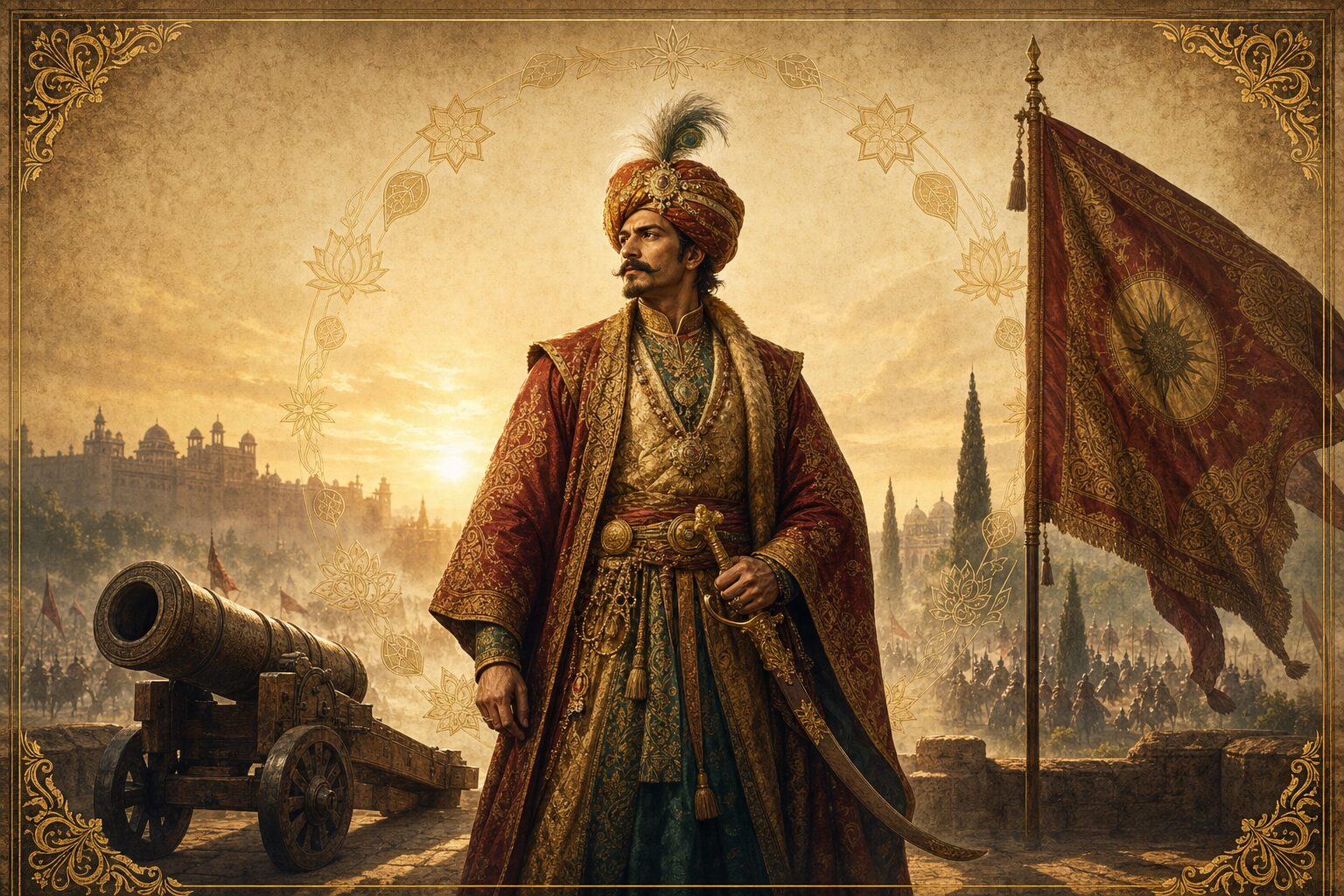
Quick Facts at a Glance
| Attribute | Detail |
|---|---|
| Full name | Zahiruddin Muhammad Babur |
| Born | 14 February 1483, Andijan (Fergana Valley, modern Uzbekistan) |
| Died | 26 December 1530, Agra (later reburied at Bagh-e Babur, Kabul) |
| Father | Umar Sheikh Mirza (Timurid prince of Fergana) |
| Mother | Qutlugh Nigar Khanum (Chagatai descent of Genghis Khan) |
| Ancestry | Timur on father’s side, Genghis Khan on mother’s side |
| Reign in India | 21 April 1526 to 26 December 1530 (4 years, 8 months) |
| Capital | Agra |
| Founding battle | First Battle of Panipat, 21 April 1526 |
| Defeated at Panipat | Ibrahim Lodi (last Sultan of Delhi) |
| Other major battles | Khanwa (1527), Chanderi (1528), Ghaghra (1529) |
| Military innovations | Field artillery, matchlock muskets, Tulghuma tactic |
| Memoir | Baburnama (Tuzuk-i-Baburi), composed in Chagatai Turkish |
| Successor | Humayun, his eldest son |
Background and Historical Context
Babur inherited the small principality of Fergana at twelve, after his father Umar Sheikh Mirza died in a freak accident when his pigeon house collapsed into a ravine on 9 June 1494. Within months, the boy-king found himself fighting his uncles for control of Samarkand, the Timurid capital his ancestor Timur had built. He captured Samarkand twice and lost it twice, finally giving up his Central Asian inheritance after the Uzbek warlord Muhammad Shaybani Khan crushed the Timurid line at the Battle of Sar-e-Pul in 1501.
Forced south, Babur captured Kabul in 1504 and used it as the base for raids into the Indian plains over the next two decades. He launched five distinct expeditions into India between 1519 and 1525 before committing to permanent conquest. The political invitation came from Daulat Khan Lodi, governor of Punjab, and Alam Khan Lodi, an uncle of Sultan Ibrahim Lodi, both alienated by Ibrahim’s centralising and abrasive rule. Rana Sanga of Mewar, the most powerful Hindu king of the period, also reportedly sought Babur’s intervention against the Lodi sultan, although the precise nature of that overture is debated.
The political map Babur entered was fragmented. The Delhi Sultanate under the Lodis controlled a shrinking core around Delhi and Agra. The Rajput confederacy under Rana Sanga of Mewar dominated central and western India. Bengal was under the independent Husain Shahi dynasty. The Deccan was split between the Bahmani successor states and the Vijayanagara Empire to the south. No single power could stop a disciplined Central Asian army with modern artillery and Babur knew it.
Key Aspects of Babur’s Reign
First Battle of Panipat (1526)
The decisive engagement took place on 21 April 1526 on the plain of Panipat, north of Delhi. Babur fielded roughly 12,000 to 15,000 troops against Ibrahim Lodi’s 100,000 men and 1,000 war elephants. He compensated for the numerical gap with two weapons new to Indian battlefields: field artillery under his Ottoman gunner Ustad Ali Quli, and the Tulghuma tactic, an Uzbek and Turco-Mongol manoeuvre that divided the army into right, left, centre and flanking units, with the flanks wheeling to attack the enemy’s rear. Babur lashed his cannon and supply carts together in a defensive line called the araba, drawn from Ottoman practice. By midday Ibrahim Lodi was dead on the field, his army shattered, and the road to Delhi and Agra was open.
Battle of Khanwa (1527)
Panipat opened the gates of Delhi but did not settle who would rule north India. The Rajput confederacy under Rana Sanga of Mewar assembled an army of nearly 80,000 horse and 500 elephants, drawing in Marwar, Amer, Idar, Ajmer, Merta, and the renegade Afghan Mahmud Lodi. The two sides met at Khanwa near Bharatpur on 16 March 1527. Babur again won decisively through the same combination of artillery and Tulghuma. He took the title Ghazi after Khanwa and the victory permanently broke organised Rajput resistance to Mughal expansion.
Battle of Chanderi (1528) and Battle of Ghaghra (1529)
Chanderi fell on 29 January 1528 to Babur’s forces against Medini Rai, a Rajput chief loyal to Rana Sanga, completing Mughal control over central India. The final major engagement, the Battle of Ghaghra on 6 May 1529, finished the Afghan resistance under Mahmud Lodi and the Bengal sultan Nusrat Shah on the banks of the Ghaghra river in modern Bihar. With this victory, Babur secured the eastern frontier of the new empire.
Administration
Babur’s administrative footprint in India was limited by time. He ruled barely four and a half years and was preoccupied with consolidation. He retained the existing Lodi revenue structure largely intact, granted jagirs to his Mughal and Afghan loyalists, and continued the Persian-style chancellery imported from Kabul. The Mughal nobility under Babur was overwhelmingly Central Asian and Persian, organised around personal loyalty rather than the formal mansabdari grading that Akbar would introduce six decades later. Coinage continued the silver tanka of the Lodis with the standardisation of the silver shahrukhi.
Cultural Output: Baburnama and Gardens
Babur’s lasting cultural legacy lies in two areas. The first is the Baburnama, his autobiographical memoir composed in Chagatai Turkish, a record of unusual candour about military, botanical, climatic and personal matters. Babur catalogued Indian fruits, animals, climate and customs with the eye of an outsider and an instinct for detail rare in royal writing. The second is the introduction of formal Central Asian and Persian charbagh gardens to the Indian plains, with running water channels dividing the garden into four symmetric quadrants. The Aram Bagh at Agra, laid out around 1528, is the earliest surviving Mughal garden in India.
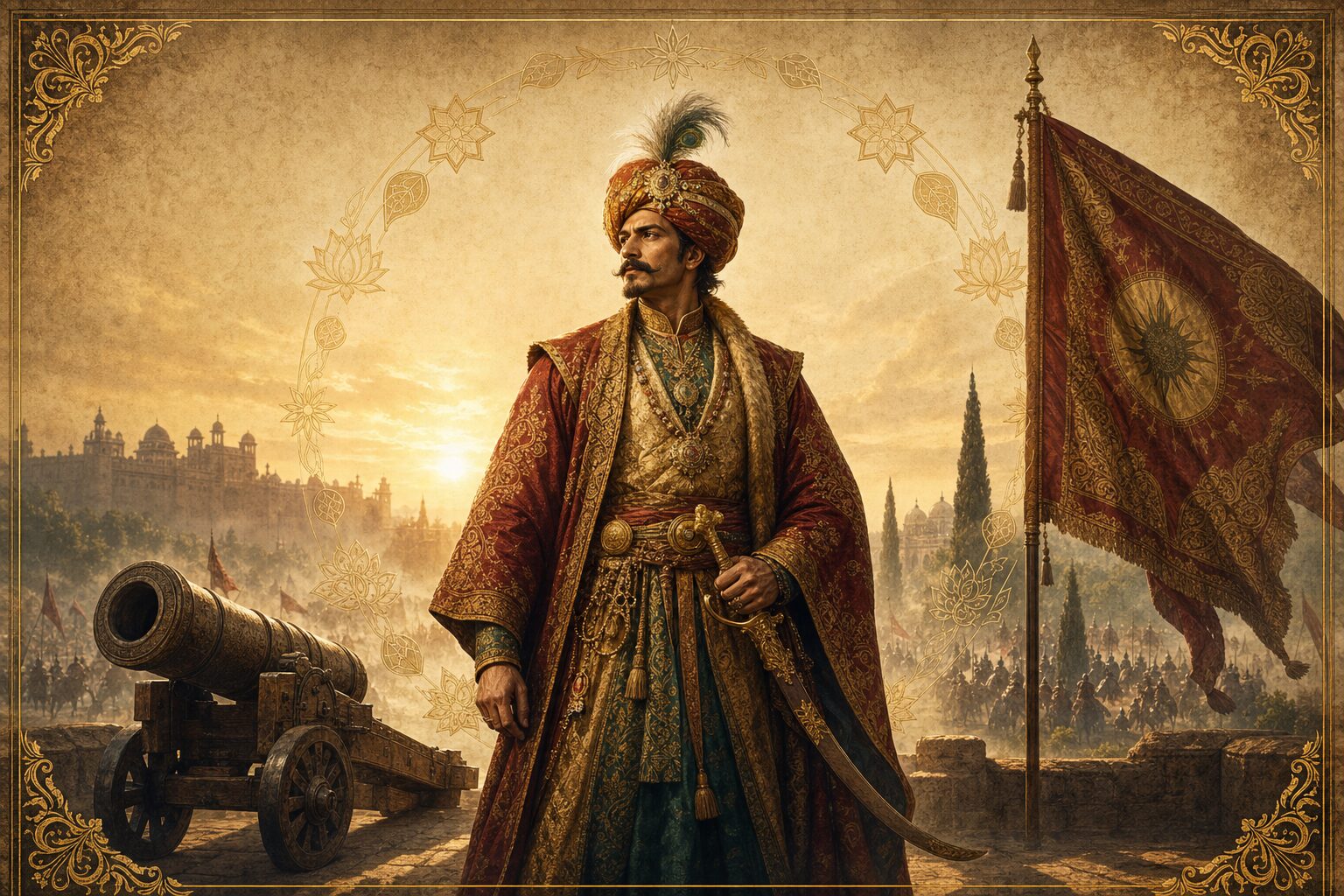
Significance for UPSC and General Knowledge
- Prelims staple for medieval Indian history: dates, battles, dynastic origins, military terminology
- GS1 Mains: founding of the Mughal Empire, transition from Delhi Sultanate to Mughal rule
- Source-based questions: Baburnama is a primary text for late Lodi and early Mughal India
- Military history: introduction of gunpowder warfare and Tulghuma tactics to the subcontinent
- Indo-Islamic architecture: charbagh garden tradition, mosque foundations at Panipat and Sambhal
- Comparative imperial history: contrast with Ottoman, Safavid and Uzbek polities of the same era
Reign and Administration: Detailed Analysis
Babur’s four and a half years in India can be read as a relentless campaign to convert military victories into a workable empire. The territorial settlement after Khanwa and Ghaghra extended Mughal authority across Punjab, Delhi, Doab, Awadh, Bihar, parts of Bengal, Malwa and the Bayana region of Rajasthan. Kabul and Badakhshan to the northwest remained under Mughal control through Babur’s Central Asian network. The empire had no clear southern frontier; the Deccan kingdoms and Vijayanagara were untouched.
Babur’s military reorganisation set the template that lasted into the eighteenth century. He institutionalised the use of field artillery as a battle-deciding arm, built a permanent corps of musketeers under Ottoman instruction, and introduced standing units of the imperial bodyguard known as the Khasa Khel. The cavalry continued to dominate, but the integration of artillery and infantry into combined-arms tactics was new. Indian military elites, including the Rajputs and the Afghans, would spend the next century catching up with these techniques.
The fiscal foundation was less innovative. Babur kept the Lodi revenue system in place, mostly because he did not have time to replace it. Land was assessed in kharaj or share-cropping terms, and revenue circulated through the existing zamindari networks. Coinage was minted at Agra, Lahore, Kabul and Jaunpur. The court language remained Persian, though Babur himself wrote in Chagatai Turkish. The cultural mood was Persian-Timurid rather than fully Indian; that absorption would come under Akbar.
Comparative Perspective
Babur is best understood against three contemporaries who built or held empires in the same generation. Each used gunpowder differently, and the Indian outcome was as much an accident of timing as of genius.
| Ruler | Reign | Capital | Key military innovation | Lasting legacy |
|---|---|---|---|---|
| Babur | 1526 to 1530 (in India) | Agra | Field artillery and Tulghuma | Founded the Mughal dynasty in India |
| Ibrahim Lodi | 1517 to 1526 | Delhi and Agra | Heavy cavalry and elephants | Last Sultan of the Delhi Sultanate |
| Selim I and Suleiman I (Ottomans) | 1512 to 1566 | Constantinople | Janissary musketeers, siege artillery | Ottoman codification, Mediterranean dominance |
| Shah Ismail I (Safavid) | 1501 to 1524 | Tabriz | Qizilbash cavalry, gunpowder adoption | Twelver Shia state, Persian cultural revival |
| Krishnadevaraya (Vijayanagara) | 1509 to 1529 | Hampi | War elephants, mounted archers, early artillery | South Indian cultural and political peak |
The contrast with Krishnadevaraya is sharpest. Vijayanagara was richer, larger and politically more stable than the Lodi sultanate, yet it never crossed the Vindhyas to challenge the northern reordering Babur was driving. The Indian political imagination still treated north and south as separate theatres in 1526. Babur’s empire eventually broke that pattern, but only under Akbar and Aurangzeb.
Controversies and Debates
Three debates dominate modern scholarship on Babur. The first is the scale of his army at Panipat. Babur’s own figures of 12,000 to 15,000 against Ibrahim Lodi’s 100,000 are stated in the Baburnama and accepted by most historians, but later commentators have argued for higher Mughal numbers, perhaps 25,000 with allied Afghans. The discrepancy matters because it changes the weight given to artillery and tactics versus simple numerical balance.
The second debate concerns the Babri Masjid at Ayodhya, a mosque commissioned by Babur’s commander Mir Baqi in 1528. The 1992 demolition and the 2019 Supreme Court verdict in M Siddiq v. Mahant Suresh Das set the political and legal context, but the question for medieval historians is whether the mosque was built on the ruins of a Hindu temple. Archaeological Survey of India excavations in 2003 reported pre-existing structures with temple-like features, while critics have contested the methodology. Babur himself never references Ayodhya in his memoir.
The third debate is about religious orientation. The Baburnama records Babur drinking wine, breaking it off in 1527 before Khanwa as a religious vow, and the Khanwa victory pronouncement uses the language of jihad. Yet his cultural framework was Timurid-Persian rather than narrowly orthodox, and his admiration for Indian flora, music and architecture is recorded with sympathy. Most historians treat Babur as a pragmatic warrior-prince in the Timurid mould rather than a religious zealot, but the readings vary by school.
Prelims Pointers
- Babur’s full name: Zahiruddin Muhammad Babur
- Born 14 February 1483 at Andijan, Fergana
- Captured Kabul in 1504 after losing Samarkand
- First Battle of Panipat: 21 April 1526, defeated Ibrahim Lodi
- Battle of Khanwa: 16 March 1527, defeated Rana Sanga of Mewar
- Battle of Chanderi: 29 January 1528, defeated Medini Rai
- Battle of Ghaghra: 6 May 1529, defeated Mahmud Lodi and Nusrat Shah
- Tactic introduced: Tulghuma; defensive line: araba
- Ottoman gunner: Ustad Ali Quli; matchlock specialist: Mustafa
- Memoir: Baburnama (Tuzuk-i-Baburi), in Chagatai Turkish
- First Mughal garden in India: Aram Bagh at Agra (1528)
- Title taken after Khanwa: Ghazi
- Died: 26 December 1530, Agra; reburied at Bagh-e Babur, Kabul
- Successor: Humayun
Mains Practice Questions
Q1. Examine the role of military innovation in Babur’s victory at the First Battle of Panipat. To what extent did artillery and tactics outweigh numerical inferiority? (15 marks, 250 words)
- Establish the numerical gap (12,000 to 15,000 vs 100,000) and battlefield context
- Explain Tulghuma flanking, araba defensive line, and Ottoman-style artillery
- Weigh innovation against Lodi internal divisions and Ibrahim Lodi’s tactical errors
- Conclude with the wider significance for Indian gunpowder warfare
Q2. “Babur’s victories settled the question of who would rule north India, but the consolidation of the Mughal Empire was Akbar’s achievement.” Discuss. (10 marks, 150 words)
- Map Babur’s territorial gains and their political settlement after Khanwa and Ghaghra
- Note the absence of administrative reforms and the loyalty-based nobility under Babur
- Contrast with Akbar’s Mansabdari, Dahsala, and Sulh-i-Kul as institutional consolidation
Conclusion
Babur’s four and a half years in India produced a dynasty that lasted three centuries. The genius lay in matching Central Asian military discipline to a fragmented Indian political map, then converting two decisive victories at Panipat and Khanwa into a workable territorial settlement. The Baburnama remains the closest contemporary view we have of how that conversion happened, and it reads as a soldier’s account rather than a sycophant’s chronicle.
What Babur built was unfinished. The fiscal architecture, the religious settlement and the cultural synthesis that gave the Mughal Empire its long shelf life were the work of his grandson Akbar. But the political fact of a Mughal sovereignty in India, against which every later contender from Sher Shah Suri to Shivaji had to position themselves, is Babur’s. That single fact is why he matters for UPSC, and why he deserves a closer reading than the textbook line allows.
Frequently Asked Questions
Who was Babur?
Babur, full name Zahiruddin Muhammad Babur, was the founder of the Mughal Empire in India. Born on 14 February 1483 in Andijan in the Fergana Valley, he was a Timurid prince descended from Timur on his father’s side and from Genghis Khan on his mother’s side. After losing his Central Asian inheritance, he captured Kabul in 1504 and later defeated Ibrahim Lodi at the First Battle of Panipat on 21 April 1526 to establish Mughal rule in India. He died at Agra on 26 December 1530.
When did Babur found the Mughal Empire?
Babur founded the Mughal Empire on 21 April 1526 after defeating Sultan Ibrahim Lodi at the First Battle of Panipat. The victory ended the Lodi dynasty of the Delhi Sultanate and gave Babur control of Delhi and Agra. The empire was further consolidated through victories at Khanwa (1527), Chanderi (1528) and Ghaghra (1529).
What were Babur’s main military innovations?
Babur introduced two new elements to Indian warfare: field artillery served by Ottoman gunners under Ustad Ali Quli, and the Tulghuma tactic borrowed from Central Asian Turco-Mongol practice. Tulghuma divided the army into right, left, centre and flanking units, with the flanks wheeling to attack the enemy’s rear. He also chained his cannons and supply carts together in a defensive line called the araba, modelled on Ottoman field doctrine.
What is the Baburnama?
The Baburnama, also called the Tuzuk-i-Baburi, is Babur’s autobiographical memoir composed in Chagatai Turkish. It covers his life from 1494 onwards, including his loss of Samarkand, his capture of Kabul, his expeditions into India and his battles for the Mughal Empire. The text is unusual for its candour and detail on military tactics, Indian flora and fauna, climate, and personal observations. It was later translated into Persian under Akbar by Abdur Rahim Khan-i-Khanan.
Why is Babur important for UPSC?
Babur is essential for UPSC 2026 because he founded the Mughal Empire, the dominant medieval Indian polity tested across Prelims and Mains. Prelims questions cover his battles, dates and military innovations. Mains GS1 questions test the political reordering of north India after 1526, the introduction of gunpowder warfare, and the Baburnama as a primary source. Source-based and essay questions also draw on his memoir for cross-references with the Delhi Sultanate and the early Mughal period.
Who succeeded Babur?
Babur’s eldest son Humayun succeeded him on 30 December 1530 at Agra, four days after Babur’s death. Humayun ruled for ten years before being driven out by the Afghan Sher Shah Suri in 1540. He recovered the throne briefly in 1555 and died the following year, leaving the consolidation of the empire to his son Akbar.