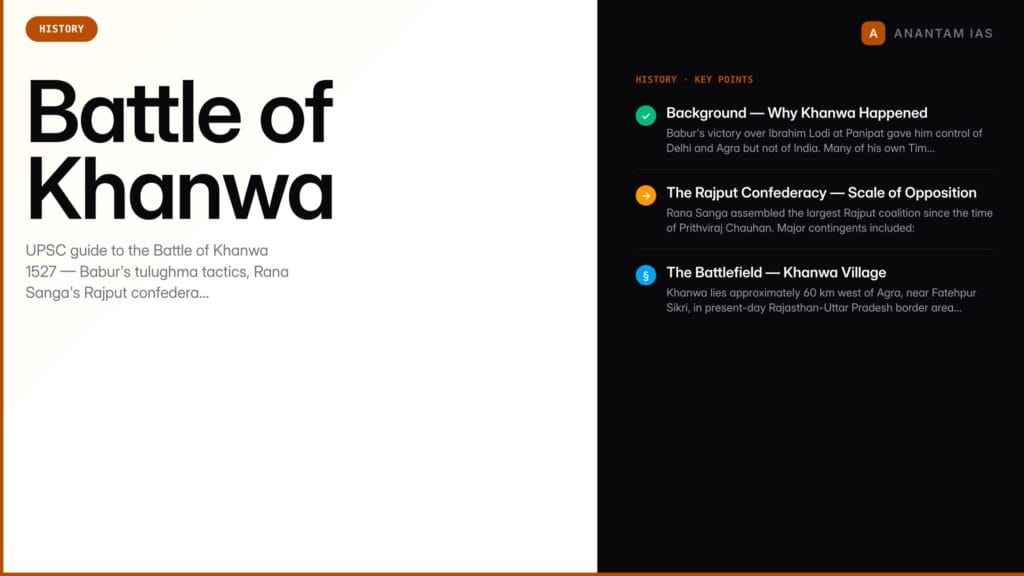
The Battle of Khanwa fought on 16 March 1527 between Babur and Rana Sanga of Mewar was the decisive engagement that consolidated Mughal rule in northern India. While the First Battle of Panipat (1526) had ended the Delhi Sultanate, it was Khanwa that broke the Rajput confederacy, eliminated the last major indigenous challenge to Babur, and confirmed Mughal military superiority through the systematic use of gunpowder, matchlocks, and the tulughma formation. For UPSC Prelims and GS Paper I (History), Khanwa is indispensable for understanding the transition from the Sultanate to the Mughal Empire.
Background — Why Khanwa Happened
After Panipat (1526)
Babur’s victory over Ibrahim Lodi at Panipat gave him control of Delhi and Agra but not of India. Many of his own Timurid chiefs wanted to return to Kabul, disliking the Indian climate. Babur’s autobiography Baburnama records his famous speech urging them to stay.
Meanwhile, three powerful forces remained outside Mughal control:
- Rana Sanga of Mewar — the undisputed leader of a Rajput confederacy
- The Afghans of the east (Bihar and Bengal) under Mahmud Lodi
- Medini Rai of Chanderi, an independent Rajput chief
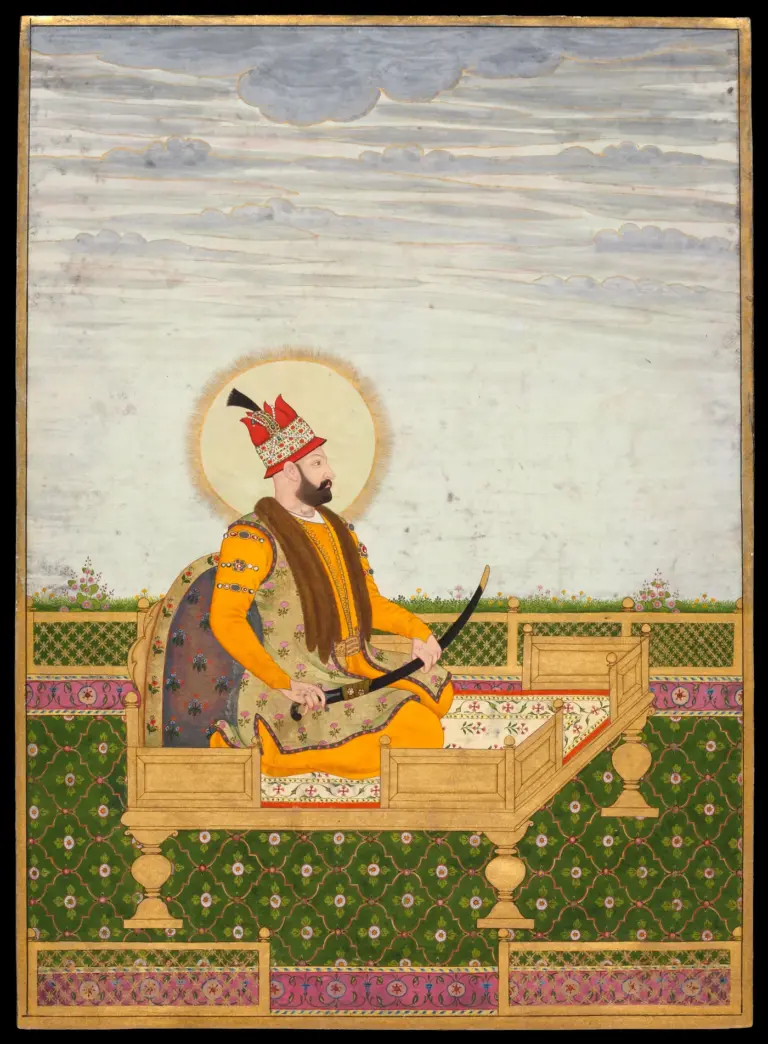
Rana Sanga — The Rajput Colossus
Maharana Sangram Singh, known as Rana Sanga, ruled Mewar from 1508–1528. Contemporary accounts describe him as having fought 100 battles and lost an eye, an arm and a leg in warfare. He had:
- Defeated the Lodi Sultans multiple times
- Defeated the Sultans of Malwa (Mahmud Khilji II was captured)
- Defeated the Sultans of Gujarat
- United most Rajput kingdoms under one banner for the first time in centuries
Why Rana Sanga Fought Babur
Two interpretations exist:
- Babur's account (Baburnama) — Rana Sanga had invited him to invade India against the Lodis but then turned hostile after Panipat
- Rajput chronicles — Sanga saw Babur as a foreign invader, like earlier Turkic sultans, whose defeat would restore Hindu power
Both views agree that Babur's presence in Agra, combined with his expansionist signals, made a confrontation inevitable.
The Rajput Confederacy — Scale of Opposition
Rana Sanga assembled the largest Rajput coalition since the time of Prithviraj Chauhan. Major contingents included:
| Contingent | Leader |
|---|---|
| Mewar | Rana Sanga (supreme commander) |
| Marwar | Rao Ganga of Jodhpur (sent his son Maldeo Rathore) |
| Amber | Raja Prithviraj Singh I |
| Chanderi | Medini Rai |
| Ajmer, Sirohi, Dungarpur, Bundi | Allied chiefs |
| Afghan ally | Mahmud Lodi (brother of Ibrahim Lodi, claimant to the throne) |
| Hasan Khan Mewati | Ruler of Mewat |
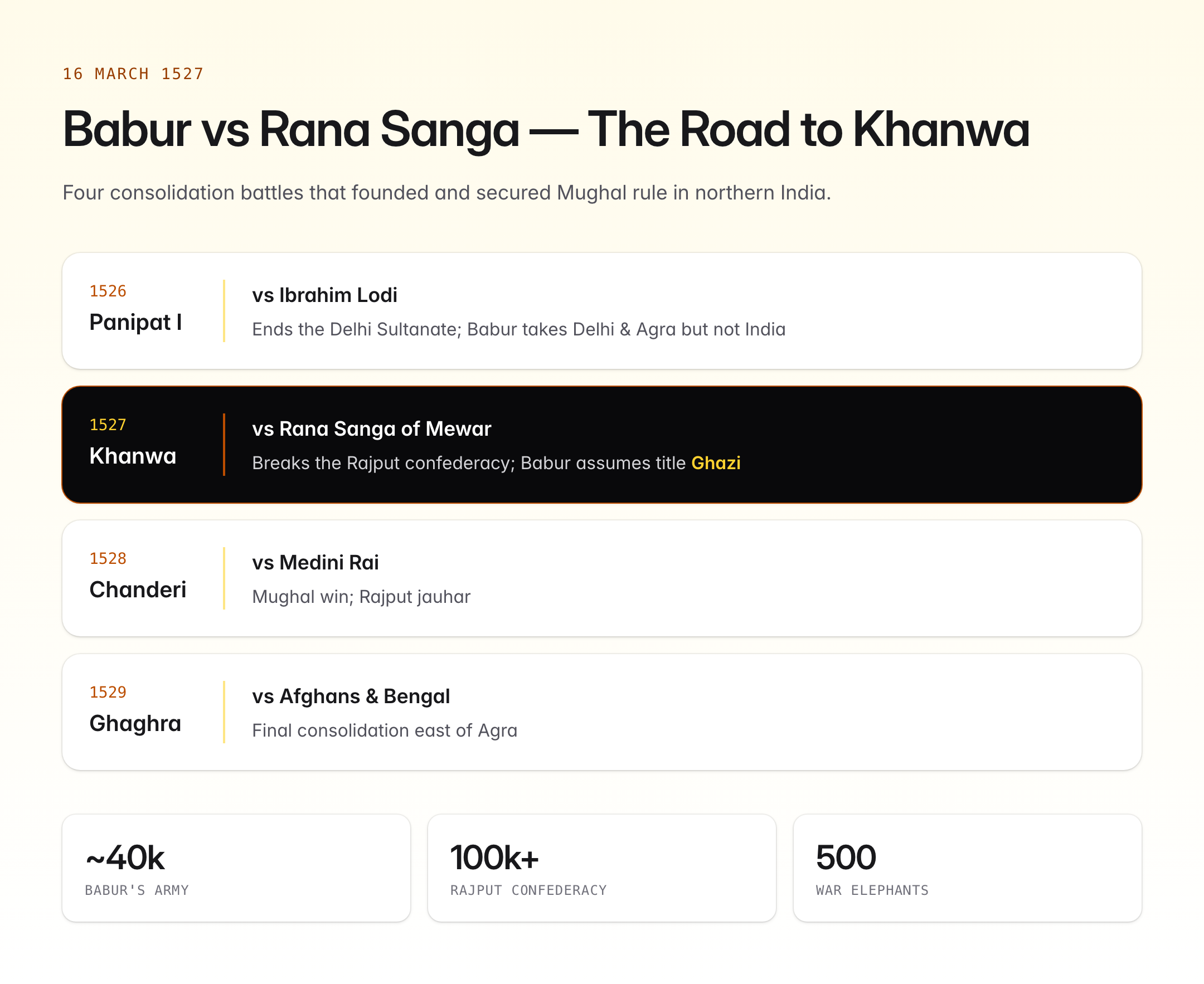
Babur estimated the Rajput army at over 100,000 cavalry and 500 war elephants, though modern historians consider this an exaggeration. His own force numbered around 40,000 but was decisively better equipped.
The Battlefield — Khanwa Village
Khanwa lies approximately 60 km west of Agra, near Fatehpur Sikri, in present-day Rajasthan-Uttar Pradesh border area. Babur chose the ground carefully — open plains that favoured his artillery and cavalry manoeuvres.
Babur's Military Innovations
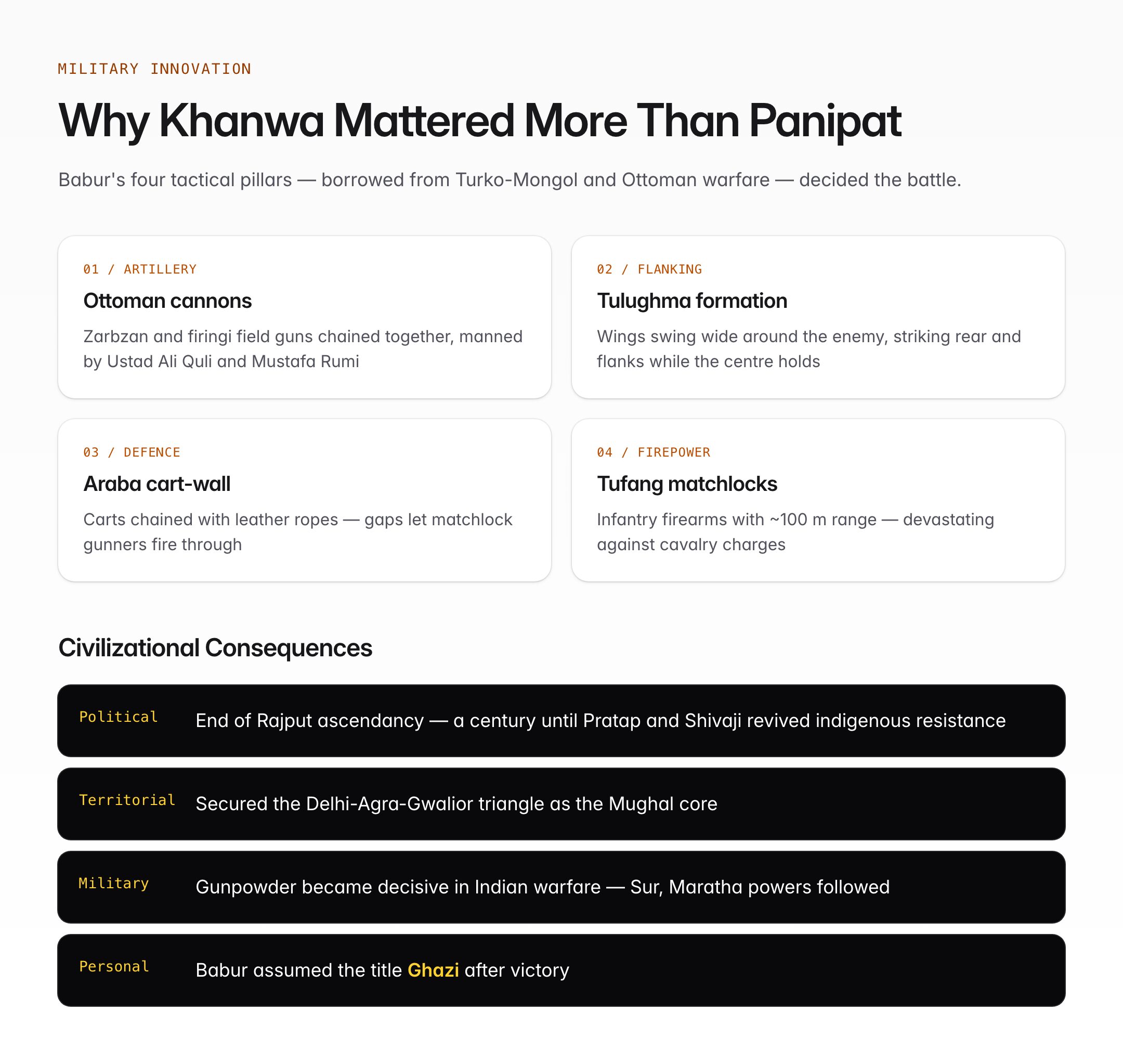
Babur's victory rested on four tactical pillars borrowed from Central Asian (Turko-Mongol) and Ottoman warfare.
1. Gunpowder and Artillery
- Babur deployed Ottoman-style cannons (zarbzan and firingi) under his gunnery chiefs Ustad Ali Quli and Mustafa Rumi
- This was only the second major use of field artillery in India (first was Panipat)
- The cannons were chained together and protected by bullock carts
2. Tulughma — The Flanking Formation
The tulughma (also spelled tulghuma) was a Central Asian tactic:
- The army was divided into three main divisions — left, right and centre
- Each was further split into sub-divisions
- Flanking parties (tulughma) were sent wide around the enemy to attack from the rear and sides
- Combined with frontal pressure, it enveloped opposing forces
3. Araba — The Cart Defence
- Carts (araba) were chained together with leather ropes to form a defensive wall
- Gaps between carts allowed matchlock (tufang) gunners to fire
- Prevented direct cavalry charges by Rajputs
4. Matchlocks (Tufang)
- Hand-held firearms used by specially trained infantry
- Effective range approximately 100 meters
- Inflicted heavy casualties on charging Rajput cavalry
Course of the Battle — 16 March 1527
Jihad Declaration
Before the battle, Babur:
- Renounced wine and broke his wine cups
- Declared the campaign a jihad against "infidels"
- Assumed the title "Ghazi" after victory
- His soldiers took an oath on the Quran not to retreat
The Combat
- The Rajput elephant corps and cavalry launched repeated frontal charges
- Babur's centre held firm behind the araba defences
- The tulughma flanking parties swung around the Rajput wings
- Rana Sanga was wounded (struck in the head, he fell unconscious) and carried off the field
- Rajput confederacy collapsed without central command
Aftermath
- Thousands of Rajput nobles perished, including Prithviraj of Amber and Hasan Khan Mewati
- Babur built a tower of skulls as was Timurid custom
- Assumed the title "Ghazi" (holy warrior)
- Rana Sanga died in January 1528 — officially of his wounds, possibly poisoned by his own nobles who opposed his plans for another campaign
- Maldeo Rathore survived and later built Jodhpur's power
Comparison — Panipat (1526) vs Khanwa (1527)
| Feature | First Battle of Panipat (1526) | Battle of Khanwa (1527) |
|---|---|---|
| Opponent | Ibrahim Lodi (Delhi Sultanate) | Rana Sanga (Rajput Confederacy) |
| Size of enemy | ~100,000 + elephants | ~100,000 + 500 elephants |
| Babur's tactic | Tulughma + araba + artillery | Same, refined |
| Casualties (enemy) | Ibrahim killed; ~15,000 | Heavy; Sanga wounded, nobles killed |
| Political outcome | End of Delhi Sultanate | End of Rajput resurgence |
| Babur's title after | Padshah | Ghazi |
| Civilizational significance | Foundation of Mughal rule | Consolidation of Mughal rule |
Consequences — Why Khanwa Mattered More Than Panipat
1. End of Rajput Ascendancy
The Rajput dream of Hindu political revival under Sanga collapsed. It would take another century (under Maharana Pratap and Shivaji) before indigenous resistance regained momentum.
2. Consolidation of Mughal Empire
- Babur gained undisputed control of the Delhi-Agra doab
- Reinforced his authority over reluctant Timurid chiefs
- Cleared the way for Chanderi (1528) and Ghaghra (1529) campaigns
3. Military Revolution in India
- Gunpowder became decisive in Indian warfare
- Rajput cavalry-elephant tradition was shown to be vulnerable
- Future Indian powers adopted artillery — from the Sur Empire to the Marathas
4. Strategic Geography
- Secured the Agra-Delhi-Gwalior triangle as the Mughal core
- Allowed expansion into Malwa and Rajputana under Akbar
Later Battles in Babur's Consolidation
| Year | Battle | Opponent | Result |
|---|---|---|---|
| 1526 | First Panipat | Ibrahim Lodi | Babur wins |
| 1527 | Khanwa | Rana Sanga | Babur wins |
| 1528 | Chanderi | Medini Rai | Babur wins (Rajput jauhar) |
| 1529 | Ghaghra | Afghans & Bengal | Babur wins |
Historiographical Sources
- Baburnama (autobiography of Babur) — primary source, written in Chagatai Turkish
- Tarikh-i-Rashidi of Mirza Haidar Dughlat
- Rajput bardic traditions — Khyats of Mewar, Marwar
- Later Mughal chronicles: Ain-i-Akbari (Abul Fazl) mentions lineage
UPSC Relevance
GS Paper Mapping
- GS Paper I — Medieval Indian history, emergence of Mughal Empire, Rajput-Mughal relations
- Essay — Turning points in Indian history
Prelims Pointers
- Battle of Khanwa: 16 March 1527; near Fatehpur Sikri, Rajasthan-UP border
- Babur defeated Rana Sanga (Maharana Sangram Singh of Mewar)
- Babur assumed title "Ghazi" after Khanwa
- Key tactics: tulughma (flanking), araba (cart-wall), matchlocks (tufang), Ottoman cannons
- Babur's gunnery chiefs: Ustad Ali Quli and Mustafa Rumi
- Rana Sanga led a Rajput confederacy including Mewar, Marwar, Amber, Chanderi
- Hasan Khan Mewati and Mahmud Lodi were Sanga's allies
- Baburnama written in Chagatai Turkish is the primary source
- Followed by Battle of Chanderi (1528) — Medini Rai, Rajput jauhar
- Followed by Battle of Ghaghra (1529) — Afghans of east India
The Battle of Khanwa was not merely a Mughal victory — it was a watershed that recast the political, military and civilizational map of the Indian subcontinent.
Tell Google you want more of this.
Add Anantam IAS as a preferred sourceOne tap, and this site shows up more often in your own Top Stories, AI Overviews and AI Mode. Remove it any time.