Introduction
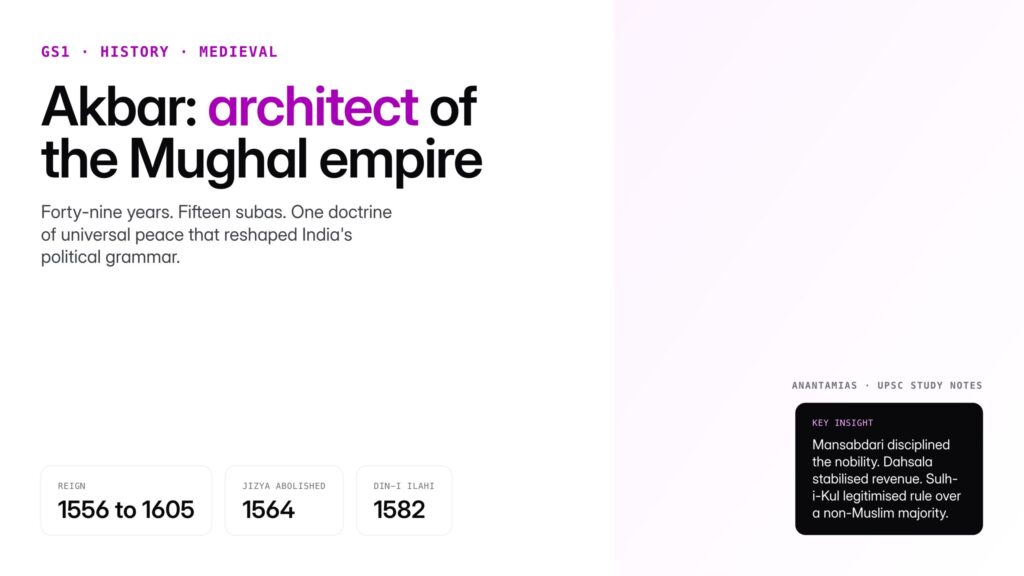
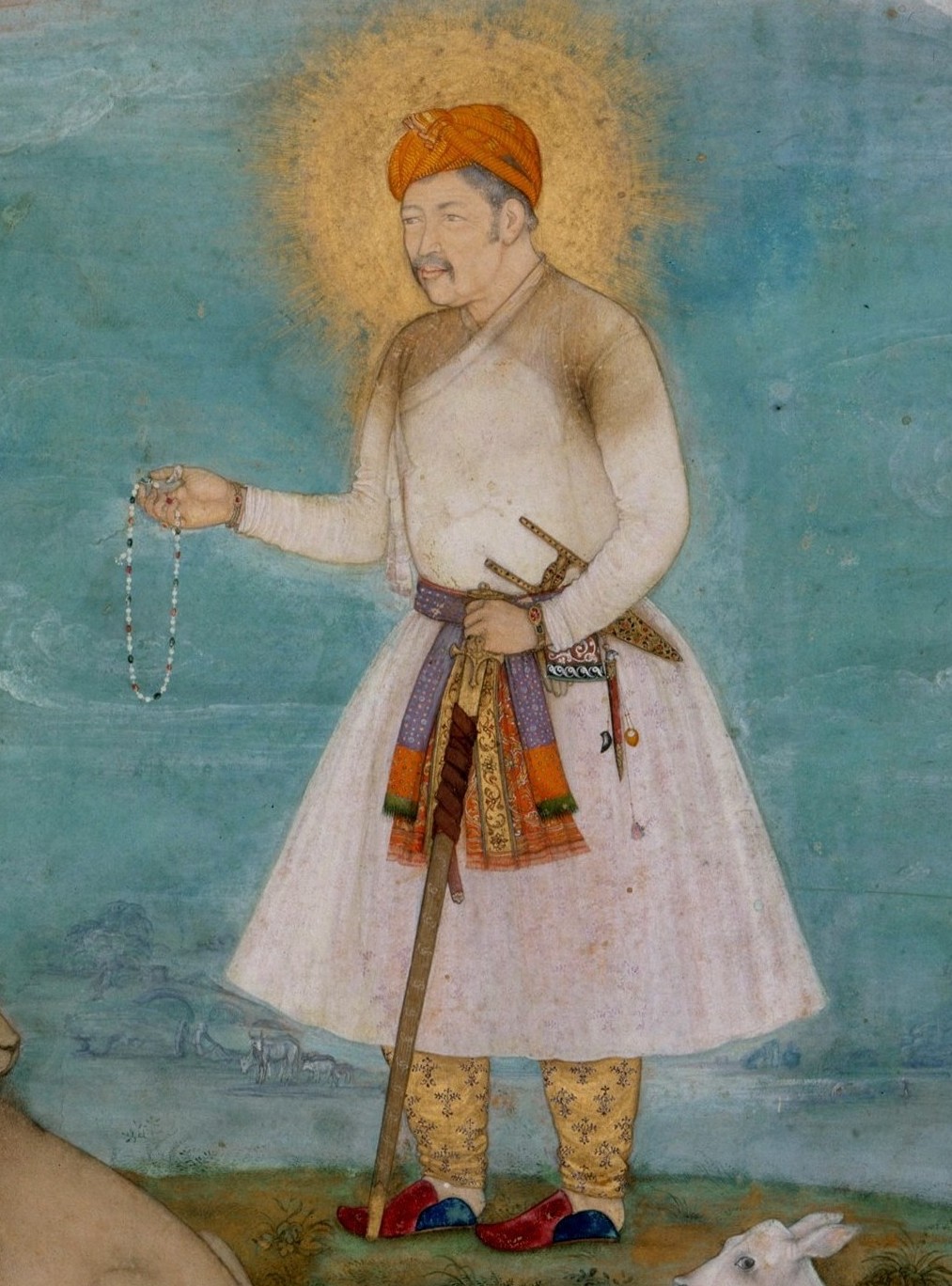
Jalaluddin Muhammad Akbar, born on 15 October 1542 at Umerkot in Sindh and crowned at fourteen in 1556, became the architect of India’s most durable medieval imperial order. His reign of forty-nine years stitched together the subcontinent from Kabul to the Deccan under a single revenue, administrative and cultural framework. By the time of his death on 27 October 1605 at Agra, Akbar had transformed a precarious inheritance from his father Humayun into an empire whose policies would shape India for two centuries.
For UPSC aspirants, Akbar is unavoidable. He appears across the Prelims syllabus for medieval history, in GS1 for society, art and architecture, and in essay questions on Indian pluralism. His Mansabdari system, land revenue reforms under Todar Mal, and the religious synthesis of Sulh-i-Kul and the Din-i Ilahi are dense with examinable detail. This guide walks through his life, administration and legacy using a framework that supports both Prelims recall and Mains analysis.
Quick Facts at a Glance
| Attribute | Detail |
|---|---|
| Full name | Jalaluddin Muhammad Akbar |
| Born | 15 October 1542, Umerkot (Sindh) |
| Died | 27 October 1605, Agra (buried at Sikandra) |
| Father | Humayun |
| Mother | Hamida Banu Begum |
| Regent (1556-1560) | Bairam Khan |
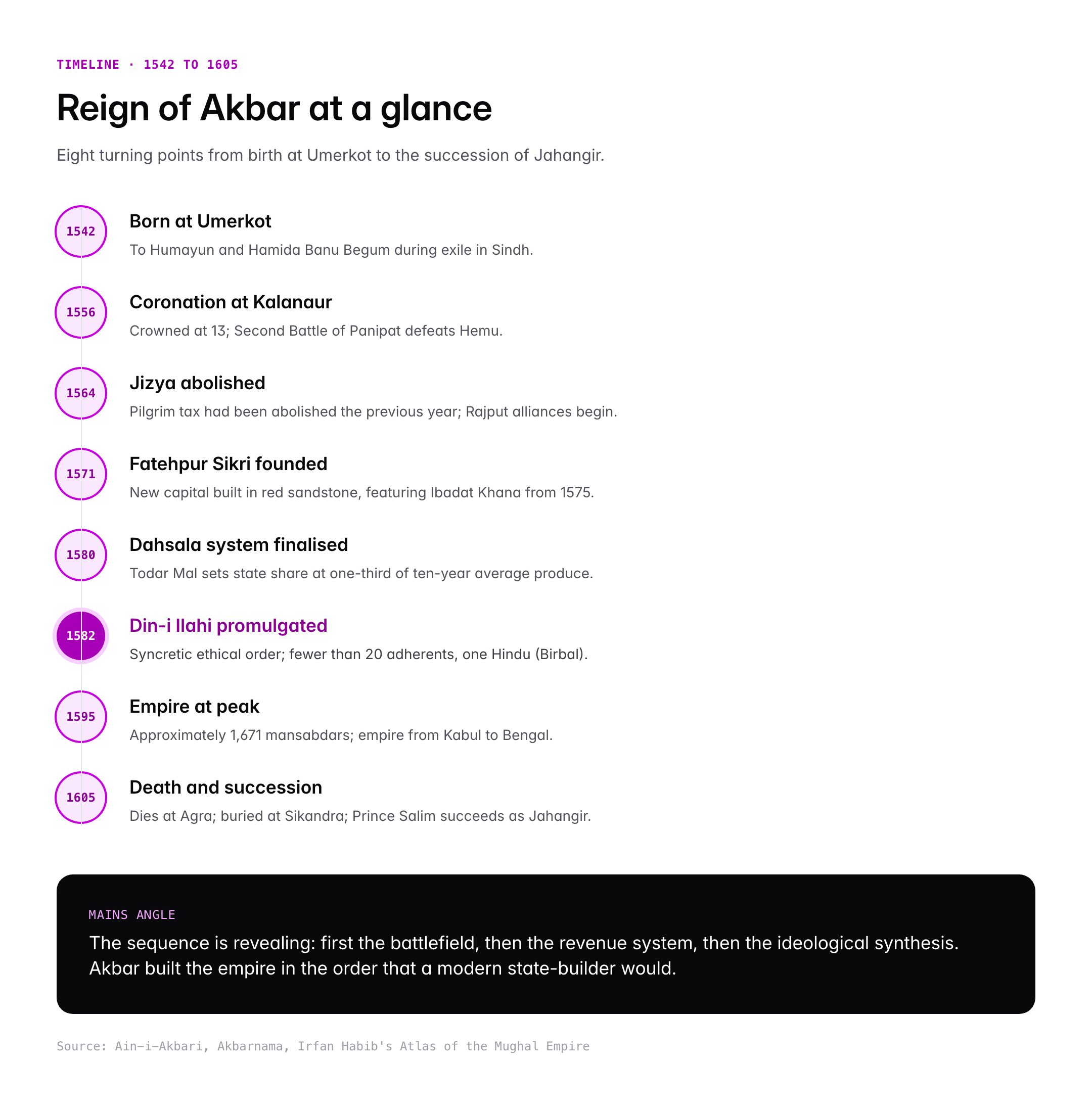
| Coronation | 14 February 1556, Kalanaur (Punjab) |
| Key battle | Second Battle of Panipat, 5 November 1556 |
| Reign | 1556 to 1605 (49 years) |
| Capital shifts | Agra → Fatehpur Sikri (1571) → Lahore → Agra |
| Religion policy | Sulh-i-Kul (universal peace) |
| Court historian | Abul Fazl, author of Akbarnama and Ain-i-Akbari |
| Empire extent at death | Kabul to Bengal, Kashmir to Ahmednagar |
Background and Historical Context
Akbar inherited the Mughal throne under the most fragile circumstances. His grandfather Babur had founded the dynasty at Panipat in 1526, but his father Humayun lost the empire to the Afghan Sher Shah Suri in 1540 and spent fifteen years in exile in Safavid Persia. Humayun recovered Delhi only in 1555 and died the next January after falling from the library stairs at Purana Qila. Akbar, then thirteen, was campaigning in Punjab with his guardian Bairam Khan.
The boy-emperor was crowned at Kalanaur in Punjab on 14 February 1556. Within months, the Hindu general Hemu, serving the last Suri, captured Delhi and Agra. The Second Battle of Panipat on 5 November 1556 decided the subcontinent’s future. An arrow struck Hemu in the eye, his army collapsed, and the Mughal restoration became fact. Bairam Khan served as regent until 1560, when the now-eighteen-year-old Akbar dismissed him and began personal rule.
The early reign (1560-1562) was marked by the influence of the harem party led by Maham Anaga and her son Adham Khan. Akbar’s assertion of authority after Adham Khan’s murder of Ataga Khan in 1562 marked the true beginning of his independent rule. From 1562 onwards, Akbar systematically consolidated the empire: Malwa (1562), Gondwana against Rani Durgavati (1564), Chittor (1568), Ranthambore (1569), Gujarat (1573), Bengal (1576), Kabul (1585), Kashmir (1586), Sindh (1591) and parts of the Deccan by 1601.
Key Provisions of Akbar’s Administration
Central Government
The central administration was headed by four pillars. The Wazir or Diwan handled revenue and finance; Todar Mal held this post and later received the title Diwan-i-Ashraf. The Mir Bakhshi controlled the military and mansab system. The Sadr-us-Sudur oversaw religious and charitable grants. The Qazi-ul-Quzat was the chief judicial officer. Abul Fazl’s Ain-i-Akbari, completed around 1598, remains the most detailed administrative manual of medieval India.
Mansabdari System
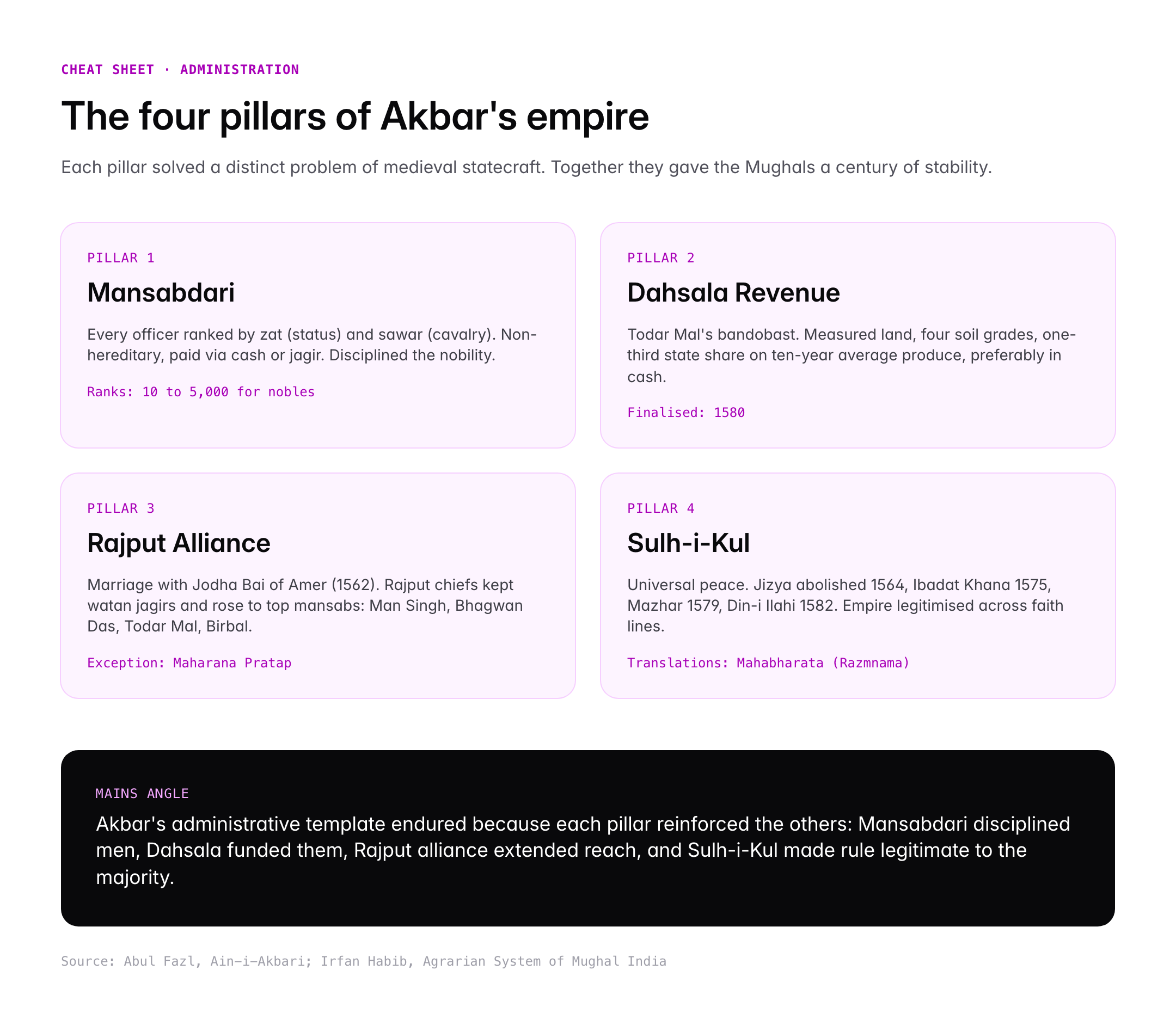
Instituted around 1570-1580, the Mansabdari system graded every officer by two numbers: zat (personal rank, denoting status and salary) and sawar (cavalry obligation). Mansabs ranged from 10 to 5,000 for nobles, with higher ranks reserved for princes. The system was non-hereditary, paid partly in cash (naqdi) and partly through revenue assignments called jagirs, and it subordinated the nobility directly to the emperor. By 1595, there were about 1,671 mansabdars.
Land Revenue: The Dahsala System
Land revenue reform under Raja Todar Mal, finalised by 1580, is called the Dahsala or Bandobast system. Land was surveyed, classified into four grades (Polaj, Parauti, Chachar, Banjar) by fertility, and the state’s share fixed at one-third of the average produce of the previous ten years, payable preferably in cash. The measurement unit was the Ilahi gaz. This Zabti system operated in the core provinces; Ghalla Bakshi (crop-sharing), Nasaq and Kankut remained in others.
Provincial Structure
The empire was divided into fifteen subas (provinces), each under a Subedar. Below lay sarkars (districts) under faujdars and parganas (groups of villages) under shiqdars. Each suba also had a Diwan (revenue), a Bakhshi (military pay), a Sadr (religious) and a Kotwal (urban police). This template endured into the British period.
Military and Forts
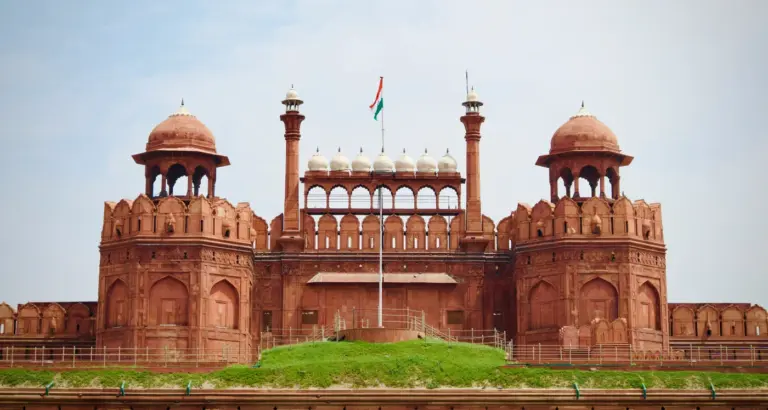
Akbar’s army was cavalry-dominant, supplemented by infantry and a growing artillery arm modernised with Ottoman technical help. He built the massive forts of Agra (1565), Lahore, and Allahabad, and the planned capital of Fatehpur Sikri (1571-1585), which was abandoned due to water scarcity.
Religious Policy: Sulh-i-Kul and Din-i Ilahi
In 1563 Akbar abolished the pilgrim tax; in 1564 he abolished the jizya on non-Muslims. The Ibadat Khana (House of Worship) at Fatehpur Sikri, built in 1575, hosted debates across Sunnis, Shias, Hindus, Jains, Zoroastrians, Jesuits (from the 1580 Portuguese mission of Aquaviva) and Sikhs. The Mazhar of 1579 made Akbar the final arbiter in religious disputes. In 1582 he promulgated the Din-i Ilahi (or Tauhid-i-Ilahi), a syncretic ethical code with at most nineteen adherents, of whom only Raja Birbal was Hindu. Sulh-i-Kul, or universal peace, was the guiding political doctrine that underpinned Mughal legitimacy across religious lines.
Significance for UPSC and General Knowledge
- Prelims staple for medieval Indian history: dates, battles, administrative terms
- GS1 Mains: art, architecture, society and religious syncretism
- Source-based questions: Ain-i-Akbari, Akbarnama, Tuzuk-i-Jahangiri for cross-reference
- Essay topics on Indian pluralism, syncretism and religious tolerance
- Comparative administration with Sher Shah Suri’s earlier reforms
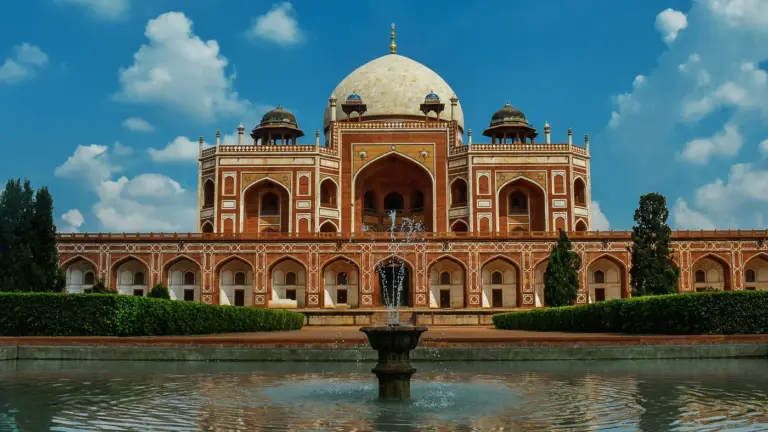
- Connects to UNESCO World Heritage sites: Fatehpur Sikri, Agra Fort, Humayun’s Tomb
Reign and Administration: Detailed Analysis
Akbar’s genius lay in converting conquest into stable administration. Three concentric circles of policy made this possible.
The first circle was fiscal. Todar Mal’s Dahsala replaced arbitrary tribute with measured, predictable revenue, giving cultivators a ten-year average to plan against and the state a reliable base. The switch to cash payment deepened monetary circulation and indirectly supported the silver rupee standardised under Sher Shah. Jagir assignments funded mansabdars without burdening the central treasury, and the periodic transfer of jagirs (every three to four years) prevented the growth of hereditary landlordism that had weakened the Delhi Sultanate.
The second circle was political incorporation. Akbar married Jodha Bai of Amer (Harka Bai) in 1562 and brought Rajputs like Bhagwan Das, Man Singh, Todar Mal and Birbal into the highest ranks. Rajput chiefs retained their watan jagirs (homeland territories) while serving the empire, creating an early form of federal accommodation. By 1595, Rajputs comprised over a fifth of top mansabdars, balancing the Turani, Irani and Indian Muslim factions. The exception was Maharana Pratap of Mewar, whose resistance at Haldighati in 1576 remains iconic.
The third circle was ideological. Sulh-i-Kul transcended the Ulema-Sultan compact that had governed earlier Muslim dynasties. Akbar commissioned translations of the Mahabharata (as Razmnama), Ramayana, Atharva Veda, Panchatantra and Bhagavad Gita into Persian, making Sanskrit thought accessible to the ruling elite. Abul Fazl’s philosophical framework of the emperor as Insan-i-Kamil (perfect man) and farr-i-izadi (divine light) sacralised imperial authority independently of clerical sanction. The Din-i Ilahi, often misread as a new religion, was more accurately an elite ethical order that reinforced loyalty to the emperor.
Art and architecture reflected this synthesis. The Indo-Islamic style matured in red sandstone at Fatehpur Sikri with the Jama Masjid, Buland Darwaza (1575, commemorating the Gujarat victory), Panch Mahal, Diwan-i-Khas and the tomb of Sheikh Salim Chishti. Painting under Mir Sayyid Ali, Abdus Samad and later Daswanth and Basawan blended Persian miniature with Indian colour and narrative. Tansen, Baiju Bawra and Birbal enriched the cultural court that housed the legendary Navaratnas, the nine jewels.
Comparative Perspective
Akbar’s administrative system is best understood against his near-contemporaries, particularly Sher Shah Suri, who ruled only briefly (1540-1545) but influenced Akbar significantly.
| Ruler | Reign | Revenue System | Religious Policy | Key Legacy |
|---|---|---|---|---|
| Sher Shah Suri | 1540-1545 | Ryotwari-like measurement | Orthodox Sunni | GT Road, rupiya coin, sarais |
| Akbar | 1556-1605 | Dahsala (Zabti) | Sulh-i-Kul, Din-i Ilahi | Mansabdari, Rajput alliance |
| Aurangzeb | 1658-1707 | Jagirdari crisis | Sharia-orthodox, jizya revived 1679 | Empire overreach, Deccan |
| Elizabeth I (England) | 1558-1603 | Taxation through Parliament | Anglican settlement | Mercantile expansion |
| Suleiman (Ottoman) | 1520-1566 | Timar system | Sunni caliphate | Codification of Kanun |
The parallels with Suleiman the Magnificent are striking; both ran contemporaneous Islamic empires, codified law and administration, and patronised grand architecture. Akbar’s distinctive contribution was the explicit accommodation of a non-Muslim majority, something the Ottoman millet system handled differently.
Controversies and Debates
Historians disagree over Akbar’s enduring achievements. The nationalist view, shaped by Jadunath Sarkar and R. C. Majumdar, praises tolerance but questions whether Sulh-i-Kul was pragmatic statecraft rather than genuine pluralism. The Aligarh school, led by Irfan Habib and Athar Ali, treats Akbar as a rationalising imperial statesman whose Mansabdari, currency and revenue reforms modernised the state. The subaltern critique asks whether peasant welfare improved meaningfully under Dahsala or whether the burden merely shifted from arbitrary to predictable exaction.
The Chittor massacre of 1568, where an estimated 30,000 were killed after the fort’s fall, is a dark counterpoint to the tolerance narrative, though the casualties included combatants and retainers by later Mughal accounts. The conquest of Gujarat (1572-73), Bengal, and the rough campaigns against Mewar complicate any reading of Akbar as uniformly benign. The abandonment of Fatehpur Sikri due to water failure, often cited as a planning lesson, is disputed; strategic needs after 1585 were also a factor.
The Din-i Ilahi remains contested. Vincent Smith called it the folly of a wise man; modern historians like Iqtidar Alam Khan treat it as a courtly fraternity rather than a proper religion.
Prelims Pointers
- Akbar’s reign: 1556-1605; 49 years
- Coronation at Kalanaur, 14 February 1556
- Second Battle of Panipat: 5 November 1556, defeat of Hemu
- Bairam Khan: regent until 1560
- Jizya abolished: 1564
- Fatehpur Sikri built: 1571; abandoned by 1585
- Ibadat Khana established: 1575
- Mazhar declaration: 1579
- Din-i Ilahi promulgated: 1582
- Navaratnas: Abul Fazl, Faizi, Birbal, Tansen, Todar Mal, Raja Man Singh, Abdur Rahim Khan-i-Khana, Mullah Do Piyaza, Fakir Aziao-Din
- Ain-i-Akbari and Akbarnama: author Abul Fazl
- Jahangir (Salim) succeeded in 1605
- Tomb at Sikandra, near Agra
Mains Practice Questions
Q1. “Akbar’s policy of Sulh-i-Kul was less a religious creed than a strategy of imperial consolidation.” Critically examine. (15 marks, 250 words)
- Define Sulh-i-Kul and trace its policy expressions: jizya abolition, Rajput marriages, Ibadat Khana
- Argue the strategic case: incorporating 75-80 percent non-Muslim population, legitimising rule
- Note counter-evidence: translation project, personal theological interest, Din-i Ilahi
Q2. Analyse the role of the Mansabdari and Dahsala systems in sustaining Mughal power under Akbar. (10 marks, 150 words)
- Describe zat and sawar ranks; jagir assignment; non-hereditary principle
- Explain Dahsala measurement, four land grades, ten-year averaging and cash payment
- Link both to centralised revenue and disciplined nobility; contrast with later decline under Aurangzeb
Conclusion
Akbar converted a fragile Central Asian dynasty into an Indian empire. Between the battlefield at Panipat in 1556 and his tomb at Sikandra in 1605, he produced a political settlement that combined a professional nobility, a rationalised revenue base and an inclusive ideological vocabulary. Each pillar, by itself, had precedents in the Delhi Sultanate or the Safavid and Ottoman worlds. Their combination was original.
Two centuries later, when the East India Company negotiated the Diwani of Bengal in 1765, it framed its authority in Mughal imperial terms because Akbar’s framework still defined legitimate rule in India. That durability, more than any single conquest, is why Akbar is called the Great.
Frequently Asked Questions
Who was Akbar the Great?
Akbar, full name Jalaluddin Muhammad Akbar, was the third Mughal emperor of India who ruled from 1556 to 1605. Born in Umerkot in 1542 and crowned at fourteen after his father Humayun’s death, he built the most powerful medieval Indian empire through military conquest, administrative reforms like Mansabdari and the Dahsala revenue system, and the religious policy of Sulh-i-Kul.
Why is Akbar important for UPSC?
Akbar is a staple Prelims and Mains topic under medieval Indian history. His Mansabdari system, Todar Mal’s Dahsala revenue reform, religious policies including Sulh-i-Kul and Din-i Ilahi, Rajput alliances, and court chroniclers Abul Fazl and Badauni feature in both factual and analytical questions. He also appears in GS1 art, architecture, society and culture topics.
What was the Mansabdari system?
The Mansabdari system was Akbar’s military-administrative grading structure introduced around 1570 to 1580. Every officer held two ranks: zat, denoting personal status and salary, and sawar, denoting the cavalry contingent to be maintained. Mansabdars were paid in cash or through revenue-assigned jagirs, were non-hereditary, and ranked from 10 up to 5,000 for nobles, with higher ranks reserved for princes.
What was Din-i Ilahi and how is it related to Sulh-i-Kul?
Din-i Ilahi, promulgated by Akbar in 1582, was a syncretic ethical order combining elements of Islam, Hinduism, Zoroastrianism and Christianity. Sulh-i-Kul, meaning universal peace, was the broader political doctrine of tolerance that guided imperial policy. Din-i Ilahi was its elite manifestation, with fewer than twenty adherents, while Sulh-i-Kul was expressed through jizya abolition, Rajput alliances and the Ibadat Khana.
Who were the Navaratnas in Akbar’s court?
The Navaratnas or nine jewels were Akbar’s most celebrated courtiers: Abul Fazl (vizier and historian), Faizi (poet), Birbal (witty minister), Tansen (musician), Raja Todar Mal (revenue expert), Raja Man Singh of Amer (general), Abdur Rahim Khan-i-Khana (poet and commander), Mullah Do Piyaza, and Fakir Aziao-Din. They symbolised Akbar’s patronage across arts, governance and military affairs.
What was the Dahsala revenue system?
The Dahsala or Bandobast system, finalised by Raja Todar Mal around 1580, was a land revenue reform that measured cultivable land, classified it by fertility into four categories, and fixed the state’s share at one-third of the average produce of the previous ten years, payable preferably in cash. It brought predictability for cultivators and stable revenue for the Mughal treasury.
When and why was Fatehpur Sikri built and abandoned?
Akbar founded Fatehpur Sikri in 1571 near Sikri, where Sheikh Salim Chishti had blessed him with a son. It served as the Mughal capital until around 1585. The city was abandoned primarily due to acute water shortage, though strategic needs for northwestern campaigns also prompted the shift to Lahore. It remains a UNESCO World Heritage site preserving red sandstone Indo-Islamic architecture.
What is the significance of the Second Battle of Panipat?
Fought on 5 November 1556 between Akbar’s forces under Bairam Khan and the Hindu general Hemu, who represented the Afghan Suri dynasty, the Second Battle of Panipat cemented the Mughal restoration. Hemu was struck in the eye by an arrow and captured; his army collapsed. The victory allowed the thirteen-year-old Akbar to rule India and transformed a precarious inheritance into the foundation of a long-lasting empire.
Tell Google you want more of this.
Add Anantam IAS as a preferred sourceOne tap, and this site shows up more often in your own Top Stories, AI Overviews and AI Mode. Remove it any time.