BHASHINI: India’s AI-Powered Multilingual Language Stack and the Bhasha Interface for a Billion Speakers
A complete UPSC GS-III explainer on BHASHINI, India's AI-powered multilingual language platform built as Digital Public Infrastructure. Covers the National Language Translation Mission, the four core pillars including Suno India, Bolo India, Bhashantar India, and Bhasha Daan, the open API model, governance and applications across e-governance, education, justice, and Parliament, and how BHASHINI fits into the wider India Stack.
A country with twenty-two scheduled languages, a hundred and twenty-one languages spoken by more than ten thousand people, and roughly seven hundred and seventy mother tongues recorded in the most recent census cannot run on English alone. Most public services in India have been delivered for decades in a working compromise where forms, websites, and call centres default to English or Hindi, and citizens whose first language is something else either learn to navigate the gap or rely on intermediaries. BHASHINI is the government’s attempt to remove that bottleneck by treating Indian languages as a public good and putting AI translation, speech recognition, and speech synthesis on an open platform that anyone can use.
The full name spells out the intent. BHASHINI stands for Bhasha Interface for India. The platform is not a translation agency. It is a stack of speech and language models, an open API, a public model repository, and a citizen-contributed dataset, all owned and operated as Digital Public Infrastructure. Any government department, any startup, any university lab, or any individual developer can call BHASHINI and get speech-to-text, text-to-speech, or translation across major Indian languages without negotiating a private contract with a vendor.
This article walks through what BHASHINI actually does, where it sits in policy, the four core pillars of the stack, the role of crowdsourcing through Bhasha Daan, the institutional and budgetary anchoring, the live applications inside and outside government, the limits and the criticisms, and how the project fits into the wider story of India Stack and AI sovereignty.
What BHASHINI Is and Is Not
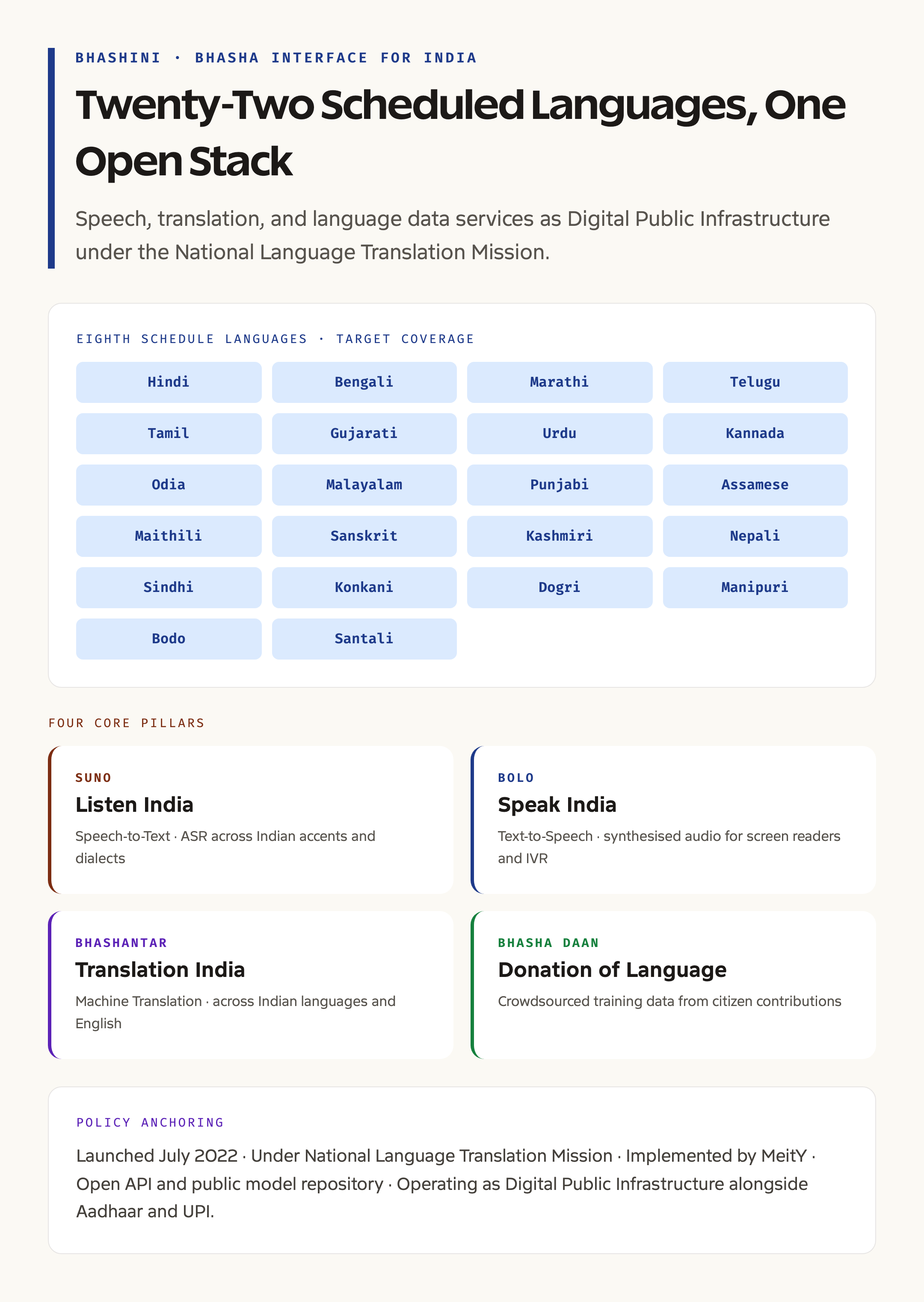
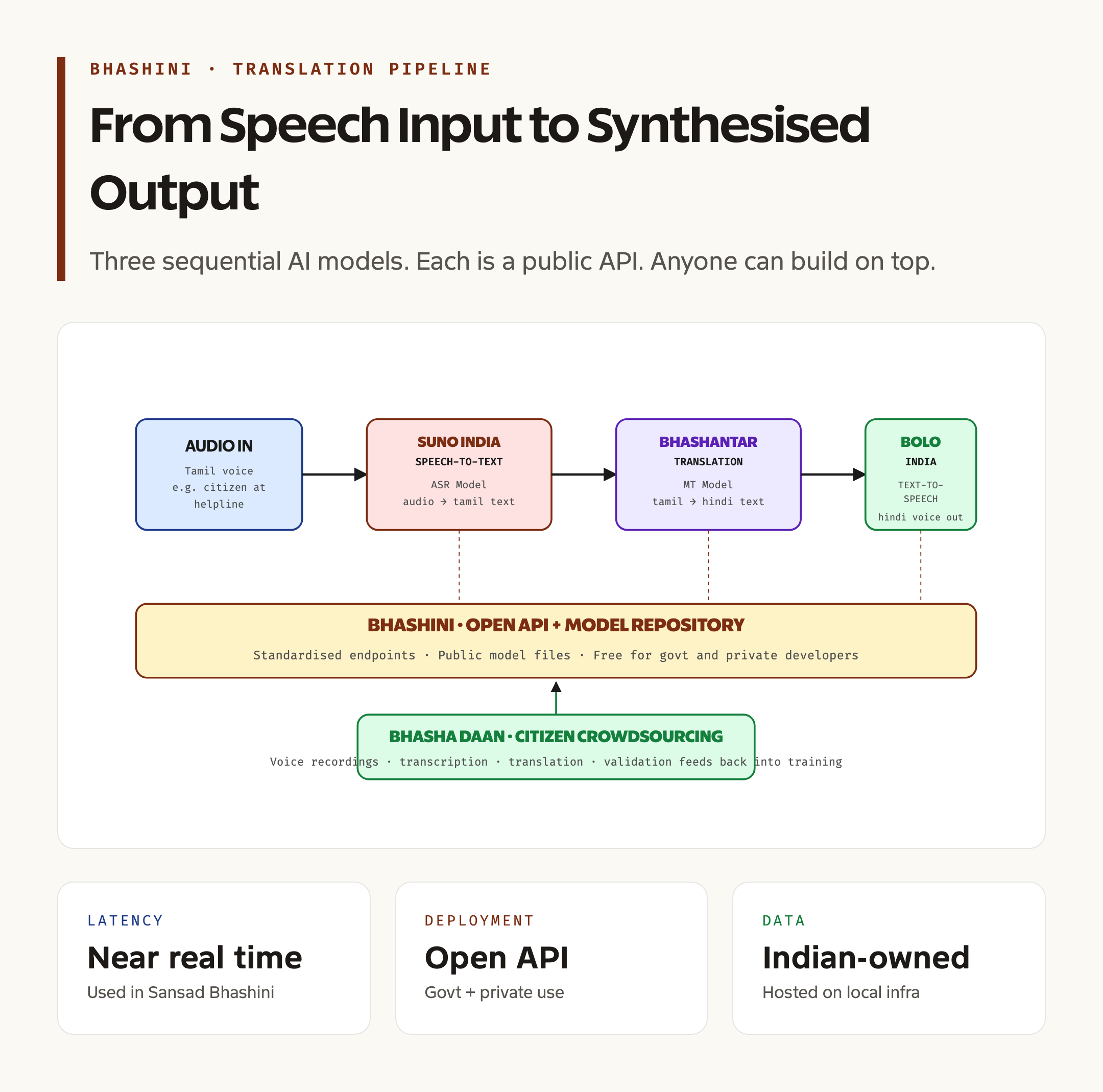
BHASHINI is a technology platform, not a workforce of human translators. The platform packages a set of artificial intelligence models for three core tasks: automatic speech recognition, which converts spoken Indian languages into text; machine translation, which moves text from one Indian language to another or between an Indian language and English; and speech synthesis, which converts text into spoken audio. The models live behind APIs that developers can call, and the underlying datasets and trained model files are progressively released into a public model repository.
It helps to clarify what BHASHINI is not. It is not a single chatbot, although chatbots can be built on top of it. It is not a search engine, although search engines can use it. It is not a substitute for legally certified translation, which still requires a human professional for court filings, contracts, and medical consent. The platform deliberately operates one layer below user-facing apps, the same way the Unified Payments Interface operates one layer below Google Pay or PhonePe. Apps consume BHASHINI through APIs, much the same way payment apps consume UPI.
Institutional and Policy Anchoring
BHASHINI was launched in July 2022 by the Prime Minister at the Digital India Week event in Gandhinagar. The platform sits under the National Language Translation Mission, which was approved by the Cabinet in 2021 and announced in the Union Budget speech of that year. The Ministry of Electronics and Information Technology is the lead implementing ministry, with the Digital India Bhashini Division serving as the operating arm. The Centre for Development of Advanced Computing, IIT Madras, and IIIT Hyderabad are among the partner institutions on the model development side.
The platform is designed as open, interoperable, and API-based. That phrasing matters. Open means the source datasets, the model weights, and the documentation are intended to be freely available rather than locked behind a private vendor. Interoperable means the same APIs work across departments, languages, and devices without bespoke integration. API-based means the platform is accessed through standardised programmatic interfaces rather than through a graphical front end. These three properties place BHASHINI alongside other building blocks of the India Stack including Aadhaar, UPI, DigiLocker, and the Account Aggregator framework.
The Four Core Pillars of the Stack
BHASHINI is structured around four functional pillars, each named in Hindi to signal the public-facing intent. The first pillar is Suno India, which means “listen India.” Suno India is the automatic speech recognition layer. It takes audio in any supported Indian language and returns text in the same language. The training data is collected across regional accents and dialects, which is the part that machine learning systems trained on English audio data tend to fail on.
The second pillar is Bolo India, which means “speak India.” Bolo India is the text-to-speech layer. It takes written text in an Indian language and produces synthesised audio that sounds like a native speaker. The output is intended for screen readers, voice assistants, IVR systems for government helplines, and audio versions of government communications for users who cannot read.
The third pillar is Bhashantar India, which means “translation India.” Bhashantar India is the machine translation layer. It moves text between any two supported Indian languages or between an Indian language and English. The translation models are trained on parallel corpora of source and target language pairs collected from government documents, news content, religious texts, parliamentary debates, and crowdsourced contributions.
The fourth pillar is Bhasha Daan, which means “donation of language.” Bhasha Daan is a crowdsourcing platform that invites Indian citizens to contribute to the training data. Citizens can record themselves reading prompts, transcribe audio clips, validate machine outputs, or translate sentences. The contributions feed back into the training pipeline. The model improves over time because the dataset grows with public participation, much like Wikipedia improves with every edit.
The Open API and Model Repository
The fifth structural element of BHASHINI is the open API and model repository, which technically sits beneath all four pillars. Developers register on the BHASHINI platform, obtain API credentials, and then call any combination of speech-to-text, translation, or speech synthesis as standardised endpoints. The model repository hosts the trained model files, the documentation, and the licence terms for downstream use.
The intent behind the open release is to break the dependency on closed-source language models from foreign technology companies. If government services in India relied on a private translation API hosted abroad, every public-sector deployment would carry the cost, the latency, and the data sovereignty risk of that dependency. The BHASHINI design replaces that with a public model that can be hosted on Indian infrastructure and audited by Indian researchers.
Languages Covered and Roadmap
The platform launched with a core set of major Indian languages and has been expanding. As of the most recent published roadmap, BHASHINI supports translation, speech recognition, and speech synthesis across the major scheduled languages, with deeper coverage for Hindi, Tamil, Telugu, Bengali, Marathi, Kannada, Malayalam, Gujarati, Punjabi, Odia, Assamese, and Urdu. Coverage of the remaining Eighth Schedule languages including Bodo, Dogri, Konkani, Maithili, Manipuri, Nepali, Sanskrit, Santali, Sindhi, and Kashmiri is being actively expanded.
The roadmap also includes a tier of widely spoken non-scheduled languages and regional dialects. The eventual target is conversational quality across all twenty-two scheduled languages plus the major non-scheduled languages and English, both written and spoken, with realistic accents.
Applications Inside the Government
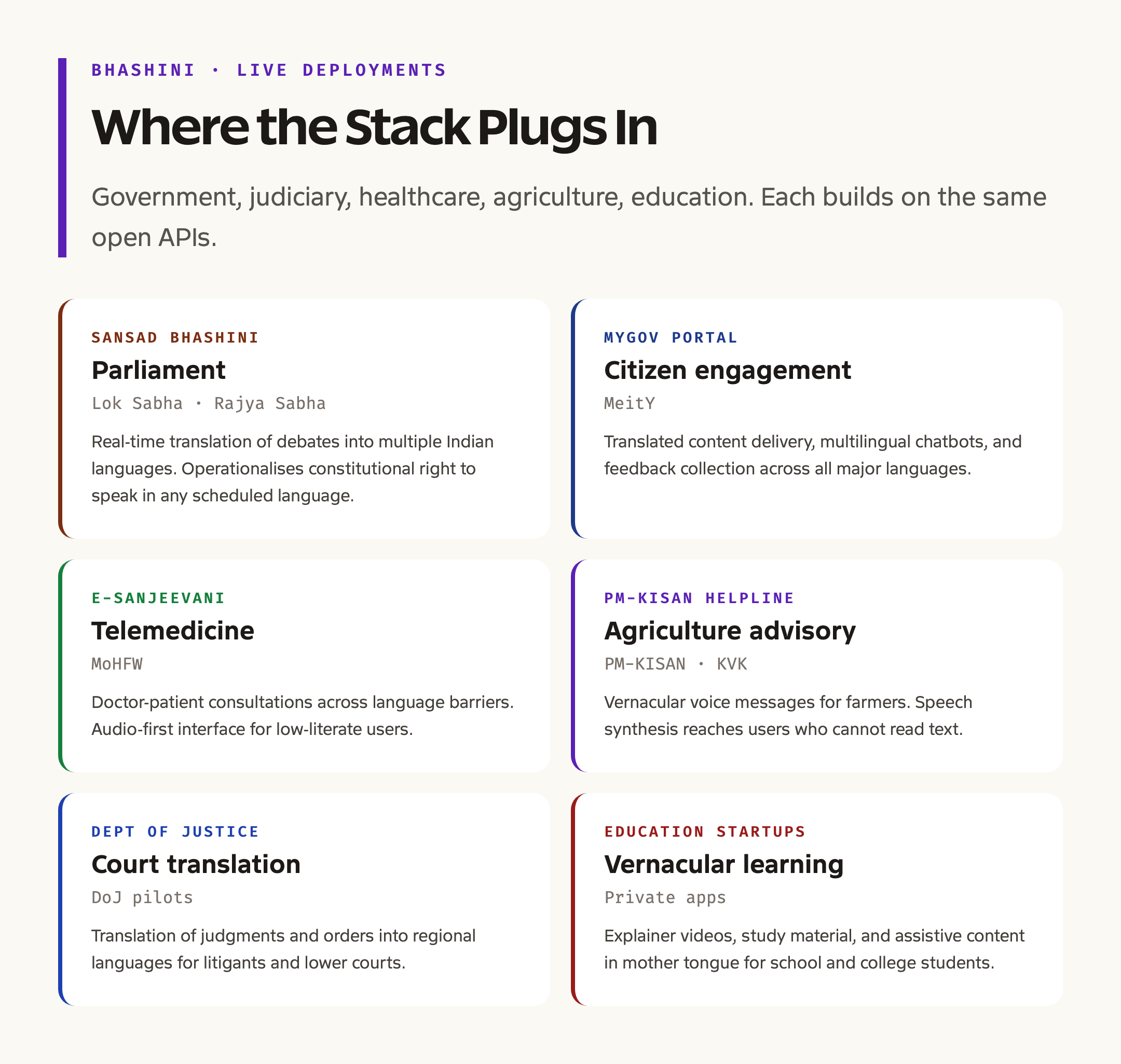
The most visible deployment of BHASHINI inside the government is Sansad Bhashini, the AI translation system used in the Lok Sabha and Rajya Sabha to render proceedings into multiple Indian languages in near real time. Members can listen to debates in their preferred language without waiting for a human interpreter. The Constitution recognises the right to speak in any of the scheduled languages in Parliament, and Sansad Bhashini operationalises that right at scale.
Beyond Parliament, BHASHINI plugs into citizen-facing services. The MyGov platform uses BHASHINI for translated content delivery. The PM-Kisan helpline and several Krishi Vigyan Kendra advisories use BHASHINI text-to-speech for vernacular voice messages. The e-Sanjeevani telemedicine platform pilots BHASHINI for doctor-patient conversations across a language barrier. Several state government portals use BHASHINI to translate scheme information across local languages. The Department of Justice has piloted BHASHINI for translating selected court orders and judgments.
Applications Beyond the Government
The open API design means private startups, social enterprises, and individual developers can build on BHASHINI. Education startups use it to deliver explainer videos in regional languages. Healthcare platforms use it to translate medical advice. Agricultural advisory startups push voice messages to farmers in their mother tongue. Accessibility tools use the speech synthesis layer to read out content for visually impaired users. Voice-based banking interfaces in rural cooperative banks pilot BHASHINI to serve customers who cannot read English account statements.
The point of the open release is precisely to enable this layer of innovation without each developer having to retrain a language model from scratch. The same logic that allowed thousands of UPI apps to bloom on top of the NPCI rails is meant to drive a similar bloom of language applications on top of the BHASHINI rails.
Bhasha Daan and the Politics of Language Data
Bhasha Daan deserves a closer look because it is the part of BHASHINI most directly visible to citizens. The platform asks users to contribute in four ways. Citizens can record their voice reading short text prompts, which builds the speech recognition training set. They can transcribe audio clips, which validates and corrects the speech recognition outputs. They can translate sentences from English or Hindi into a regional language, which builds the parallel corpus for machine translation. They can validate machine-produced translations and rate quality, which gives the models supervised feedback.
The political dimension is real. Language data has historically been collected by foreign technology companies for proprietary models, and the resulting models have systematically underperformed on Indian accents, code-mixed speech, and non-Latin scripts. Bhasha Daan is an attempt to keep the data inside Indian institutions, license it on terms that the government can govern, and use it to train models that the government can deploy without paying foreign rent.
Limits, Criticisms, and Open Questions
BHASHINI is not yet a finished product, and the gap between the announced ambition and the on-ground performance is honest to acknowledge. Translation quality is uneven across language pairs. Hindi-English performs well. Some smaller scheduled languages still lag behind. Speech recognition struggles with code-mixed speech, where users freely swap between English and a regional language inside the same sentence, which is the actual conversational norm in urban India. Speech synthesis still produces audio that can sound flat or robotic in some languages.
There are also governance questions. The platform collects voice and text data from citizens at scale, and the privacy framework around that collection is governed by the Digital Personal Data Protection Act of 2023 plus the BHASHINI-specific terms of use. The handling of dialect data, the rights of language communities, and the question of consent for downstream model training are issues that will need clearer rules over time. Bias in the training data also feeds bias in the output, which is a concern shared with all large language models.
Where BHASHINI Sits in the AI Sovereignty Story
BHASHINI is part of the wider AI in India strategy that includes the IndiaAI Mission, the proposed sovereign foundation model, and the GPU compute capacity being built for public AI infrastructure. The argument is that critical AI capabilities for a population the size of India cannot rely on foreign closed-source models, and the language layer is the most obviously public-good piece of that capability. Translation, speech recognition, and speech synthesis are infrastructure in the same sense that roads, ports, and railways are infrastructure. The state has a legitimate interest in owning the rails.
The international dimension is also relevant. Other developing countries with similar linguistic diversity look at BHASHINI as a possible export. The MOSIP framework from IIIT Bangalore has already been adopted as a national identity layer by several countries. Whether the BHASHINI stack follows a similar export path will depend on the quality of the released models and on the diplomatic packaging that accompanies them.
What to Watch Next
For UPSC preparation, the running threads to track are the expansion of language coverage to the full Eighth Schedule, the deeper integration of BHASHINI into Parliament and judicial workflows, the release of larger sovereign foundation models trained on Indian data, and the regulatory frame around language data under the DPDP Act. Each of those threads connects directly to questions of digital sovereignty, federalism, and public service delivery that show up across GS papers. BHASHINI is one of the cleanest case studies of how a technology platform, treated as public infrastructure, can change the texture of citizen-state interaction in a multilingual democracy.