The Eighth Schedule languages of India form one of the most unusual constitutional lists in the democratic world. Twenty-two languages, written in a dozen scripts, spoken by populations ranging from a few lakh (Sanskrit, Bodo) to several hundred million (Hindi, Bengali). They share a constitutional roof, a set of rights and aspirations under Article 344 and Article 351, and a long queue of contenders waiting for entry. As of April 2026, that queue has 38 names on it.
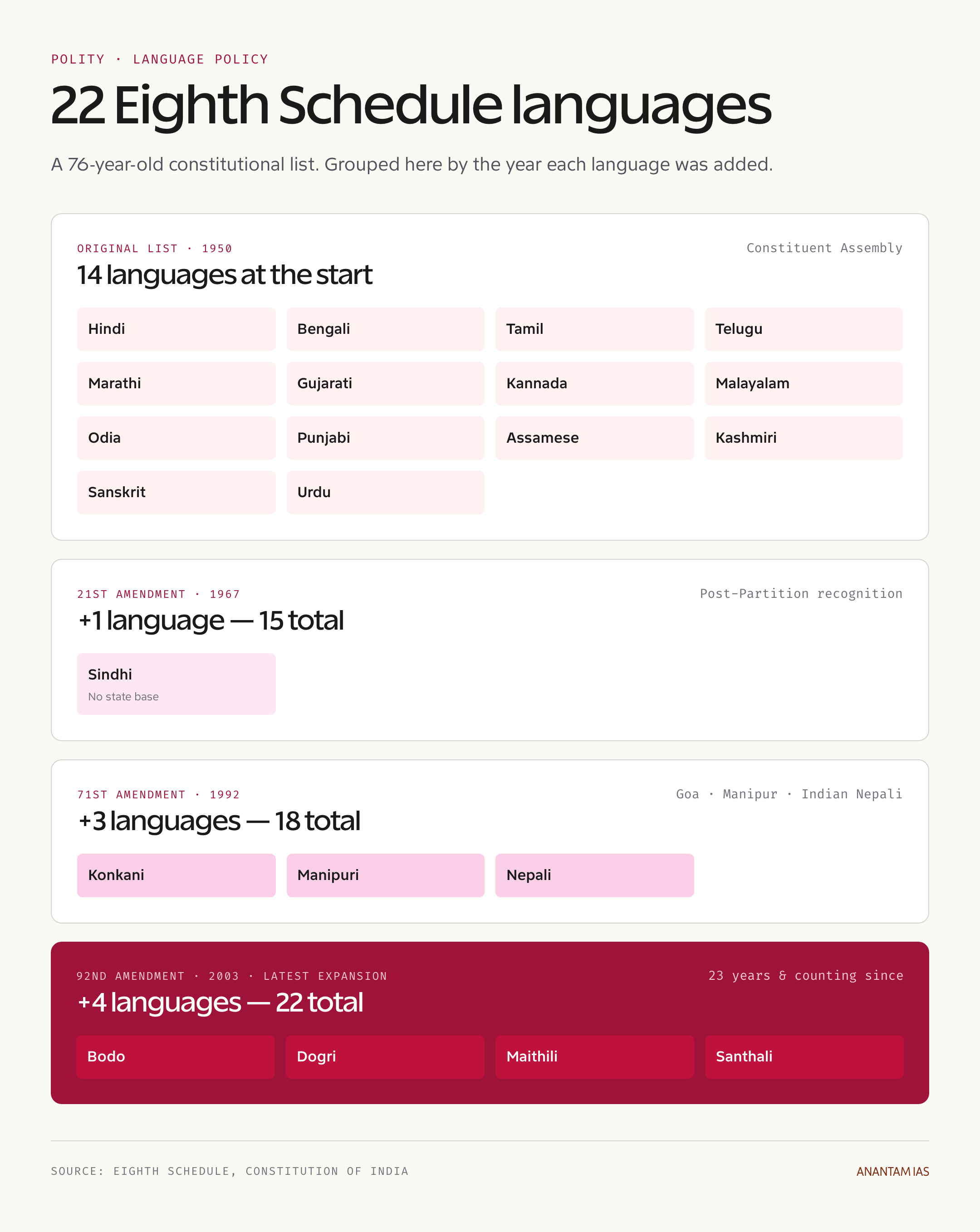
The schedule started life modestly in 1950 with 14 languages. It grew to 15 in 1967 (Sindhi added), to 18 in 1992 (Konkani, Manipuri, Nepali added), and to 22 in 2003 (Bodo, Dogri, Maithili, Santhali added). No language has been added since. That 23-year freeze is itself a story.
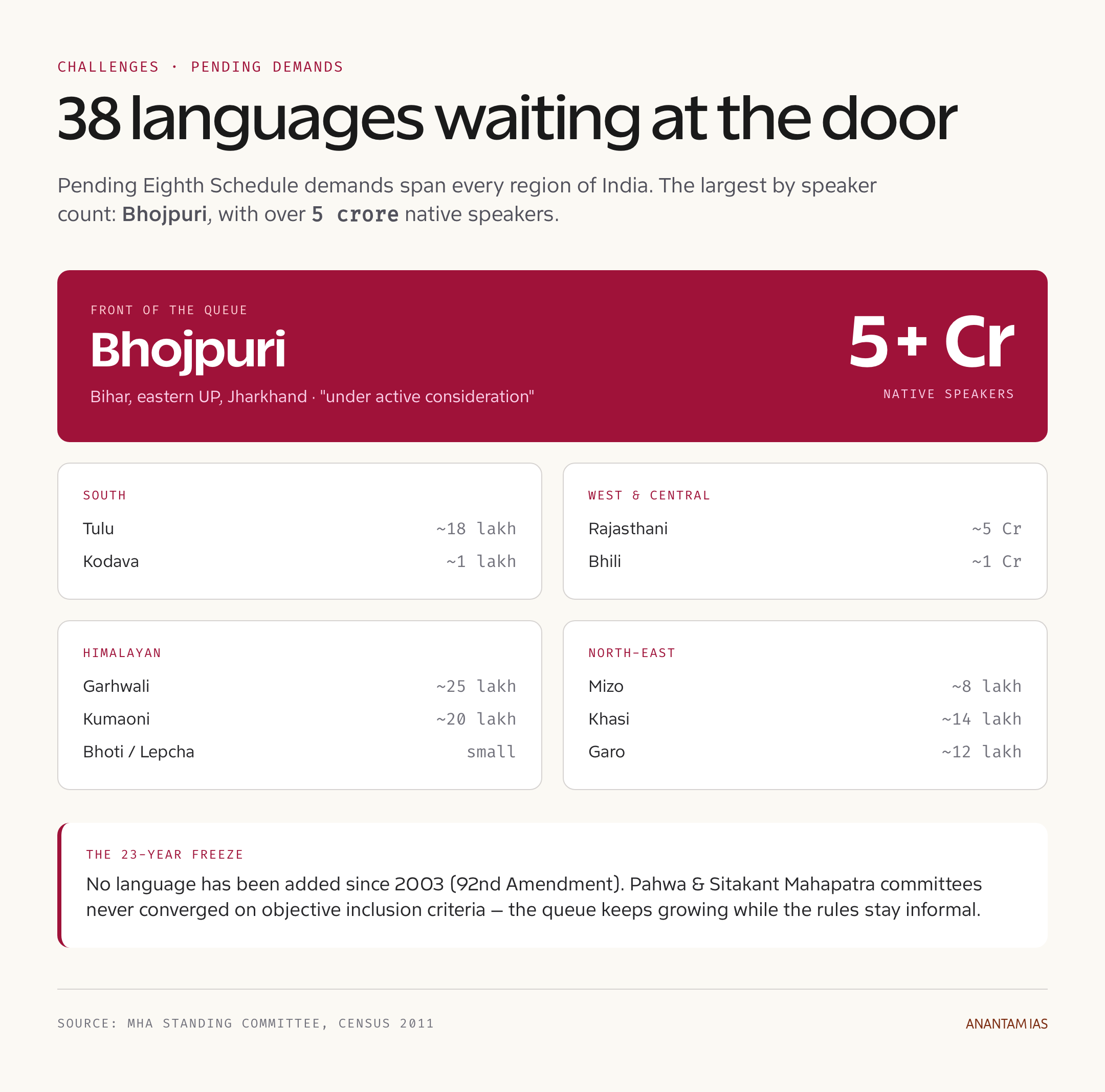
The Eighth Schedule is back in news because the Standing Committee of the Sites and Languages division of the Ministry of Home Affairs has scheduled fresh hearings on the long-pending demands for Bhojpuri, Tulu, Rajasthani, Kodava, and Garhwali. Members of Parliament have raised the issue in the Budget Session of 2026. The political math, the linguistic criteria, and the constitutional framework are all worth a careful walk-through.
Quick Facts at a Glance
- Number of scheduled languages: 22 (as of 2026)
- Original list (1950): 14 languages
- Current 22: Assamese, Bengali, Bodo, Dogri, Gujarati, Hindi, Kannada, Kashmiri, Konkani, Maithili, Malayalam, Manipuri, Marathi, Nepali, Odia, Punjabi, Sanskrit, Santhali, Sindhi, Tamil, Telugu, Urdu
- Constitutional articles: Article 344 (Official Languages Commission), Article 351 (Hindi enrichment directive)
- Latest addition: Bodo, Dogri, Maithili, Santhali in 2003 via the 92nd Constitutional Amendment
- Pending demands: 38 languages, including Bhojpuri, Tulu, Rajasthani, Kodava, Garhwali, Kumaoni, Lepcha, Mizo, Khasi, Bhoti
- Classical languages: A separate parallel category. As of latest available data, India recognizes 11 classical languages (Tamil, Sanskrit, Telugu, Kannada, Malayalam, Odia, Marathi, Pali, Prakrit, Assamese, Bengali) following the 2024 expansion
Why the Eighth Schedule Is in News
Three triggers brought the Eighth Schedule languages debate back to the front page in April 2026. First, a parliamentary written reply confirmed that the demand for Bhojpuri (the largest non-scheduled language by speaker count, with over 5 crore native speakers) is under “active consideration.” Second, the 2024 classical-language expansion created political momentum for parallel Eighth Schedule expansion. Third, a Supreme Court bench observed that the absence of clear inclusion criteria leaves the schedule vulnerable to ad-hoc politics rather than principled language policy.
For UPSC aspirants, the Eighth Schedule appears in Prelims as a list-recall question (which language was added when, total count, related articles) and in Mains as a federalism, identity, and policy question. The 2026 cycle will almost certainly carry at least one question touching this area.
Background and Historical Context
How the Eighth Schedule Was Born
The Constituent Assembly’s Munshi-Ayyangar formula of 1949 was the compromise that solved India’s language problem on paper. Hindi in Devanagari became the official language of the Union under Article 343, with English continuing for 15 years. The Eighth Schedule was inserted to recognize a list of “languages” that, while not official in the Union sense, would form the linguistic core of India’s federation. The original 14 languages were Assamese, Bengali, Gujarati, Hindi, Kannada, Kashmiri, Malayalam, Marathi, Odia (then Oriya), Punjabi, Sanskrit, Tamil, Telugu, and Urdu.
The list reflected the major literary traditions. It excluded Sindhi, despite a substantial speaker community displaced by Partition, because Sindhis lacked a contiguous home territory. That gap was closed in 1967 by the 21st Amendment. Konkani, Manipuri (Meiteilon), and Nepali came in 1992 via the 71st Amendment, recognizing decades-old demands from Goa, Manipur, and the Indian Nepali community. Bodo, Dogri, Maithili, and Santhali entered in 2003 through the 92nd Amendment, the largest single expansion since the original drafting.
Why the 23-year pause since 2003? Three reasons. The Sitakant Mahapatra Committee (2003) and subsequent expert groups have not converged on objective criteria. Political bargaining around Bhojpuri’s inclusion has been entangled with Hindi politics, since recognizing Bhojpuri as a separate language risks reducing Hindi’s official-count strength. And the financial implications, language inclusion brings UPSC examination rights, government printing, currency-note recognition and translation infrastructure, are non-trivial.
Key Features and Constitutional Provisions
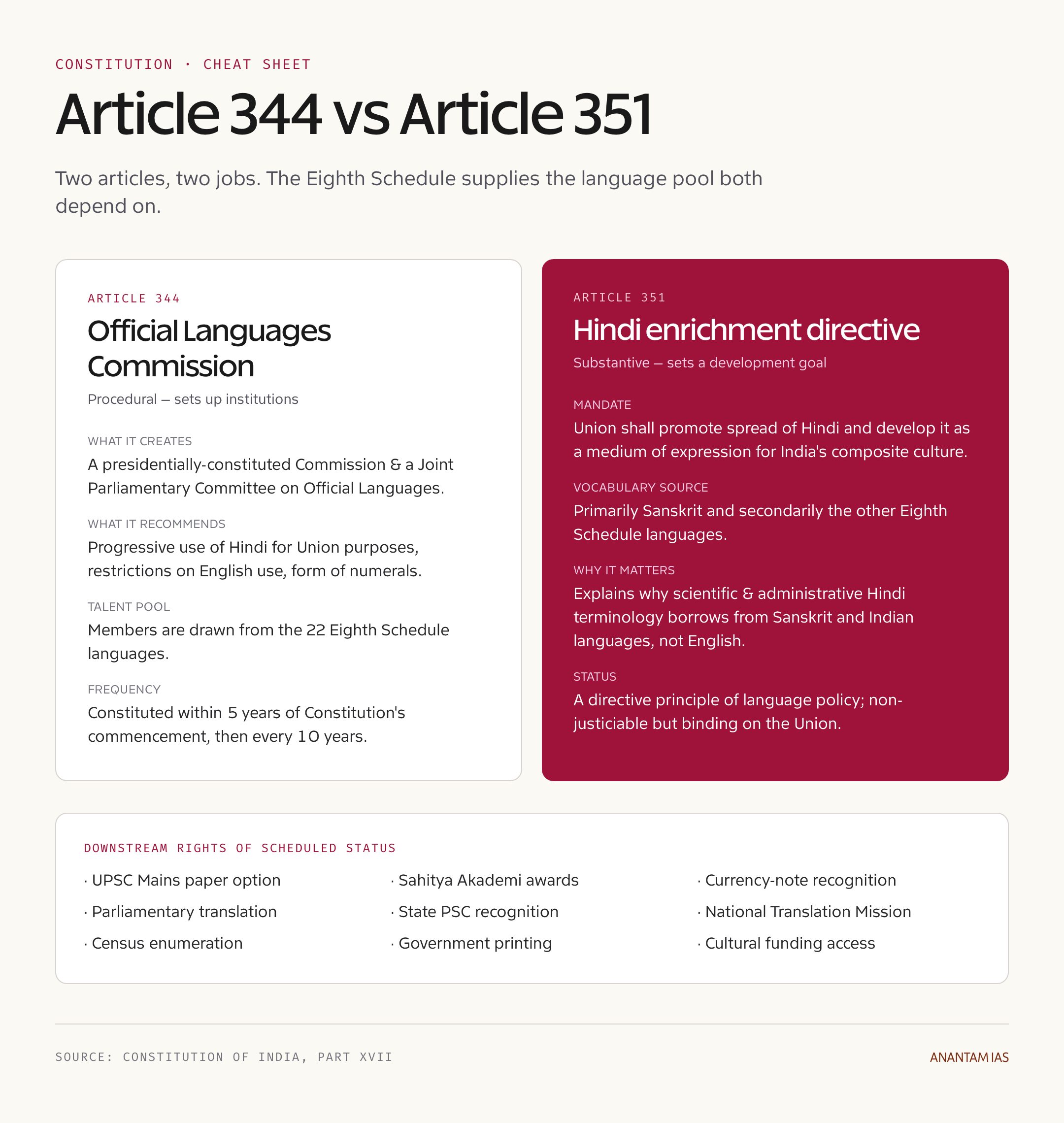
The Eighth Schedule itself is a list. Its operational consequences flow from two articles.
Article 344 sets up the Official Languages Commission and a Joint Parliamentary Committee on Official Languages. The Commission, constituted by the President, recommends measures for the progressive use of Hindi for official Union purposes, restrictions on English use, and the form of numerals. The Eighth Schedule languages provide the talent pool from which Commission members are drawn.
Article 351 directs the Union to promote the spread of Hindi, develop it as a medium of expression, and draw on the Eighth Schedule languages as well as Sanskrit for vocabulary enrichment. This is why scientific and administrative Hindi terminology often borrows from Sanskrit and other Indian languages rather than from English.
Beyond these direct constitutional ties, Eighth Schedule recognition triggers a cluster of practical rights:
- UPSC examinations can be written in the language (Mains paper, optional subject, interview).
- Sahitya Akademi awards include the language.
- Currency notes of the Reserve Bank of India display the rupee value in all 22 scheduled languages alongside Hindi and English.
- Translation services are mandated for parliamentary debates and official communications.
- Public Service Commissions of states recognize the language for state services.
- National Translation Mission funds translation projects in scheduled languages.
- Census categorization treats the language as a “scheduled” mother tongue with separate enumeration.
For broader context on how the Constitution treats classification lists, the primer on the Seventh Schedule and the explainer on the Sixth Schedule cover related federal-design choices.
Why Eighth Schedule Languages Matter
The Eighth Schedule languages debate is not really about lists. It is about how a country with 121 mother tongues recognized in the 2011 Census (and 1,369 raw mother tongues before grouping) chooses which to elevate to constitutional status. The choice is consequential.
Speakers of scheduled languages get tangible rights. Speakers of unscheduled languages do not. Bhojpuri has over 5 crore speakers but lacks the rights Konkani enjoys, even though Konkani has fewer than 25 lakh speakers. The disparity is not based on speaker count, literary tradition, or geographic concentration alone. It is based on a political process that has been opaque and uneven.
The cultural stakes are real. Languages that lose intergenerational transmission die within two or three generations. UNESCO classifies several Indian languages as endangered. Eighth Schedule recognition does not, by itself, save a language, Sanskrit’s status as scheduled has not produced a thriving Sanskrit-speaking community, but it provides institutional support that makes survival more likely. Read the related primer on classical languages of India for the parallel framework.
Detailed Analysis: How Languages Get In
There is no single, written test for inclusion. What there is, is a layered set of considerations that successive governments have used. The Pahwa Committee (1996) and the Sitakant Mahapatra Committee (2003) tried to formalize criteria. Neither set was adopted as binding policy.
The de facto criteria that emerge from the historical record:
Speaker base. Scheduled languages tend to have at least a few lakh speakers, but the lower bound is fuzzy. Sanskrit had under 25,000 first-language speakers in the 2011 Census but stayed in. Bodo had about 14 lakh speakers when it was added.
Distinct literary tradition. A documented body of literature, ideally with a Sahitya Akademi-recognized canon, helps the case.
Political mobilization. Sustained advocacy by speakers, regional political parties, and state governments matters. Konkani’s inclusion was driven by Goa’s statehood politics. Maithili’s by sustained Bihar advocacy. Santhali’s by tribal-rights mobilization.
Geographic coherence. Languages with a clear regional base have an easier path. Sindhi’s lack of a home state was offset by demographic concentration in border districts.
Constitutional and political economy. Adding a language opens financial commitments and reshapes the politics of Union official-language counting. This makes governments cautious, especially around Hindi-cluster languages like Bhojpuri.
Demands currently pending include Bhojpuri, Tulu, Rajasthani, Kodava, Garhwali, Kumaoni, Lepcha, Mizo, Khasi, Bhoti, Bhili, Gondi, Nagpuri, Sambalpuri, Kurukh, Mundari, and several smaller languages. Each has different political dynamics.
Comparative Perspective: India’s Approach Versus the World
India’s constitutional language list is unusual. Most multilingual democracies handle the question differently. South Africa lists 11 official languages in its Constitution (Section 6) with all 11 carrying equal official status. Switzerland has four national languages and three official ones. Canada has two official languages with constitutional bilingualism but separate provincial regimes.
India’s split, one official Union language (Hindi), one associate (English), and 22 scheduled languages with rights short of full official status, reflects a federal-democratic balancing act. The 1965 anti-Hindi agitations in Tamil Nadu and the broader resistance from non-Hindi states forced the Union to keep English alongside Hindi for official purposes indefinitely. The Eighth Schedule provides recognition without the friction full official status would create.
The classical languages framework, separate from the Eighth Schedule, recognizes literary antiquity and has expanded to 11 languages by 2024. Tamil was first (2004), followed by Sanskrit, Telugu, Kannada, Malayalam, Odia, then in October 2024 by Marathi, Pali, Prakrit, Assamese, and Bengali. Read the related explainer at classical languages of India for the full timeline.
Challenges and Critiques
No transparent criteria. The biggest gap. Without published, debated, and agreed criteria, every inclusion decision becomes a political negotiation. This favors well-organized advocacy groups over genuinely deserving languages.
The Bhojpuri question. Recognizing Bhojpuri would functionally split the Hindi heartland into Hindi proper and a Bhojpuri-Maithili-Magadhi cluster. The Hindi-belt politics of this is fraught.
Resource constraints. Each new language adds translation, examination, and printing costs. The Union has been reluctant to commit additional permanent expenditure.
Endangered language gap. The Eighth Schedule does not protect endangered languages. Many of India’s 197 languages classified as endangered by UNESCO are tribal or regional speech forms that lack the political mobilization for inclusion.
Script politics. The schedule lists languages, not scripts, but in practice script choices (Devanagari vs Kaithi for Bhojpuri, Ol Chiki vs Devanagari vs Bengali script for Santhali) become inclusion battles.
For background on the Hindi language framework, the related notes on Indian national language and Hindi compulsory reading comprehension provide useful context.
UPSC Prelims Pointers
- The Eighth Schedule of the Indian Constitution lists 22 languages as of 2026.
- The original list in 1950 had 14 languages.
- Sindhi was added by the 21st Amendment in 1967.
- Konkani, Manipuri (Meiteilon), and Nepali were added by the 71st Amendment in 1992.
- Bodo, Dogri, Maithili, and Santhali were added by the 92nd Amendment in 2003.
- Article 344 establishes the Official Languages Commission and the Joint Parliamentary Committee on Official Languages.
- Article 351 directs the Union to promote Hindi by drawing on the Eighth Schedule languages and Sanskrit.
- The 2003 Mahapatra Committee examined inclusion criteria but its recommendations were not adopted as binding.
- Bhojpuri is the largest non-scheduled language by speaker count.
- Sahitya Akademi awards include all 22 scheduled languages plus English and Rajasthani.
- The 2011 Census recorded 121 grouped mother tongues, with the 22 scheduled languages spoken by approximately 96% of the population.
Mains Practice Questions
- “The Eighth Schedule of the Constitution is both a recognition of India’s linguistic diversity and a source of policy contention.” Discuss with reference to the recent demands for inclusion. (GS Paper II, 250 words)
- Examine the relationship between Articles 343, 344, 350A, 350B, and 351, and the Eighth Schedule in the constitutional architecture of language policy. (GS Paper II, 250 words)
- The absence of objective criteria for inclusion in the Eighth Schedule has led to ad-hoc politics in language policy. Critically evaluate. (GS Paper II, 150 words)
- Discuss the role of language in shaping Indian federalism and identity. How does the Eighth Schedule contribute to or constrain that role? (GS Paper I / II, 250 words)
Way Forward
The Eighth Schedule languages framework needs three reforms, none of them constitutionally complicated.
Publish criteria. The Mahapatra Committee’s framework can be cleaned up, debated, and codified as policy. Speaker-base thresholds, literary-tradition tests, and political-mobilization signals can all be made transparent. This is administrative reform, not constitutional reform.
Decouple from Hindi politics. The reluctance to recognize Bhojpuri because of its impact on Hindi’s official strength is bad policy. The two issues should be separated.
Tier the rights. Not every demand needs full Eighth Schedule recognition. A two-tier system, with full schedule rights for languages meeting certain thresholds and a junior-tier set of rights (translation, education-medium support, Sahitya Akademi recognition) for endangered or smaller languages, would expand recognition without overloading the system.
The 22 Eighth Schedule languages have served India well for 76 years. The list is not sacred. It is an instrument. Updating it should be a routine policy exercise, not a once-a-decade political event. The 23-year pause since 2003 has made the schedule look frozen at a moment when India’s language landscape is shifting fast. May 2026 is a good time to thaw it.
Frequently Asked Questions
Q1. How many languages are in the Eighth Schedule of the Indian Constitution?
There are 22 languages in the Eighth Schedule as of 2026: Assamese, Bengali, Bodo, Dogri, Gujarati, Hindi, Kannada, Kashmiri, Konkani, Maithili, Malayalam, Manipuri, Marathi, Nepali, Odia, Punjabi, Sanskrit, Santhali, Sindhi, Tamil, Telugu, and Urdu.
Q2. When were the latest languages added to the Eighth Schedule?
The most recent additions were Bodo, Dogri, Maithili, and Santhali, included by the 92nd Constitutional Amendment Act, 2003.
Q3. What is the difference between Article 344 and Article 351?
Article 344 sets up the Official Languages Commission and the Joint Parliamentary Committee to oversee Hindi’s progressive use as the Union’s official language. Article 351 is a directive to promote and enrich Hindi by drawing on Sanskrit and the Eighth Schedule languages.
Q4. Which languages are demanding inclusion in the Eighth Schedule?
Bhojpuri, Tulu, Rajasthani, Kodava, Garhwali, Kumaoni, Lepcha, Mizo, Khasi, Bhoti, Bhili, Gondi, Nagpuri, Sambalpuri, Kurukh, and Mundari are among the 38 pending demands.
Q5. What rights does an Eighth Schedule language enjoy?
UPSC and PSC examination rights, Sahitya Akademi recognition, currency note display, parliamentary translation, National Translation Mission funding, and treatment as a scheduled mother tongue in the Census.
Q6. Is Hindi the official language of India?
Hindi in the Devanagari script is the official language of the Union under Article 343, alongside English which continues for official purposes. India has no constitutionally declared “national language.”
Q7. How is the Eighth Schedule different from the classical languages list?
The Eighth Schedule is a constitutional list of 22 languages with specific rights under Articles 344 and 351. The classical languages list is a separate non-constitutional category recognized by the Government of India for languages with documented antiquity. Eleven languages currently hold classical status as of latest available data.
Q8. Why is Bhojpuri not in the Eighth Schedule despite having so many speakers?
The reasons are political. Recognizing Bhojpuri as a separate language could reduce Hindi’s official speaker count and affect Hindi-belt politics. Successive governments have kept the demand under “active consideration” without final action.
Tell Google you want more of this.
Add Anantam IAS as a preferred sourceOne tap, and this site shows up more often in your own Top Stories, AI Overviews and AI Mode. Remove it any time.