Bhoodan Movement: Vinoba Bhave’s Land Reform
Bhoodan Movement by Vinoba Bhave sought voluntary land redistribution. Learn about Gramdan, Sarvodaya philosophy, achievements, limitations, and UPSC relevance.
Bhoodan Movement: Vinoba Bhave’s Land Reform
The Bhoodan Movement (Land Gift Movement) was a voluntary land redistribution campaign launched by Acharya Vinoba Bhave on 18 April 1951 from Pochampally village in Telangana. Inspired by Gandhian principles of non-violence and trusteeship, the movement asked landowners to voluntarily donate one-sixth of their land for redistribution to the landless. Over its active period (1951–1969), the movement collected approximately 45 lakh acres of land, though only about 15 lakh acres were actually distributed to landless families.
Background: The Land Question in India
Land ownership in post-independence India was deeply unequal. Despite zamindari abolition laws passed by state governments after 1947, the actual redistribution of land remained minimal. Millions of agricultural labourers and tenant farmers had no land of their own, creating rural poverty and social tension.
Pre-Bhoodan Land Reform Efforts
| Reform | Period | Approach |
|---|---|---|
| Zamindari Abolition | 1950s | Abolishing intermediary landlord systems |
| Tenancy Reforms | 1950s–60s | Protecting tenant rights and fixing rents |
| Land Ceiling Acts | 1960s–70s | Limiting maximum land holding per family |
| Bhoodan-Gramdan | 1951–69 | Voluntary land donation and village ownership |
All these approaches attempted to address the same fundamental problem: highly concentrated land ownership. The Bhoodan Movement stood apart because it relied on moral persuasion rather than legislation.
The Pochampally Incident
In April 1951, Vinoba Bhave was walking through Telangana — then witnessing Communist-led armed peasant struggles demanding land redistribution. At Pochampally village, 40 Dalit families approached him asking for 80 acres of land to sustain their families. Vinoba appealed to the village landlords, and one landlord, V. Ramchandra Reddy, offered 100 acres. This spontaneous act of giving birth to the Bhoodan concept.
Acharya Vinoba Bhave: The Walking Saint
Vinoba Bhave (1895–1982) was Mahatma Gandhi‘s spiritual successor and one of India’s most remarkable social reformers.
Life and Philosophy
- Born as Vinayak Narahari Bhave in Gagode, Maharashtra on 11 September 1895
- Joined Gandhi’s Sabarmati Ashram in 1916 after being inspired by a Gandhi speech
- Selected by Gandhi as the first individual Satyagrahi in 1940
- Deeply influenced by the Bhagavad Gita — translated it into Marathi (Geetai)
- Advocated Sarvodaya (welfare of all) as the goal of social transformation
- Awarded the Bharat Ratna in 1983 (posthumously)
- Known as “Walking Saint of India” for his padayatras covering over 70,000 km
Sarvodaya Philosophy
Sarvodaya — literally “rise of all” or “progress of all” — was the philosophical foundation of the Bhoodan Movement. Adapted from John Ruskin’s “Unto This Last” (which Gandhi translated as “Sarvodaya”), the philosophy held that:
- True progress means the advancement of every individual, not just the majority
- Wealth is held in trust for the community
- Non-violent means must be used for social transformation
- Village self-governance (Gram Swaraj) is the ideal political unit
Phases of the Movement
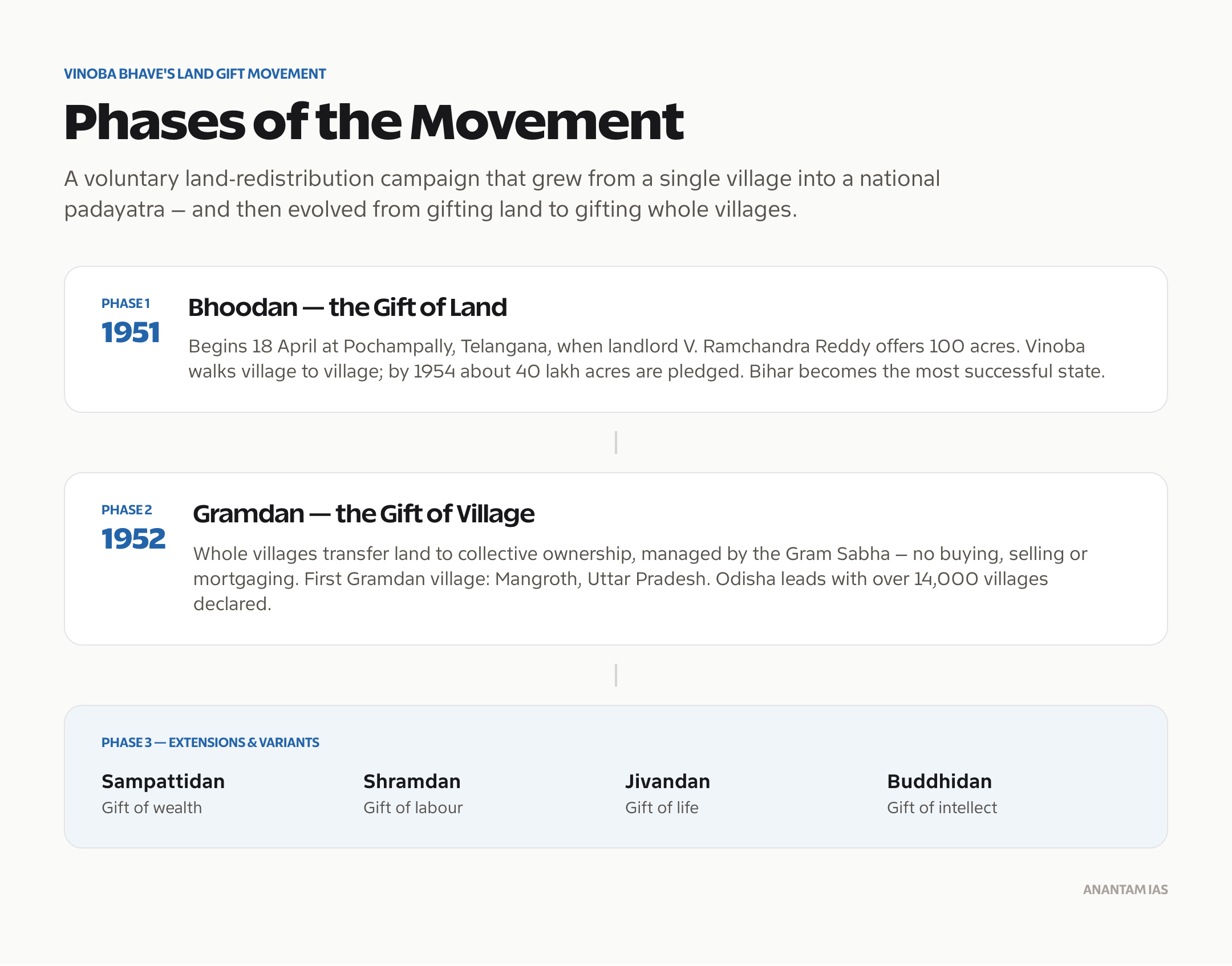
Phase 1: Bhoodan (Land Gift) — 1951 onwards
Vinoba walked from village to village across India, asking landowners to donate land voluntarily. The appeal was simple: if a landlord had five sons, could the landlord not consider the landless as a sixth son and give one-sixth of the land?
Key achievements:
- Telangana: The movement began here and received enthusiastic response
- Bihar: The most successful state — Vinoba spent extended time walking across Bihar
- Uttar Pradesh: Significant land donations from large landholders
- By 1954, approximately 40 lakh acres had been pledged
Phase 2: Gramdan (Village Gift) — 1952 onwards
Recognizing that individual land distribution had practical limitations, Vinoba evolved the concept to Gramdan — entire villages donating their land to collective village ownership.
Gramdan principles:
- All land in the village transferred to village community ownership
- Land redistributed equally among all families
- Village council (Gram Sabha) manages all land collectively
- No buying, selling, or mortgaging of land
- Decisions by consensus
The first Gramdan village was Mangroth in Uttar Pradesh (1952). Odisha became the most successful Gramdan state, with over 14,000 villages declaring Gramdan.
Phase 3: Extensions and Variants
| Concept | Meaning | Scope |
|---|---|---|
| Bhoodan | Gift of land | Individual landowners donate land |
| Gramdan | Gift of village | Entire village communalizes land |
| Sampattidan | Gift of wealth | Wealthy donate a share of their wealth |
| Shramdan | Gift of labour | Voluntary labour for community development |
| Jivandan | Gift of life | Dedicating one’s life to the movement |
| Buddhidan | Gift of intellect | Intellectuals contributing ideas and skills |
Achievements and Impact
Quantitative Achievements
| Metric | Data |
|---|---|
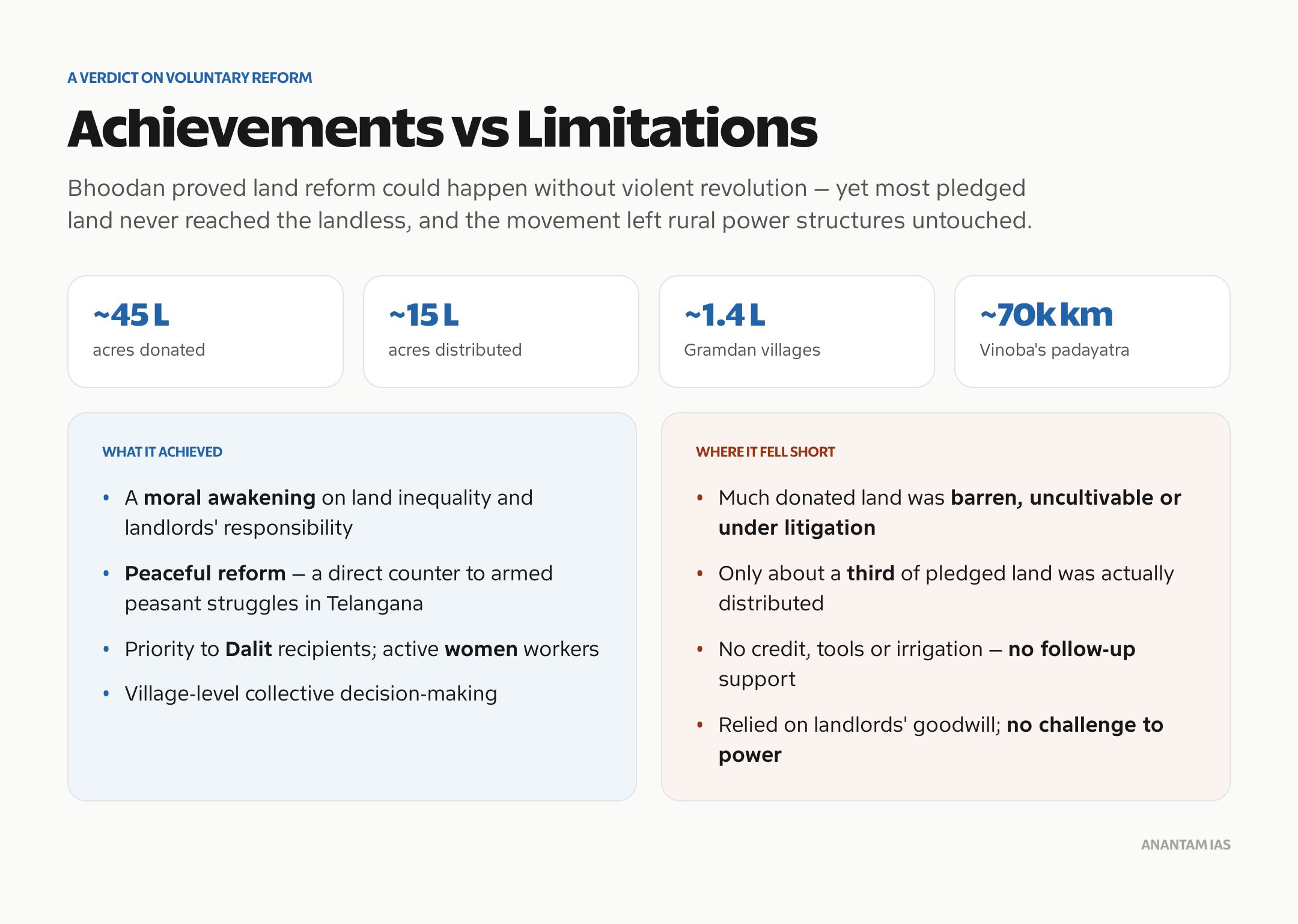
| Total land donated | ~45 lakh acres (4.5 million acres) |
| Land actually distributed | ~15 lakh acres |
| Gramdan villages | ~140,000 (declared) |
| States most impacted | Bihar, Uttar Pradesh, Odisha, Madhya Pradesh |
| Vinoba’s padayatra | ~70,000 km over 13 years |
Qualitative Impact
- Moral awakening: The movement created awareness about land inequality and the moral responsibility of landholders
- Peaceful land reform: Demonstrated that land redistribution could happen without violent revolution — a direct counter to the Communist-led armed struggles in Telangana
- Women’s empowerment: Many women participated actively as Bhoodan workers and land recipients
- Dalit empowerment: Prioritized land distribution to Dalits and other marginalized communities
- Village community building: Gramdan fostered village-level collective decision-making
- International recognition: Inspired similar movements in other countries
Criticism and Limitations
Despite its noble intentions, the Bhoodan Movement faced significant criticism.
Practical Failures
- Quality of land donated: Much of the donated land was uncultivable, barren, or under litigation
- Gap between donation and distribution: Only about one-third of donated land was actually distributed
- Lack of follow-up: No mechanism to ensure recipients could actually cultivate the land (no credit, tools, or irrigation support)
- Legal issues: Many donations were contested by heirs or lacked proper legal documentation
- Gramdan on paper: Many Gramdan declarations were formal rather than genuine community commitment
Structural Criticism
- No challenge to power structures: The movement relied on the goodwill of landlords rather than challenging their structural power
- Inadequate scale: Even if fully successful, the movement couldn’t address the scale of India’s landlessness
- Conservative approach: Critics like the Communist parties argued that revolutionary land reform, not voluntary donation, was needed
- Romanticization of village life: The Gramdan model assumed village harmony that didn’t account for caste and power dynamics within villages
Jayaprakash Narayan’s Involvement
Jayaprakash Narayan (JP) became a major supporter of the Bhoodan-Gramdan movement after leaving active politics. His involvement brought political weight but also shifted the movement’s focus. JP later moved toward the Total Revolution (Sampoorna Kranti) movement in the 1970s.
UPSC Relevance
Prelims Focus
- Bhoodan launch date (18 April 1951) and place (Pochampally)
- Vinoba Bhave — key facts (first Satyagrahi, Bharat Ratna)
- Gramdan concept and first Gramdan village (Mangroth)
- Differences between Bhoodan, Gramdan, Sampattidan
Mains (GS Paper I — Post-Independence History)
- Bhoodan as a Gandhian approach to land reform
- Comparison with legislative land reforms (zamindari abolition, land ceiling)
- Sarvodaya philosophy and its relevance today
- Success and failure of voluntary social reform movements
- Role of civil society in post-independence India
Comparison: Bhoodan vs Legislative Land Reform
| Aspect | Bhoodan Movement | Legislative Land Reform |
|---|---|---|
| Method | Voluntary moral persuasion | Legal mandate and enforcement |
| Scope | Limited to willing donors | All landholders above ceiling |
| Speed | Gradual, campaign-based | Immediate (on paper) |
| Quality of land | Often poor quality | Should be cultivable |
| Enforcement | None — goodwill based | State machinery (often weak) |
| Political impact | Minimal political opposition | Strong landlord resistance |
| Success rate | Partial | Partial (widespread evasion) |
Mahatma Gandhi: Life and Legacy
Independence Movement of India
Swadeshi Movement: Economic Nationalism in India
Frequently Asked Questions
What was the Bhoodan Movement and who started it?
The Bhoodan (Land Gift) Movement was started by Acharya Vinoba Bhave on 18 April 1951 from Pochampally village in Telangana. The movement asked landowners to voluntarily donate one-sixth of their land for redistribution to landless farmers, using Gandhian principles of moral persuasion rather than legislation.
What is the difference between Bhoodan and Gramdan?
Bhoodan involved individual landowners donating portions of their land for redistribution to landless families. Gramdan took the concept further — entire villages collectively donated all their land to community ownership, with the Gram Sabha managing redistribution and use. Gramdan aimed at creating egalitarian village communities.
Why did the Bhoodan Movement fail to achieve its goals?
The movement’s limitations included poor quality of donated land (often barren or under litigation), a large gap between land donated and actually distributed, lack of support systems for land recipients, legal complications, and inability to challenge structural power dynamics. Only about one-third of donated land reached the landless.
How is the Bhoodan Movement relevant to UPSC?
Bhoodan is important for understanding post-independence land reform approaches, Gandhian social movements, and Sarvodaya philosophy. UPSC frequently asks about land reforms, comparing voluntary and legislative approaches. The movement also connects to themes of social justice, rural development, and non-violent social transformation.