Bipan Chandra History of Modern India: Edition, Chapter Map and How It Differs from India’s Struggle for Independence
Bipan Chandra's History of Modern India is the 360-page narrative to read before Spectrum. The edition to buy, a 14-chapter map and where India's Struggle for Independence fits.
Bipan Chandra History of Modern India, as most booklists write it, is a 360-page narrative from Orient BlackSwan, and the confusion around it is mostly a confusion of titles. Bipan Chandra’s name sits on two books that UPSC aspirants buy: this one, a textbook that runs from the decline of the Mughals to 1947, and India’s Struggle for Independence, a 600-page history of the national movement he wrote with four colleagues. The first is where you learn the period. The second is where you learn to argue about it.
Aspirants tend to handle the pair in one of three ways. Some buy both in week one and finish neither. Some start with India’s Struggle for Independence as beginners and lose a month in the 1920s. And some skip Bipan Chandra altogether for a fact book, then find in Mains that they know every Congress session and can’t explain why any movement began or ended.
The sensible order is short. Read History of Modern India first, in four weeks, as the story. Take the facts from Spectrum, and open India’s Struggle for Independence one chapter at a time for Mains. Before any of that, the edition question, because the free file most people have is not the book booklists mean.
What History of Modern India is, and which edition to buy
History of Modern India is published by Orient BlackSwan. The current paperback is the 2020 edition, 360 pages, ISBN 9789390122554, and the publisher also sells it as an eBook. This reprint comes with the free Orient BlackSwan Smart App, which carries question banks from previous competitive exams and nearly 100 multiple-choice questions. The Hindi edition, Adhunik Bharat ka Itihas, is a 2020 new edition of 376 pages from the same publisher.
Bipan Chandra (1928 to 2014) was Professor Emeritus at the Centre for Historical Studies, Jawaharlal Nehru University, and chaired the National Book Trust from 2004 to 2012. He is usually described as a nationalist-Marxist historian, which is worth knowing before you quote him in an answer.
The book has a longer history than its 2020 date suggests. Its chapter plan follows Modern India, the Class XII NCERT textbook he wrote in 1971. The preface to that NCERT book promised an emphasis on “forces, movements and institutions rather than on military and diplomatic events and on individual administrators and political leaders”. That sentence still describes the Orient BlackSwan book better than any blurb. The differences between the two are small but real:
- The NCERT book’s separate chapters on European settlements and the British conquest are one chapter here.
- The NCERT chapter on India and her neighbours is gone.
- The Struggle for Swaraj is split into two chapters, 1919 to 1927 and 1927 to 1947.
Because the publisher calls the current book a reprint, what’s new in 2020 is the app, not the argument. An older Orient BlackSwan copy in good condition is a fair buy. A scan of the 1971 NCERT is not the same book.
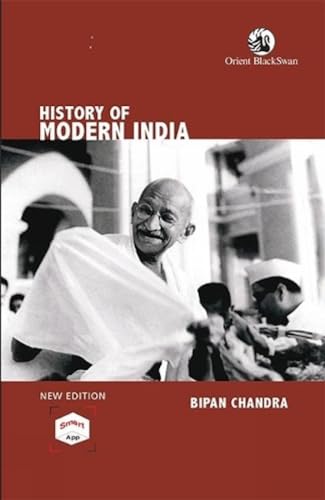
History of Modern India, Bipan Chandra (Orient BlackSwan), 2020 edition
- 360 pages, Orient BlackSwan, ISBN 9789390122554
- 14 chapters from the decline of the Mughal Empire to the Struggle for Swaraj, 1927 to 1947
- Comes with the free Orient BlackSwan Smart App: past exam question banks and nearly 100 MCQs
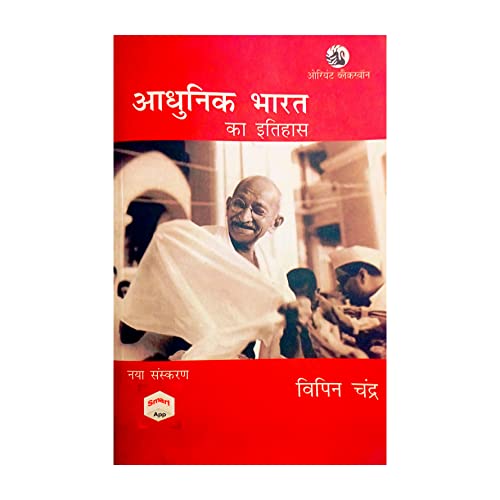
आधुनिक भारत का इतिहास, बिपन चंद्र (Orient BlackSwan, नया संस्करण)
- 376 पेज, Orient BlackSwan, 2020 का नया संस्करण
- मुग़ल साम्राज्य के पतन से स्वतंत्रता तक की कहानी, कारणों के साथ
- वही लेखक, वही प्रकाशक: हिंदी माध्यम के लिए यही संस्करण
If you write in Hindi, take Adhunik Bharat ka Itihas. It is the same author’s text in the same publisher’s edition, and the Hindi-medium paper rewards the Hindi terms for land revenue systems and reform movements.
Who it is for, and who should skip it
The Bipan Chandra History of Modern India book is for anyone meeting modern Indian history properly for the first time, and for every Mains aspirant who needs a causal spine under the facts. It is not the book for last-minute Prelims revision.
The GS Paper I syllabus asks for modern Indian history “from about the middle of the eighteenth century until the present”, with significant events, personalities and issues, and for the freedom struggle in its various stages. Bipan Chandra’s first three chapters cover that eighteenth-century ground: the Mughal decline, the successor states and how a trading company won. That’s the part of the syllabus most fact books rush through.
Mains is where the book pays. Modern Indian history is 32 of 270 GS Paper I questions from 2013 to 2025, and our Mains analysis finds the same themes again and again: land revenue, the deindustrialization argument, famine and administration, and the reform movements judged by whom they reached. Those themes are the subjects of chapters 4, 5, 9 and 11 of this book.
Read it as your first modern history book if:
- You’re starting the period from the NCERT level or below.
- Mains answers keep coming back marked as descriptive, with facts but no argument.
- History is your optional. The history optional guide puts India’s Struggle for Independence on its Paper 2 list, and this book is the easier way into it.
It can wait if:
- Prelims is eight weeks away and you haven’t read a fact book yet. Go to Spectrum first; the 91 modern history questions in our Prelims analysis reward detail this book doesn’t keep.
- You’ve already read India’s Struggle for Independence carefully. Then read only chapters 1 to 6 here, the pre-1857 story that book doesn’t cover.
History of Modern India or India’s Struggle for Independence?
History of Modern India comes first, and India’s Struggle for Independence comes second, selectively. They are not two versions of the same book.
- Range. History of Modern India starts with the eighteenth century and the conquest. India’s Struggle for Independence starts in 1857, as its title says, so the whole pre-1857 story is absent from it.
- Authors. India’s Struggle for Independence was written by Bipan Chandra with Mridula Mukherjee, Aditya Mukherjee, Sucheta Mahajan and K.N. Panikkar, and published by Penguin at about 600 pages.
- Job. The Orient BlackSwan book explains colonialism as a system, with the economy at its center. India’s Struggle for Independence explains the national movement as a strategy, phase by phase.
One caution for answer writing. In 2016 the use of the phrase ‘revolutionary terrorist’ in chapter 20 of India’s Struggle for Independence, about Bhagat Singh and his comrades, drew objections in the Rajya Sabha; co-author Mridula Mukherjee said it was not meant as pejorative. Whatever you make of that debate, don’t lift the phrase into an answer. Revolutionary nationalists is the term an examiner reads without friction. The Kakori action note on this site uses that framing, and the Bhagat Singh note covers the man himself.
The chapter map, and what each chapter is worth
The Bipan Chandra History of Modern India table of contents runs to 14 chapters, and unlike most exam books nearly all of them earn a proper read. The map below sorts them by use.
| Chapter | What it covers | UPSC use | State PSC and other exams |
|---|---|---|---|
| 1. The Decline of the Mughal Empire | Causes of the decline | Context; read fast | Read |
| 2. Indian States and Society in the Eighteenth Century | Hyderabad, Bengal, Awadh, Mysore, the Sikhs, the Marathas, society and education | Read; the syllabus starts here | Read properly |
| 3. European Penetration and the British Conquest of India | Company trade, the Anglo-French struggle, Bengal, expansion to 1857 | Read; Prelims asks a few questions on the Europeans | Core |
| 4. The Structure of Government and the Economic Policies of the British Empire in India, 1757 to 1857 | Government, economic policy, land revenue | Core; land revenue is a Mains staple | Core |
| 5. Administrative Organisation and Social and Cultural Policy | Civil services, army, police, courts, rule of law, modern education | Core | Core |
| 6. Social and Cultural Awakening in the First Half of the Nineteenth Century | Rammohun Roy, Derozio, Vidyasagar, reformers in western India | Core | Core |
| 7. The Revolt of 1857 | Causes, course, weaknesses, suppression | Core | Core |
| 8. Administrative Changes after 1858 | Army, services, princely states, racial antagonism, foreign policy | Read | Read |
| 9. The Economic Impact of British Rule | The traditional economy, new landlordism, agriculture, poverty and famines | Core; the most useful chapter for Mains | Core for descriptive papers |
| 10. The Nationalist Movement: 1858 to 1905 | Predecessors of the Congress, early nationalists, the economic critique of imperialism | Core | Core |
| 11. Religious and Social Reform after 1858 | Ramakrishna and Vivekananda, Arya Samaj, Theosophists, Aligarh, women, caste | Core | Core |
| 12. The Nationalist Movement: 1905 to 18 | Anti-partition movement, Swadeshi and boycott, revolutionaries, Home Rule, Lucknow 1916 | Core | Core |
| 13. The Struggle for Swaraj: 1919 to 27 | Montagu-Chelmsford, Rowlatt, Gandhi’s ideas, Champaran, Jallianwala Bagh | Core | Core |
| 14. The Struggle for Swaraj: 1927 to 47 | Simon Commission, Poorna Swaraj, 1935 to 1939, peasants and workers, princely states, communalism | Core | Core |
If you read only one chapter twice, make it chapter 9. The disruption of the traditional economy, the new landlordism, the stagnation of agriculture and the famines are the evidence behind the evaluate-the-impact questions Mains sets on British rule, and chapter 10 then shows the early nationalists turning that evidence into an economic critique of imperialism.
How to read Bipan Chandra’s modern history book in four weeks
About 15 pages a day, six days a week, finishes the book in four weeks. The seventh day is for writing, because this is a book you prove you understood by explaining it, not by listing it.
- Week 1, chapters 1 to 3. At the end of the week, write half a page on why a trading company could conquer a subcontinent. The eighteenth-century chapters exist to answer that question.
- Week 2, chapters 4 to 7. Make one-page notes on land revenue, education policy and the causes of 1857, each with one cause and one consequence you could defend in an answer.
- Week 3, chapters 8 to 11. Read chapter 9 twice. Then write a 150-word answer to a real Mains theme: did the reform movements reach beyond the urban upper castes?
- Week 4, chapters 12 to 14. For each phase, note the method the leadership chose, constitutional pressure, mass satyagraha or underground action, and who joined it.
After the four weeks, move to Spectrum for the tables and to India’s Struggle for Independence for the chapters your answers keep needing. The Mains PYQ bank will tell you which chapters those are.
What to skip, and what to cross-check
Skim chapter 1 and the foreign-policy section of chapter 8; they are context rather than exam material. Everything else deserves a proper read, which is the unusual thing about this book.
Cross-check three kinds of material:
- Prelims detail. Founders, years, session presidents and Act provisions are thinner here than in Spectrum. Confirm them there before they go into your notes.
- Interpretation. Bipan Chandra’s reading of the national movement is one school’s reading. Mains rewards an answer that can name another, and the perspectives on the national movement note lays out the liberal, socialist, Marxist and other readings side by side.
- Anything after 1947. The book doesn’t go there, and the syllabus does.
The book closes with a list of books for further reading. History optional candidates should treat that list as a map; GS aspirants can leave it alone.
What History of Modern India will not do
It won’t take you past 1947. The GS syllabus runs until the present, and post-independence India is a separate 11 questions in Mains, so you’ll need another book for that stretch. It won’t hold the Prelims pairing detail. It won’t cover world history. And it won’t give you answer frames; it gives you the causal chain that answer frames are built from.
That last part is the whole reason to read it. A fact book tells you when the Rowlatt Act was passed. This one tells you why it ended in a satyagraha and then in Jallianwala Bagh.
History of Modern India vs India’s Struggle for Independence vs From Plassey to Partition
The Bipan Chandra History of Modern India book shares a shelf with two others in most bookshops, and the right choice depends on how far you’re taking the subject.
| Book | Pages and edition | What it is | Verdict |
|---|---|---|---|
| History of Modern India, Bipan Chandra (Orient BlackSwan) | 360, 2020 edition | A narrative textbook from the Mughal decline to 1947 | The pick: read it first, in four weeks |
| India’s Struggle for Independence, Bipan Chandra and others (Penguin) | About 600 | A history of the national movement, 1857 to 1947 | For Mains and history optional, chapter by chapter |
| From Plassey to Partition and After, Sekhar Bandyopadhyay (Orient BlackSwan) | 608, 2nd edition | A longer survey that, as the title says, carries on past 1947 | Only for history optional |
For the fact side of modern history, the Spectrum modern history guide covers the book that usually sits next to this one on an aspirant’s desk. For the whole stack across ancient, medieval and modern, see the best book for Indian history page.
Is there a Bipan Chandra History of Modern India PDF?
Not a free official one. Orient BlackSwan sells the book as a paperback and as an eBook, and the app that comes with the paperback is the only free extra it offers.
Most of the free files that circulate under this name are scans of the 1971 NCERT Modern India. That is the same author’s text in an older form: 15 chapters, a chapter on India and her neighbours, the Swaraj years in one chapter, and no question bank. It’s readable and it isn’t worthless. It just isn’t the edition your booklist means, and a 1970s school textbook shouldn’t be the last word on anything in your answers.
Bipan Chandra’s History of Modern India is the book that makes the rest of modern history make sense. Buy the Orient BlackSwan edition, read it in four weeks in order, read chapter 9 twice, and only then open Spectrum for the tables and India’s Struggle for Independence for the chapters your answers need. Read that way, the three books stop competing and start doing separate jobs. Open chapter 2 tonight; the eighteenth century is where the story, and the syllabus, begins.
Frequently Asked Questions
Is Bipan Chandra’s History of Modern India enough for UPSC?
Not on its own. It gives you the causes and the story from the eighteenth century to 1947, which is what Mains answers are built on, but it holds less Prelims detail than Spectrum and stops at 1947. Read it first, then take the facts from Spectrum.
What is the difference between History of Modern India and India’s Struggle for Independence?
History of Modern India is a 360-page textbook that starts with the eighteenth century and explains colonialism as a system. India’s Struggle for Independence is a 600-page Penguin history of the national movement from 1857 to 1947, written with four co-authors. Read the first as your base and the second chapter by chapter for Mains.
Is History of Modern India the same as the old NCERT by Bipan Chandra?
Close, but not the same. Its chapter plan follows Modern India, the Class XII NCERT textbook he wrote in 1971, but the Orient BlackSwan book merges the chapters on European settlements and the conquest, drops the chapter on India and her neighbours and splits the Struggle for Swaraj into two chapters.
Which edition of Bipan Chandra’s History of Modern India should I buy?
The Orient BlackSwan 2020 edition, 360 pages, ISBN 9789390122554, which comes with the free Orient BlackSwan Smart App. The Hindi edition is Adhunik Bharat ka Itihas, a 2020 new edition of 376 pages from the same publisher.
Should I read Bipan Chandra or Spectrum first?
Bipan Chandra first if modern history is new to you, because the narrative makes Spectrum’s lists easier to remember. If Prelims is only a few weeks away and you have not read a fact book, go to Spectrum first and come back to Bipan Chandra for Mains.
Does History of Modern India cover India after independence?
No. The last chapter ends with the struggle for Swaraj up to 1947. The GS Paper I syllabus runs until the present, so post-independence India needs a separate book.
How long does it take to read History of Modern India?
About four weeks at 15 pages a day, six days a week, with the seventh day kept for writing short answers from what you read. Chapter 9 on the economic impact of British rule deserves a second reading.
Is there a free PDF of Bipan Chandra’s History of Modern India?
There is no free official PDF. Orient BlackSwan sells the book as a paperback and an eBook. Most free files are scans of the 1971 NCERT Modern India, an older version of the same author’s text without the later changes or the app.