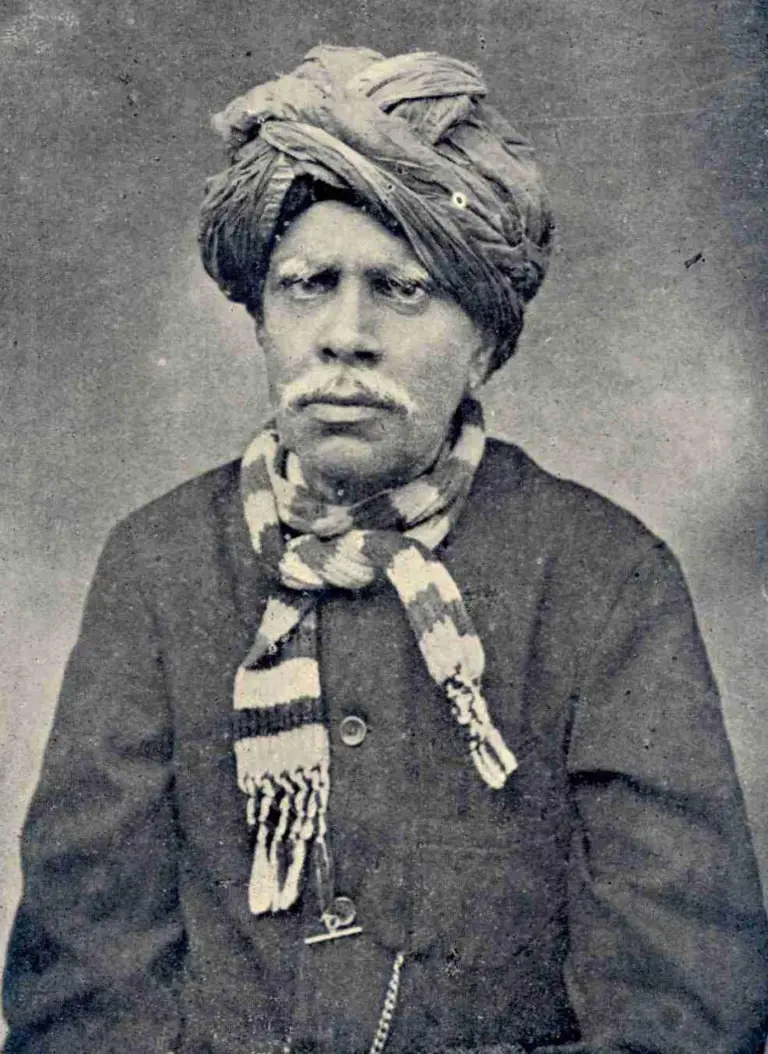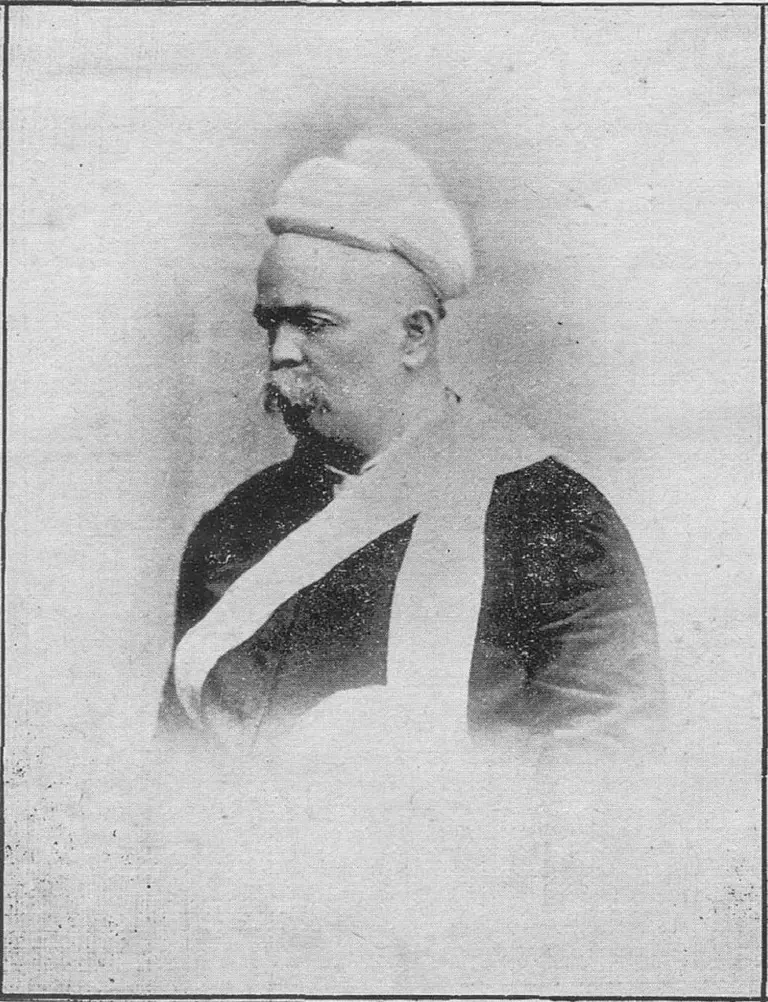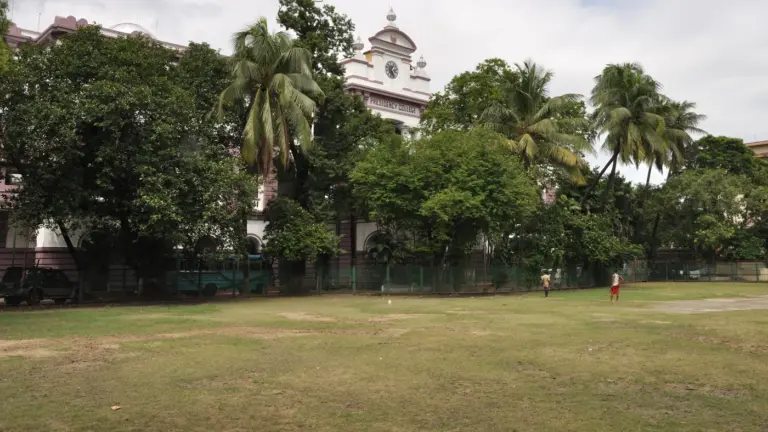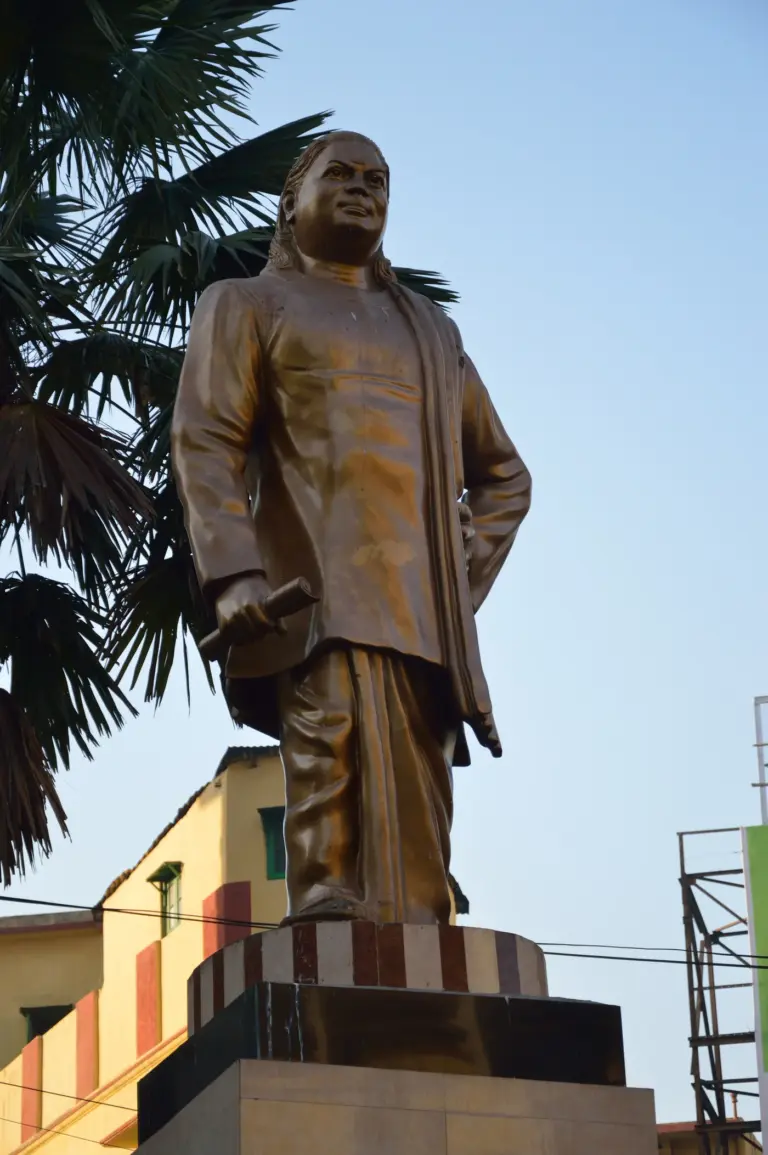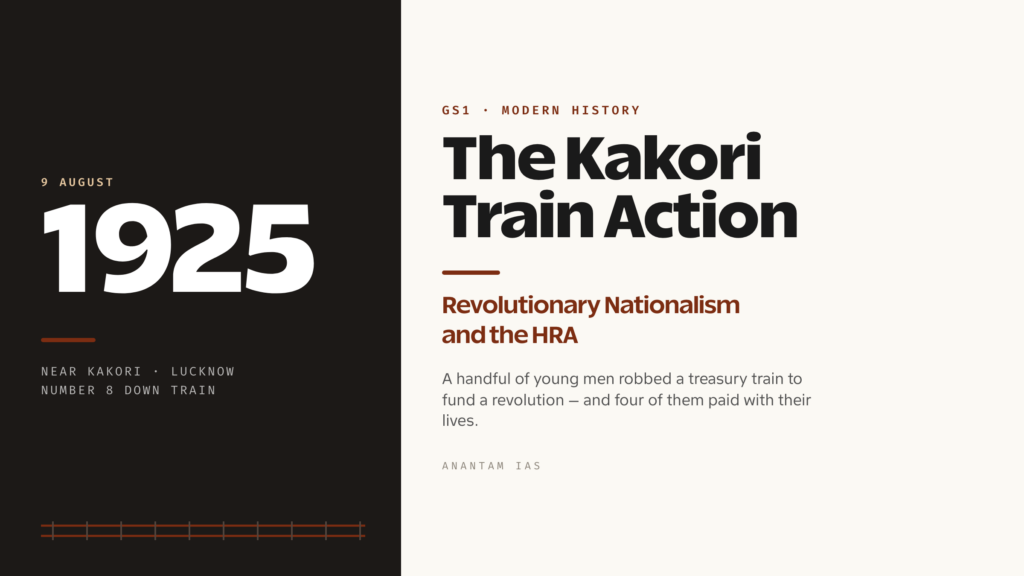
On the morning of 9 August 1925, a small band of young men boarded the Number 8 Down train as it left Shahjahanpur for Lucknow. As it slowed near the village of Kakori, about sixteen kilometres short of the city, one of them, Rajendra Lahiri, yanked the emergency chain and brought the train shuddering to a halt. The others jumped down, overpowered the guard, and hauled out the iron safe carrying government tax money bound for the colonial treasury. They broke it open, scooped out the cash — roughly eight thousand rupees by the official reckoning — and melted back into the countryside before help could arrive. It was over in minutes. And it would send four of them to the gallows.
This was the Kakori Train Action, and it matters far more than a robbery of eight thousand rupees should. The men were members of the Hindustan Republican Association, a fledgling revolutionary party, and the money was meant to buy guns for an armed overthrow of British rule. So for a UPSC aspirant, Kakori is not a footnote about a train heist. It is the clearest window we have into the revolutionary, or militant, stream of Indian nationalism — the current that ran alongside the Congress-led mass movement and sometimes against it, that believed freedom would have to be seized rather than petitioned for. Understanding why these particular young men, of both faiths, chose the gun in 1925, and what it cost them, opens up a whole chapter of GS1 Modern History that examiners return to again and again.
Why the HRA Turned to the Gun
To understand Kakori you have to start with a sense of betrayal. In February 1922, after a mob at Chauri Chaura in the United Provinces burned a police station and killed the policemen inside, Mahatma Gandhi abruptly called off the Non-Cooperation Movement, the first nationwide mass agitation against the Raj. He judged that the country was not yet disciplined enough for non-violence and that the movement was sliding into chaos. But to thousands of young men who had thrown themselves into the struggle, the withdrawal felt like a door slammed shut. They had boycotted schools and courts, courted arrest, and watched the movement build real momentum, only to see it switched off over a single riot. Many concluded that constitutional agitation and Gandhian patience would never shake an empire loose — that the British would leave only when made to.
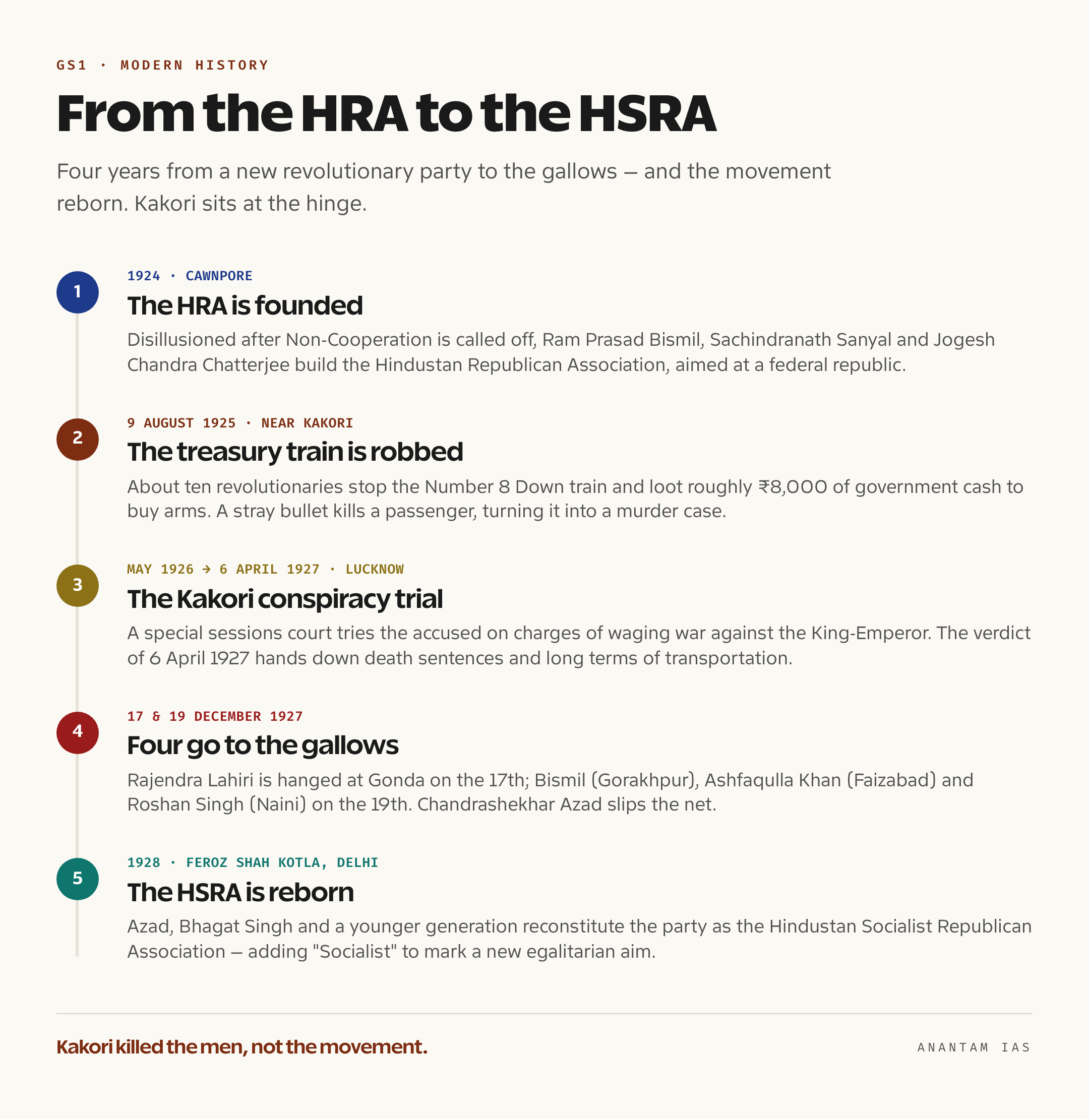
Out of that disillusion came the Hindustan Republican Association. It took shape in 1924, formally constituted at a meeting in Cawnpore — today’s Kanpur — in October that year, and its founders were a remarkable trio: Ram Prasad Bismil, the poet-revolutionary from Shahjahanpur; Sachindranath Sanyal, the veteran Bengali conspirator who had already served a term of transportation for life in the Andamans; and Jogesh Chandra Chatterjee. Sanyal drafted the party’s manifesto, a fiery four-page pamphlet titled The Revolutionary, which was scattered across north India in January 1925 and openly called on the youth to take up arms. The HRA’s stated aim was nothing less than a federal republic of the United States of India, founded on adult franchise and freed from every form of exploitation. This was no mere band of assassins. It had a constitution, a name, and a political programme that put a republic — not just the expulsion of the British — at its centre.
And a party that wants to fight needs weapons, and weapons need money. The HRA was broke. Its early attempts at fund-raising, including some small dacoities at private houses, had produced little and drawn criticism for robbing fellow Indians. So Bismil proposed a different target — the government’s own money, the tax revenue the colonial state itself was carrying by rail. Robbing the treasury, the logic went, struck at the Raj directly, hurt no ordinary Indian, and dramatised the cause. It was a deliberate political act dressed as a robbery, designed both to fund the revolution and to announce that the revolutionaries existed. That decision, taken in the summer of 1925, led straight to the tracks at Kakori.
The Action and the Men Who Carried It Out
About ten revolutionaries took part in the action itself, and the roll-call reads like a who’s who of the period. Ram Prasad Bismil led it. With him were Ashfaqulla Khan, his closest comrade and the party’s treasurer; Rajendra Lahiri, who stopped the train; Chandrashekhar Azad, the young firebrand who would become the movement’s most hunted man; and others including Sachindra Bakshi, Keshab Chakravarty, Manmathnath Gupta, Mukundi Lal, Murari Lal and Banwari Lal. They were mostly in their twenties. They were schoolteachers, poets and students as much as fighters, and several of them wrote — Bismil’s Urdu and Hindi verse, signed with the pen-name Bismil, meaning “the wounded one,” is still recited.
But the raid did not go cleanly. In the confusion, Manmathnath Gupta fired a shot that killed a passenger, a lawyer named Ahmad Ali who had stepped down to look in on his wife in the women’s compartment. His death was unintended, but it changed everything legally. What the revolutionaries had planned as a bloodless strike at government property now carried a charge of murder, and it handed the colonial authorities both the moral argument and the legal grounds to come down with full force. The take itself was modest — the eight thousand rupees barely covered the party’s costs — so in narrow financial terms Kakori achieved little. Its real yield was symbolic and, as it turned out, catastrophic for the men involved.
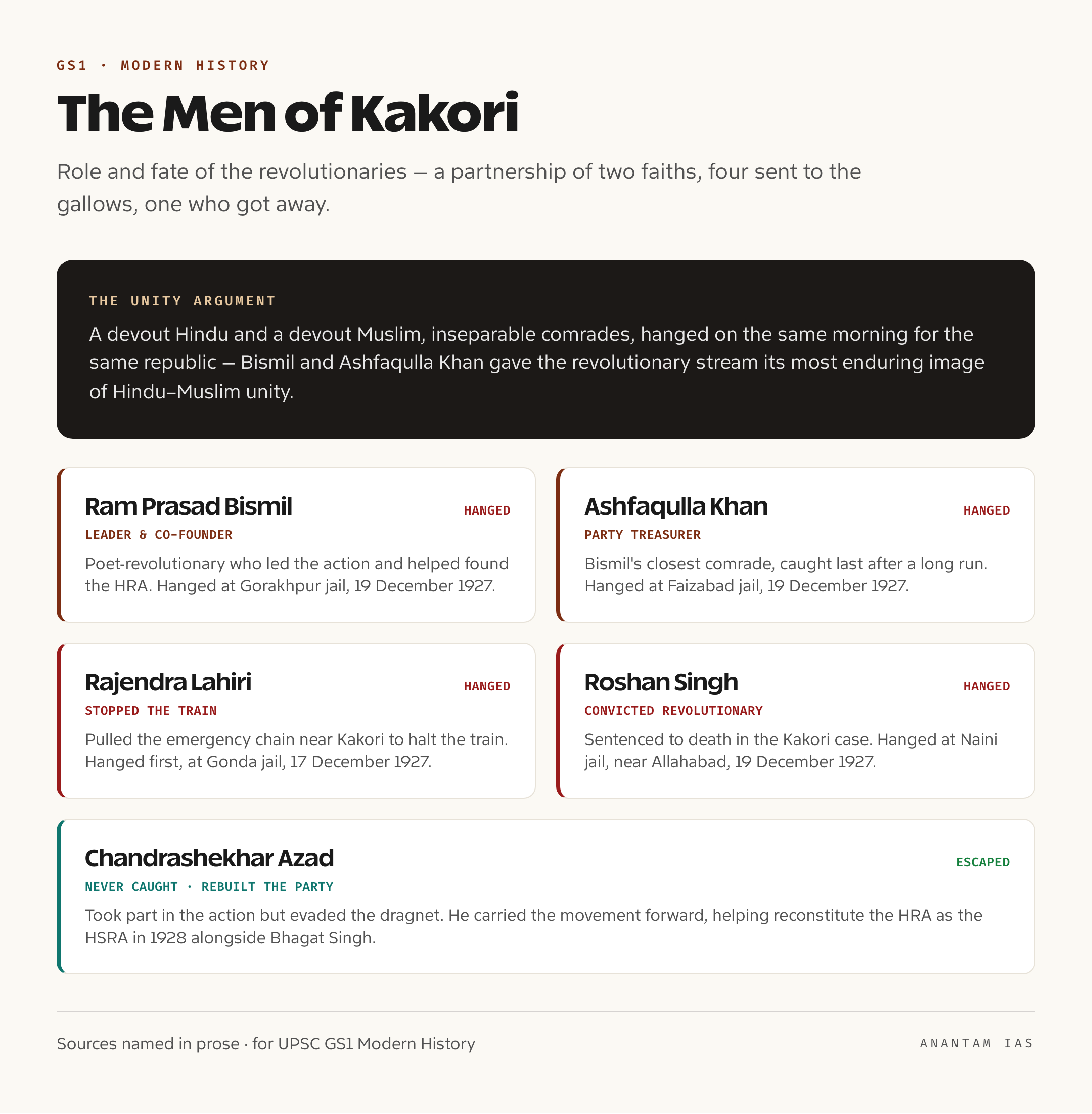
What lifts Kakori above an ordinary conspiracy is who stood shoulder to shoulder in it. Bismil was a devout Hindu, steeped in Arya Samaj ideas; Ashfaqulla Khan was an equally devout Muslim from a respected Pathan family of Shahjahanpur. They were inseparable, and their partnership became, in the revolutionary stream, a living rebuttal to the colonial claim that Hindus and Muslims could not act as one nation. In an era when communal politics was beginning to harden, two friends of different faiths going to the gallows for the same republic gave the freedom struggle one of its most enduring images of unity. That is the detail to carry into any answer on Kakori — it is not just history, it is argument.
The Kakori Trial and the Executions of 1927
The British response was swift and sweeping. Police arrested dozens across the United Provinces; Bismil was taken at Shahjahanpur in October 1925, and Ashfaqulla Khan, who had stayed on the run longest, was finally caught at Delhi over a year later. The colonial state then mounted an elaborate show trial — the Kakori conspiracy case — at a special sessions court in Lucknow, where proceedings against the main group of accused opened on 1 May 1926. The prosecution leaned heavily on Sanyal’s The Revolutionary manifesto and the party’s written constitution as proof of a wider plot to wage war against the King-Emperor, turning a train robbery into evidence of treason. The defendants, for their part, used the dock as a stage, making speeches that turned the trial into propaganda for the cause.
The verdict came on 6 April 1927. Three men — Ram Prasad Bismil, Rajendra Lahiri and Thakur Roshan Singh — were sentenced to death, and a fourth death sentence, for Ashfaqulla Khan, was confirmed when the Chief Court upheld the judgment that August. Others drew long terms of transportation and rigorous imprisonment. A public campaign for clemency followed, with appeals carried as far as the Privy Council in London and pleas to the King-Emperor through sympathetic lawyers, and even some members of the Central Legislative Assembly petitioned for mercy. The government refused. It had decided the hangings would proceed.
So in December 1927 the sentences were carried out. Rajendra Lahiri was hanged first, on 17 December at Gonda jail. Two days later, on 19 December 1927, the other three went to the gallows in three separate prisons on the same morning — Ram Prasad Bismil at Gorakhpur, Ashfaqulla Khan at Faizabad, and Roshan Singh at Naini near Allahabad. Bismil reportedly walked to the rope reciting his own verse, the couplet beginning Sarfaroshi ki tamanna ab hamare dil mein hai — “the desire to sacrifice is now in our hearts” — lines popularised by the Kakori men that became an anthem of the whole struggle. One man, though, was never caught. Chandrashekhar Azad slipped through the dragnet and stayed free, and it was around him that the broken organisation would soon be rebuilt. In 1928 the surviving and younger revolutionaries — Azad, Bhagat Singh, Sukhdev, Rajguru and others — gathered at Feroz Shah Kotla in Delhi and reconstituted the HRA as the Hindustan Socialist Republican Association, the HSRA, adding “Socialist” to the name to mark a turn toward an explicitly egalitarian, anti-exploitation goal. Kakori had killed the men, but not the movement.
The Wider Stream of Revolutionary Nationalism
Kakori makes most sense as one bright flare in a long line of them. Revolutionary nationalism in India ran in waves from the 1890s to the 1930s, and it had its own geography and rhythm. The first stirrings came in Maharashtra in the 1890s, when the Chapekar brothers assassinated a British plague official, W. C. Rand, in Pune in 1897 in anger at the brutal handling of the plague-control measures. Then the centre of gravity shifted to Bengal during the agitation against the 1905 Partition of Bengal, where secret societies like the Anushilan Samiti and its more militant offshoot Jugantar built networks of young men trained in arms and bomb-making. The most famous early episode came in 1908, when Khudiram Bose and Prafulla Chaki tried to kill an unpopular judge, Kingsford, at Muzaffarpur — an attempt that misfired and killed two British women instead, and led on into the long Alipore bomb case that put Aurobindo Ghosh in the dock.
The stream also ran abroad. During the First World War, Indian emigrants on the west coast of North America launched the Ghadar movement, an attempt to spark a mutiny in the British Indian Army with help from Indians overseas; it was crushed, but it left a tradition of internationalist revolt. Each of these phases shared a basic creed — that organised, dramatic violence against the colonial state could shake it loose where petitions could not — but they were scattered, regional and easily broken by an empire with an efficient police. The HRA and then the HSRA represent the maturing of that tradition in the 1920s, more ideological and more national in reach, carrying it from individual assassination toward the idea of a republic and, with the HSRA, toward socialism. Its most celebrated act came in April 1929, when Bhagat Singh and Batukeshwar Dutt threw two low-intensity bombs into the Central Legislative Assembly in Delhi — not to kill, but, in their own words, “to make the deaf hear” — and then courted arrest to use the trial as a platform.
But it is worth being clear-eyed about where this stream stood in the larger struggle. It never became a mass movement; its strength lay in symbolism, courage and the moral pressure of sacrifice, not in numbers. The Congress under Gandhi mobilised millions through Non-Cooperation and, later, Civil Disobedience, and that mass mobilisation was always the main engine of the freedom movement. The revolutionaries were a smaller, sharper current running beside it — sometimes admired by Congress leaders, sometimes disowned for their methods, but undeniably effective at keeping the flame of defiance alive in the years when mass agitation paused. So the honest verdict is a double one: the revolutionary path did not, on its own, win freedom, but the willingness of men like the Kakori four to die for a republic inspired a generation and helped make the British presence feel morally untenable. Both the Congress mainstream and the revolutionary fringe, in the end, were pushing the same boulder.
For Your Mains Answer
This is a high-value topic for GS Paper 1, which covers the freedom struggle, its various stages and important contributors from different parts of the country. Questions on revolutionary nationalism, the distinction between the militant and Gandhian streams, the role of secret societies, and the contribution of figures like Bismil, Azad and Bhagat Singh can all be answered with this material. Kakori is also a clean, dateable case study for any question that asks you to assess whether revolutionary activity was a help or a hindrance to the freedom movement. The skill examiners reward is the same one this article uses: anchor the narrative to exact dates and names, and always place the single event inside the wider phase.
How to Build the Answer
Open with the trigger, not the train — the disillusion after the 1922 withdrawal of Non-Cooperation that pushed young men toward armed struggle. Then move in a chain: the HRA’s founding in 1924 and its republican aim, why it needed funds and chose a government target, the action of 9 August 1925, the accidental killing that turned it into a murder case, the trial and the 1927 executions, and the reorganisation into the HSRA in 1928. Close by situating Kakori in the longer arc from the Chapekars and Anushilan Samiti to Bhagat Singh, and by judging the stream’s place beside the Congress mass movement. That arc — cause, organisation, action, consequence, legacy — fits almost any revolutionary-nationalism question.
Common Mistakes to Avoid
Don’t call the killing of Ahmad Ali a planned assassination; it was an unintended shot that changed the legal character of the case. Don’t muddle the two organisations — the HRA came first in 1924, and it became the HSRA only in 1928, with “Socialist” added to reflect a new ideological turn. Don’t say all the Kakori accused were hanged; four were executed, while others received transportation or imprisonment, and Azad was never caught. And don’t present the revolutionaries as the main engine of freedom — frame them as a sharper, smaller current beside the Congress-led mass movement.
A Compact Answer Spine
Post-1922 disillusion after Non-Cooperation withdrawn → HRA founded 1924 (Bismil, Sanyal, Chatterjee), aim a republic, manifesto The Revolutionary → needs funds → robs Number 8 Down treasury train near Kakori, 9 Aug 1925 (~₹8,000) → Ahmad Ali killed by stray bullet, case becomes murder → Kakori conspiracy trial, Lucknow, from May 1926 → verdict 6 April 1927 → four hanged Dec 1927: Lahiri (17th), Bismil, Ashfaqulla Khan, Roshan Singh (19th) → Azad escapes → HSRA reconstituted at Feroz Shah Kotla, Delhi, 1928 → wider stream: Chapekars, Anushilan/Jugantar, Alipore, Ghadar, Bhagat Singh’s Assembly bomb 1929 → verdict: symbolic, not mass, but kept defiance alive.
Diagram or Flowchart Idea
Draw a simple horizontal timeline with five nodes — HRA 1924, Kakori 9 Aug 1925, trial verdict 1927, executions Dec 1927, HSRA 1928 — running beneath a parallel band showing the Congress mass movements of the same decade. The two parallel lines, revolutionary and mainstream, communicate the central argument at a glance and are quick to sketch in the margin of an answer.
A Balanced-Conclusion Line
A line that lands the marks: “Kakori funded little and freed no one, yet by sending poets of two faiths to the gallows for a single republic, it gave the freedom struggle a moral charge the Raj could never quite answer — proof that the revolutionary stream, though never a mass movement, was a conscience the empire could not silence.”
How to Use Data Without Cramming
You need only a handful of anchors, not a chronicle: the HRA’s founding in 1924, the action on 9 August 1925, the verdict on 6 April 1927, the executions in December 1927, and the HSRA in 1928. Pair those with the two names that carry the unity argument — Bismil and Ashfaqulla Khan — and the one who escaped, Azad. Attribute the framing plainly — “as the Kakori conspiracy case records show” — rather than scattering dates without a thread.
FAQ
What was the Kakori Train Action and when did it happen? It was a planned political robbery carried out on 9 August 1925 near the village of Kakori, about sixteen kilometres from Lucknow. Members of the Hindustan Republican Association stopped the Number 8 Down train running from Shahjahanpur to Lucknow, overpowered the guard and looted the government treasury cash it was carrying — roughly eight thousand rupees — to fund their planned armed revolution against British rule.
Why did the revolutionaries rob a government train? The HRA needed money to buy arms but had no funds, and earlier dacoities at private houses had been criticised for robbing fellow Indians. So Bismil proposed targeting the colonial government’s own tax revenue instead. Robbing the treasury struck directly at the Raj, hurt no ordinary citizen, and dramatised the cause — a political statement as much as a fund-raiser.
Who was executed in the Kakori conspiracy case? Four men were hanged in December 1927: Rajendra Lahiri on 17 December at Gonda jail, and Ram Prasad Bismil (Gorakhpur), Ashfaqulla Khan (Faizabad) and Roshan Singh (Naini, near Allahabad) on 19 December. Others were given transportation for life or rigorous imprisonment. Chandrashekhar Azad evaded arrest entirely and went on to help reorganise the movement.
How is Kakori connected to the HSRA and Bhagat Singh? After Kakori shattered the original HRA, the survivors and a younger generation regrouped in 1928 at Feroz Shah Kotla in Delhi and renamed the party the Hindustan Socialist Republican Association — the HSRA — adding “Socialist” to mark a turn toward egalitarian goals. It was the HSRA, led by figures like Chandrashekhar Azad and Bhagat Singh, that carried out the 1929 Central Assembly bombing.
Practice Questions
Prelims MCQs
- The Kakori Train Action of 9 August 1925 was carried out by members of which organisation?
(a) The Anushilan Samiti
(b) The Ghadar Party
(c) The Hindustan Republican Association
(d) The Indian National Army
Answer: (c) The action was planned and executed by the Hindustan Republican Association, founded in 1924, which was later reorganised as the HSRA in 1928. - Who among the following was associated with the Kakori Train Action but escaped arrest and later helped reorganise the movement?
(a) Ram Prasad Bismil
(b) Ashfaqulla Khan
(c) Rajendra Lahiri
(d) Chandrashekhar Azad
Answer: (d) Azad evaded capture, while Bismil, Ashfaqulla Khan and Lahiri were among those tried and hanged; Azad later helped form the HSRA. - With reference to the Hindustan Republican Association (HRA), consider the following statements:
1. It was founded in 1924.
2. Its manifesto was titled The Revolutionary.
3. It was renamed the Hindustan Socialist Republican Association in 1928.
Which of the statements are correct?
(a) 1 and 2 only
(b) 2 and 3 only
(c) 1 and 3 only
(d) 1, 2 and 3
Answer: (d) All three are correct: the HRA was founded in 1924, Sanyal wrote the manifesto The Revolutionary, and the party became the HSRA in 1928. - The four revolutionaries hanged in the Kakori conspiracy case in December 1927 were:
(a) Bismil, Ashfaqulla Khan, Lahiri and Roshan Singh
(b) Bismil, Azad, Bhagat Singh and Sukhdev
(c) Khudiram Bose, Prafulla Chaki, Bismil and Lahiri
(d) Bhagat Singh, Rajguru, Sukhdev and Azad
Answer: (a) Lahiri was hanged on 17 December and Bismil, Ashfaqulla Khan and Roshan Singh on 19 December 1927; Azad was never caught. - Which of the following correctly pairs a revolutionary episode with its phase?
(a) Chapekar brothers — 1929 Assembly bomb
(b) Khudiram Bose — Alipore bomb case
(c) Ghadar movement — Partition of Bengal agitation
(d) Bhagat Singh — Kakori conspiracy case
Answer: (b) Khudiram Bose’s Muzaffarpur attempt of 1908 led into the Alipore bomb case; the Chapekars belonged to the 1890s, the Ghadar to the First World War, and Bhagat Singh to the HSRA’s later actions.
Mains Practice Questions
- Trace the evolution of revolutionary nationalism in India from the 1890s to the 1920s, using the Hindustan Republican Association and the Kakori Train Action as a focal point. (15 marks, 250 words)
- “The Kakori Train Action funded little but signified much.” In light of this statement, evaluate the significance of the 1925 episode for the freedom struggle. (15 marks, 250 words)
- Examine the role of the revolutionary stream of nationalism in relation to the Congress-led mass movements. Were the two currents in conflict or complementary? (15 marks, 250 words)
- The partnership of Ram Prasad Bismil and Ashfaqulla Khan has been read as a symbol of Hindu-Muslim unity in the freedom struggle. Discuss its significance. (10 marks, 150 words)
- Account for the transformation of the Hindustan Republican Association into the Hindustan Socialist Republican Association in 1928, and assess the ideological shift this represented. (15 marks, 250 words)
Tell Google you want more of this.
Add Anantam IAS as a preferred sourceOne tap, and this site shows up more often in your own Top Stories, AI Overviews and AI Mode. Remove it any time.